What is Scalping in Crypto? Tools & Expectations
— By AliceOnChain in Tutorials

Scalping crypto involves capitalizing on minuscule, short-term price fluctuations. Discover how to leverage advanced on-chain tools, read micro-trends, and manage risk with realistic expectations in highly volatile decentralized markets.
What is Scalping in Crypto? Tools and Realistic Expectations
The velocity of decentralized finance (DeFi) markets creates continuous micro-movements in asset prices. While long-term investors focus on fundamental milestones and multi-month trends, short-term traders look at the minute-by-minute order flow. This high-frequency approach to capturing minor price changes is known as scalping.
Scalping crypto requires a granular understanding of technical analysis, order book dynamics, and on-chain metrics. Because decentralized exchanges (DEXs) operate differently than centralized entities, scalping in DeFi presents unique challenges and opportunities. Success relies less on predicting macroeconomic shifts and more on identifying fleeting supply-and-demand imbalances.
Understanding the Mechanics of Crypto Scalping
Scalping is a trading strategy focused on executing dozens or hundreds of trades per day, aiming to profit from minimal price increments. Instead of targeting a 20% gain on a single position, a scalper may aim for twenty 1% gains.
In traditional markets, scalpers rely heavily on centralized order books and market makers. In DeFi, the landscape shifts toward Automated Market Makers (AMMs) and liquidity pools. This environment introduces variables that every short-term trader must account for before committing capital.
Price Impact and Slippage
In a decentralized environment, executing a fast-paced strategy requires a deep analysis of available liquidity. When a trader places a large market order relative to the size of a liquidity pool, the execution price shifts unfavorably. This shift is known as price impact. Scalpers must focus on highly liquid pairs to minimize both price impact and slippage, ensuring that transaction costs do not consume their narrow profit margins.
The Role of Network Fees
Unlike centralized exchanges that charge a flat percentage fee per trade, blockchain networks require gas fees to process smart contracts. On high-throughput networks, these fees are often fractions of a cent, making high-frequency strategies viable. However, on networks experiencing temporary congestion, rising gas costs can turn a winning scalping strategy unprofitable. Successful execution requires constant monitoring of network conditions.
Essential On-Chain Tools for Micro-Trend Identification
To navigate the rapid fluctuations of decentralized pairs, traders require real-time data feeds that aggregate blockchain activity. Standard charting platforms often lag when tracking newly deployed pools or rapid shifts in DEX liquidity. Utilizing specialized on-chain analysis platforms can help bridge this information gap.
Advanced Real-Time Charting
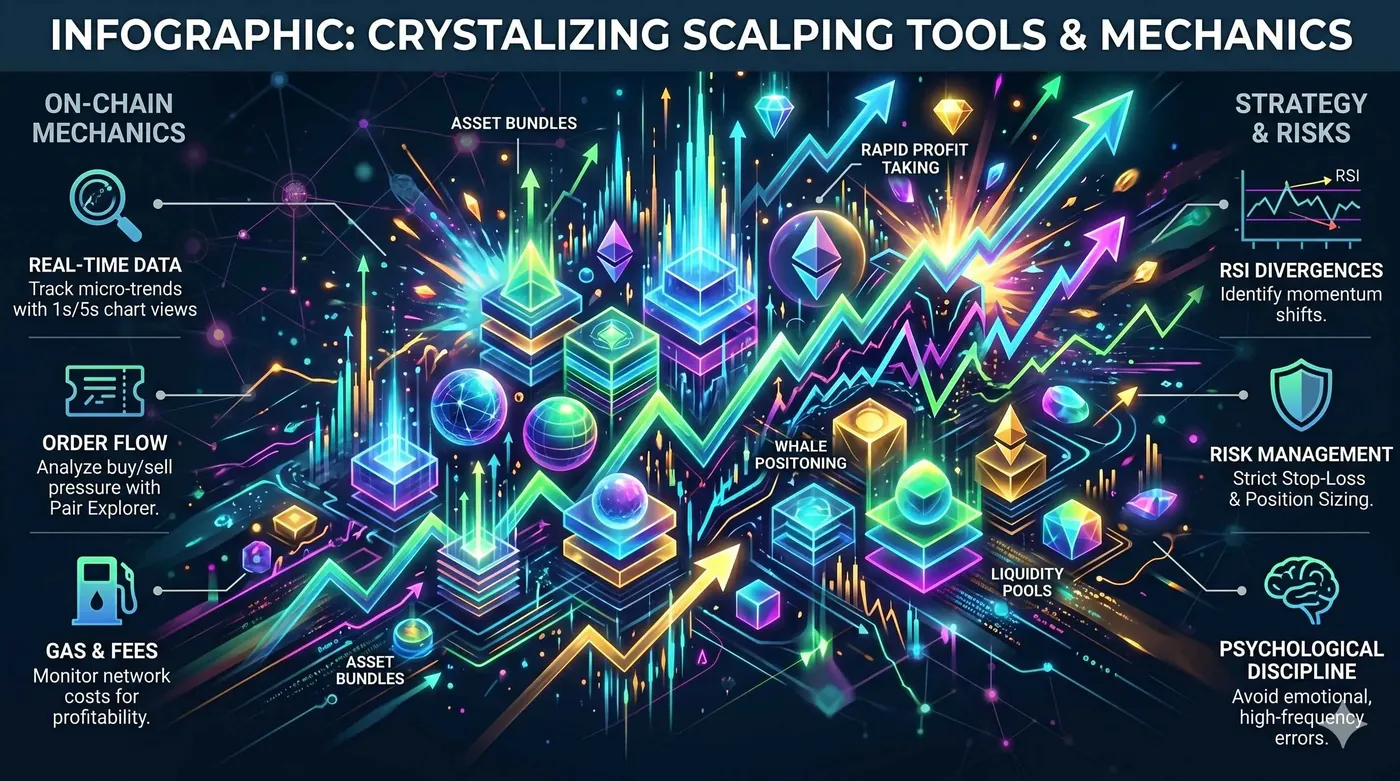
Evaluating sub-minute price action requires sub-minute data. Features like the DEXTools Charts allow traders to view ultra-short timeframes, such as the 1-minute or 5-minute intervals. These granular charts reveal minor consolidation patterns and sudden volume spikes that remain invisible on hourly variations. Observing candle formations at this level helps identify localized support and resistance zones where brief price reversals frequently occur.
Granular Order Flow Tracking
In DeFi, the transaction history of a liquidity pair serves as the equivalent of a centralized order book. Monitoring this live stream of buy and sell orders provides immediate insight into market momentum. Platforms offering a Pair Explorer allow traders to inspect every incoming transaction instantly. By filtering these transactions, a scalper can identify whether a sudden price increase is driven by distributed retail accumulation or isolated, large-scale positions.
Tracking Liquid Pools and Volume Spikes
A sudden influx of trading volume typically precedes increased volatility, which is the lifeblood of a scalper. When volume rises while available liquidity remains static or decreases, price swings tend to exaggerate. Tracking these sudden deviations in volume-to-liquidity ratios allows traders to identify pairs that are entering a window of high intraday volatility.
Developing a Scalping Framework: On-Chain Indicators
An effective scalping framework combines classic technical indicators with native on-chain metrics. Relying on a single signal often results in false entries, particularly in highly volatile markets.
Identifying Relative Strength Index (RSI) Divergences
The Relative Strength Index is a standard momentum oscillator used to evaluate overbought or oversold conditions. For micro-trend trading, scalpers look for divergences between price action and RSI momentum on 1-minute to 5-minute charts:
Bullish Divergence: This occurs when the asset price prints a lower low, but the RSI forms a higher low. It may signal that selling pressure is exhausting, suggesting a brief upward bounce.
Bearish Divergence: This occurs when the price prints a higher high, while the RSI charts a lower high. This can signal waning buying momentum, indicating a potential short-term pullback.
Support, Resistance, and Price Action
Because scalping positions last from minutes to mere seconds, historical daily levels hold less immediate relevance than intraday structures. Scalpers identify micro-support and resistance levels by looking for price areas that have been tested and rejected multiple times within the same hour. Combining these structural levels with volume confirmation increases the probability of identifying clean breakouts or reliable bounces.
Analyzing Holder Distribution and Large Transactions
On-chain transparency allows traders to evaluate the structural health of a token’s market. Before attempting to scalp a pair, analyzing the holder distribution is crucial. A token concentration where a few addresses control a significant percentage of the supply introduces tail risk; a single sell order from a major holder can instantly wipe out short-term technical patterns.
Using tools like Holder Analysis or visual contract breakdowns such as Bubblemaps can help ensure the asset is sufficiently decentralized for predictable price action. Furthermore, setting up Price Alerts and tracking whale wallet activity can warn a trader of oncoming market-moving transactions before they interact with the liquidity pool.
The Reality of Scalping: Managing Expectations
Social media channels frequently depict scalping as a low-effort path to compounding exponential returns. The operational reality of professional trading is starkly different, requiring immense discipline, rapid execution, and a strict acceptance of statistical probabilities.
Win Rate vs. Risk-to-Reward Ratio
Many amateur traders assume that a successful scalping strategy requires a 90% win rate. In practice, many market participants operate with win rates between 50% and 60%. The sustainability of the strategy depends on the risk-to-reward ratio. For instance, if a trader structures their setups to gain 1.5% on a winning trade while cutting losses strictly at 0.5%, they can remain profitable even if nearly half of their trades result in a loss.
The Impact of Psychological Fatigue
Scalping is mentally taxing. It demands undivided attention, rapid mathematical calculations, and instant decision-making. Unlike swing trading, where positions develop over days, scalpers face immediate feedback on their choices. This environment often triggers emotional trading behaviors, such as overtrading to recover losses or holding a losing position too long in hopes of a recovery. Acknowledge that cognitive fatigue degrades execution quality, making structured breaks an essential part of any system.
Identifying the Top Traders Anomalies
Advanced analytical platforms frequently feature sections highlighting the performance of historical top traders for a specific pair. While studying these addresses can offer valuable insights into wallet behavior and positioning timing, cloning their strategies blindly carries substantial risk. Top performers may have entry advantages, vastly different capital sizes, or sophisticated automated execution scripts that a manual retail trader cannot match.
Mitigating Risk in Decentralized Environments
Managing risk is the defining factor that separates long-term survivors from those who deplete their accounts. In high-frequency environments, a single unmitigated error can erase days of disciplined accumulation.
Defining Strict Invalidation Points
Every scalp trade must have a predetermined invalidation point before the order is sent to the blockchain. If the price breaches a specific micro-support level, the original thesis is no longer valid, and the position should be terminated immediately. Relying on mental stops is notoriously unreliable during periods of extreme volatility; utilizing mechanical stop-loss orders or automated execution tools helps remove emotion from the equation.
Position Sizing and Capital Allocation
Because scalping relies on high-frequency turnover, risking a large portion of a trading account on a single position is mathematically dangerous. Professional risk models rarely expose more than 1% to 2% of total trading capital to a single trade's maximum loss. This conservative approach ensures that a string of consecutive losses—a natural occurrence in any probabilistic system—does not result in catastrophic drawdown.
Summary
Scalping crypto is a highly technical, fast-paced methodology that thrives on short-term market inefficiencies and localized volatility. By utilizing advanced on-chain tools, maintaining rigorous risk discipline, and separating market data from emotional noise, traders can navigate these environments with a structured framework. However, success requires an objective understanding of transaction costs, liquidity limitations, and human psychological constraints.
Liquidity Pool Economics: Fees, Slippage and Impermanent LossDEX Volume Recap: Liquidity Trends & Price Impact Insights
What Is Technical Analysis in Crypto Trading: Complete Beginner Guide
What Is Order Flow in Crypto Trading? Guide
Disclaimer: This article is for informational purposes only and does not constitute investment advice, financial advice, trading advice, or any other kind of advice. DEXTools does not recommend buying, selling, or holding any cryptocurrency or token. Users should conduct their own research and consult with a qualified financial advisor before making any investment decisions. Cryptocurrency investments are volatile and high-risk. DEXTools is not responsible for any losses incurred.