What Are Liquidity Pools in DeFi? Explained (2026)
— By Whatsertrade in Tutorials

Liquidity pools in DeFi are smart contracts holding crypto assets, enabling decentralized trading without intermediaries. Learn how they work.
Liquidity pools are foundational smart contracts in decentralized finance (DeFi) that hold crypto asset pairs, enabling automated, permissionless trading and lending. They eliminate the need for traditional order books by allowing users to swap tokens directly against the pool's reserves, with prices determined by an algorithmic formula. Liquidity providers (LPs) deposit assets into these pools, earning a share of trading fees and sometimes additional token incentives, while navigating risks like impermanent loss.
What Are Liquidity Pools in DeFi? The Core Concept
At their heart, liquidity pools are collections of two or more cryptocurrency tokens locked in a smart contract. These pools facilitate decentralized trading by providing the necessary liquidity for users to swap tokens instantly, without needing a traditional buyer and seller to directly match. Instead of an order book, an Automated Market Maker (AMM) algorithm manages the pool's assets and determines prices based on supply and demand within the pool.
When a user wants to swap Token A for Token B, they interact with the smart contract, depositing Token A into the pool and withdrawing an equivalent value of Token B. The pool's balances adjust, and the AMM algorithm recalculates the price to maintain equilibrium. This continuous rebalancing is what enables seamless, always-on trading in DeFi.
How Liquidity Pool Economics Work: Beyond the Basics
Once you understand the basic definition, the real intrigue of liquidity pools lies in their economic mechanics. This section delves into how these pools function after initial deposits, focusing on the incentives and challenges for liquidity providers (LPs).
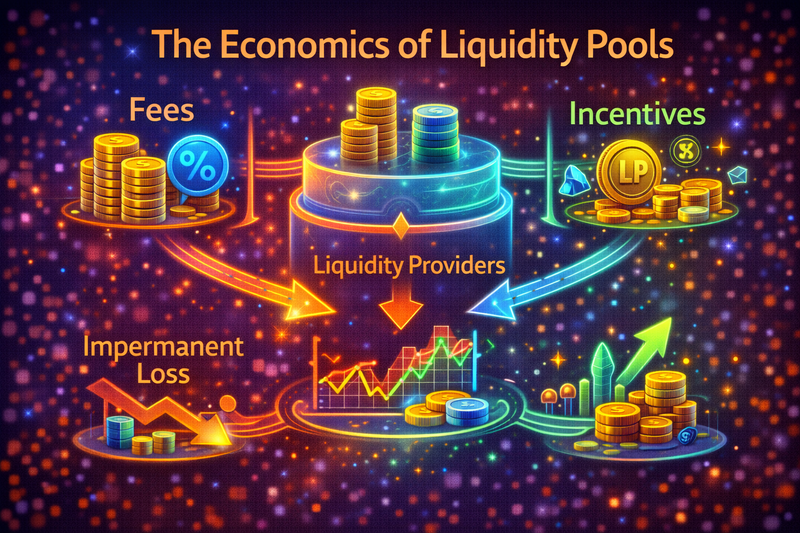
LPs are the backbone of this system; they deposit their crypto assets into these pools, effectively becoming market makers. In return for providing this crucial service, they receive a share of the trading fees generated by the pool, and sometimes additional incentives in the form of governance tokens or other rewards. The goal for LPs is to earn more from these rewards than they lose to potential risks, primarily impermanent loss.
The Role of Automated Market Makers (AMMs)
AMMs are the algorithms that govern liquidity pools. They define the pricing curve and rebalancing mechanism. The most common AMM model is the constant product formula (x * y = k), popularized by Uniswap. Here, 'x' and 'y' represent the quantities of the two assets in the pool, and 'k' is a constant. As traders swap assets, the quantities of x and y change, but the product 'k' must remain constant. This formula automatically adjusts prices to ensure there's always liquidity, albeit at a potentially higher price for larger trades.
More advanced AMMs, like those used by Curve Finance (constant sum/stable swap) or Balancer (multi-asset, weighted pools), offer optimized formulas for specific asset types (e.g., stablecoins) or more complex portfolio management.
How Liquidity Providers (LPs) Generate Income
LPs primarily rely on three income streams, though their reliability varies:
- Trading Fees: This is the most consistent and fundamental income source. Every time a trader swaps assets using the pool, a small percentage fee (e.g., 0.05% to 0.30%) is charged. These fees are then distributed proportionally among all LPs based on their share of the total liquidity in the pool. Pools with high trading volume and deep liquidity generate substantial fee income.
- Token Incentives (Yield Farming): Many DeFi protocols offer additional rewards, often in their native governance tokens, to LPs to attract liquidity. This practice is known as yield farming. These incentives can significantly boost LP returns, especially in nascent or rapidly growing protocols. However, these rewards are often temporary and can be subject to high volatility.
- Appreciation of Underlying Assets: While not a direct income from the pool mechanism itself, LPs benefit if the underlying assets they've deposited increase in value. However, this is offset by impermanent loss if one asset appreciates significantly more than the other.
Understanding Trading Fees and Slippage
Trading fees are the lifeblood of liquidity pools, directly compensating LPs for their capital. These fees are typically a small percentage of the trade value and accumulate over time, forming the primary yield for LPs. The higher the trading volume, the greater the fee income distributed to providers.
Slippage, however, is a critical concept for both traders and LPs. It refers to the difference between the expected price of a trade and the actual price at which the trade is executed. In liquidity pools, larger trades relative to the pool's total liquidity can cause significant price impact, leading to higher slippage. This happens because the AMM formula adjusts the price more drastically to maintain the constant product (x * y = k) when large quantities of assets are swapped. For LPs, high slippage on large trades means the pool's assets are rebalanced more aggressively, potentially exacerbating impermanent loss.
Impermanent Loss: The LP's Invisible Cost
Impermanent loss (IL) is arguably the most complex and misunderstood aspect of providing liquidity. It occurs when the price ratio of the assets you've deposited into a liquidity pool changes compared to when you initially deposited them. Here's how it works:
- Initial Deposit: You deposit an equal value of Token A and Token B into a pool.
- Price Divergence: The market price of Token A significantly increases relative to Token B (or vice-versa).
- Pool Rebalancing: The AMM algorithm continuously rebalances the pool to maintain the defined price ratio. This means the pool automatically sells some of your appreciating asset (Token A) to buy more of the depreciating or stable asset (Token B).
- Withdrawal: When you withdraw your liquidity, you will have more of the relatively depreciating asset and less of the appreciating asset than if you had simply held both tokens in your wallet (HODL).
The 'loss' is the difference in value between holding the assets outside the pool and holding them within the pool. It's called 'impermanent' because if the asset prices return to their original ratio, the loss theoretically disappears. However, in volatile markets, prices rarely revert perfectly, making the loss often permanent in practice. LPs must generate enough fee income and token incentives to outweigh this potential loss.
Capital Efficiency and Its Evolution
Traditional AMMs (like Uniswap V2) distribute liquidity uniformly across the entire price range from zero to infinity. This means a significant portion of the capital locked in the pool is rarely used, leading to low capital efficiency. For instance, if a token pair typically trades within a narrow price band, the liquidity provided far outside that band contributes little to active trading volume but still incurs impermanent loss risk.
Newer AMM designs, such as Uniswap V3's concentrated liquidity, address this by allowing LPs to specify custom price ranges where their liquidity is active. This enables LPs to provide more concentrated liquidity within expected trading ranges, earning higher fees on their deployed capital. However, this also introduces more active management, as LPs must adjust their ranges as prices move, or risk their liquidity becoming inactive and earning no fees.
Token Incentives and Yield Farming Strategies
Token incentives are a powerful tool used by DeFi protocols to bootstrap liquidity. By distributing their native governance tokens to LPs, protocols can rapidly attract significant capital, increasing their trading volume and overall ecosystem activity. This practice, often called yield farming, allows LPs to earn additional rewards on top of trading fees.
Strategies for yield farming can range from simple deposit-and-hold to complex multi-protocol interactions, often involving leveraging assets. While lucrative, yield farming comes with its own set of risks, including:
- Token Price Volatility: The value of the incentive tokens can fluctuate wildly.
- Smart Contract Risk: Vulnerabilities in the smart contracts could lead to loss of funds.
- Rug Pulls: Malicious developers can drain liquidity from a pool, leaving LPs with worthless tokens.
- High Gas Fees: Frequent interactions with pools (depositing, withdrawing, claiming rewards) can incur significant transaction costs on networks like Ethereum.
How to Become a Liquidity Provider (LP)
Becoming an LP involves a few straightforward steps, though the specifics vary slightly between platforms:
- Choose a DeFi Platform: Select a decentralized exchange (DEX) or lending protocol (e.g., Uniswap, SushiSwap, Curve, PancakeSwap, Raydium).
- Select a Liquidity Pool: Research and choose a pool based on the asset pair, expected APY (Annual Percentage Yield), trading volume, and impermanent loss risk. Stablecoin pools often have lower IL but also lower fees.
- Acquire Required Assets: Ensure you hold both assets of the chosen pair in your wallet (e.g., ETH and USDC) in roughly equal dollar values.
- Connect Your Wallet: Connect your Web3 wallet (e.g., MetaMask, Trust Wallet) to the chosen DeFi platform.
- Approve Tokens: For each asset, you'll need to approve the smart contract to spend your tokens. This is a one-time transaction per token per contract.
- Deposit Liquidity: Navigate to the 'Pool' or 'Liquidity' section of the platform, select the chosen pair, enter the amounts, and confirm the deposit. You will receive LP tokens representing your share of the pool.
- Monitor & Manage: Keep an eye on your LP position, including earned fees, potential impermanent loss, and any available token incentives. You may need to claim rewards periodically or adjust your position (especially with concentrated liquidity).
Comparing Different Types of Liquidity Pools
Not all liquidity pools are created equal. Their design and underlying AMM formulas are optimized for different asset types and use cases:
The Future of Liquidity Pools in DeFi (2026 and Beyond)
As DeFi matures, liquidity pools are continuously evolving. We expect to see:
- Increased Capital Efficiency: Further innovations building on concentrated liquidity, potentially with dynamic range adjustments or automated LP strategies.
- Cross-Chain Liquidity: Greater interoperability allowing liquidity to flow seamlessly across different blockchain networks, reducing fragmentation.
- Enhanced Risk Management Tools: More sophisticated analytics and insurance protocols to help LPs better understand and mitigate impermanent loss and smart contract risks.
- Institutional Adoption: Tailored liquidity solutions for institutional players, potentially involving KYC/AML compliant pools.
- Specialized AMMs: Continued development of AMMs optimized for specific asset classes (e.g., real-world assets, NFTs, derivatives).
How DEXTools Helps Liquidity Providers and Traders
For both traders and liquidity providers, having access to real-time, comprehensive data is paramount. DEXTools provides invaluable insights into liquidity pools across various DEXs and blockchains. Users can:
- Track Pool Performance: Monitor trading volume, liquidity depth, and price changes for specific pools.
- Identify Trending Pairs: Discover new and high-volume pools that might offer lucrative LP opportunities or trading potential.
- Analyze Token Metrics: Get detailed information on token contracts, holder distribution, and historical data to make informed decisions.
- Assess Risk: Use DEXTools' analytics to better understand the volatility and health of a pool before committing capital.
By offering a transparent view into the complex world of liquidity pools, DEXTools empowers users to navigate DeFi with greater confidence and make more strategic choices.
Frequently Asked Questions
What is a liquidity pool in DeFi?
A liquidity pool is a smart contract holding a pair of crypto assets, enabling decentralized trading by providing liquidity for users to swap tokens without traditional order books.
How do liquidity providers (LPs) make money?
LPs earn income primarily through a share of trading fees generated by swaps within the pool, and sometimes through additional token incentives (yield farming) offered by the protocol.
What is impermanent loss?
Impermanent loss occurs when the price ratio of assets in a liquidity pool changes after deposit, leading to a smaller dollar value upon withdrawal compared to simply holding the assets outside the pool.
What is an Automated Market Maker (AMM)?
An AMM is the algorithm that governs a liquidity pool, determining asset prices and rebalancing the pool's contents based on trading activity, ensuring continuous liquidity.
What is slippage in liquidity pools?
Slippage is the difference between the expected price and the executed price of a trade, often caused by large trades relative to the pool's liquidity, which significantly impacts the asset ratio and price.
What is capital efficiency in liquidity pools?
Capital efficiency refers to how effectively the capital locked in a liquidity pool is utilized for trading. Newer AMMs like Uniswap V3 aim to improve this by allowing concentrated liquidity within specific price ranges.
Are liquidity pools safe?
While liquidity pools offer opportunities, they carry risks including impermanent loss, smart contract vulnerabilities, rug pulls, and high gas fees. Due diligence and risk assessment are crucial.
What are LP tokens?
LP tokens are received by liquidity providers upon depositing assets into a pool. These tokens represent their share of the pool's total liquidity and accumulated fees, and can often be staked for additional rewards.
How do stablecoin liquidity pools differ?
Stablecoin pools (e.g., on Curve Finance) are optimized for assets that should maintain a similar price (like different stablecoins). They use specific AMM formulas to minimize slippage and impermanent loss, often resulting in lower fees but higher trading volume.