What is Stacks (STX)? Bitcoin Smart Contracts Explained
— By AliceOnChain in Tutorials

An advanced breakdown of the Stacks (STX) network, exploring how it unlocks programmability on Bitcoin through Proof-of-Transfer, Clarity code, and native decentralized applications.
What is Stacks (STX)? Bitcoin Smart Contracts Explained
Bitcoin has long been revered as the ultimate decentralized store of value. Its robust security framework and immutable proof-of-work consensus mechanism make it the bedrock of the cryptocurrency world. However, this extreme security comes at a cost: programmability. Unlike Ethereum or Solana, Bitcoin’s native scripting language is intentionally restrictive to minimize attack vectors and maintain network stability. This limitation historically relegated Bitcoin to a passive asset, forcing developers looking to build decentralized applications (dApps) or decentralized finance (DeFi) protocols to migrate to alternative layer-1 networks.
This is where Stacks (STX) enters the ecosystem. Stacks is a generalized smart contract layer that connects directly to Bitcoin, enabling developers to build apps and smart contracts that inherit Bitcoin's security and settlement power. By creating a unique, bi-directional relationship with the Bitcoin mainnet, Stacks unlocks billions of dollars in dormant Bitcoin liquidity without altering the core Bitcoin protocol itself. Understanding how Stacks operates, its underlying technical architecture, and its economic model is essential for any serious on-chain analyst or DeFi trader looking to capitalize on the expanding Bitcoin ecosystem.
The Core Architecture: How Stacks Connects to Bitcoin
To comprehend Stacks, one must understand that it is not a traditional sidechain, nor is it a standard Ethereum-style Layer 2. Instead, Stacks is an independent blockchain layer that tethers its state transitions directly to the Bitcoin blockchain. Every block minted on the Stacks network is cryptographically bound to a corresponding Bitcoin transaction, ensuring that once a Stacks block is settled, its history is backed by the full cryptographic weight of Bitcoin’s hash power.
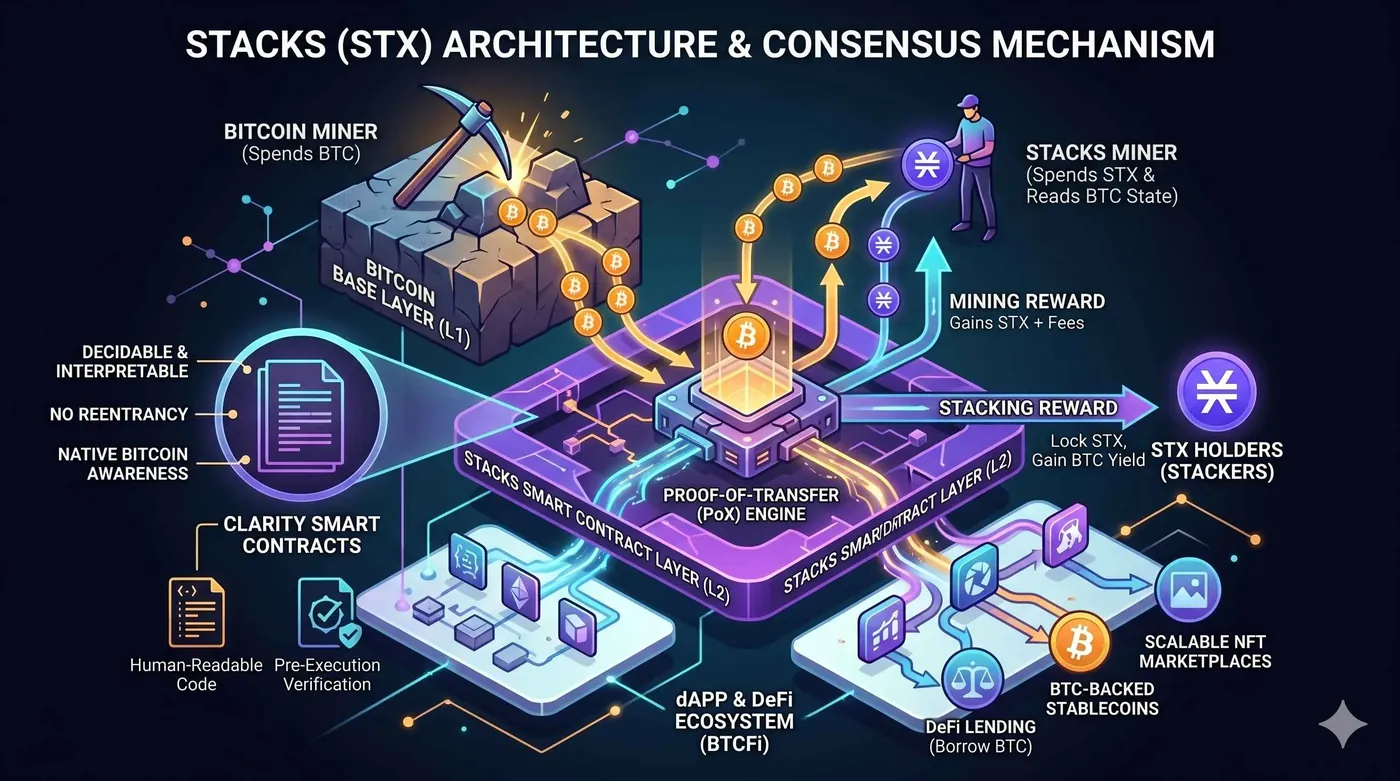
This unique connection is achieved through a consensus mechanism known as Proof-of-Transfer (PoX). Unlike Proof-of-Work (PoW) where miners burn electricity, or Proof-of-Stake (PoS) where validators lock up native capital, Proof-of-Transfer leverages an already established, secure cryptocurrency—in this case, Bitcoin—to secure the new network.
In the Stacks PoX cycle, miners do not consume computational energy. Instead, they spend native Bitcoin (BTC) to bid for the right to mine the next Stacks block. The Stacks protocol randomly selects a winning miner, with the probability of selection directly proportional to the amount of BTC committed. The selected miner then mints the new Stacks block and receives rewards in the form of newly minted STX tokens, alongside transaction fees.
Crucially, the BTC spent by miners is not burned or sent to a dead address. It is distributed directly to STX token holders who actively participate in the network through a process called "Stacking." By locking up their STX tokens for a specified duration and providing programmatic validation, holders earn yield denominated directly in native Bitcoin. This creates a compelling economic loop where Bitcoin capital secures Stacks, and Stacks yields yield in Bitcoin.
Clarity: A New Paradigm for Smart Contract Security
Smart contract vulnerabilities represent a significant risk vector in DeFi trading, often leading to massive capital drain through exploits, reentrancy attacks, and logic flaws. Ethereum’s Solidity is a Turing-complete language, which offers immense flexibility but introduces unpredictable execution pathways. Stacks mitigates these risks by utilizing a purpose-built programming language called Clarity.
Clarity is a decidable language. In computer science, this means that the execution behavior, resource consumption, and outcome of a program can be mathematically determined before the code is actually executed. This design choice eliminates several common vulnerabilities that plague EVM-compatible networks:
No Reentrancy Attacks: Reentrancy occurs when a smart contract calls an external contract before updating its own internal state, allowing attackers to repeatedly drain funds. Clarity inherently prevents reentrancy by disallowing external re-entrant calls.
Interpretability over Compilation: Clarity code is not compiled into abstract bytecode before deployment. Instead, the human-readable source code is published directly on-chain and interpreted by the blockchain nodes. This transparency allows developers and advanced on-chain analysts to inspect the exact logic running in a live environment, minimizing hidden bugs.
Native Bitcoin Awareness: Clarity contracts have direct visibility into the state of the Bitcoin mainnet. A Stacks smart contract can read Bitcoin transactions, balances, and block headers natively. This allows developers to create triggers based on specific Bitcoin movements without relying on centralized or third-party oracle solutions.
The Role of the STX Token in the Ecosystem
The STX token is the operational fuel of the Stacks network. It serves multiple overlapping utilities that sustain the decentralized lifecycle of the platform:
Transaction Execution: Similar to gas fees on Ethereum, every smart contract invocation, token transfer, and dApp interaction on Stacks requires paying a transaction fee in STX.
Network Consensus: Miners must possess and spend BTC to earn STX, establishing an arbitrage-driven floor value based on operational costs.
Yield Generation (Stacking): Long-term participants can lock their STX tokens to receive passive rewards in BTC. This mechanism reduces the circulating supply of STX during periods of high network engagement, often shifting the supply-demand dynamics in favor of price appreciation during expansionary market phases.
From an on-chain perspective, tracking the aggregate volume of STX locked in the Stacking contract provides a clear indicator of long-term investor sentiment. High lock-up rates demonstrate structural confidence in the network's stability, reducing the immediate sell pressure on liquid exchanges.
Unlocking Bitcoin DeFi and On-Chain Applications
The introduction of smart contracts to the Bitcoin network opens up a vast matrix of financial use cases that were previously impossible. The expanding Bitcoin DeFi (frequently referred to as BTCFi) ecosystem relies on Stacks to enable decentralized lending, synthetic asset creation, and automated market makers (AMMs).
Decentralized Lending and Borrowing
Historically, to unlock liquidity from Bitcoin without selling it, holders had to rely on centralized custodians. These platforms required users to surrender custody of their private keys, exposing them to counterparty risks. Through Stacks, users can lock their Bitcoin into a decentralized smart contract as collateral, allowing them to mint stablecoins or borrow other liquid assets natively. The underlying contract automates liquidation thresholds based on transparent price feeds, maintaining system solvency without human intervention.
Bitcoin-Backed Stablecoins
Stablecoins backed by native Bitcoin collateral represent a significant growth vertical. By tying the value of a stablecoin to algorithmic or over-collateralized positions secured by Bitcoin, the ecosystem builds a censorship-resistant medium of exchange that does not rely on traditional banking rails or centralized fiat issuers.
Non-Fungible Tokens (NFTs) and Digital Artifacts
While Bitcoin Ordinals brought native digital artifacts to the Bitcoin blockchain, Stacks offers a more flexible environment for scalable NFT marketplaces. Creators can deploy complex generative art collections or gaming assets on Stacks, benefiting from faster confirmation times and lower fees while anchoring the ultimate ownership proofs directly to Bitcoin blocks.
Utilizing DEXTools for STX On-Chain Analysis
Navigating the Stacks ecosystem requires an analytical framework that goes beyond simple price tracking. As liquidity flows from native Bitcoin into STX-based decentralized exchanges, utilizing advanced tooling like DEXTools becomes imperative for monitoring market microstructure, identifying institutional accumulation, and managing volatility risk.
Analyzing Liquidity Pools and Pair Explorer
When trading tokens built on top of the Stacks network, savvy traders rely on the DEXTools Pair Explorer to monitor real-time transaction flows. Volatility in emerging DeFi ecosystems can be acute; therefore, checking the ratio between absolute liquidity and 24-hour trading volume is essential. A pool with high volume but shallow liquidity is highly susceptible to price slippage, which can negatively impact trade execution. Monitoring liquidity additions and removals ensures that you are trading in a healthy, sustainable market environment.
Tracking Holder Distribution and Smart Money
Advanced metrics, such as holder distribution analysis and the integrated Bubblemaps feature on DEXTools, allow market participants to dissect the concentration of supply. In young token ecosystems, a high concentration of tokens held by a few wallet addresses poses a structural risk. If a whale wallet decides to liquidate their position, it can trigger a cascading drawdown across the pair's liquidity pool. Evaluating whether a token's supply is healthily distributed among retail participants or monopolized by early insiders provides an objective proxy for market risk.
Setting Structural Price Alerts
Given the inherent volatility of crypto assets, setting precise price alerts based on established support and resistance levels is a vital risk management practice. By mapping out historical order blocks and liquidity pockets, traders can use DEXTools to signal when an asset is approaching an accumulation zone or a major resistance level, eliminating the emotional bias often associated with manual market monitoring.
Comparative Outlook: Stacks vs. Other Smart Contract Layers
To accurately value Stacks, analysts must contrast it with other scaling solutions. Traditional sidechains operate on independent consensus models with separate validator sets, meaning they do not directly inherit the security of the root chain. If the validator set of a sidechain is compromised, the assets bridged to it are lost, regardless of how secure the base Bitcoin layer remains.
Stacks differs significantly because its state transitions are validated and finalized on the Bitcoin blockchain itself. Reverting a finalized Stacks transaction would require a successful reorganization of the Bitcoin blockchain, a feat that demands an impractical amount of computational and financial resources. This structural reliance on Bitcoin’s immutable ledger distinguishes Stacks from isolated smart contract platforms, making it an attractive destination for risk-averse institutional capital looking for programmable utility without sacrificing foundational security.
Conclusion: The Roadmap Ahead for Stacks
Stacks represents a pivotal paradigm shift in how the industry views blockchain utility. Rather than attempting to compete with Bitcoin as money, Stacks compliments it by serving as its expressive execution environment. The continuous upgrades to the Stacks network, such as the Nakamoto release, aim to drastically improve transaction throughput and introduce fast block times, lowering the latency between user action and network settlement.
As institutional interest in Bitcoin matures through spot exchange-traded funds (ETFs) and corporate treasury accumulation, the demand for capital efficiency will naturally intensify. Stacks is strategically positioned to capture this demand, acting as the primary pipeline connecting passive Bitcoin wealth with active decentralized applications. For on-chain analysts, developers, and macro traders, monitoring the growth metrics of the Stacks network—such as unique active wallets, total value locked (TVL), and Stacking yields—is no longer optional; it is a fundamental component of analyzing the modern crypto landscape.
Top 5 NFT Marketplaces in 2026: Where to Buy and Sell Digital AssetsFee Revenue per Active Wallet vs Total Fees: Which Shows Real dApp Monetization?
Token Unlocks: Navigating Microcap Sell Pressure
DEXTools Pair Explorer for Early Liquidity Signals
Disclaimer: This article is for informational purposes only and does not constitute investment advice, financial advice, trading advice, or any other kind of advice. DEXTools does not recommend buying, selling, or holding any cryptocurrency or token. Users should conduct their own research and consult with a qualified financial advisor before making any investment decisions. Cryptocurrency investments are volatile and high-risk. DEXTools is not responsible for any losses incurred.
The Nuances of Bitcoin Finality and Stacks Transaction Settlement
While Stacks transactions achieve their own finality on the Stacks blockchain, their ultimate security and "Bitcoin finality" are derived from the Proof-of-Transfer (PoX) mechanism. This is a critical distinction for understanding how Stacks truly leverages Bitcoin's security. Stacks blocks are anchored to Bitcoin blocks, meaning that a Stacks block is considered finalized only after its corresponding Bitcoin transaction, which committed the PoX data, has been sufficiently confirmed on the Bitcoin blockchain itself. This multi-layered finality ensures that the security of Stacks ultimately inherits the immutability and censorship resistance of Bitcoin.
The practical implication is that while a transaction might appear confirmed on the Stacks explorer almost instantly, true Bitcoin finality, especially for high-value operations, requires waiting for a certain number of Bitcoin block confirmations. This design choice is fundamental to Stacks' value proposition, allowing for faster, more complex smart contract execution on Stacks while retaining the foundational security of the world's most robust blockchain.
Practical Considerations for Developers and Users
- Understand that Stacks block production is tied to Bitcoin block production, roughly every 10 minutes on average.
- For critical Stacks transactions, monitor Bitcoin block confirmations of the PoX anchor transaction.
- Applications might implement varying thresholds for "Bitcoin finality" based on transaction value or risk profile.
- Developers must account for the asynchronous nature of Stacks and Bitcoin finality in their smart contract designs.
- The Stacks chain can fork independently, but PoX miners always follow the heaviest Bitcoin chain, aligning security.
Related Guides
- What Is thirdweb: Smart Contracts, Wallets and Web3 Developer Tools (2026)
- Best Free Smart Contract Analysis Tools in 2026
- What Are Crypto Futures? Perps and Contracts 2026
- How to Vet Memecoin Contracts, Holders and Risk
- How to Use PolygonScan: Track Polygon Transactions, Tokens and Contracts (2026)
Frequently Asked Questions
What is Stacks (STX)?
Stacks is a network that brings smart contracts and decentralized applications to Bitcoin. It aims to enable programmability while settling on the Bitcoin blockchain.
How does Stacks connect to Bitcoin?
Stacks uses a consensus mechanism called Proof of Transfer that ties its activity to the Bitcoin chain. This design lets Stacks anchor its security to Bitcoin.
What is the Clarity language in Stacks?
Clarity is the smart contract programming language used on Stacks. It is designed to be predictable and to let developers see the outcomes of contract code more clearly.
What can you build on Stacks?
Developers can build decentralized applications and smart contracts that interact with Bitcoin through Stacks. This includes use cases like DeFi and other on chain applications.