What Are Crypto Futures? Perps and Contracts 2026
— By Tony Rabbit in Tutorials

Crypto futures explained: learn how perpetual, quarterly, and inverse contracts work, including funding, expiry, liquidation, and where each one fits.
Intent check: This page covers the full futures product family, including perps, quarterly contracts, and inverse structures. If you only want the no-expiry subtype, read What Are Perpetual Futures in Crypto?
Crypto futures are the largest market in all of crypto. On any given day, the combined notional volume traded across perp and quarterly contracts on Binance Futures, Bybit, OKX, and Hyperliquid dwarfs spot volume by a factor of three to five. If you look at where price discovery actually happens in this industry, it is on a futures order book somewhere, not on a spot exchange. Bitcoin, Ethereum, and the long tail of altcoins all trade more aggressively as derivatives than as the underlying asset itself.
That liquidity comes at a cost. The same leverage that lets you turn a 5% move into a 50% return also turns a 5% move against you into total account destruction. Public exchange data, internal liquidation feeds, and academic research all converge on the same uncomfortable number: somewhere between 75% and 90% of retail traders who touch crypto futures lose money over a 6 to 12 month horizon. The casualty rate is not because futures are inherently bad. It is because most people use 20x to 100x leverage on instruments they do not understand, with no stop loss, no funding rate awareness, and no exit plan.
This guide is the antidote to that. By the end, you will understand exactly what a crypto future is, the four product types you will encounter, how the funding rate keeps perpetuals anchored to spot, how the liquidation engine actually decides when to close your position, and how to place your first trade on Binance, Bybit, or onchain on dYdX without blowing up. You will also see the math on a worked leverage example, the basis trade that hedge funds run for free yield, and the tax implications most beginners ignore. No platform shilling, no get-rich-quick promises, just the mechanics.
What Are Crypto Futures?
A crypto future is a derivative contract that tracks the price of an underlying cryptocurrency without requiring you to own that cryptocurrency. When you buy 1 BTC perpetual contract, you do not receive a single satoshi. What you have instead is an agreement with the exchange (or with another trader, depending on the venue) that pays or charges you based on the movement of BTC's price. If BTC rises $1,000 after you go long, you gain $1,000. If it falls $1,000, you lose $1,000. The contract is settled in cash, never in actual bitcoin.
The "future" in the name comes from traditional finance, where a futures contract is an agreement to buy or sell an asset at a predetermined price on a specific future date. A March 2026 oil future, for example, locks in a price today for delivery in March. Crypto inherited this structure for quarterly contracts but then innovated something genuinely new: the perpetual future, which has no expiration date and never settles. Perpetual futures were created by BitMEX in 2016 and are now the dominant product in the entire crypto derivatives market. When you hear "futures volume" reported by an exchange, perpetuals account for roughly 90% of that figure.
The two features that define every crypto future are leverage and the ability to go both long and short. Leverage means you can control a position larger than your collateral, sometimes up to 125x on Binance or 100x on Bybit, although professional traders rarely use more than 3 to 10x. Going short means you profit when the price drops, which is impossible in pure spot trading unless you borrow the asset first. Futures collapse both capabilities into one product, making them the most efficient way to express any directional view on crypto. To go deeper on direction, our guide on long vs short positions covers the basics.
The 4 Types of Crypto Futures
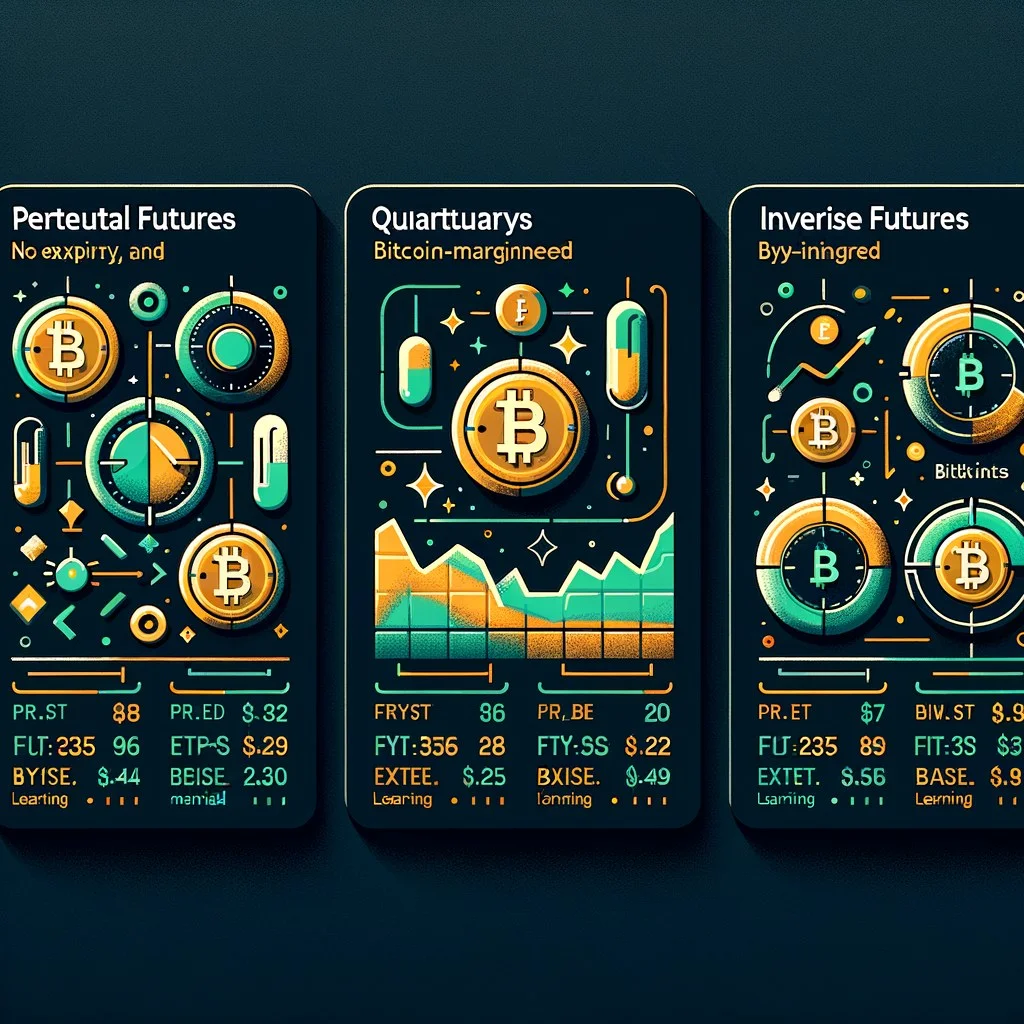
The word "futures" is a catch-all term that hides four very different products. They behave differently, settle differently, and suit different strategies. Confusing them is the first mistake most beginners make. Here is the clean taxonomy.
No expiry date. Anchored to spot via the funding rate every 8 hours (sometimes 1 hour). Roughly 90% of all crypto futures volume. The default product for most retail and pro traders.
Expires every three months. Trades at a basis (premium or discount) to spot. Preferred by basis traders, cash-and-carry funds, and anyone wanting to avoid funding payments.
Collateralized and settled in the crypto itself (BTC-margined BTCUSD). PnL is non-linear. Loved by long-term BTC holders who want to express views while keeping coins.
Technically not futures, but listed alongside them. Right (not obligation) to buy/sell at strike. Defined max loss for buyers. Mostly traded on Deribit. Out of scope for this guide.
Most of this guide focuses on perpetuals because that is what 9 out of 10 readers will actually trade. We cover quarterlies in depth because they unlock the basis trade, and we touch on inverse contracts because long-term BTC holders need to understand them. Options are a different beast entirely and deserve their own dedicated tutorial.
Perpetual Futures Deep Dive
A perpetual future, usually shortened to perp, is a futures contract with no expiration date. You can hold a BTC perp position open for an hour, a week, or three years. It will never automatically settle. That sounds simple, but it creates an immediate problem: without an expiration date, what stops the futures price from drifting arbitrarily far away from the spot price? In traditional finance, the convergence of futures to spot at expiry is what keeps the two markets linked. Perpetuals have no expiry, so something else has to do that job.
That something is the funding rate. Every 8 hours (or every 1 hour on some venues like dYdX and Hyperliquid), every open perpetual position either pays or receives a small fee based on the difference between the perpetual price and the spot index price. When perpetuals trade above spot, longs pay shorts. When perpetuals trade below spot, shorts pay longs. This payment creates a financial incentive for arbitrageurs to push the perpetual price back toward spot, which is exactly what they do. The result is that BTC perp and BTC spot rarely deviate by more than a fraction of a percent at any given moment.
The two price feeds you need to know are the mark price and the index price. The index price is a weighted average of BTC spot prices from major exchanges like Binance, Coinbase, and Kraken. It is the "fair" reference price. The mark price is a smoothed version of the perpetual order book price, designed to prevent liquidations from being triggered by short-lived wicks or order book manipulation. Your liquidation level is calculated against the mark price, not the last traded price. This distinction has saved thousands of accounts from getting wicked out of positions that were actually fine.
For a more granular breakdown of perp mechanics, see our dedicated guide on perpetual futures in crypto.
Funding Rate Mechanics
The funding rate is the single most underestimated cost in crypto futures trading. New traders look at the 8-hour funding number, see something like 0.01%, and dismiss it as noise. Then they hold a leveraged position for two weeks during a strong rally and wonder why their PnL is bleeding even though the price is going up.
Annualized: 0.01% × 3 × 365 = ~10.95% per year
Position size: $10,000 long
Cost per funding: $1.00 paid to shorts
Cost over 30 days: ~$90 just in funding
That 10.95% annualized figure is a benign case. During the 2021 bull market, BTC perp funding regularly hit 0.1% per 8 hours, which annualizes to over 100%. During the 2024 spot ETF rally, ETH and SOL perps spent weeks at 0.05% to 0.08% per 8 hours, costing leveraged longs 50% to 90% per year in funding alone. If you held a 5x long with 0.05% funding for a full year, the funding payments alone would consume your entire margin even if the price did not move.
The flip side is the funding rate farming strategy. When funding is high and positive, you can short the perp and simultaneously buy the equivalent amount of spot. You are delta-neutral, meaning price movement does not affect you. But every 8 hours, the funding payment from longs to shorts lands in your account. During extreme funding regimes, this trade can yield 50% to 100% annualized with minimal directional risk. Hedge funds, market makers, and a handful of sophisticated retail traders run this around the clock.
Quarterly Futures and the Basis Trade
Quarterly futures are the older, more traditional product. They have a fixed expiration date, usually the last Friday of March, June, September, and December. At expiry, the contract cash-settles against a final reference price, and any open positions are closed automatically.
Because they have an expiry, quarterly futures do not need a funding rate. The convergence to spot at expiry handles the anchoring naturally. What you get instead is a basis, which is the difference between the futures price and the spot price. During a bull market, BTC quarterly futures often trade at a 5% to 15% premium to spot, a state called contango. During severe sell-offs or panics, quarterlies can trade below spot, a state called backwardation.
The basis is what enables the cash-and-carry trade, one of the most reliable yields in crypto. Here is how it works. Say BTC spot is at $80,000 and the March 2026 BTC quarterly future is at $82,400. That is a 3% basis with three months to go, which annualizes to roughly 12%. You buy $80,000 of BTC on spot and simultaneously short one BTC March 2026 future. You are now delta-neutral. The price of BTC can do anything between now and March, and you do not care. When the future expires, it converges to spot. You close both legs and pocket the $2,400 difference, which is the 12% annualized yield. Institutional desks at Galaxy, Cumberland, and the larger market makers run this trade in size during contango regimes.
Quarterly futures are also useful for traders who want to take leveraged directional positions without paying funding. If you are bearish for the next 90 days and short a quarterly contract, you simply pay the premium baked into the basis at entry and ride the position to expiry. No funding surprises, no daily bleed. This makes quarterlies popular for medium-term directional bets where the duration is known in advance.
Inverse vs Linear (USD-Margined) Contracts
The next distinction you will hit on every major exchange is between linear and inverse contracts. Linear contracts are USD-margined (technically USDT, USDC, or stablecoin-margined). You deposit USDT as collateral, and your PnL is denominated in USDT. If you go long 1 BTC at $80,000 and BTC rises to $82,000, you gain 2,000 USDT. Simple, intuitive, and the default product for nearly all altcoin perps.
Inverse contracts flip the collateral. They are margined and settled in the underlying crypto. A BTCUSD inverse perp uses BTC as collateral. PnL is paid in BTC. The contract size is denominated in USD (typically $1 or $100 per contract), but everything else is BTC. This creates a non-linear payoff structure. If you go long 100 contracts of BTCUSD inverse at $80,000 and the price rises to $88,000, you make more BTC than you would lose if it dropped from $80,000 to $72,000 by the same dollar amount. Inverse contracts are inherently convex for longs and concave for shorts.
Why do these exist? Two reasons. First, in the early years of crypto futures, stablecoins were not trusted or widely available. BitMEX launched the first inverse perp in 2016 because BTC was the only realistic collateral on a non-custodial-ish exchange. Second, long-term BTC and ETH holders prefer to keep their stack denominated in the underlying asset. If you believe BTC will go to $200,000, you do not want your hedges or directional trades paid out in USDT, which you would just have to convert back to BTC anyway. Inverse contracts let you trade leverage while keeping your coin balance pure.
For new traders, stick with linear (USDT-margined) perps. They are easier to reason about, easier to position-size, and easier to integrate with stop losses and risk management. Inverse contracts are for traders who have a specific reason to want crypto-denominated PnL.
Margin Modes: Isolated vs Cross
Every futures position you open will use one of two margin modes: isolated/cross margin. The choice is not cosmetic. It fundamentally changes your risk profile.
Isolated margin means each position has its own dedicated collateral. If you allocate $500 of margin to a 10x BTC long, only that $500 is at risk. If the position liquidates, you lose the $500 and the rest of your futures wallet is untouched. This is the safe default for new traders. You can also adjust isolated margin manually, adding more collateral to a position to push the liquidation price further away.
Cross margin means all your futures wallet collateral backs every open position. If you have $10,000 in the wallet and a $500 BTC long starts losing, the system will automatically draw on the entire $10,000 to keep the position alive. This sounds convenient, and for delta-neutral or hedged portfolios it is genuinely useful. But for a directional retail trader running one or two leveraged positions, cross margin is how accounts get fully wiped out instead of just losing the originally committed amount. A single bad trade in cross mode can take everything.
The rule of thumb: use isolated margin for every directional position unless you have a specific reason to want cross. Use cross margin only when you are running multiple offsetting positions (like a basis trade) where the system needs to net the collateral across legs. For deeper coverage, see our guide on margin trading in crypto.
Liquidation Engine: How Forced Closes Work
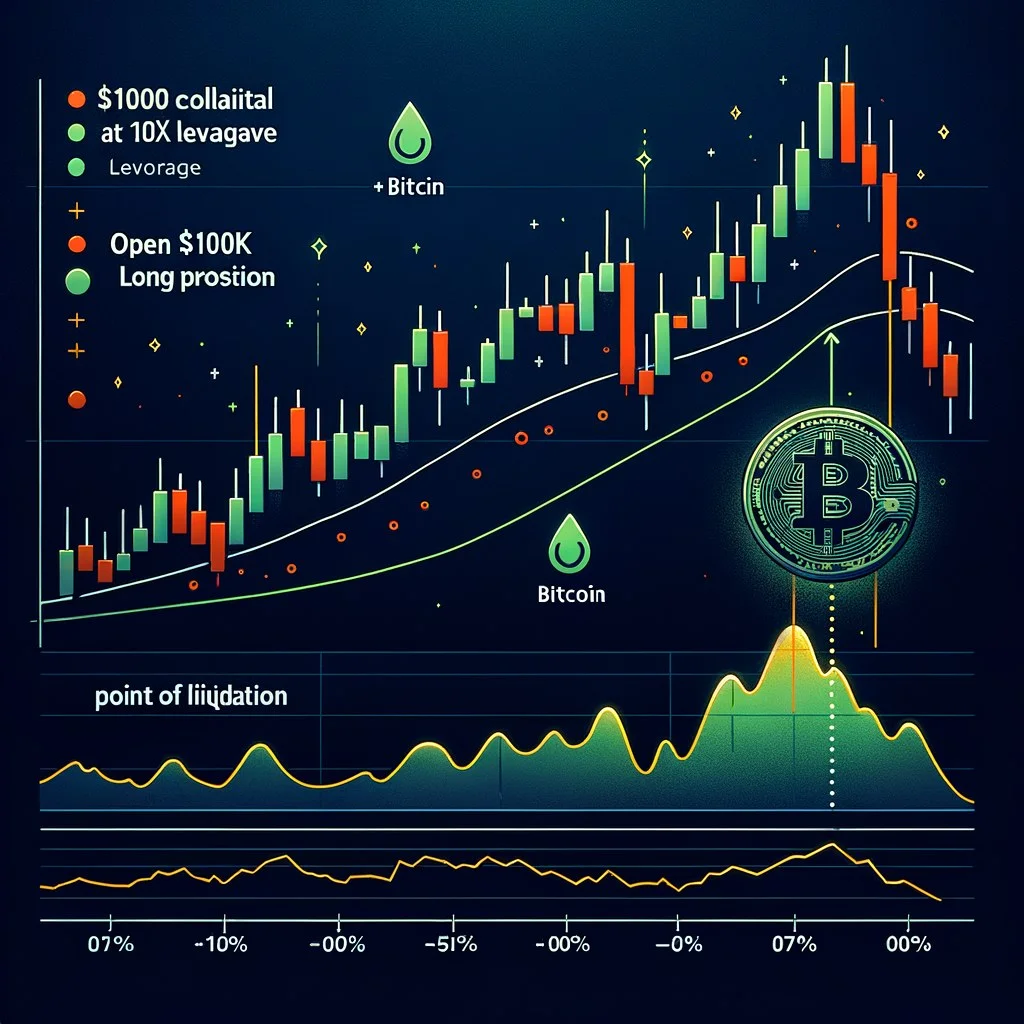
Liquidation is the moment your position is forcibly closed by the exchange because your collateral is no longer sufficient to cover potential losses. Understanding the mechanics here is non-negotiable. Most traders who blow up do so because they did not understand exactly how and when liquidation triggers.
The mechanics work like this. Every position has an initial margin (what you put up to open it) and a maintenance margin (the minimum equity required to keep it open, usually 0.4% to 1% of notional on major exchanges). The mark price is constantly checked against your position. The moment your equity, calculated as collateral plus unrealized PnL, falls below the maintenance margin requirement, the liquidation engine takes over.
The engine does not just close your position at market. It uses a tiered process. First, it tries to close the position in the order book at the bankruptcy price. If liquidity is sufficient, the trade fills and you walk away with zero (or close to zero) equity. The insurance fund absorbs the small gap between your maintenance margin and the actual fill price, which is why the insurance fund grows during normal market conditions.
If the position is too large or the order book is too thin, the system escalates to ADL (Auto-Deleveraging). ADL is the nuclear option. The exchange ranks all profitable traders on the opposite side by PnL and leverage. The top of that list has their positions force-closed at the bankruptcy price to absorb the liquidation. ADL is rare on Binance and Bybit because the insurance funds are massive (often hundreds of millions in USDT), but it does happen during black swan events. The May 2021 crash and the August 2024 yen carry unwind both triggered ADL on multiple venues.
To avoid liquidation, three rules work in practice. First, use lower leverage. Most professional traders use 2x to 5x, almost never above 10x. Second, set a stop loss well above the liquidation price, so you exit on your own terms before the engine takes over. Our guide on stop loss and take profit placement covers this in depth. Third, use isolated margin so a single bad trade cannot drain the entire wallet.
Step-by-Step: How to Open Your First Crypto Futures Trade
Theory only gets you so far. Here is the actual click-by-click for opening a futures position on the three platforms most traders will encounter: Binance Futures (the largest CEX by volume), Bybit (the most popular alternative), and dYdX (the leading onchain derivatives exchange).
Binance Futures: Step by Step
Binance Futures sits on top of a separate wallet from your spot account. The first step is transferring USDT from spot to the USDS-M Futures wallet. Go to Wallet, select Futures, click Transfer, and move whatever amount you intend to risk. Never transfer your entire spot balance into futures. Even pros only put trading capital in the futures wallet.
Once funded, navigate to the BTCUSDT perpetual contract. You will see the chart, order book, and order entry panel. Set your leverage by clicking the leverage selector (usually shows 20x by default) and dragging the slider down to 3x or 5x for your first trade. Higher leverage is not optional risk, it is mandatory risk. Below the leverage selector, choose Isolated margin mode.
In the order panel, select Limit or Market. For learning, use Limit so you can set your exact entry price. Enter the price, then the size in BTC or in USDT notional. Click Buy/Long if you are bullish, Sell/Short if you are bearish. Before clicking, double-check three things: the leverage is what you intend, the margin mode is isolated, and the position size is small enough that a full liquidation would only cost you 1% to 2% of your total trading capital. After confirming, the order goes to the book. Once filled, you will see the position in the Positions tab below the chart, along with your unrealized PnL, mark price, and liquidation price.
Immediately set a stop loss. On the position row, click the Stop Loss field, enter a price 1% to 2% away from your entry (in the loss direction), and confirm. This is the single most important habit in futures trading and the one most beginners skip.
Bybit: Step by Step
Bybit's interface is structurally similar to Binance but cleaner for futures-first users. Transfer USDT from your Funding wallet to your Derivatives wallet. Navigate to USDT Perpetual and select BTCUSDT. The leverage selector is in the top-right of the order panel. Set it to 3x or 5x. Select Isolated.
Bybit defaults to one-way mode (you can be either long or short, not both simultaneously on the same contract). For beginners this is the right setting. Place your limit order, set the size, click Open Long or Open Short. Bybit also has a TP/SL field directly in the order entry, which is excellent for new traders because it forces you to define exit levels before the position is even open. Always fill these in.
Bybit's funding rate is displayed prominently next to the mark price, refreshing in real time. Get into the habit of glancing at it before every entry. A 0.1% funding number means longs are bleeding to shorts every 8 hours. Sometimes that is fine, sometimes it is a reason to wait or to flip your view.
dYdX: Step by Step (Onchain)
dYdX runs on its own Cosmos appchain and settles positions onchain rather than on an exchange's internal database. To use it, you need a self-custody wallet like MetaMask or Keplr. Connect your wallet to dydx.trade, sign the onboarding message, and deposit USDC from Ethereum, Arbitrum, or directly onto the dYdX chain via the bridge.
The interface is familiar if you have used a CEX. Select BTC-USD (or any of the 200+ markets dYdX supports), set your leverage (dYdX caps most markets at 20x, with BTC and ETH going up to 50x), choose your order type, and submit. Trades are signed and broadcast to the dYdX validators, who match orders in a decentralized order book. Funding is paid every 1 hour instead of every 8 hours, so the rates look 8x smaller but annualize to similar levels.
The trade-off versus a CEX is real. dYdX gives you self-custody (your funds are not held by any centralized entity), no KYC, and access from jurisdictions that block CEX futures. The cost is that the order book is thinner than Binance for most pairs outside BTC and ETH, slippage on large market orders can be higher, and the UX still feels more technical than a polished CEX. For US-based traders, dYdX is often the only legal option, since most CEX futures products are geofenced from the US. For more on how this all fits together, see our comparison of major crypto exchanges.
Common Crypto Futures Strategies
Once you understand the mechanics, the strategies fall into four buckets. Each suits a different risk profile and time horizon. Mixing them up is fine, but understand which one you are running before you click buy.
Directional Long/Short: The simplest strategy. You think BTC is going up over the next week, you go long. You think it is going down, you go short. The advantage of futures over spot for directional trades is leverage and the ability to short. The disadvantage is funding cost and liquidation risk. This strategy lives or dies on entry timing, stop loss discipline, and position sizing. Roughly 80% of all retail futures volume is directional. Our guide on shorting crypto covers the short side in detail.
Basis Trade (Cash-and-Carry): Buy spot, short the dated future. Capture the basis as risk-free yield over the life of the contract. Works only when quarterlies trade at a premium to spot, which is most of the time during bull markets. Annualized yields ranged from 5% to 25% throughout 2023 to 2025. Requires significant capital to be worthwhile after fees, but is one of the few genuinely low-risk trades in all of crypto.
Funding Rate Farming (Delta-Neutral): Short the perp, buy the spot. Collect the funding payment every 8 hours. Works when funding is persistently positive, which is the norm during bull regimes. Identical PnL profile to the basis trade but uses perps instead of dated futures. Easier to scale up and down quickly. The risk is funding rates can flip negative during sharp pullbacks, instantly turning the strategy from a yield trade into a small bleed.
Hedging: If you have a large spot stack you do not want to sell (often for tax reasons), you can short an equivalent notional in futures to neutralize downside risk during periods of expected weakness. The position is delta-neutral, so you stop benefiting from upside, but you also stop suffering from drawdowns. Long-term holders use this during earnings season, macro events, or after major rallies when a correction looks likely. For more on the mechanics of opposing directional bets, see leverage trading.
Top Crypto Futures Venues in 2026
The futures venue landscape has consolidated. Five years ago, FTX, BitMEX, Bybit, and Binance fought for dominance. Today the rankings are more stable, with a clear split between centralized leaders and onchain challengers.
Largest by volume. 300+ perpetual markets, deepest liquidity, lowest fees. Geofenced from US.
Strong number two. Excellent UX, deep liquidity on BTC and ETH, growing altcoin coverage.
Heavy Asian volume. Strong copy trading product, broad altcoin perp listings.
The options venue. Dominates BTC and ETH options. Smaller perp business but excellent quarterly futures.
Self-custody onchain. Cosmos appchain. No KYC. US-accessible.
Arbitrum-native, oracle-priced perps. No order book, pools take the other side. Limited markets.
Fastest growing onchain perp DEX. Native L1, CEX-class UX, 1-hour funding cycles.

Risks: Why Most Traders Lose Money
Crypto futures are not a fair game for retail. The structural advantages sit with market makers, exchange-affiliated trading desks, and well-capitalized professionals. That does not mean retail cannot win, but the average outcome is heavily negative. Here are the risks that actually matter.
Over-leverage: The single biggest killer. Retail traders consistently use 20x to 100x leverage on directional trades. At 50x leverage, a 2% adverse move wipes out the entire position. BTC moves 2% in the wrong direction multiple times per week. The math is unforgiving.
Funding bleed: Holding a position through extended funding periods at high rates can consume more PnL than the price movement. A 5x long held for a month at 0.05% per 8 hours pays 5 × 0.05% × 3 × 30 = 22.5% of margin in funding alone. The price has to rise more than 4.5% just to break even on funding.
Exchange counterparty risk: Your collateral lives on the exchange. If the exchange has solvency issues, undisclosed losses, or executes a withdrawal halt, you cannot access your funds. FTX in November 2022 made this risk extremely concrete. Self-custody onchain venues like dYdX, GMX, and Hyperliquid mitigate this but introduce their own smart contract risks.
Manipulation and stop hunts: Thinly-traded altcoin perps are prone to coordinated wicks designed to liquidate clustered stops. Mark price smoothing helps but does not eliminate the issue. Stick to BTC, ETH, and the top 20 by perp volume to minimize this.
Information asymmetry: Market makers see order flow in real time. You see a candlestick chart. They run statistical arbitrage on every visible level. You guess. This asymmetry is permanent and cannot be eliminated, only reduced by trading less frequently and on longer timeframes.
Statistics: How Many Futures Traders Lose Money?
The retail loss rate in crypto futures is not a secret, but it is rarely advertised. Multiple sources of data converge on the same range. eToro disclosure data on CFD products (the closest regulated analog) shows 70% to 85% of retail accounts lose money in any given quarter. Crypto futures, with their higher leverage and 24/7 markets, are almost certainly worse.
Studies of Bitcoin futures trader cohorts published in the Journal of Financial Markets and several preprints between 2022 and 2024 estimate 78% to 89% of retail traders are net negative over a 12-month period. Internal data leaked from one major exchange in 2023 suggested the figure for traders using 25x or higher leverage exceeded 95%. The pattern is consistent: the more leverage used, the worse the survival rate.
The implication is not that you cannot make money. A meaningful minority of disciplined traders do. The implication is that the default outcome of opening a futures account, clicking buy with high leverage, and trading on intuition is account loss. To be in the winning minority, you need lower leverage than feels exciting, stricter risk management than feels necessary, and longer holding periods than feel comfortable. Almost no beginner does any of those three things, which is why the loss rate is what it is.
Tax Implications of Crypto Futures
Tax treatment varies wildly by jurisdiction, and crypto futures specifically have some quirks worth knowing. This section is informational and not tax advice. Talk to a qualified accountant before filing.
In the United States, crypto futures traded on a CFTC-regulated venue (like CME Bitcoin futures or Kraken Futures' US-eligible products) generally qualify as Section 1256 contracts. These benefit from 60/40 treatment: 60% of gains and losses are taxed at long-term capital gains rates regardless of holding period, and 40% at short-term rates. For high earners, this is meaningfully lower than ordinary income or short-term capital gains rates. Mark-to-market accounting at year-end is required.
However, perpetual futures and most products on offshore exchanges (Binance, Bybit, OKX) are generally not Section 1256 contracts. Most US tax preparers treat them as ordinary capital assets, with each closed trade producing a short-term capital gain or loss. This is less favorable but simpler. The IRS has not issued definitive guidance on offshore crypto perps, so positions vary among practitioners.
In the UK, futures trading typically falls under capital gains tax, with a tax-free allowance and standard rates above that. In Germany, derivatives are taxed at the flat 25% Abgeltungsteuer rate. In Australia, capital gains rules apply with a 50% discount on positions held over 12 months. In most of Latin America and Southeast Asia, enforcement is inconsistent but the legal framework usually treats futures PnL as taxable income.
The practical advice for anyone trading futures seriously: keep detailed records (most exchanges provide CSV exports), use a crypto tax tool like Koinly or CoinTracker to aggregate across venues, and consult a local accountant. The complexity grows quickly once you mix spot, perps, basis trades, and onchain positions.
FAQs
What is the difference between crypto futures and spot?
Spot trading means buying the actual cryptocurrency. You send dollars, you receive BTC, and you own the BTC. Futures trading means buying a derivative contract that tracks the price of BTC without owning any. Spot has no leverage, no funding, no liquidation, and no expiration. Futures offer leverage (up to 125x on some venues), can be both long and short, charge funding (on perpetuals) or trade at a basis (on quarterlies), and can be force-closed by the exchange if your margin runs out. Spot is for accumulation. Futures are for active directional bets and yield strategies. Most traders should use spot for most of their portfolio and limit futures to a small percentage of trading capital.
How much leverage should I use?
For nearly every trader, the honest answer is 2x to 5x maximum. Professional desks rarely run more than 5x on directional positions. Anything above 10x is gambling, not trading. The exchanges advertise 50x to 125x because high leverage generates the most fee revenue and the most liquidations, both of which benefit the platform. New traders should start at 2x or 3x, get comfortable with how a position moves, build a stop loss habit, and only consider higher leverage after at least three months of consistent profitability. Even then, 10x is a reasonable cap. If a trade needs 50x leverage to be worthwhile, the trade is too small and the position sizing is wrong.
What is funding rate?
The funding rate is a periodic payment between long and short holders of a perpetual futures contract, used to keep the perp price anchored to the spot price. Every 8 hours (or 1 hour on some venues), the funding rate is calculated based on the premium or discount of the perp to the index. If the perp trades above spot, longs pay shorts. If the perp trades below spot, shorts pay longs. A typical funding rate of 0.01% per 8 hours annualizes to roughly 10.95%. During bull markets, rates can hit 0.05% to 0.1% per 8 hours, which annualizes to 50% to 100%. Funding is the main reason holding leveraged perps for extended periods is expensive even when you are right on direction.
Can you short Bitcoin with futures?
Yes. Shorting is one of the core reasons futures exist. On any major futures venue, you can open a short position on BTC, ETH, SOL, and hundreds of other assets by clicking Sell or Short instead of Buy or Long. The position profits when the price falls and loses when the price rises, the mirror image of a long. Shorting requires no borrowing, no locate, and no special account approval, unlike traditional equity markets. The funding rate often favors shorts during bull markets (because longs pay shorts when perps trade above spot), which can produce small additional yield on top of any price gains. For deeper coverage of the short side specifically, see our guide on how to short crypto.
Are crypto futures legal in the US?
It depends entirely on the venue. CME Bitcoin and Ether futures are fully legal and regulated by the CFTC. Kraken Futures offers regulated products to eligible US persons. Coinbase International Exchange offers perps but excludes US retail. Most large offshore venues including Binance Futures, Bybit, OKX, and BitMEX geofence US IP addresses and require non-US KYC. dYdX, GMX, and Hyperliquid are accessible from the US because they are decentralized protocols rather than registered exchanges, though the regulatory status of using them as a US person is unsettled. The pragmatic answer for US traders is: CME or Kraken for regulated exposure, dYdX or Hyperliquid for onchain perps, and offshore CEX access requires either a VPN (against most exchanges' terms of service) or non-US residency.
What is the best crypto futures exchange?
There is no single best answer. The right venue depends on your jurisdiction, the markets you want to trade, your tolerance for KYC, and whether you prioritize liquidity or self-custody. Binance Futures has the most liquidity and the broadest selection but is closed to US users. Bybit is the strongest alternative with excellent UX and competitive fees. OKX dominates Asian volume. Deribit is unbeatable for options. dYdX and Hyperliquid lead the onchain segment. For new traders outside the US, Bybit is often the easiest starting point. For US traders, dYdX is the most accessible. For traders who want full custody and no KYC, Hyperliquid has become the default choice in 2026. Our broader exchange comparison guide covers the spot side of this same decision.
Conclusion
Crypto futures are the deepest, most liquid, and most professional market in all of crypto. They are also the fastest way to lose your account if you do not respect the mechanics. The taxonomy you now understand (perpetual, quarterly, inverse, options) maps to four genuinely different products with different risks and different uses. The funding rate is not noise, it is a meaningful cost or yield depending on which side you are on. The mark price, not the last trade, is what triggers your liquidation. Isolated margin protects you, cross margin can destroy you. Lower leverage wins over time, higher leverage wins in marketing campaigns and loses in real accounts.
The traders who survive and eventually profit in crypto futures share a small number of habits. They size positions so a single loss is bounded to 1% to 2% of total capital. They use stops without exception. They track funding cost and avoid holding perps through prolonged negative regimes. They prefer BTC and ETH over thinly-traded altcoin perps. They take profits incrementally rather than swinging for moonshots. None of this is glamorous, and none of it is what the typical Twitter futures influencer is selling. But it is what the boring data shows works.
If you are starting from zero, do not jump straight into a 50x perp on a memecoin. Open a small account, fund it with money you can fully lose, trade BTC at 2x to 3x for the first month, set a stop on every position, and rebuild your intuition for how leveraged PnL actually feels. Once you can survive a month without blowing up, you have already separated yourself from the bottom 80% of futures traders. The rest is iteration, discipline, and time. Crypto futures will still be here. Your job is to make sure your account is still here too.
Related Guides
- What Is Futures Trading in Crypto? How Leverage, Margin and Liquidation Work (2026)
- How to Use Kraken Pro: Spot, Futures, Staking and Fees (2026)
- How to Use Paradex for Perps Trading in 2026
- How to Use Ostium for RWA Perps Trading 2026
- How to Use Avantis: Perps Trading on Base Tutorial (2026)
- What Are Renko Charts in Crypto Trading? A Complete Guide (2
- What Are Three White Soldiers in Crypto Trading? 2026 Guide
- What Are Option Greeks in Crypto Trading? 2026 Guide
- What Are Bollinger Bands? Crypto Trading Guide 2026
- What Are Pivot Points in Crypto? Trading Guide 2026
- What Are Heikin Ashi Candles in Crypto? Trading Guide 2026
Frequently Asked Questions
What are crypto futures?
Crypto futures are contracts to buy or sell an asset at a set price, used to speculate on or hedge price movements without necessarily holding the underlying coin. They often use leverage, which magnifies both gains and losses.
What is the difference between perpetual and quarterly futures?
Perpetual contracts have no expiry and use a funding mechanism to keep their price near the spot market, while quarterly contracts expire on a set date. Perpetuals are popular for ongoing positions, while dated contracts settle at expiry.
What is funding in perpetual futures?
Funding is a periodic payment exchanged between long and short traders that keeps the perpetual contract price aligned with the spot price. Depending on market conditions, longs may pay shorts or shorts may pay longs.
What is liquidation in futures trading?
Liquidation happens when your position loses enough that your margin can no longer support it, so the exchange closes the position automatically. Using lower leverage and maintaining extra margin reduces how easily this occurs.