CASHCAT Wicked to $0.08 in Three Minutes on Hyperliquid, About 60% Down, Then Snapped Right Back
— By Tony Rabbit in News
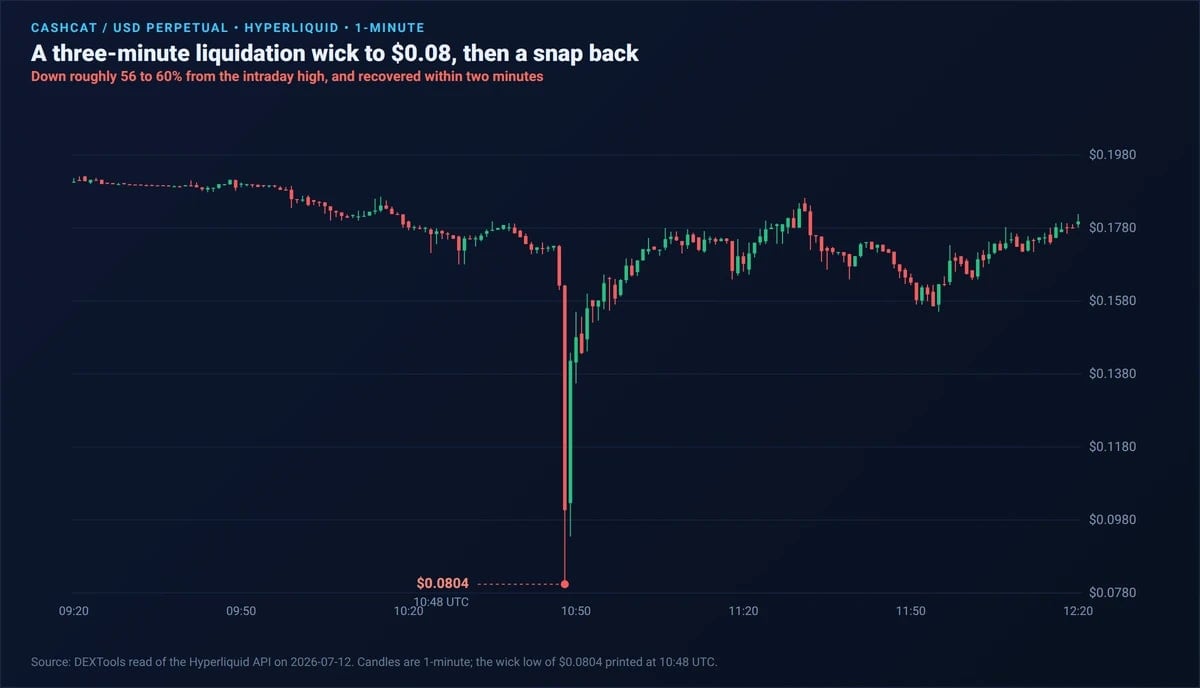
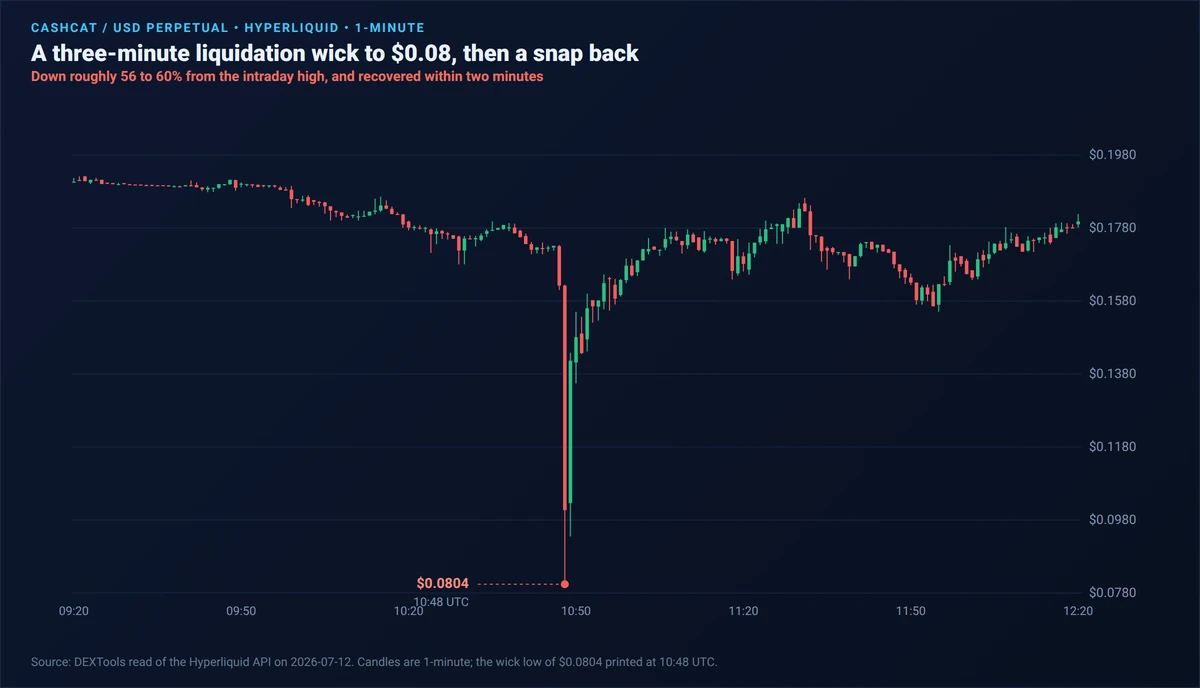
In three minutes on July 12, CASHCAT's perpetual on Hyperliquid crashed from about $0.18 to a low of $0.0804, roughly 56 to 60% down, then snapped back within two minutes. We read the chain: nothing changed about the token. It was a leverage liquidation cascade, and it is a clean reminder that leverage is not your friend.
On July 12, 2026, a cat memecoin called CASHCAT did something that looks terrifying on a chart and turns out to be almost boring once you read it: its perpetual futures market on Hyperliquid fell from about $0.18 to a low of $0.0804 in roughly three minutes, a drop of around 56 to 60% from the intraday high, and then snapped back to about $0.14 within two minutes. If you were watching live, it felt like a rug. It was not. We pulled the Hyperliquid data, and the candles tell a very specific story: this was a leverage liquidation cascade, and nothing about the token changed.
What the chart actually shows
We read the one-minute candles straight from the Hyperliquid API. CASHCAT was trading calmly near $0.17 at 10:46 UTC. At 10:47 it slipped to $0.162 as volume began to spike. Then came 10:48, the minute that did all the damage: the price wicked all the way down to $0.0804 before closing the same minute back at $0.1006, on about 21.3 million CASHCAT of volume in that single candle, roughly a thousand times a normal minute. By 10:49 it was back to $0.142, and by 10:50 it was near $0.15. Five candles contained the entire crash and most of the recovery.
Minute by minute
Here is the same event as a ledger, so you can see how fast it moved and how quickly it healed.
| Minute (UTC) | Low | Close | What happened |
|---|---|---|---|
| 10:46 | $0.1718 | $0.1731 | calm, trading near $0.17 |
| 10:47 | $0.1609 | $0.1622 | first slip, volume jumps |
| 10:48 | $0.0804 | $0.1006 | the cascade: 21.3M traded, wick to $0.08 |
| 10:49 | $0.0935 | $0.1416 | snap back begins |
| 10:50 | $0.1354 | $0.1481 | recovered, near $0.15 |
Why a token drops 60% and instantly comes back
A move like this is almost always mechanical, not fundamental. On a perpetual futures market, traders can take positions with leverage, which means the exchange will forcibly close a position, a liquidation, if it moves too far against them. When CASHCAT started slipping, leveraged long positions began to get liquidated. Each forced liquidation is a market sell, and in a thin order book each sale pushes the price down further, which triggers the next liquidation, which pushes the price down again. That feedback loop is a liquidation cascade, and it can travel a very long way in seconds. The instant snap-back is the giveaway that it was mechanical: once the leveraged positions were flushed out, there were no more forced sellers, buyers stepped into the vacuum, and the price returned to where real supply and demand sat. The token did not become worth 60% less and then worth 60% more in the space of three minutes. Only the leverage moved.
- the wick low was $0.0804, printed on the Hyperliquid perp at 10:48 UTC
- about 21.3 million CASHCAT changed hands in that one minute, versus a few thousand in the minutes before
- it recovered to roughly $0.14 within two minutes and trades near $0.177 now
- open interest is about $43.7M and 24h volume about $42.3M on the perp
- this was a leverage liquidation cascade, not news about the token
- as price slipped, leveraged long positions were force-liquidated into a thin book
- each forced sale pushed price lower and triggered the next liquidation, all the way to $0.08
- the instant snap-back is the tell: nothing fundamental changed, the move was mechanical
The Robinhood Chain and Hyperliquid split that matters
There is an important nuance here about where this happened. CASHCAT is a memecoin that lives on Robinhood Chain, where its deepest spot pool, CASHCAT against wrapped ETH, holds about $11.15 million of real liquidity and turns over roughly $30 million a day. That is the token itself. The $0.08 wick did not happen there. It happened on a separate venue, the CASHCAT perpetual on Hyperliquid, which is a leveraged derivative with its own order book. During a liquidation cascade a perp can dislocate hard from the underlying spot price precisely because the forced selling is happening inside the perp, not in the spot pools. So the headline number, a 60% wick, is real, but it is a picture of leverage unwinding on one derivatives market, not of the memecoin losing and regaining half its value everywhere at once.
The reminder: leverage is not your friend
You did not need to be wrong about CASHCAT to get hurt in that three-minute window. A trader who was simply long with too much leverage could have been liquidated at $0.09 and watched the price close the same minute at $0.10 and sit at $0.15 a few minutes later, right after their position was gone. That is the quiet cruelty of leverage on thin, volatile memecoins: the market does not have to prove you wrong, it only has to move far enough, fast enough, to close you out before it comes back. Cascades like this are a recurring feature of leveraged memecoin trading, not a bug you can time around. If you want to see how thin a market really is before you size a position, our token safety checker reads a token's live liquidity and risk signals on chain.
Method and disclosures: all price, candle, volume, open interest and funding figures for the CASHCAT perpetual were read by DEXTools from the public Hyperliquid API on 2026-07-12, and the spot liquidity figure from GeckoTerminal on the same day. The wick low of $0.0804 printed at 10:48 UTC. This article is informational, describes a market mechanism, is not trading or investment advice, and does not accuse any party of wrongdoing. On-chain and market values move continuously and were accurate at the time of writing.