Robinhood Chain Flipped Hyperliquid on Volume. We Read the Chain: It Is $521M of Memecoins on $29M of Liquidity
— By Tony Rabbit in News
Robinhood Chain made headlines by overtaking Hyperliquid in 24-hour DEX volume just a week after launch. We read the chain: roughly $521 million of that volume rests on about $29 million of real liquidity, the top pools are all memecoins, and several trade tens of millions of dollars on almost no liquidity at all. The tokenized stocks it was built for are nowhere near the top.
Robinhood Chain has a genuinely eye-catching headline: barely a week after its mainnet went live, the new Ethereum Layer-2 overtook Hyperliquid in 24-hour decentralized exchange volume, printing somewhere around $560 to $570 million in a single day and crossing $1 billion in cumulative DEX volume in its first week. That is a real number, and it is being reported everywhere. So we did what we do, and read the chain underneath it. The volume is real. The market it describes is almost entirely memecoins trading on top of very little liquidity, and the tokenized stocks the chain was built to host are nowhere to be found.
The record, as reported
The milestone itself is well sourced. On July 8, 2026, seven days after launch, Robinhood Chain passed Hyperliquid in 24-hour DEX volume, and outlets from Cryptonews to Crypto Briefing tied the surge to a wave of memecoins rather than to the real-world assets Robinhood has pitched. The single biggest driver was a cat memecoin called CASHCAT, credited with roughly $98 million of the day's volume on its own, alongside Robinhood-themed tokens like Dog In Hood, TENDIES and ARROW. The chain has since kept climbing. None of that is in dispute. The question is what that volume is actually made of.
What we read on-chain
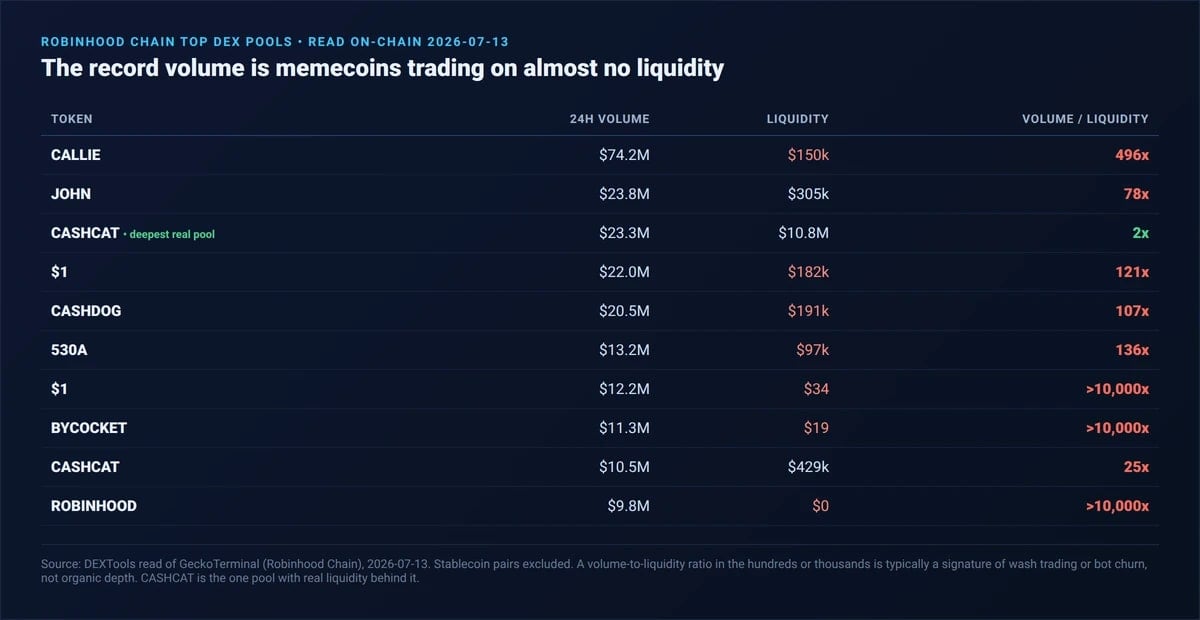
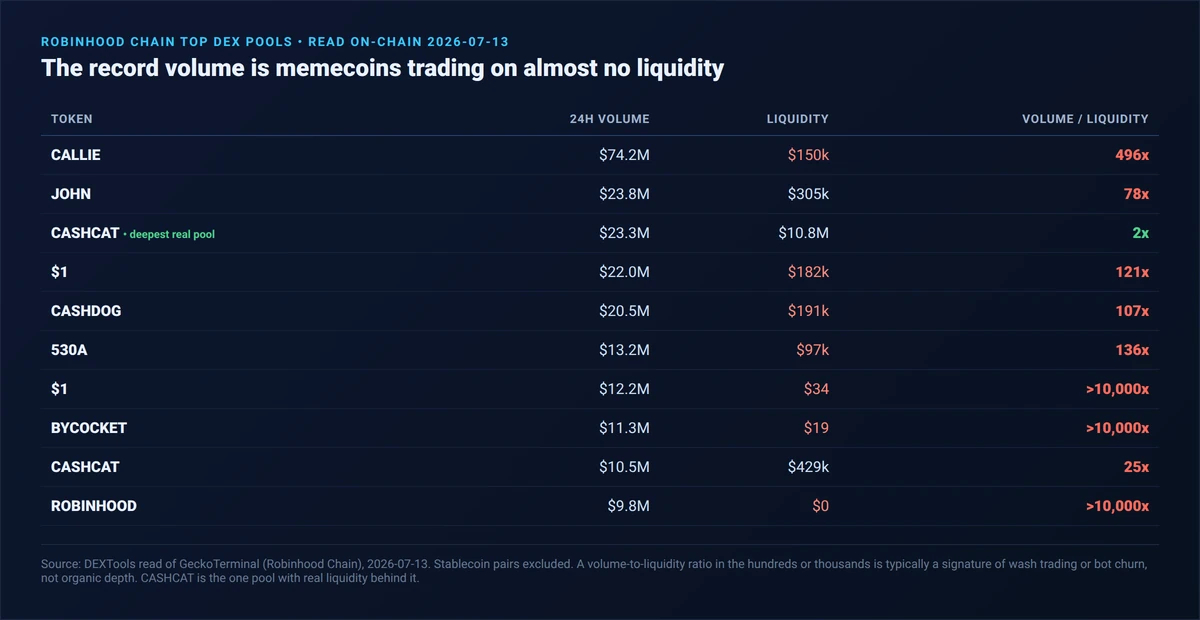
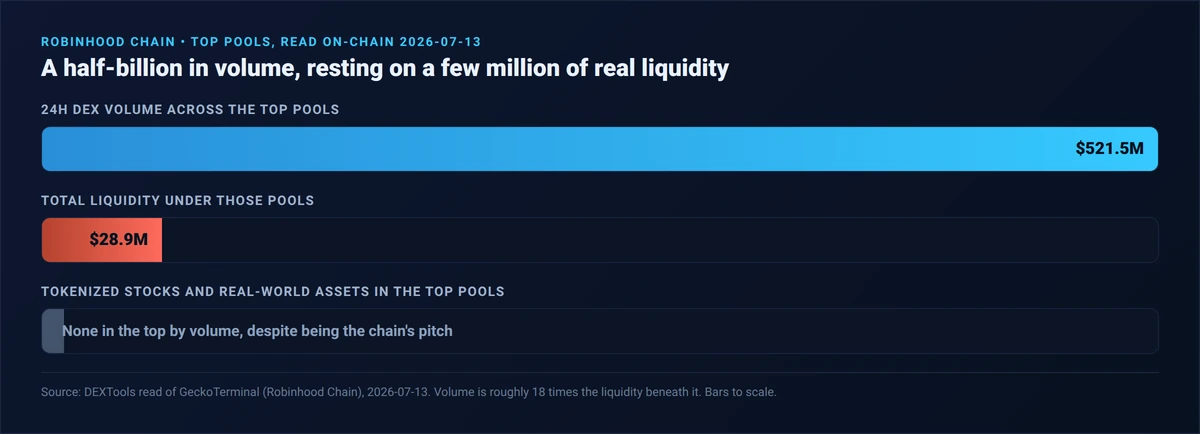
We pulled Robinhood Chain's pools from GeckoTerminal. Across its top pools, we read about $521 million of 24-hour volume sitting on only about $29 million of total liquidity, which means the chain is turning over its entire tradable depth roughly 18 times a day. The top of the leaderboard is not tokenized Apple or Tesla. It is CALLIE, a memecoin doing $74.2 million of volume on $150,000 of liquidity, then JOHN, then CASHDOG, then a token literally named $1, then 530A, then HOODCAT. The only pool near the top with real depth behind it is CASHCAT, whose main pool holds about $10.8 million and trades at a sane ratio.
The number that should make you pause
Look at the last column of that table. A healthy market trades some sensible multiple of its liquidity in a day. CALLIE traded almost 500 times its liquidity. Several pools are far worse: a token trading $12.2 million of volume on $34 of liquidity, BYCOCKET doing $11.3 million on $19, a ROBINHOOD token doing $9.8 million on effectively zero. Volume-to-liquidity ratios in the hundreds, let alone the tens of thousands, are not what organic demand looks like. That pattern is the classic signature of wash trading and automated bot churn, where the same value is bounced back and forth to manufacture a volume figure. We are describing an on-chain pattern, not accusing any named person, but the pattern is unmistakable and it is a large share of the record.
Built for tokenized stocks, running on memecoins
Here is the irony that makes this more than a memecoin story. Robinhood pitched Robinhood Chain as the home for tokenized equities and real-world assets, the on-chain version of the stocks it lists in its app, part of the same tokenized-stock race that Coinbase and Kraken are also chasing. On the chain itself, in the volume that just beat Hyperliquid, those tokenized stocks are invisible. What is actually driving the flagship metric is a casino of cat coins and dollar-named memecoins, one of which, CASHCAT, we watched wick 60% in three minutes on a leveraged perp the same week. The infrastructure is serious. The traffic on it, so far, is not.
Why volume without depth is a vanity metric
None of this means Robinhood Chain has failed. New chains often bootstrap on speculation before real use arrives, and a billion dollars of week-one volume genuinely signals attention. But volume is the easiest number in crypto to inflate and the least meaningful on its own. Depth, the liquidity actually sitting in the pools, is what decides whether you can trade size without moving the price, and on Robinhood Chain that depth is a few million dollars spread thin under a half-billion-dollar headline. When you see a chain or a token top a volume chart, the honest next question is always the same: volume on top of how much liquidity? You can check that yourself, pool by pool, before you trust the headline. Our token safety checker reads a token's real liquidity on chain.
- Robinhood Chain overtook Hyperliquid in 24h DEX volume at about $560 to $570M on July 8
- it crossed $1B in cumulative DEX volume in its first week, seven days after mainnet
- coverage credited memecoins, led by CASHCAT, plus Robinhood-themed tokens like Dog In Hood, TENDIES and ARROW
- about $521M of 24h volume across the top pools sits on only ~$29M of liquidity
- the top pools are all memecoins: CALLIE, JOHN, CASHDOG, $1, 530A, HOODCAT and more
- several trade tens of millions on under $200 of liquidity, a wash-trading or bot signature
- CASHCAT is the one pool with real depth (~$10.8M); tokenized stocks are absent from the top
Method and disclosures: volume and liquidity figures for Robinhood Chain pools were read by DEXTools from GeckoTerminal on 2026-07-13, taking the top pools by 24-hour volume and excluding stablecoin pairs. The $560 to $570M single-day and $1B cumulative figures are attributed to reporting by Cryptonews, Crypto Briefing and others and were not independently recomputed by us. References to wash trading describe an on-chain volume-to-liquidity pattern, not a finding of wrongdoing against any identified party. This article is informational, is not investment advice, and on-chain values move continuously and were accurate at the time of writing.