US House Bill Would Bar Lawmakers From Crypto Prediction Markets
— By Tony Rabbit in Markets
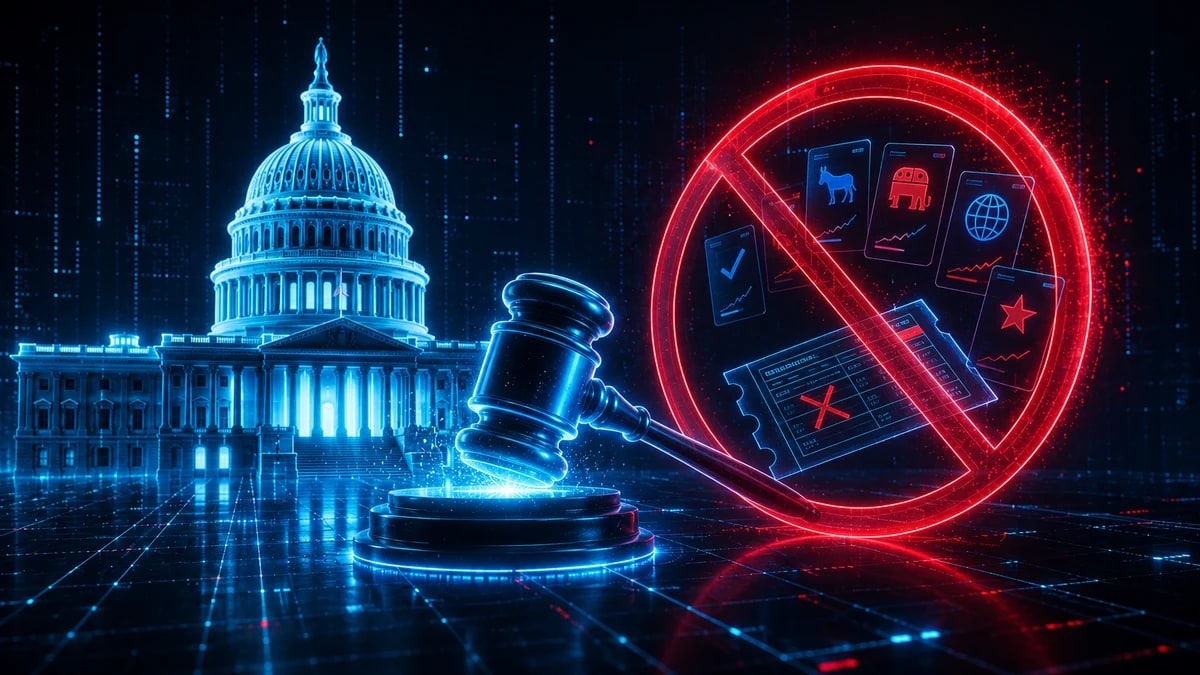
US House lawmakers plan to expand a congressional stock-trading ban to explicitly cover crypto prediction-market platforms such as Polymarket and Kalshi, citing conflict-of-interest concerns.
US House lawmakers are preparing to widen the scope of a congressional stock-trading ban so that it explicitly covers crypto prediction-market platforms such as Polymarket and Kalshi. The move would make clear that members of Congress cannot place bets on these venues, closing a gap that critics say could otherwise let officials profit from outcomes they help shape.
Representative Bryan Steil signaled on Thursday, June 4, 2026, that the bill would be expanded to include these platforms. The proposed language is still just that, a proposal, and has not become law. But it reflects a broader push in Washington to define how public officials should interact with a fast-growing corner of the markets.
What the Bill Would Do
The underlying measure is a ban on members of Congress trading individual stocks, an idea that has circulated in various forms for years. The new step is to add language that names prediction-market platforms directly, so that betting on real-world outcomes through services like Polymarket and Kalshi falls under the same restrictions as trading equities. Supporters argue that without explicit language, prediction markets could become an obvious workaround for officials who are barred from buying and selling stocks.
Because the text would be folded into an existing trading-ban effort, the prediction-market provisions are presented as an extension of the same principle rather than a brand-new framework. The intent is to treat wagering on events the way the bill already treats trading in securities.

What Is a Prediction Market?
A prediction market is a platform where people buy and sell contracts tied to the outcome of a future event. Instead of buying a share in a company, a participant buys a position on a question such as whether a particular candidate will win, whether a sports team will take a title, or whether an economic figure will land above or below a set level. The price of each contract moves with the crowd's collective view of how likely the outcome is, and the contract pays out if the event resolves a certain way.
That structure is what makes prediction markets useful as a gauge of expectations. It is also what makes them sensitive when the people placing bets have power over the events being traded. Traders who follow markets through analytics dashboards like DEXTools are used to watching prices react to news, but prediction markets add a twist: the news itself can be influenced by some of the participants.
Why a Lawmaker Bet Raises Concerns
The core worry is conflict of interest. A member of Congress can vote on bills, shape policy, sit on committees, and influence decisions that move real-world outcomes. If that same lawmaker holds a position on a prediction market tied to one of those outcomes, the official could stand to gain financially from actions taken in an official capacity. That blurs the line between public duty and personal profit.
Consider a simplified example. If a lawmaker can affect whether a policy passes, and that lawmaker has placed a bet on the policy passing or failing, then every vote carries a personal financial angle. Even when no wrongdoing occurs, the mere possibility can undermine public trust in the integrity of the institution. Backers of the expanded language say removing the temptation entirely is cleaner than trying to police it case by case.
Why This Is Happening Now
Prediction markets surged in popularity through 2025 and into 2026. Activity climbed around elections, sports events, and economic data releases such as Federal Reserve decisions, drawing in large volumes of participants and attention. Polymarket and Kalshi emerged as two of the most prominent venues during that stretch, becoming household names for people who follow markets and politics alike.
As these platforms grew, so did scrutiny of how officials and other public figures use them. The proposed House language is one piece of that broader examination. Rather than treating prediction markets as a niche product, lawmakers are now weighing them as a mainstream venue that deserves the same conflict-of-interest guardrails applied to traditional trading.

How Polymarket and Kalshi Fit In
Polymarket and Kalshi are named in the discussion because they have become the most visible prediction-market platforms in the current cycle. Both let users take positions on the likelihood of future events, and both saw heavy interest during high-profile periods. Naming specific platforms in the legislation is meant to leave little room for interpretation about what counts as a covered venue.
The platforms themselves are not the target of any accusation in this proposal. The focus is on who is allowed to use them, specifically whether sitting members of Congress should be permitted to place wagers there at all. The bill aims to set a rule for lawmakers rather than to judge the services.
What to Watch
The key point for readers is that this is a proposal, not a law. For the prediction-market language to take effect, the broader trading-ban bill would need to advance through the legislative process, and details could change along the way. Watch for whether the expanded language stays in the final text, how prediction markets are defined, and whether the measure gains enough support to move forward.
For now, the development signals that prediction markets have moved from the fringe to the center of policy debate in Washington. This article is informational and is not financial advice. Anyone following the story should rely on official sources for the latest status of the bill as it develops.