How to Choose the Right Pool When a Token Trades on Multiple DEXs
— By Whatsertrade in Crypto
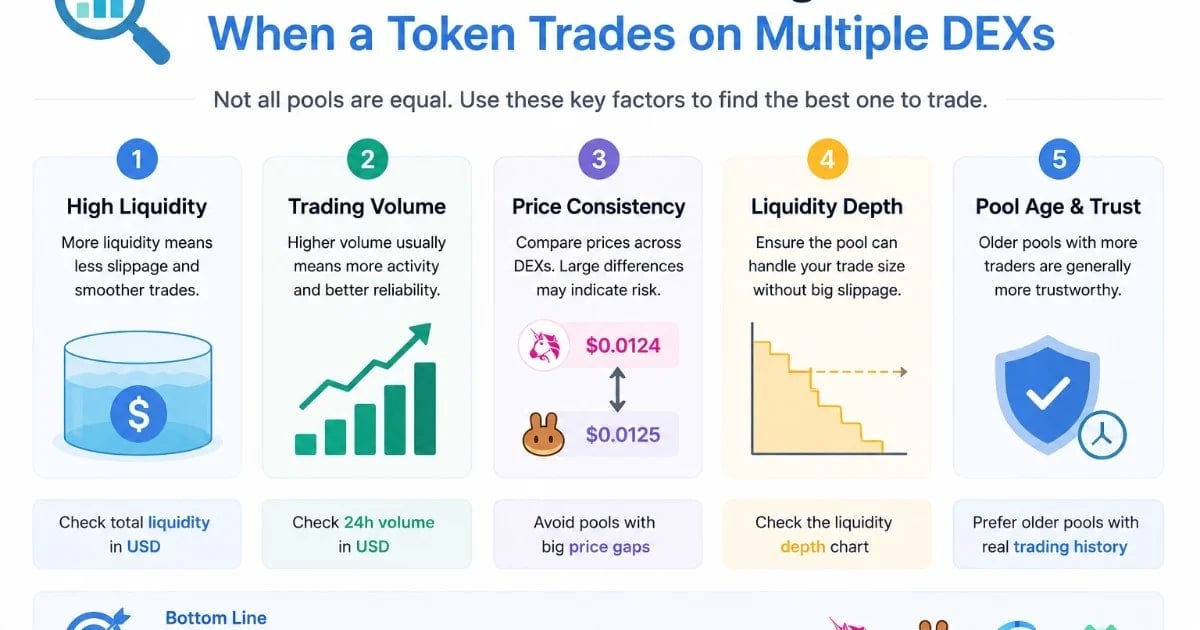
Many tokens trade on more than one decentralized exchange. They may also have several pools on the same chain, different paired assets, or versions across multi
Many tokens trade on more than one decentralized exchange. They may also have several pools on the same chain, different paired assets, or versions across multiple networks. For traders, this creates an important question: which pool should you actually watch and trade?
Choosing the wrong pool can lead to poor execution, misleading price analysis, bad liquidity conditions, or even exposure to unofficial versions of a token. Choosing the right pool helps traders understand the real market, follow the most relevant chart, and avoid decisions based on fragmented data.
DEXTools makes this process easier by allowing traders to explore token pairs, compare market activity, and identify where the most meaningful trading is happening.
Why Tokens Have Multiple Pools
A token can appear in multiple pools for several reasons. A project may launch liquidity on more than one decentralized exchange. Community members may create additional pools. A token may be paired with different assets such as ETH, WETH, USDC, USDT, BNB, or chain native assets. In some cases, a token may also exist across several chains through bridges or separate deployments.
Not every pool has the same importance. One pool may represent the main market, while another may have low activity. One may have deep liquidity, while another may move sharply on small trades. One may be official, while another may be confusing or risky.
A trader who looks at only one chart without checking the broader pool landscape may miss the real market context.
The Main Pool Is Usually Where Liquidity and Volume Meet
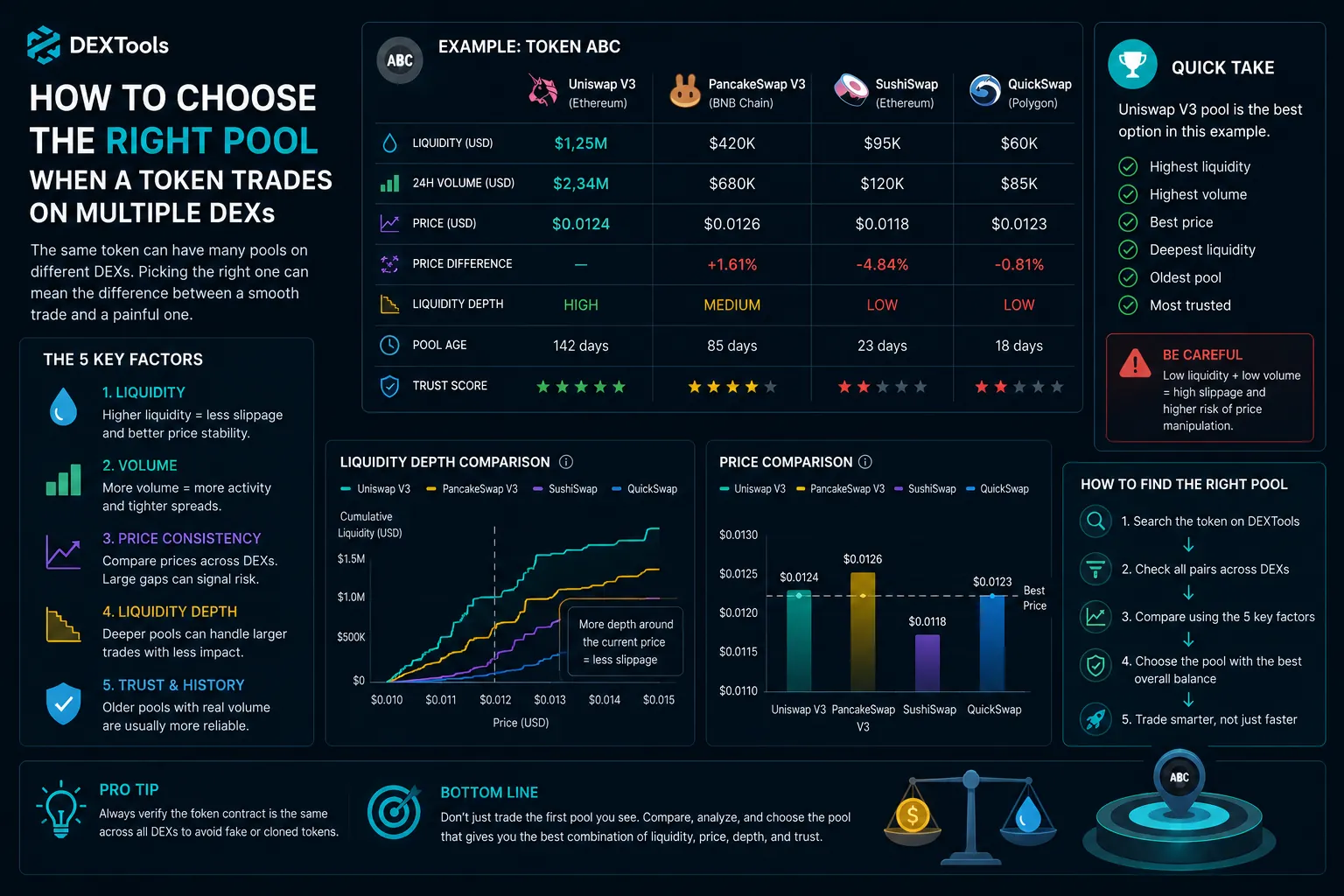
The most relevant pool is usually not the one with only the highest liquidity or only the highest volume. The strongest signal often appears where liquidity and volume meet.
High liquidity with almost no volume may indicate a quiet or inactive pool. High volume with low liquidity may indicate a volatile and risky trading environment. A more useful pool often has enough liquidity to support trades and enough volume to show that the market is active.
When comparing pools, traders should look for the pair that best represents real demand. If most traders are buying and selling in one pool, that pool is likely to provide the clearest market signal.
Check Which Pair Sets the Price
When a token trades in several pools, price differences can appear. Arbitrage traders may reduce these gaps over time, but smaller tokens can still show temporary differences across pools. The pool with the strongest liquidity and volume often becomes the primary price reference.
This matters for chart analysis. If you are studying a low volume pool, the chart may look distorted. A single trade can create a candle that does not reflect the broader market. Support and resistance levels may be less meaningful if the pool is not where most trading happens.
Before analyzing a chart, confirm that the pool you are watching is actually relevant. Otherwise, you may be reading a weak signal.
Compare Liquidity Depth, Not Just Liquidity Size
A pool with more visible liquidity is often preferable, but size alone is not enough. Traders should consider whether the pool can handle their position size with reasonable slippage. A pool with lower headline liquidity but more stable execution may sometimes be more useful than a larger pool with chaotic conditions.
Watch how price reacts to recent buys and sells. If small trades create large candles, the pool may not have enough executable liquidity. If larger trades are absorbed more smoothly, the pool may offer better trading conditions.
The best pool for analysis is often the one where price movement feels most connected to real market activity rather than random jumps.
Watch Transaction Activity
Transaction activity helps confirm whether a pool is alive. A pool may have liquidity, but if few people trade there, it may not be the best place to follow the token. Active pools show a more continuous flow of buys and sells.
Traders should look at the rhythm of transactions. Are trades happening regularly, or only once in a while? Are transactions mostly tiny, or do they include meaningful size? Does the pool react naturally to market events, or does it seem disconnected from the main token narrative?
A pool with steady transaction activity is often more useful for decision making than a quiet pool that only looks strong on paper.
Confirm the Official Token and Contract
When multiple pools exist, contract verification becomes even more important. Traders should make sure they are looking at the correct token contract and not a copy, fake version, or unofficial pair. This is especially relevant during trending narratives, when clones and lookalike tokens can appear quickly.
A token may have the same name or ticker as another asset, but the contract address is what matters. Before trading, confirm that the token page, pair, and contract match the asset you intend to analyze.
DEXTools can help traders navigate token pages and pairs, but traders should still develop the habit of checking contract details carefully.
Consider the Paired Asset
The paired asset can affect how a pool behaves. A token paired with ETH or WETH may move differently from a token paired with a stablecoin. A stablecoin pair may make price interpretation easier for some traders because values are shown against a more stable unit. A native asset pair may reflect both token movement and movement in the paired asset.
For example, if a token trades against a volatile chain asset, part of the chart movement can be influenced by the paired asset itself. This does not make the pool bad, but traders should understand what they are reading.
When several pools are active, the paired asset can help determine which chart is easier to analyze and which market is most important.
Be Careful With Cross Chain Versions
Some tokens trade across multiple chains. This can create confusion because the same brand may appear in different markets with different liquidity, volume, and contract structures. A token on one chain may be official, while another may be bridged or community created.
Cross chain trading requires extra caution. Liquidity can be fragmented, and price can vary by chain. Traders should understand which version they are buying, how it relates to the main token, and whether there are any bridge or redemption risks.
The right pool is not always the pool with the most exciting chart. It is the pool that accurately represents the asset you intend to trade.
Build a Pool Comparison Routine
A simple routine can help traders avoid mistakes. First, search the token and review the available pairs. Then compare liquidity, volume, transaction activity, and pair age. Next, identify which pool appears to be the main market. After that, confirm the token contract and paired asset. Finally, evaluate whether the pool can support your trade size.
This routine does not need to take long. Even a quick comparison can prevent traders from analyzing the wrong chart or entering a weak pool.
Conclusion
When a token trades on multiple DEXs, the pool you choose matters. The wrong pool can distort your analysis, increase slippage, and hide the real market. The right pool gives you a clearer view of price action, liquidity, volume, and trader behavior.
DEXTools gives traders the data needed to compare pools and identify where meaningful activity is taking place. By focusing on liquidity, volume, transaction rhythm, contract accuracy, paired assets, and cross chain context, traders can make smarter decisions before entering a trade.
In crypto, the token is only part of the story. The pool is where the market actually happens.
How to Bridge Crypto Between Chains: Complete Cross-Chain Tutorial 2026 How to Use 1inch for Swaps: Classic, Fusion and Limit Orders (2026) How to Use OKX Web3 Wallet: Multi-Chain DeFi Hub Guide (2026)Frequently Asked Questions
Q: What factors influence pool selection across multiple DEXs?
A: Key factors include liquidity depth, trading volume, transaction fees, impermanent loss risk, and the specific DEX's reputation and security. Analyzing these can help optimize trading or yield farming strategies.
Q: How does liquidity depth impact pool choice?
A: Deeper liquidity pools generally offer better price execution for larger trades and reduce slippage. A token's liquidity can vary significantly across different DEXs.
Q: Why is trading volume important when choosing a pool?
A: Higher trading volume often indicates a more active and efficient market for the token on that specific DEX. It can also suggest better opportunities for yield farming rewards.
Q: What role do transaction fees play in pool selection?
A: Transaction fees, including gas fees and DEX-specific trading fees, directly impact profitability. Comparing these costs across different DEXs is crucial for net returns.
Q: How does impermanent loss relate to pool selection on multiple DEXs?
A: Impermanent loss is a risk for liquidity providers. Understanding the volatility of the token and the specific DEX's pool mechanics can help assess and mitigate this risk across different platforms.