How Ripple Built a Full-Stack Institutional Finance Empire
— By Tony Rabbit in Markets

Ripple spent roughly $2.45 billion on acquisitions in 2025, turning the XRP company into a vertically integrated institutional finance platform spanning prime brokerage, treasury, and stablecoin payments.
Over the course of 2025, Ripple, the company most associated with the XRP token, quietly transformed itself from a payments specialist into something much broader. Through roughly $2.45 billion of acquisitions, it assembled a vertically integrated institutional finance platform that now spans prime brokerage, corporate treasury management, and stablecoin payments, all layered on top of its existing custody and payments business.
The result is a company that increasingly looks like institutional financial infrastructure rather than a single-product firm. To understand why this matters, it helps to walk through the deals one by one, explain the unfamiliar jargon in plain language, and look at the early signs that the strategy is generating real revenue.
The Three Deals That Reshaped Ripple
Three acquisitions form the backbone of Ripple's new structure. The largest was Hidden Road, a prime brokerage that Ripple bought for about $1.25 billion. It now operates under the name Ripple Prime and is described as the first global multi-asset prime broker owned by a crypto company. The second was GTreasury, a corporate treasury software provider, acquired for roughly $1 billion. The third was Rail, a Toronto-based stablecoin payments platform, for about $200 million.
Each piece serves a different part of how large institutions move and manage money. Together they let Ripple offer a connected set of services rather than asking clients to stitch together products from several different vendors.

What Is a Prime Broker, in Plain Terms
A prime broker is a kind of financial middleman for large, active market participants such as hedge funds, trading firms, and asset managers. Instead of dealing separately with many exchanges and counterparties, a client routes activity through the prime broker, which handles things like clearing trades, holding collateral, lending, and providing margin financing so clients can trade at larger sizes than their cash alone would allow.
For institutions, a prime broker is a single trusted relationship that simplifies the operational mess of trading across many venues. Owning one gives Ripple a direct line into the daily workflows of professional trading desks, which is a meaningful position to hold in the digital asset market.
Why Owning the Whole Stack Matters
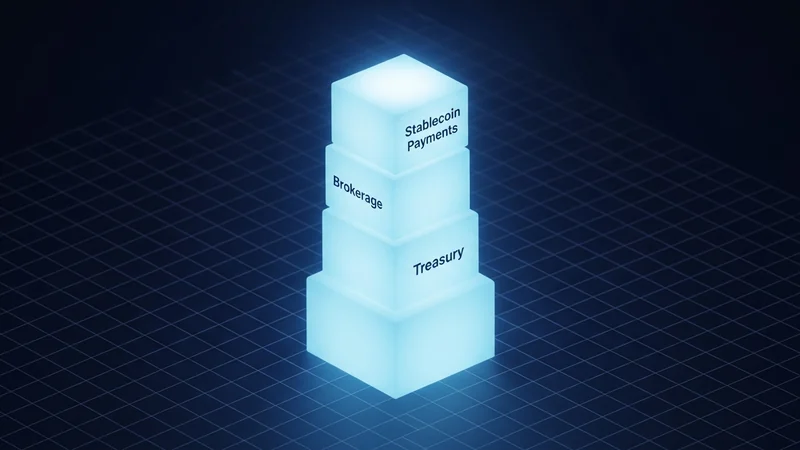
The strategic logic becomes clearer when you consider the three new businesses side by side. Prime brokerage, through Ripple Prime, handles trading, clearing, lending, and margin. Treasury management, through GTreasury, helps companies track cash, manage liquidity, and handle payments across accounts. Stablecoin payments, through Rail, provide rails for moving value in stablecoins quickly and at scale.
When one company controls brokerage, treasury, and stablecoin rails at the same time, an institutional client can theoretically trade, finance positions, manage corporate cash, and settle payments without leaving the platform. That reduces friction, the number of vendor relationships, and the operational overhead that often slows institutions down. It also means more of the value chain, and the fees attached to it, stays inside Ripple.
The Existing Foundation: Custody and Payments
These acquisitions did not arrive on a blank slate. Ripple already ran a custody business, which means securely holding digital assets on behalf of clients, and a payments business focused on moving value across borders. Custody and payments are foundational services that institutions need before they will commit serious capital to a platform.
Adding prime brokerage, treasury, and stablecoin payments on top of that foundation is what turns a collection of products into a stack. Each layer reinforces the others, and the existing custody and payments operations give the newer businesses a base of clients and infrastructure to build on.
A Fresh Debt Facility to Fuel Lending
The build-out continued into 2026. In May, Ripple Prime secured a $200 million debt facility from Neuberger Specialty Finance. The purpose was straightforward: to scale capacity for institutional lending and margin financing as client demand rose. In plain terms, a prime broker needs capital on hand to lend to clients and to back the leverage it extends, and a debt facility provides exactly that kind of fuel.
Securing outside financing specifically to expand lending capacity is a signal that the brokerage arm is being used, not just owned. It suggests demand from institutional clients is real enough to justify scaling up the balance sheet behind it.
Early Signs the Strategy Is Working
One of the clearest indicators so far comes from Ripple Prime itself. Since the Hidden Road acquisition, the unit has tripled its revenue year over year. That kind of growth in a newly integrated business suggests the prime brokerage piece is finding traction with the institutional clients it was built to serve.
Revenue growth alone does not tell the whole story, and the full picture across treasury and stablecoin payments will take longer to read. But for the centerpiece of the acquisition strategy, tripling revenue is a concrete data point rather than a projection. For market participants who want to keep an eye on how XRP itself trades while this corporate strategy plays out, traders can track XRP on DEXTools.
Bottom Line
With roughly $2.45 billion deployed across Hidden Road, GTreasury, and Rail, Ripple has stitched together prime brokerage, treasury management, and stablecoin payments, then bolted them onto its existing custody and payments operations. The framing the company is reaching for is institutional financial infrastructure rather than a payments company.
The next things worth watching are whether the $200 million debt facility translates into broader lending activity, whether revenue growth at Ripple Prime holds up, and whether the treasury and stablecoin arms show the same kind of traction. The architecture is now in place; the open question is how fully institutions choose to use it.