RWA Liquidity Quality: Why Tokenized Assets Can Be Real but Still Hard to Trade
— By Whatsertrade in Tutorials

Real-world assets are one of the most important narratives in crypto. Tokenized treasuries, commodities, real estate, private credit, stocks, bonds, and other r
Real-world assets are one of the most important narratives in crypto.
Tokenized treasuries, commodities, real estate, private credit, stocks, bonds, and other real-world assets aim to bring traditional financial value on-chain.
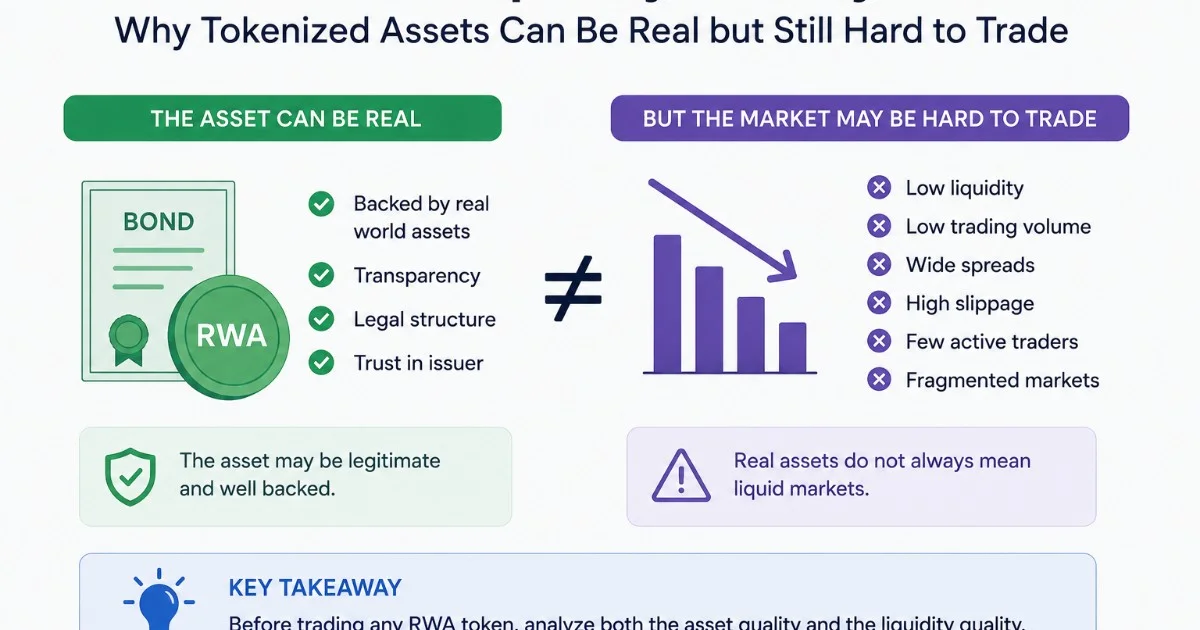
For many investors, this sounds powerful. If a token is backed by something real, it may feel safer than a purely speculative asset.
But traders need to understand one important point: a tokenized asset can be real and still be hard to trade.
This is where RWA liquidity quality matters.
What Is RWA Liquidity Quality?
RWA liquidity quality refers to how easily a tokenized real-world asset can be bought or sold without major price impact, delays, wide spreads, or execution problems.
A token may represent a real asset, but that does not guarantee strong secondary market liquidity.
For traders, the key question is not only "What backs this token?" The better question is "Can this token trade efficiently?"
Real Asset Does Not Always Mean Liquid Market
Many traders assume that if an asset is real, its token should be easy to trade.
That is not always true.
A tokenized asset may have strong backing but limited demand on DEX markets. It may also have restrictions, fragmented liquidity, low volume, or a small active buyer base.
For example, a tokenized treasury product may be backed by a reliable asset, but if very few traders are active in the pool, selling quickly may still be difficult.
The asset can be real while the market remains thin.
Why RWA Tokens Can Have Weak Liquidity
RWA liquidity can be weaker than expected for several reasons.
1. Limited Trader Base
Some RWA tokens attract investors rather than active traders. This can reduce daily volume and make the market less dynamic.
2. Regulatory or Access Restrictions
Some tokenized assets may have eligibility rules, transfer restrictions, or compliance requirements. These can limit who can buy or sell the token.
3. Fragmented Liquidity
Liquidity may be split across chains, DEXs, custodians, issuers, or private venues. This can make the visible DEX pool look incomplete.
4. Low Speculative Interest
Many RWA tokens are not designed for high volatility. This can reduce trader attention compared with memecoins, AI tokens, or other high-momentum narratives.
5. Weak Secondary Markets
Some tokenized assets are easier to mint or redeem than to trade actively on DEX markets. This can create gaps between asset value and market execution.
Why Liquidity Quality Matters More Than Narrative
A strong narrative can attract attention, but liquidity determines trade quality.
If a trader buys an RWA token with low usable liquidity, exiting may be harder than expected. Even if the token is backed by a real asset, the trader may still face slippage or poor execution.
This is especially important for larger positions.
A small trade may execute smoothly, while a larger trade may reveal that the market is much thinner than it looks.
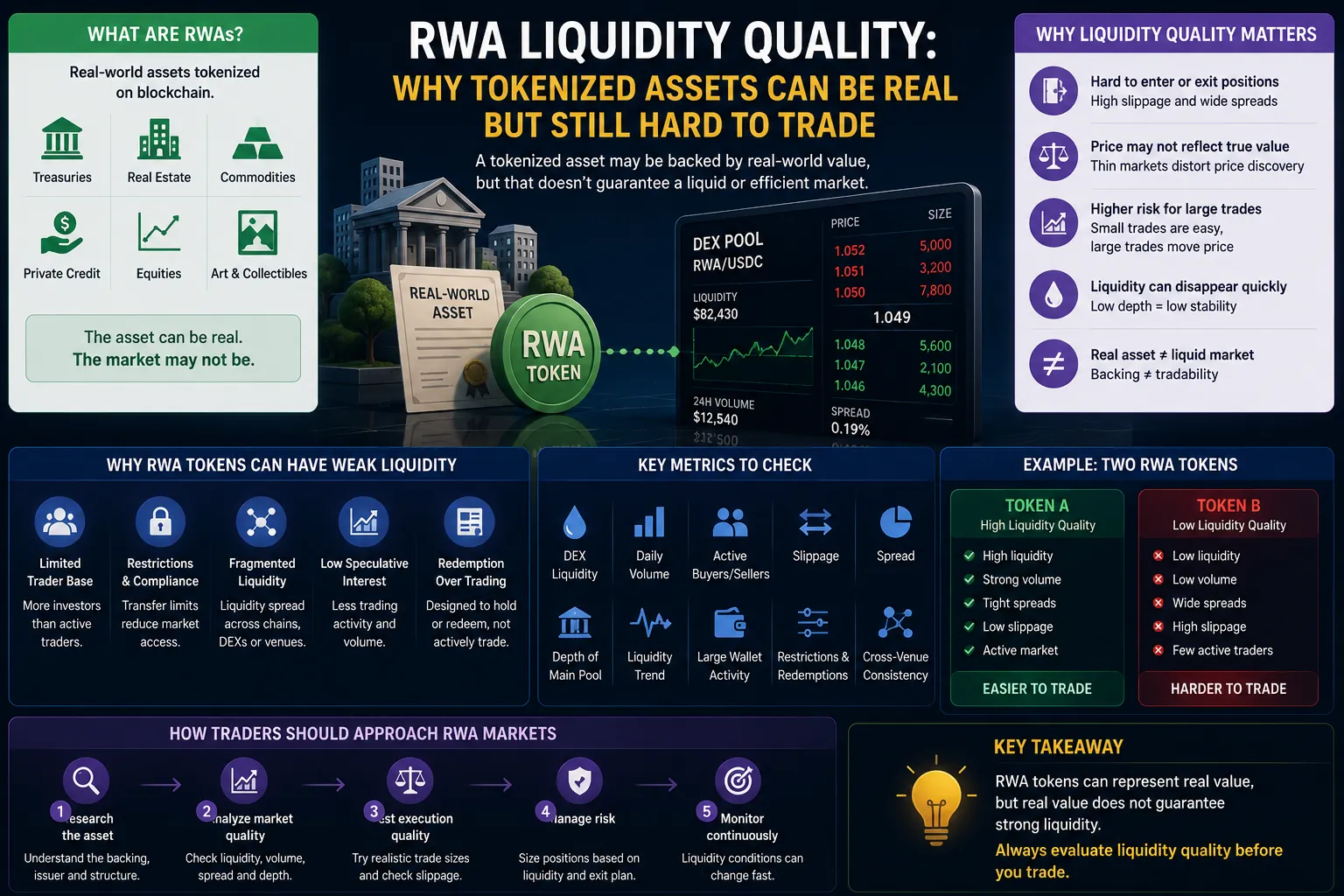
Key Metrics to Watch
When analyzing an RWA token, traders should review more than the asset story.
Important market signals include:
- DEX liquidity
- Daily volume
- Number of active buyers and sellers
- Slippage for realistic trade sizes
- Spread between pools
- Liquidity changes over time
- Large wallet activity
- Redemption or transfer restrictions
- Price consistency across venues
- Depth of the main trading pool
These metrics help separate a strong asset from a strong trading market.
RWA Tokens vs Regular Crypto Tokens
RWA tokens can behave differently from typical crypto tokens.
A memecoin may trade mostly on attention, momentum, and speculation. An RWA token may trade closer to yield, asset backing, redemption value, or institutional demand.
This can make RWA markets slower, less volatile, and sometimes less liquid.
That does not make them bad. It simply means traders should use a different analysis framework.
The question is not only "Can this token pump?" The question is "Does this market support clean execution?"
Signs of Poor RWA Liquidity Quality
Traders should be cautious when they see:
- High market cap but low DEX liquidity
- Large spreads between buy and sell prices
- Low daily trading volume
- Big price impact on small trades
- Few active wallets
- Liquidity concentrated in one weak pool
- Price gaps between venues
- Unclear redemption mechanics
- Low activity after initial launch
- Heavy dependence on incentives
These signs suggest that the token may be real but not easy to trade.
How Traders Can Approach RWA Markets
A better approach is to separate asset quality from market quality.
Asset quality asks:
- What backs the token?
- Who issues it?
- What rights does the token holder have?
- How transparent is the structure?
Market quality asks:
- Where does it trade?
- How deep is the liquidity?
- Can traders exit efficiently?
- Is there real volume?
- Is the main pool active?
Both matter.
Final Thoughts
RWA tokens can bring real value on-chain, but real value does not automatically create liquid markets.
For traders, liquidity quality is essential.
A tokenized asset may be legitimate, backed, and useful, while still being difficult to trade on a DEX. That difference can affect entries, exits, slippage, and risk management.
Before trading an RWA token, ask two questions: is the asset real, and is the market liquid enough?
Both answers matter.
How to Read On-Chain Data: Metrics, Wallet Flows and Dashboards (2026) What Is Chain Abstraction: The End of Bridging in Crypto (2026) Event-Driven Liquidity: How Airdrops, Listings and TGEs Create Temporary MarketsFrequently Asked Questions
What are Real World Assets (RWAs) in crypto?
Real World Assets in crypto refer to tangible or intangible assets from the traditional financial world, such as real estate, commodities, or intellectual property, that are tokenized and brought onto a blockchain.
Why are tokenized RWAs considered 'real'?
Tokenized RWAs are considered 'real' because they represent actual underlying assets with verifiable ownership and value in the physical world, even though their representation is digital.
What makes tokenized RWAs hard to trade?
Tokenized RWAs can be hard to trade due to factors like illiquidity in the underlying asset market, regulatory uncertainties, and the current nascent state of infrastructure for secondary trading on-chain.
How does liquidity quality affect RWA trading?
Liquidity quality directly impacts RWA trading by determining how easily and efficiently these tokenized assets can be bought or sold without significantly affecting their price. Low liquidity leads to higher price volatility and larger bid-ask spreads.
What is needed to improve RWA liquidity?
Improving RWA liquidity requires enhanced market infrastructure, clearer regulatory frameworks, increased institutional participation, and standardized tokenization practices to foster greater trust and accessibility.
Related Guides
- Tokenized Treasuries: Complete 2026 Guide to Onchain US T-Bills
- What Is Tokenization? How Real World Assets Become Onchain Claims (2026)
- What Are Real World Assets (RWA) in Crypto? Asset Types, Yield and Risks (2026)
- RWA Tokenization: A Beginner's Guide to Real-World Assets
- Top 5 Real World Asset (RWA) Tokens in 2026: Tokenized Finance Goes Mainstream
- Fake Market Cap vs Real Exit Liquidity
- BlackRock BUIDL for Institutions