Understanding Proof of Reserves in Crypto
— By Whatsertrade in Tutorials

Discover how proof of reserves impacts crypto transparency, what it verifies, and its limits concerning liabilities and financial health.
Proof of reserves is a hot topic in crypto transparency, especially following major exchange failures that left users questioning whether platforms genuinely held the assets they claimed. This transparency tool employs a methodology used by crypto exchanges, custodians, or lending platforms to demonstrate they hold specified digital assets on behalf of customers. It aims to boost trust, reduce uncertainty, and provide users with a clearer picture of whether a platform operates responsibly.
While it sounds straightforward, the truth is more complex. Proof of reserves can be a beneficial tool, but it's no magic bullet that guarantees safety. It offers part of the picture, but not the whole story. Therefore, for crypto users, knowing what proof of reserves can and cannot prove is crucial.
Key Takeaways
- Decoding Proof of Reserves in Crypto
- What Proof of Reserves Confirms and What It Doesn't
- Frequently Asked Questions
- Related Guides
Decoding Proof of Reserves in Crypto
Understanding the Concept
Proof of reserves serves as a transparency initiative to verify that a crypto entity holds enough on-chain assets to back customer balances, although this is only valid at a particular point in time. Essentially, the platform reveals wallet addresses or offers cryptographic evidence of reserve ownership, coupled with a means to confirm customer liabilities.
Key Components
Many proof of reserves systems feature two pivotal elements. First, they display the assets they manage on-chain. Second, they equip users with a cryptographic method to verify their account balance as part of the liability snapshot without divulging private user data.
This is frequently achieved using a Merkle tree, enabling the platform to demonstrate that customer balances were part of an aggregated dataset. Users can verify their inclusion in the total without accessing everyone else's balances.
In essence, proof of reserves seeks to answer the question: does the platform appear to hold sufficient crypto to meet what it owes users?
Operational Dynamics
The proof of reserves process typically kicks off with a snapshot. Platforms record customer balances at a specified time then pinpoint the wallets supposedly holding the corresponding assets. These wallet balances undergo on-chain scrutiny.
Tackling the liability side is usually more challenging. Customer balances need to be aggregated in a manner that maintains privacy while still enabling some form of verification. This is where cryptographic proofs come into play, allowing each user a way to validate the inclusion of their balance in the total liabilities.
When both facets are pieced together, the platform or an external auditor might publish a report indicating if the reserves meet or exceed the liabilities at the snapshot.
While this may sound reassuring, it's still subject to constraints.
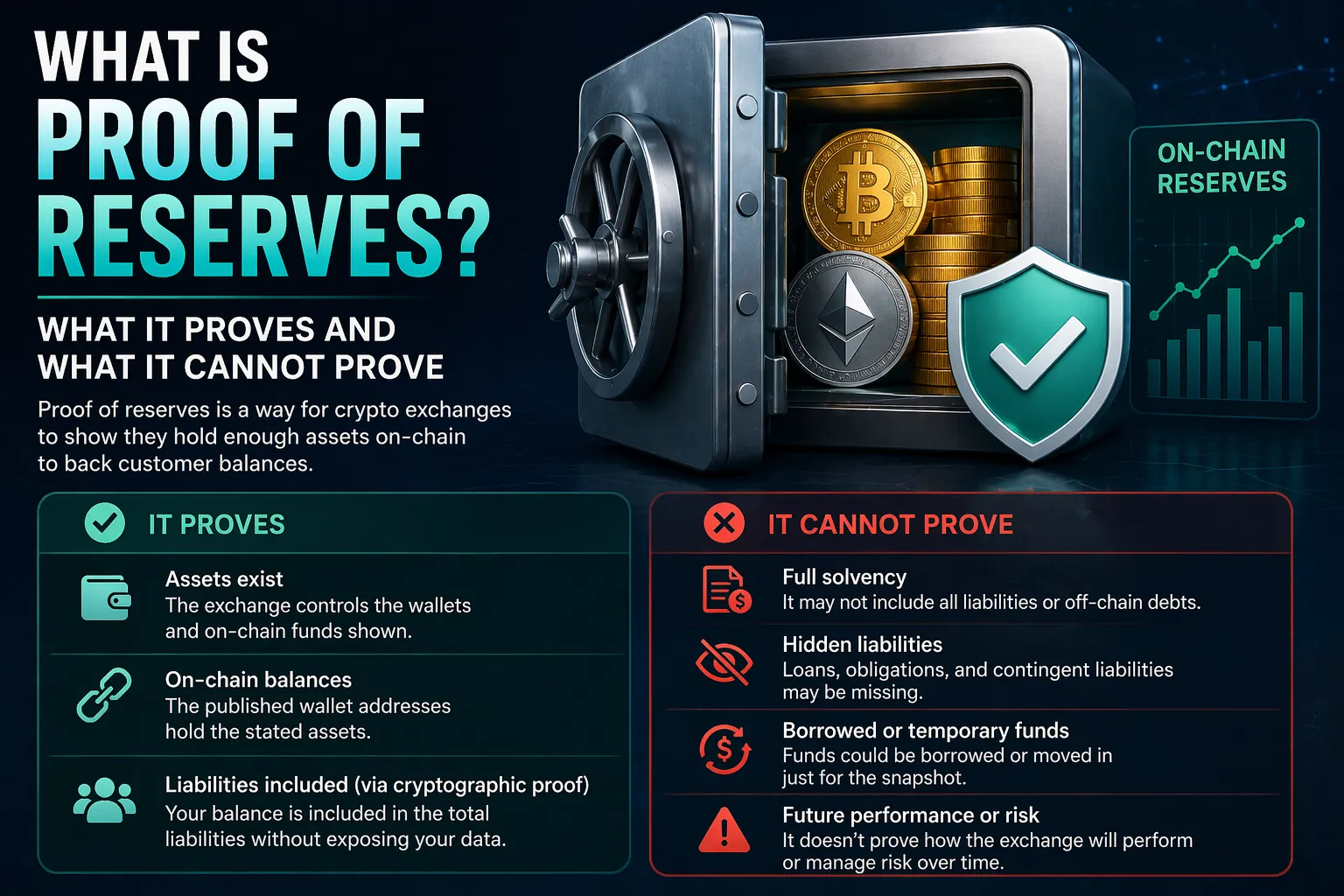
What Proof of Reserves Confirms and What It Doesn't
Potential Verifications
Proof of reserves can confirm that a platform controls specific wallets at a given time and that those wallets contain certain on-chain assets. This is significant as it provides indisputable evidence of reserves visible on a public blockchain.
It can also enhance user confidence by making exchanges and custodians more transparent. Instead of merely relying on internal assertions, proof of reserves offers something independently verifiable.
Additionally, it can ascertain whether assets align with customer balances within the snapshot. If executed correctly, it allows users to see whether the platform appears fully backed on the asset aspect.
For platforms aiming to demonstrate commitment and discipline, proof of reserves can serve as a transparency benchmark. It signals readiness to open parts of their records, letting users review the data rather than relying solely on brand reputation.
Limitations and Misperceptions
This is where misunderstandings often arise. Proof of reserves does not confirm a platform's complete solvency in every significant sense.
Firstly, proof of reserves might not expose all liabilities. Companies could have debts omitted from the customer snapshot, like obligations to lenders, investors, or other counterparties. If such commitments are absent, the reserve portrayal can seem rosier than the reality.
Secondly, proof of reserves doesn't always reveal if reserves are borrowed. A platform might transfer assets into wallets before the snapshot, passing the check, only to move them elsewhere later. This can present an inaccurate image of financial solidity if the reserves were temporary.
Thirdly, it doesn't reassure about internal controls, governance, or operational risks. A company may possess assets now yet still be poorly managed or vulnerable to hacks and risky decisions.
Fourthly, it doesn't ensure that assets are unencumbered. A platform may control funds, but some assets might already be pledged elsewhere.
Ultimately, proof of reserves doesn't guarantee that customer funds are safely managed over time. It often represents a snapshot rather than a live depiction of continuous financial health.
Evaluating the Importance
Despite its limitations, proof of reserves still holds significance. It's better than having no transparency whatsoever. In a market where trust can evaporate overnight, any credible system that enables users to inspect reserves is advantageous.
However, proof of reserves should be perceived as one of many tools, not a definitive judgment. Savvy crypto users should assess it as part of a broader checklist, continuing to question liabilities, risk management, custody practices, security, withdrawal tendencies, and sustainability of the business model.
A platform boasting proof of reserves may be more transparent, but it doesn't automatically ensure safety.
Methods for Truthful Evaluation
When assessing a proof of reserves report, focus on quality over mere headlines. A robust system should facilitate ease in verifying wallet balances on-chain and confirm that customer liabilities were incorporated in the snapshot.
Consider whether the report is periodic or a one-off occurrence. Regular disclosures are more reliable than a sole publication under pressure.
Also, seek out details. Does the platform clarify which assets are featured, how liabilities were computed, and whether any exclusions apply? The more ambiguity in the report, the less trust it merits.
Most notably, remember that proof of reserves is distinct from proof of solvency. Genuine solvency necessitates a full view of assets, liabilities, obligations, and risk exposure.
Proof of reserves is a critical step toward heightened transparency in crypto. It can affirm the existence of reserves, confirm certain wallet balances, and show that customer balances were part of a verification process. This is both valuable and meaningful.
Nevertheless, it falls short of telling the entire story. It doesn't fully prove solvency, disclose hidden liabilities, or assure sound management. Thus, the smartest approach is seeing proof of reserves as a helpful indicator, not a comprehensive safety certificate.
For anyone using exchanges or custodial platforms, the compelling lesson remains: transparency is vital, but context carries even more weight. In crypto, the chasm between a comforting snapshot and genuine financial health can be significant.
How to Bridge Crypto Between Chains: Complete Cross-Chain Tutorial 2026 How to Use 1inch: Complete DEX Aggregator Swap Tutorial (2026) How to Use OKX Web3 Wallet: Multi-Chain DeFi Hub Guide (2026)Frequently Asked Questions
What is 'proof' in cryptocurrency?
In cryptocurrency, 'proof' refers to a mechanism used to validate transactions and maintain the integrity of a blockchain. It ensures that data is accurate and that network participants adhere to established rules.
How does Proof of Reserves work?
Proof of Reserves (PoR) involves an independent audit to verify that a cryptocurrency exchange or custodian holds the digital assets they claim to have on behalf of their users. This typically uses cryptographic methods to prove ownership of specific wallet addresses.
Why is Proof of Reserves important for crypto exchanges?
PoR is crucial for transparency and user trust in crypto exchanges. It provides assurance that an exchange has sufficient assets to cover user deposits, mitigating risks of insolvency and potential 'runs on the bank'.
What is the difference between Proof of Reserves and Proof of Solvency?
Proof of Reserves specifically verifies the existence of assets held by an entity. Proof of Solvency, a broader concept, confirms that an entity's assets exceed its liabilities, demonstrating its overall financial health.
Are there limitations to Proof of Reserves?
While beneficial, PoR typically only shows assets, not liabilities, which means an exchange could still be insolvent even with verified reserves if its debts are too high. The audit's scope and independence are also critical factors.