The future of blockchain is modular. Our 2026 guide explains what Celestia (TIA) is, how it solves the data availability bottleneck, and why it's the foundation for thousands of new rollups.
What is Celestia (TIA)? Modular Data Availability Explained
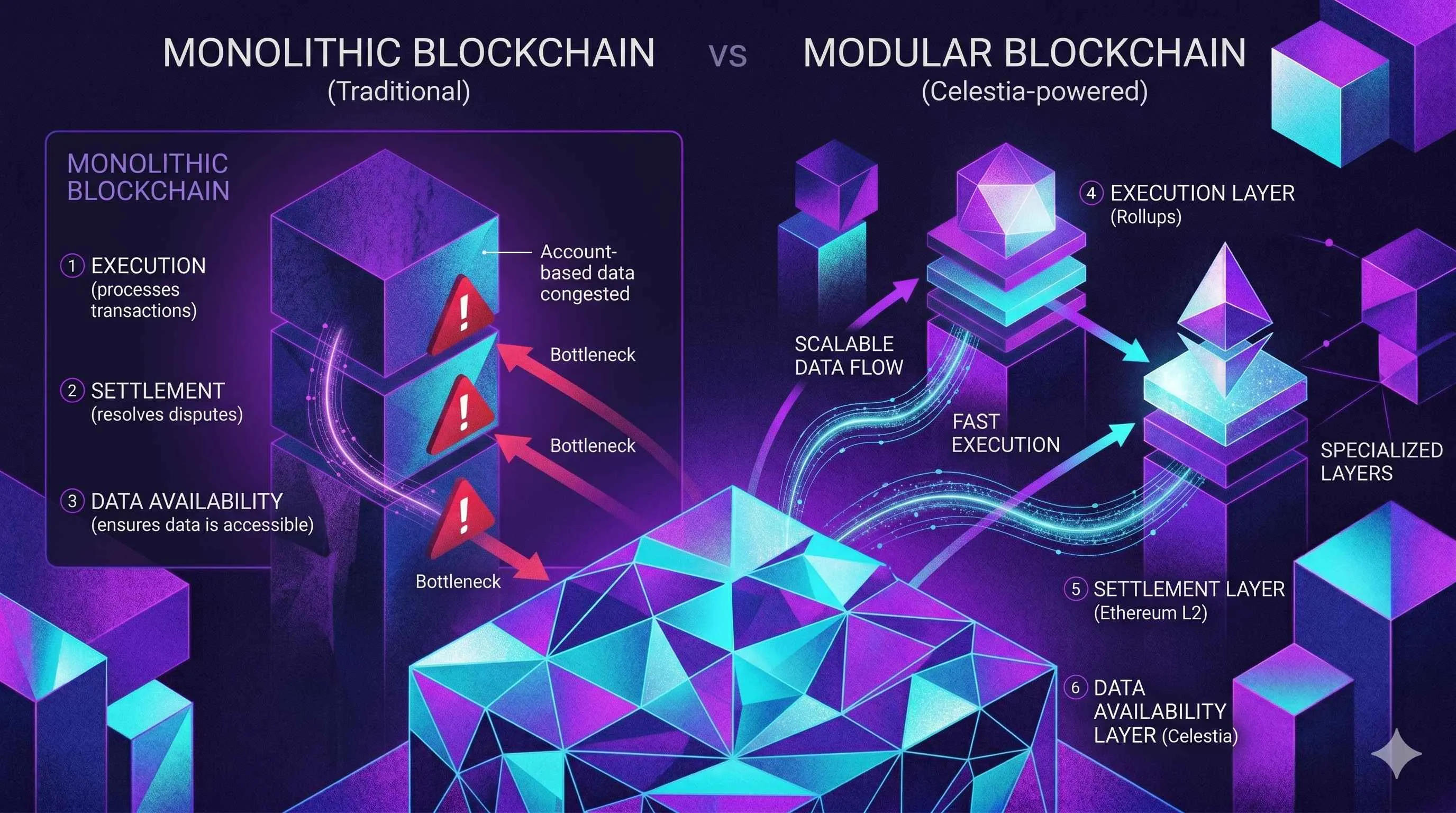
For years, blockchains like Bitcoin and Ethereum operated as "monoliths." In this traditional design, a single network is responsible for every single task: execution (processing transactions), settlement (resolving disputes and finality), and data availability (ensuring transaction data is accessible). However, as user demand surged, these all-in-one networks faced massive congestion and soaring fees. If you are asking what is Celestia (TIA), you are looking at the world's first modular blockchain network-a paradigm shift that breaks the "monolith" by specializing strictly in data availability.
For the DEXTools community, Celestia represents the "Lego-fication" of the industry, providing a foundational layer that allows developers to launch custom blockchains with unprecedented ease and low cost.
The Modular Shift: How Celestia Reinvents the Stack
To truly understand the network, we must first visualize the "Modular Stack." In a modular world, developers no longer need to build a massive, complex infrastructure from scratch. Instead, they can plug into specialized layers to handle different parts of the blockchain's operations.
The protocol focuses exclusively on the Data Availability (DA) layer. It does not execute smart contracts, and it does not manage user balances directly. Instead, its sole mission is to ensure that the data for any transaction is published and remains accessible to all network participants. By stripping away execution, the ecosystem can scale its throughput far beyond the hard limits of traditional, general-purpose chains.
Data Availability Sampling (DAS): The Technical Core
A frequent question when exploring what is Celestia (TIA) is how a network can handle massive amounts of data without becoming centralized. The answer lies in a breakthrough technology called Data Availability Sampling (DAS).
Typically, nodes must download the entire blockchain to verify its validity. This requires massive hardware. Celestia's DAS allows light nodes-which can run on a standard laptop or even a smartphone-to verify that data is available by only downloading tiny, random samples of each block.
Scalability through Participation: Unlike traditional chains where more nodes don't necessarily mean more speed, Celestia gets faster as more light nodes join.
The 1GB Milestone: In early 2026,the infrastructure successfully implemented 1GB blocks. This allows the network to support tens of thousands of parallel rollups simultaneously, maintaining sub-cent fees even during peak market activity.
TIA in 2026: The Backbone of Modular Finance
The TIA token is far more than just a speculative asset; it is the essential "fuel" for the modular era. Its utility has expanded significantly throughout 2025 and 2026 as the number of integrated rollups reached record highs:
Paying for Blobspace: Just as Ethereum users pay for gas, modular rollups pay the project in TIA to publish their transaction data. This is often referred to as purchasing "blobspace."
Security and Staking: Holders stake their assets to secure the network through a Proof of Stake (PoS) mechanism. In 2026,TIA staking has become one of the most popular activities in DeFi, as many new modular protocols utilize "staked-drop" models, rewarding TIA stakers with their own native tokens.
Network Governance: The community uses the token to vote on critical technical parameters, such as block size expansions and the long-term roadmap of the Blobstream protocol.
On DEXTools, monitoring the price action and volume of TIA provides a macro view of the entire rollup market. When you see high demand for TIA, it often signals a surge in activity across the hundreds of "AppChains" that rely on the protocol for security.
Blobstream: Connecting Celestia to Ethereum
By mid-2026,the protocol is no longer viewed as an Ethereum competitor, but rather as its most critical scaling partner. Through a technology called Blobstream, Celestia's high-throughput DA layer is now natively accessible to Ethereum-based Layer 2 solutions.
This integration allows a developer to maintain the high security of Ethereum for settlement while using Celestia for data storage. This hybrid approach has reduced transaction costs for end-users by over 95% compared to traditional L2s. When traders on DEXTools ask what is Celestia (TIA) today, the answer is often "the high-speed backplane of the modular internet."
Why Modularity Matters for the Future
The modular approach solves the "Blockchain Trilemma"-the struggle to achieve security, scalability, and decentralization all at once. By decoupling the layers, Celestia allows each layer to optimize for its specific task. This flexibility is what enabled the explosion of decentralized applications (dApps) we are seeing in 2026, ranging from high-frequency gaming chains to sovereign financial networks.
Conclusion
Understanding what is Celestia (TIA) requires a shift in perspective. It isn't just another blockchain; it is a specialized tool that makes every other blockchain better. By providing a scalable, secure, and neutral layer for data, the network has unlocked a future where launching a blockchain is as easy as deploying a website. As we progress through 2026, Celestia remains the bedrock of the modular revolution, making Web3 more affordable and accessible for everyone.
Disclaimer: This article is for informational purposes only and does not constitute investment advice, financial advice, trading advice, or any other kind of advice. DEXTools does not recommend buying, selling, or holding any cryptocurrency or token. Users should conduct their own research and consult with a qualified financial advisor before making any investment decisions. Cryptocurrency investments are volatile and high-risk. DEXTools is not responsible for any losses incurred.
Celestia is a modular blockchain network that focuses on data availability rather than executing all applications itself. TIA is its native token used for paying for data availability and securing the network.
What is data availability in blockchain?
Data availability means that the data behind transactions is published and accessible so anyone can verify the chain's state. It is essential for rollups and other chains to prove their transactions are valid.
What is a modular blockchain?
A modular blockchain separates core functions such as execution, consensus, and data availability into specialized layers instead of one chain doing everything. This design aims to improve scalability and flexibility.
How does Celestia help rollups?
Celestia provides a dedicated layer where rollups can publish their transaction data cheaply and verifiably. This lets new rollups launch without each one needing to build its own data availability solution from scratch.