What Is IoTeX (IOTX)? Modular DePIN Platform for IoT + AI Explained in 2026
— By Tony Rabbit in Tutorials
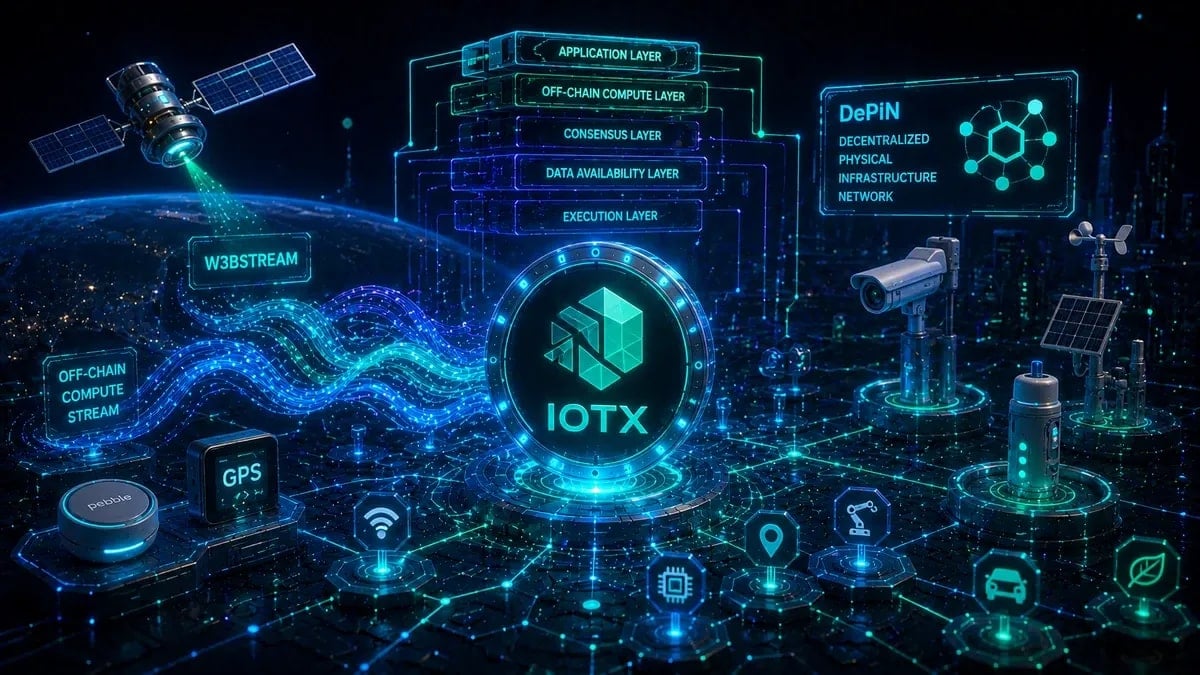
IoTeX (IOTX) is the modular Layer-1 blockchain purpose-built for decentralized physical infrastructure networks. This 2026 guide covers the IoTeX 2.0 upgrade, DePIN Infrastructure Modules (DIMs), the W3bstream off-chain compute layer, Pebble Tracker, Ucam, Quicksilver, IOTX tokenomics, and how IoTeX compares against Helium, Hivemapper, Render, Akash and IO.NET.
What Is IoTeX (IOTX)? Modular DePIN Platform for IoT + AI Explained in 2026
Decentralized physical infrastructure networks, or DePIN, became one of the most discussed verticals across the entire cryptocurrency landscape between 2023 and the first half of 2026. The pitch is simple to state and brutally hard to deliver: instead of building telecom towers, mapping fleets, GPU farms or sensor networks inside a single corporation, you let thousands of contributors deploy the hardware themselves, then reward them on-chain with tokens proportional to the useful work their devices perform. Among the projects that have been building toward that vision since long before the acronym existed, IoTeX is one of the very few whose stack, hardware lineage, and token design were engineered from day one for connected devices rather than retrofitted later.
IoTeX launched in 2017 with a specific bet: the next generation of blockchains would need to talk to the physical world, and the existing general-purpose Layer-1s were not designed for that workload. Internet of Things devices generate huge volumes of small, frequent, latency-sensitive data points. They need privacy guarantees that smart contract networks did not naturally provide. They run on constrained hardware that cannot store or validate a full chain. And they need an economic layer that can reward billions of micro-events without choking on gas. IoTeX set out to fill that gap by combining a high-performance EVM-compatible Layer-1 with bespoke off-chain compute, identity and oracle infrastructure aimed at IoT and DePIN workloads.
In 2024 the project announced IoTeX 2.0, a major architectural overhaul that turned the platform into an explicitly modular DePIN stack with a set of composable building blocks called DePIN Infrastructure Modules, or DIMs. That upgrade reframed IoTeX from a single Layer-1 trying to do everything into a configurable toolkit that other DePIN projects can plug into for hardware abstraction, connectivity, off-chain compute, storage and identity. By 2026, IoTeX has become one of the canonical references in the DePIN conversation and one of the few names that consistently appears alongside Helium, Render and Akash in category overviews. This guide breaks down the entire stack: what IoTeX actually is, how IoTeX 2.0 and the DIMs architecture work, what W3bstream and the hardware lineup do, how the IOTX token is used, and how the project compares with the rest of the DePIN field.
FEATURED SNIPPET
IoTeX (IOTX) is a modular Layer-1 blockchain purpose-built for decentralized physical infrastructure networks (DePIN) that connect Internet of Things devices to Web3. Launched in 2017 by Raullen Chai, Qevan Guo and Jing Sun, IoTeX combines an EVM-compatible chain with a set of DePIN Infrastructure Modules (DIMs) covering hardware abstraction, connectivity, off-chain compute through W3bstream, storage and real-world data oracles. The IOTX token pays for gas, secures the network through staking, drives governance, and serves as the native currency for DePIN reward programs across an ecosystem that includes Pebble Tracker, Ucam, the Quicksilver dashboard and many third-party device networks.
What Is IoTeX in Plain English
Think of IoTeX as a blockchain operating system designed specifically for projects that want to put real-world hardware on-chain. If you want to launch a network of weather sensors that gets paid each time someone consumes its data, a fleet of cameras that earns rewards for verifying physical locations, or a wireless network where individual hotspots are compensated for the coverage they provide, you can build it on a general-purpose Layer-1, but you will end up rebuilding the same set of primitives every single time: a way for devices to prove who they are, a way to batch and verify their data off-chain so you do not bury the chain in tiny events, a way to translate physical actions into token rewards, and a way for the network to upgrade as the hardware fleet grows.
IoTeX provides those primitives as ready-made modules. The chain itself is fast and cheap enough to serve as the settlement layer. The DePIN Infrastructure Modules sit on top of it, exposing standardized interfaces for the recurring problems every DePIN project has to solve. The W3bstream compute layer takes raw data streams from devices off-chain, runs verifiable logic over them, and only pushes finalized proofs onto the chain so it never gets clogged. Hardware products like Pebble Tracker show how a sensor with on-board cryptography can produce signed, tamper-evident readings that the chain can trust. The IOTX token glues everything together: it pays for gas, secures consensus, denominates rewards and serves as the unit of account for every DePIN-native action that happens inside the ecosystem.
To zoom out one more level: where Bitcoin made money programmable and Ethereum made contracts programmable, IoTeX is trying to make physical infrastructure programmable. For a wider treatment of why this matters, our guide to decentralized physical infrastructure networks walks through the entire DePIN category and the economic argument behind it. IoTeX sits inside that category as one of the few projects offering the underlying infrastructure for other DePIN projects, rather than a single end-user device network.
Founding Team and Origin Story
IoTeX was founded in 2017 by Raullen Chai, Qevan Guo and Jing Sun, a trio whose combined backgrounds neatly map onto the three big problems the project was set up to solve. Raullen Chai is a cryptographer and engineer with prior experience at Google, where he worked on security infrastructure, and at Uber, where he helped build systems that moved sensitive data at scale. Qevan Guo is a machine learning and computer vision researcher with a PhD background and prior work at Facebook focused on large-scale data systems. Jing Sun brings deep venture and operating experience in early-stage technology investing, with a long track record across blockchain and IoT companies. Together they made an unusually credible team for a project that needed cryptography, large-scale data engineering and ecosystem development from day one.
The mainnet launched in 2018 with consensus tuned for predictable finality, light clients suitable for edge hardware, and privacy primitives capable of keeping device telemetry confidential. The years that followed were spent shipping the supporting stack: a developer toolchain, the first hardware products, W3bstream, and the transition into a modular DePIN platform with IoTeX 2.0.
The team has also been actively involved in shaping the DePIN category as a concept. Members of the IoTeX ecosystem co-founded the DePIN Alliance, an industry working group that brings together projects, hardware vendors and investors. In an emerging vertical where common interfaces have not yet solidified, being one of the projects holding the pen matters more than narrative cycles alone.
IoTeX Timeline: From IoT Pioneer to Modular DePIN Stack
IoTeX 2.0: The Modular DePIN Platform Upgrade
IoTeX 2.0 is the single most consequential upgrade in the project's history. Before 2024, IoTeX was a Layer-1 chain with a strong IoT brand and a growing collection of supporting products. After IoTeX 2.0, the same code base is presented and architected as a modular DePIN platform: a stack of independent building blocks that other DePIN projects can adopt selectively, rather than a monolithic chain trying to do everything for everyone.
The shift mirrors a broader industry pattern. Just as Ethereum scaling went from a single congested chain to a constellation of rollups and data availability layers, the DePIN stack is splitting into modules that can be mixed and matched. With IoTeX 2.0, a new DePIN project can compose only the components it needs and inherit existing tooling for identity, compute and storage.
From a developer's point of view, IoTeX 2.0 cuts the cost of launching a DePIN project from "build everything yourself" to "compose a few modules and focus on hardware and economics." From an investor's point of view, it positions IOTX as a toll bridge for an entire category of physical infrastructure projects, not only the ones IoTeX itself ships in-house.

DePIN Infrastructure Modules (DIMs) Explained
DePIN Infrastructure Modules, or DIMs, are the core composable units inside IoTeX 2.0. Each DIM solves one well-defined recurring problem that virtually every DePIN project has to address, and each one is exposed through standard interfaces so that projects can adopt them independently and combine them in whatever shape their network needs. The IoTeX 2.0 architecture currently groups the DIMs into five logical buckets, each of which would be a multi-quarter engineering project for any team trying to build it from scratch.
Hardware Abstraction
Standard interfaces and SDKs for connecting any physical device, secure element or trusted execution environment to the chain with consistent identity and signing.
Connectivity
Modules that handle network access, message transport and integration with wireless protocols, so devices can deliver data into the system without each project rebuilding its own stack.
Off-Chain Compute
W3bstream and related modules run heavy data processing, aggregation and verification off-chain, producing succinct proofs that the chain can settle without storing every raw event.
Decentralized Storage
Storage modules anchor large or sensitive device data in distributed networks while keeping cryptographic commitments on IoTeX, useful for raw imagery, telemetry archives or compliance records.
Real-World Data Oracles
Oracle modules turn signed device data into structured on-chain feeds that smart contracts and DePIN reward formulas can consume directly, bridging the gap between sensors and contracts.
The deeper point is composability. A DePIN project that already has its own hardware fleet might only need IoTeX's identity, oracle and settlement layers. A new mobility project might want the full stack, from hardware abstraction through to reward distribution. A research-grade weather network might bolt W3bstream onto an existing chain only for verifiable off-chain compute. Because every module exposes a well-defined interface, none of these projects are forced into an all-or-nothing decision. That flexibility is the technical reason IoTeX has been able to position IOTX as a settlement asset for many networks at once, not only for the products IoTeX itself ships.
W3bstream: The Off-Chain Compute Layer
W3bstream is the heart of IoTeX's DePIN architecture and one of the components developers in the category talk about most. The problem it solves is fundamental: real-world devices generate orders of magnitude more events than any general-purpose blockchain can afford to store or process directly. A network of ten thousand environmental sensors reporting every minute would already produce more than half a billion data points per year. Posting each one to a Layer-1 is technically and economically impossible, and even on a cheap Layer-2 the noise-to-value ratio would be terrible.
W3bstream sits between the devices and the chain. Devices stream raw data into W3bstream nodes, which run custom logic defined by the DePIN project: filtering, aggregation, statistical analysis, anomaly detection, anti-Sybil checks, reward calculations and more. The output of that off-chain pipeline is not a flood of raw events but a compact summary, optionally accompanied by cryptographic proofs that the computation was performed correctly. Only that summary is posted on-chain, where it triggers settlement, reward distribution or oracle updates.
The result is that an arbitrarily large DePIN network can settle through IoTeX without overwhelming the chain. The cost of putting one more device online is dominated by hardware and connectivity, not by chain throughput. For projects that need real-time responsiveness, W3bstream can serve as a near-online layer for analytics and decisions, while the chain serves as the slower, authoritative record. That separation of concerns mirrors how modern rollup-centric Ethereum has split execution from settlement, but tuned for physical-world workloads instead of financial transactions.
W3bstream is also the natural home for AI integrations. Coordinating fleets of devices, scoring data quality or applying machine learning at the edge are the kind of compute-heavy workloads that do not belong on-chain. Running them inside W3bstream and committing only the conclusions to IoTeX lets DePIN projects layer AI on top of their networks without giving up the trust guarantees that brought them to a blockchain in the first place.
Pebble Tracker: The Reference IoT Device
Pebble Tracker is the reference hardware product that demonstrates what an IoT device built for IoTeX actually looks like. It is a compact multi-sensor device equipped with GPS, accelerometer, gyroscope, temperature, humidity and light sensors, all wrapped around a secure element that signs every reading with a private key the device itself never reveals. The combination of physical sensors and cryptographic identity means that whatever data leaves the device is provably attached to that specific hardware unit and cannot be plausibly forged by software alone.
That property is the foundation of trustworthy DePIN. If anyone can plug random numbers into a smart contract and call it sensor data, the rewards are easy to game and the network collapses into a Sybil attack. By rooting the signing key in hardware, Pebble Tracker makes it costly and physically traceable to fake readings. Developers building on top of Pebble or any similarly designed device can therefore write reward formulas with confidence that the inputs were produced by real sensors in the real world.

The use cases that Pebble Tracker has been deployed for include supply chain tracking, environmental monitoring, asset verification, fleet telemetry and proof-of-presence for distributed events. None of those use cases are unique to crypto, but the on-chain twist is what makes them new: contracts can pay automatically for verified data, refuse to pay for missing or malformed data, and let any party audit the device's complete reading history without trusting a single corporate operator. That is the DePIN promise made tangible in a single product, and Pebble Tracker has served as the blueprint that many third-party devices in the IoTeX ecosystem have copied.
Pebble Tracker is not the only device in the IoTeX lineup. Ucam, the private home security camera that pairs with the chain for end-to-end encrypted video, has been on the market for years. Beyond first-party hardware, the ecosystem includes a growing list of partner devices that follow the same design pattern: secure element, signing protocol, and an on-chain identity tied to an IoTeX address. The DIMs architecture is meant to make that pattern the default rather than the exception.
Quicksilver: The User-Facing Dashboard
Quicksilver is the dashboard that brings the IoTeX DePIN experience together for everyday users. Where the DIMs and W3bstream serve developers, and the hardware lineup serves device operators, Quicksilver is aimed at people who want a single place to manage their exposure to the IoTeX ecosystem and the broader DePIN economy that settles through it. The interface combines portfolio views, device management, staking tools, governance access and DePIN-specific dashboards that show rewards, network health and category-level metrics.
For users new to DePIN, Quicksilver also serves as an educational on-ramp. It surfaces explainers, recommended projects and step-by-step flows for participating in DePIN networks that use IoTeX rails, removing much of the friction that has historically kept the category niche. The strategic intent is clear: if Quicksilver becomes the default dashboard for DePIN participants, IOTX becomes the default settlement and gas asset they hold, and the entire ecosystem compounds usage in the way that consumer-facing products always compound. It is the same pattern that turned wallets into critical infrastructure for entire categories elsewhere in crypto.
Quicksilver is also positioned to integrate AI agents that can help users manage their DePIN exposure: rebalancing across staking pools, allocating across networks, or auto-claiming rewards. Those agents are exactly the kind of workload that benefits from running inside W3bstream's verifiable compute environment, which is one of the structural reasons IoTeX positions itself at the intersection of DePIN and AI.
IOTX Token Utility and Economic Design
The IOTX token is the economic backbone of everything described above. It is the native asset of the IoTeX chain, and its design intentionally bundles together every form of utility a DePIN-focused Layer-1 needs to function. Rather than splitting roles across multiple tokens, IoTeX uses IOTX as a single unit of account, which simplifies the user experience and reduces the surface area for governance and incentive complexity.
Gas is the most basic role. Every transaction on the IoTeX chain pays its gas in IOTX, just as every transaction on Ethereum pays its gas in ETH. Because the chain is intentionally cheap, the per-transaction cost is small, which is essential for an ecosystem where many transactions originate from devices or from automated reward distributions rather than from human users actively trading.
Staking secures the network. Validators and delegators stake IOTX to participate in consensus and earn rewards proportional to their stake and performance. For users who want a deeper conceptual introduction to staking before delegating IOTX, our explainer on how crypto staking works walks through the mechanics, the trade-offs and the risks that apply generically across networks and that IoTeX delegators should understand before sizing a position.
Governance gives token holders explicit influence over upgrades, parameters and treasury decisions. As the project leans into its modular DePIN identity, governance proposals increasingly cover not only chain-level mechanics but also the rollout of new DIMs, ecosystem grants for DePIN projects, and integrations with third-party hardware vendors. Token holders who participate in governance therefore shape the direction of the platform itself, not only the day-to-day economics.
Finally, and most distinctively, IOTX serves as the DePIN currency for many networks that settle through IoTeX. Rewards, registration fees, staking deposits for hardware operators and oracle data payments are all denominated in IOTX inside many ecosystem projects. That role makes IOTX something closer to a sectoral base asset than a generic gas token, similar in spirit to how some Layer-1 native assets have grown into the default unit of account for the applications that live on top of them.
Real-World Data Oracles and the AI Connection
Real-world data oracles are the glue between IoTeX's hardware and compute layers and the smart contracts that consume their output. A weather contract that pays farmers based on rainfall, a logistics contract that releases payment when a sealed container reaches a specified location, or an environmental compliance contract that triggers when an emissions sensor exceeds a threshold all need the same thing: a trustworthy stream of structured data, signed by hardware whose identity can be verified, processed off-chain in a way that can be audited, and finally posted in a form that smart contracts understand.
IoTeX is one of the few platforms designed around that complete pipeline rather than only the on-chain end of it. The oracle DIM exposes data feeds that are sourced from real devices, validated through W3bstream, and tied to specific cryptographic identities. The combination is what people in the category sometimes call proof of real world activity: the property that on-chain economic events cannot be triggered without a corresponding, verifiable physical event having occurred.
The connection to AI is increasingly important. Modern AI systems trained on synthetic or web-scraped data face a growing crisis of provenance: it is harder than ever to know which images, sensor readings or telemetry streams were actually captured in the physical world versus generated. DePIN networks that produce hardware-signed data, settled and indexed on a chain like IoTeX, offer a natural answer. They provide datasets whose origin is cryptographically attested, which is valuable both for training and for any AI agent that needs to make decisions about the real world.
That is why the IoTeX roadmap increasingly frames the project as a DePIN plus AI platform rather than only a DePIN platform. AI agents inside W3bstream can coordinate devices, score data quality, or interface with off-chain models. AI models elsewhere can consume IoTeX-anchored data with provenance guarantees no centralized API can match. The two narratives are not separate stories; on IoTeX they are explicit design goals of the same stack.
IoTeX vs Helium, Hivemapper, Render, Akash and IO.NET
DePIN as a category covers an unusually wide range of physical infrastructure: wireless coverage, mapping, GPU compute, cloud capacity, sensor data and more. IoTeX, given its modular platform identity, is best understood as a peer not only to single-network DePIN projects but also to other infrastructure layers that some of those projects could in theory adopt. The comparisons below frame how IoTeX relates to five of the most discussed DePIN names in 2026: Helium, Hivemapper, Render, Akash and IO.NET.

IoTeX vs Helium. Helium is the original DePIN poster child: a decentralized wireless network where hotspot operators are rewarded for providing coverage. Helium runs on its own Solana-based stack and is a single-network project focused on connectivity. IoTeX, in contrast, is a horizontal platform: a project building a similar wireless network could potentially run on IoTeX rails using its hardware and oracle DIMs. For deeper context, our guide to Helium Mobile and the Helium DePIN stack covers the connectivity story in full, and shows how a vertical DePIN project differs in scope from a platform like IoTeX.
IoTeX vs Hivemapper. Hivemapper is a decentralized street-level mapping network whose contributors run dashcams and earn HONEY tokens for the mapping data they collect. It is another vertical DePIN play, this time in geospatial data, with its own chain choices and its own hardware lineup. IoTeX overlaps in spirit because its DIMs would let a similar mapping project bootstrap with hardware abstraction, oracles and off-chain compute without rebuilding all of that infrastructure. Our standalone overview of Hivemapper and HONEY looks at how a single-category DePIN economy is structured in practice.
IoTeX vs Render and IO.NET. Render and IO.NET both focus on decentralized GPU compute, with Render historically emphasizing rendering workloads and IO.NET emphasizing general AI training and inference. They are compute-side DePIN: contributors plug in GPUs and earn tokens for the work they perform. IoTeX is data-side DePIN: contributors plug in sensors, cameras and devices, and earn tokens for the data they produce. The two layers are complementary rather than competitive. The IoTeX team has explicitly framed its W3bstream and DIMs stack as the natural settlement and identity layer for DePIN projects whose hardware is sensors rather than GPUs. Our breakdown of IO.NET and decentralized GPU networks dives into the compute side in detail.
IoTeX vs Akash. Akash is a decentralized cloud compute marketplace where providers offer servers and users rent capacity priced in AKT. Akash is in the same broad family as Render and IO.NET but extends beyond GPUs to general cloud compute. Again, the relationship with IoTeX is mostly complementary: an Akash-style cloud market could in principle source verified hardware telemetry from devices integrated through IoTeX, and IoTeX-anchored DePIN projects could in turn rent off-chain compute from Akash providers when they need it. Our deeper coverage of Akash Network and AKT walks through how that cloud marketplace works.
IoTeX vs Aethir and Grass. A few neighbouring DePIN names round out the picture. Aethir is another decentralized GPU cloud focused on gaming and AI inference, and Grass coordinates a network of bandwidth contributors whose unused connectivity is sold to AI training pipelines. Both could in principle interoperate with an IoTeX-anchored ecosystem for identity and oracles. Our guides to Aethir and ATH and Grass and decentralized bandwidth cover the vertical-DePIN pattern from two more angles.
Taken together, the picture is that IoTeX is most accurately described as a horizontal platform inside a category whose most visible projects are vertical networks. That positioning is exactly what makes IoTeX 2.0 strategically interesting: as the number of DePIN projects grows, the demand for shared infrastructure grows even faster, and a platform sitting under many of them captures usage that no single vertical can.
How to Participate in IoTeX: Users, Operators, Developers
There are three natural entry points into IoTeX, and which one fits depends on what you want out of the project. The first is participating as a user. The second is operating hardware that integrates with the ecosystem. The third is building DePIN projects on top of the platform itself. None of them require the other two, but each one becomes more valuable when combined with familiarity with the others.
Use the network as a token holder. The simplest entry is to hold IOTX, stake it through a validator and follow ecosystem activity through Quicksilver. This path exposes you to the economic outcomes of the platform without requiring you to deploy hardware or write code. Before doing this, it pays to study staking trade-offs in general, including unbonding periods and slashing risks, which our staking primer covers in depth and which apply to any IOTX delegation as well.
Operate hardware. Hardware operators run devices that produce data the ecosystem can consume. That could mean acquiring an IoTeX-compatible device, joining a third-party DePIN project that settles through IoTeX, or deploying sensors in a context where verified telemetry has value, such as supply chain pilots, environmental research or community projects. The economic upside here is usage-based and depends on which specific project you join, but the operational side is broadly common across DePIN: provisioning, monitoring uptime, claiming rewards on a schedule, and managing the resulting position.
Build a DePIN project on the DIMs stack. Developers can adopt IoTeX as their underlying infrastructure layer. The DIMs cover the most labor-intensive parts of the build, leaving the team free to focus on hardware design, market fit and tokenomics. The same flow can also extend an existing chain with IoTeX-style identity and oracle features without migrating the rest of the application.
Practice good operational security. Whichever path you take, the security discipline is the same: tight custody hygiene, never sign blindly, verify contract addresses through official IoTeX channels, and stay aware of the wider scam landscape. Address poisoning does not care which Layer-1 you are on; our explainer on how to avoid address poisoning scams applies directly to IOTX users as well.
Monitor liquidity and market structure. Keeping an eye on IOTX liquidity, listings, holder distribution and DEX activity is sensible discipline. Our walkthrough of the DEXTools toolkit covers how to read those signals across chains, and the same workflow applies to any DePIN project building on top of IoTeX.
Risks, Caveats and Open Questions
IoTeX is one of the more technically ambitious projects in DePIN, and ambition implies execution risk. The platform's modular vision is compelling on paper, but the long-term value of the DIMs stack depends on how many third-party DePIN projects actually adopt it and on how thoroughly the modules are battle-tested across diverse workloads. A modular architecture only pays off if it accumulates real users; otherwise it remains a sophisticated answer to a problem few projects choose to solve through IoTeX.
Hardware is harder than software. Shipping devices, supporting them in the field and keeping their firmware secure are non-trivial commitments that few crypto projects have done at scale. IoTeX has more experience than most thanks to Ucam and Pebble Tracker, but as the ecosystem expands to many third-party devices the surface area grows, and secure hardware design has to be maintained across vendors the foundation does not directly control.
Regulation is another structural variable. Real-world data networks intersect with privacy laws, sectoral rules on energy and telecoms, and emerging frameworks for AI training data. A platform whose explicit identity is to bridge physical infrastructure and crypto is more exposed to the regulatory frontier than a purely financial protocol would be. The team's track record of engaging with policy bodies is a partial mitigation, but anyone sizing exposure to IOTX should hold a realistic view of how the legal layer might evolve.
Finally, like every Layer-1 native asset, IOTX is exposed to market cycles and category rotation. A bad season for DePIN, an exploit on a high-profile partner, or an underwhelming roadmap delivery can compress sentiment even when the underlying technology is on track. None of those events would be unique to IoTeX, but they are part of the honest risk picture.
IoTeX FAQ
1. What is IoTeX in one sentence?
IoTeX is a modular Layer-1 blockchain built specifically for decentralized physical infrastructure networks, combining an EVM-compatible chain with composable DePIN Infrastructure Modules for hardware abstraction, connectivity, off-chain compute, storage and real-world data oracles.
2. What is IoTeX 2.0?
IoTeX 2.0 is the major 2024 upgrade that reframed IoTeX as a fully modular DePIN platform organized around DePIN Infrastructure Modules (DIMs). Where the previous architecture treated IoTeX as a single Layer-1 trying to do everything, IoTeX 2.0 exposes the stack as a configurable set of building blocks that other DePIN projects can adopt selectively.
3. What are DePIN Infrastructure Modules (DIMs)?
DIMs are the composable building blocks of IoTeX 2.0. They cover hardware abstraction, connectivity, off-chain compute via W3bstream, decentralized storage, and real-world data oracles. Each module exposes a standard interface so DePIN projects can adopt one, several or all of them according to their needs.
4. What is W3bstream?
W3bstream is IoTeX's off-chain compute layer. It ingests raw data streams from devices, runs custom logic over them off-chain, and emits cryptographic proofs and compact summaries that the chain can settle. It is what makes high-frequency DePIN workloads economically viable on IoTeX without overwhelming the Layer-1 with raw event data.
5. What is the IOTX token used for?
IOTX pays for gas on the IoTeX chain, secures the network through staking, drives governance votes, and serves as the native DePIN currency for rewards, registration fees and oracle payments across many ecosystem projects. It is a single unit of account for the entire stack rather than one of several role-specific tokens.
6. Who founded IoTeX?
IoTeX was founded in 2017 by Raullen Chai, Qevan Guo and Jing Sun. Chai is a cryptographer with experience at Google and Uber, Guo is a machine learning and computer vision researcher with prior work at Facebook, and Sun brings early-stage venture and operating experience across blockchain and IoT companies.
7. What is Pebble Tracker?
Pebble Tracker is IoTeX's reference IoT device. It combines GPS, accelerometer, gyroscope, temperature, humidity and light sensors with a secure element that signs every reading. The hardware-rooted signatures make device data tamper-evident and provide the foundation for trustworthy DePIN reward formulas that depend on real-world inputs.
8. What is the Quicksilver dashboard?
Quicksilver is the user-facing dashboard for IoTeX. It unifies portfolio views, device management, staking, governance and DePIN-specific dashboards across the ecosystem, and is increasingly being integrated with AI agents that can help users manage their DePIN exposure autonomously.
9. How is IoTeX different from Helium, Hivemapper, Render and IO.NET?
Helium, Hivemapper, Render and IO.NET are vertical DePIN networks focused on a single category each: wireless coverage, mapping, rendering and AI compute respectively. IoTeX is a horizontal platform whose DIMs and W3bstream could serve as shared infrastructure for many vertical networks. The two layers are complementary rather than competitive.
10. Is IoTeX an AI project or a DePIN project?
Both. The platform's primary identity is DePIN infrastructure, but the same architecture is naturally suited to AI workloads: W3bstream can host AI agents and inference, and IoTeX-anchored data carries hardware-rooted provenance that AI systems can rely on for training and decision making. The roadmap explicitly frames the project as a DePIN plus AI platform.
11. What are the main risks of using or holding IOTX?
Key risks include execution risk on the modular DIMs roadmap, the difficulty of shipping and supporting hardware at scale, evolving regulation around IoT data and AI, the security surface of third-party partner devices, and broader market cycles that can compress sentiment in the DePIN category regardless of underlying progress. None are unique to IoTeX, but all should be sized into any allocation.
12. Where can I buy and stake IOTX?
IOTX is listed on major centralized exchanges and on decentralized exchanges across chains where it is bridged. Staking is performed natively by delegating to a validator through Quicksilver or compatible wallets. Always verify official contract addresses through IoTeX's own documentation before interacting with any pool, and confirm liquidity on monitoring tools like DEXTools before sizing a position.
Closing Thoughts: IoTeX in the 2026 DePIN Stack
Among the projects competing inside DePIN, IoTeX occupies a position that is unusually structural. Most of the headlines belong to vertical networks like Helium, Hivemapper, Render, Akash and IO.NET, each of which owns a specific category and a specific reward economy. IoTeX, instead, is the horizontal infrastructure underneath much of that activity: a chain whose modules, off-chain compute and identity primitives are designed to be reused by many DePIN projects rather than locked inside a single product. That choice is what makes the project conceptually different from most of its peers, and it is also what makes the long-term value of IOTX harder to summarize in a single chart.
For users, holding IOTX comes with a defensible reason beyond speculation: real device networks, real reward flows, and third-party projects that settle through the chain. For developers, the DIMs and W3bstream represent a serious head start on the engineering work every DePIN project has to do. For investors, IOTX is one of a small handful of Layer-1 assets whose narrative is anchored in physical-world activity rather than pure DeFi or AI hype.
None of this guarantees success. Modular platforms are difficult, hardware is unforgiving, and the next wave of regulation around AI training data and connected devices will continue to reshape the economics of every DePIN project. But anyone seriously studying the intersection of crypto, AI and physical infrastructure in 2026 has to include IoTeX in the conversation, ideally next to Helium, Hivemapper, Render, Akash and IO.NET. The next chapter of DePIN will almost certainly be written with IoTeX as one of the load-bearing layers underneath it.
This article is educational content, not financial advice. Always do your own research, verify contract addresses through official sources, and size any position to your personal risk tolerance. Cryptocurrency assets, DePIN networks and AI platforms are all subject to rapid change and meaningful downside risk.
Related Guides
- DePIN Tokens Compared: Helium, IoTeX, Render and More 2026
- What Is a Modular Blockchain: Celestia and the New Stack (2026)
- What Is Data Availability (DA): Complete Modular Blockchain Guide (2026)
- What Is Propy (PRO)? The Blockchain Real Estate Transaction Platform Explained in 2026
- What Is IOTA: Tangle DAG Crypto Complete Guide (2026)