What Is Karak Network? Universal Restaking Guide 2026
— By Tony Rabbit in Tutorials
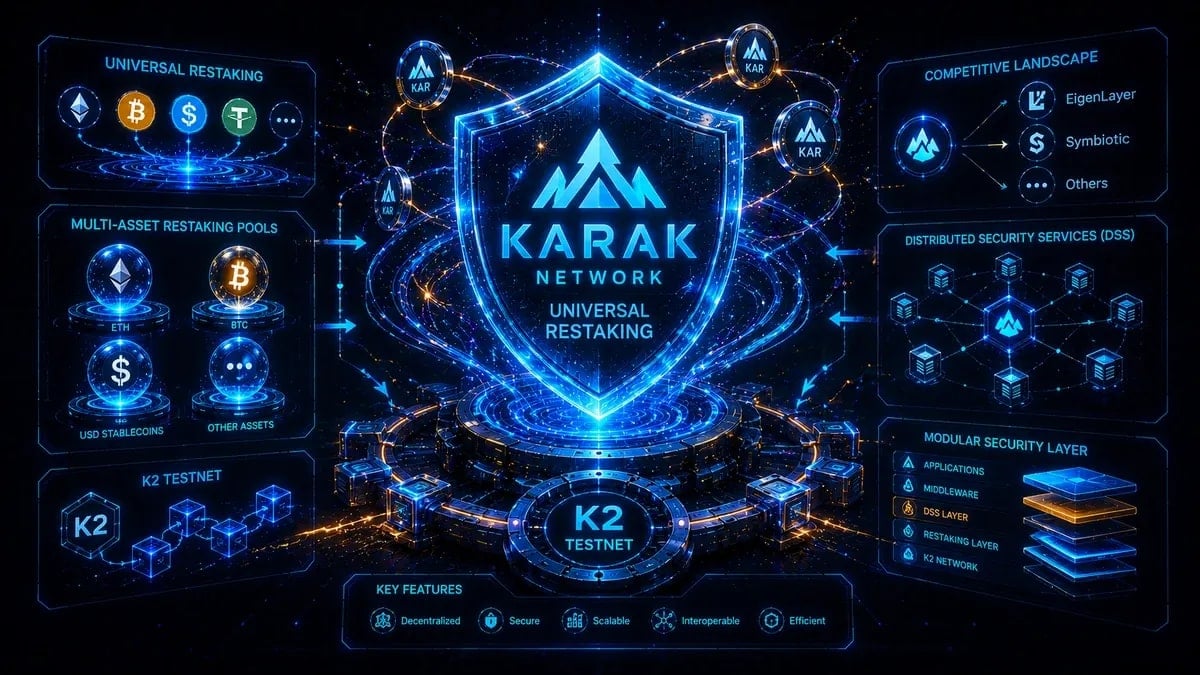
Karak Network universal restaking explained: deposit ETH, BTC, stables or RWAs, secure DSS, earn $K airdrop XP. Karak vs EigenLayer, K2 chain, risks.
If liquid staking was the defining DeFi primitive of 2023 and EigenLayer-style restaking dominated 2024, then 2026 belongs to universal restaking. And in that conversation, one protocol keeps surfacing: Karak Network. Launched in early 2024 by a team that includes Drew Patel and former Andre Cronje collaborators from the Fantom ecosystem, Karak has quietly built one of the deepest restaking stacks in crypto, surpassing $1 billion in total value locked and now anchoring its own Layer-2 chain called Karak K2.
While EigenLayer pioneered restaking by letting Ethereum stakers reuse staked ETH to secure additional services, Karak generalised the idea. Instead of being limited to ETH and liquid restaking tokens (LRTs), Karak accepts stablecoins, Bitcoin tokens, real-world asset tokens, and assets across multiple chains. Restakers can secure Distributed Secure Services (DSS) such as oracles, bridges, MEV networks, and even AI compute attestations, earning rewards while keeping their underlying capital productive.
This guide unpacks what Karak Network actually is, how universal restaking works, how it compares with EigenLayer, Symbiotic, and Babylon, and how to deposit assets, accumulate Karak XP, and opt into specific DSS. You will also get a practical view of the Karak K2 chain, the upcoming $K token economics, and the risks restakers face. By the end you will know whether Karak fits your portfolio and how to use it safely in 2026.
What Is Karak Network?
Karak Network is a universal restaking layer that lets holders of a wide range of crypto assets reuse those assets as economic security for new protocols called Distributed Secure Services. Rather than being tied to a single base asset like ETH, Karak supports ETH, liquid staking tokens, liquid restaking tokens, stablecoins, BTC tokens, and tokenised real-world assets, all aggregated across Ethereum, Arbitrum, Mantle, BNB Chain, and the Karak K2 Layer-2. The goal is to make economic security a portable, multi-chain commodity.
In simple terms, you deposit assets into Karak, those assets back one or more DSS, and you earn rewards from the DSS operators in exchange for accepting the risk of slashing if validators misbehave. Karak takes the modular thesis of EigenLayer and stretches it across every major crypto asset class, which is why it markets itself as universal rather than just Ethereum-native.
The Story Behind Karak: Founders and Origins
Karak Network was founded by Drew Patel and Andrew Saunders, two engineers with deep DeFi pedigree. Both worked alongside Andre Cronje in the Fantom Foundation orbit, contributing to early experiments in cross-chain liquidity and yield infrastructure. After Cronje's high-profile exit from DeFi in 2022, the team regrouped around a new thesis: economic security was becoming the most valuable resource in crypto, and the existing models were too narrow.
The protocol was built by Andalusia Labs, the same team behind Subsea (a smart contract insurance platform) and Watchtower (an on-chain security monitor). That security-first DNA shows up everywhere in Karak's design, from its conservative slashing module to the deeply audited K2 bridge. Karak went live in early 2024 with a multi-asset deposit vault and crossed $1 billion in TVL within weeks, riding the wave of restaking interest that EigenLayer had created the previous year.
By mid-2025 Karak supported more than two dozen assets and announced Karak K2, a Layer-2 chain secured by Karak restaked capital. That recursive structure is one of the most distinctive bets in modular blockchain design today.
How Universal Restaking Works
To understand Karak, you need a working mental model of restaking itself. Traditional staking on Ethereum works like this: validators lock 32 ETH, run consensus software, earn rewards, and risk slashing if they violate protocol rules. Ethereum consensus is secured by roughly $100 billion of staked ETH at current prices. That security is enormous, but it only secures Ethereum itself.
Restaking asks a simple question: what if that same staked capital could simultaneously secure other systems, like an oracle, a bridge, or a sidechain? The staker accepts additional slashing conditions in exchange for additional rewards. EigenLayer pioneered this by letting stETH and native ETH back what it calls Actively Validated Services. Karak generalises it: any approved asset can back any approved DSS, across any approved chain.
The core technical building blocks inside Karak are vaults, operators, and DSS. A Vault is a smart contract that holds your deposited asset and tracks share ownership. Each supported asset has its own vault. Operators are entities that run the actual validator software for one or more DSS. DSS are the services consuming security. When you delegate your vault shares to an operator, that operator can opt into any DSS the asset is approved for.
Slashing in Karak is modular. Each DSS defines its own slashing logic via a custom slasher contract that the protocol reviews and whitelists. If a DSS detects misbehaviour (a fraudulent oracle update, a double-signed bridge message, an invalid attestation), it can call the slasher and burn or redirect a portion of the operator's delegated stake. That penalty flows back to the restaker, which is why operator selection matters.
Distributed Secure Services (DSS) Explained
The DSS is the user of restaked security. In EigenLayer they are called Actively Validated Services, in Symbiotic they are called Networks, and in Karak they are DSS, but the concept is the same: any system that needs decentralised attestations, validation, or computation can rent security from the restaking marketplace instead of bootstrapping its own validator set.
This is a huge unlock. Before restaking, every new sidechain or oracle had to convince hundreds of validators to stake its native token from day one, which meant high inflation, token dumps, and weak security. With DSS, a new protocol can launch with hundreds of millions in economic security from day one by tapping into Karak's existing vault depth.
Real DSS Categories on Karak
Karak's DSS roster spans several distinct categories, each with its own risk and reward profile.
Price feed networks that need slashable attestations. Pull oracles and prediction market resolvers are early DSS candidates.
Cross-chain message validators that previously relied on multisigs. Karak gives them billions in slashable security per bridge route.
New rollups and appchains use Karak operators to run sequencers, fraud provers, or DA layers. Karak K2 is the flagship example.
Block-builder marketplaces and order-flow auctions that need slashable commitments from block proposers to prevent toxic MEV.
Compute marketplaces that need verifiable proofs that a GPU node actually ran an inference. Karak operators stake on the truthfulness.
Alt-DA layers that store rollup data off Ethereum need committee security. Karak provides slashable economic guarantees.
Each DSS sets its own commission, slashing parameters, and supported assets. Some DSS only want ETH-denominated security. Others (especially RWA settlement networks) want stablecoin collateral. Some BTC-bridge DSS only accept WBTC, tBTC, or wrapped BTC variants. This asset segmentation is exactly why universal restaking matters: the right collateral for the right service.
Karak vs EigenLayer: The Asset Breadth Story
EigenLayer is the obvious comparison, and the most important difference between the two is asset breadth. EigenLayer is fundamentally an ETH-centric protocol. It supports native staked ETH and a curated list of liquid staking tokens like stETH, cbETH, and rETH, plus a slowly expanding list of LRTs. The thesis is that ETH is the strongest economic security asset and that AVS should be paid in ETH-denominated terms.
Karak takes the opposite stance. By accepting stablecoins, BTC tokens, mETH, weETH, ezETH, USDC, USDT, and RWAs, it argues that different services need different security profiles. A stablecoin-settlement bridge between two L2s might prefer USDC-backed security because the asset matches the unit of account. A Bitcoin DeFi protocol benefits from WBTC-backed security because that aligns with user holdings. An institutional RWA platform might want tokenised treasuries as collateral because of regulatory matching.
Comparison Table: Karak vs EigenLayer vs Symbiotic vs Babylon
Symbiotic is the closest competitor in design philosophy. Like Karak, it is asset-agnostic and lets any ERC-20 collateralise networks. The main differences are that Symbiotic remains Ethereum-only, has no native L2, and gives more authority to networks to define their own collateral rules. Babylon is a different beast entirely: it secures protocols using native Bitcoin via timestamping rather than wrapped BTC tokens. We will return to that contrast later because BTC restaking on Karak versus Babylon is one of the most interesting strategic debates in crypto right now.
Supported Assets on Karak
The list of supported deposit assets is what makes Karak feel different the first time you connect a wallet. Most LST and LRT users expect to see ETH variants. Karak adds stablecoins, wrapped Bitcoin, restaked Bitcoin, and exotic LRTs from multiple chains. As of mid-2026 the active vaults include:
- Liquid staked ETH: stETH, rETH, cbETH, sfrxETH, ankrETH
- Liquid restaked ETH: weETH (ether.fi), ezETH (Renzo), rsETH (Kelp), pufETH (Puffer)
- Native ETH and WETH: direct ETH and wrapped ETH deposits
- Mantle LSTs: mETH, cmETH for Mantle ecosystem alignment
- Stablecoins: USDT, USDC, sDAI, USDe, sUSDe
- Bitcoin tokens: WBTC, tBTC, FBTC, M-BTC, Solv BTC, LBTC (Lombard)
- RWA tokens: select tokenised treasuries from Ondo and partners under RWA frameworks
Each vault has its own deposit cap, withdrawal queue, and approved DSS list. The protocol enforces these limits to prevent runaway concentration in a single asset or service. You can see the live caps and utilisation in the Karak dashboard, and they update as new DSS launch.
Karak K2: The Layer-2 Secured by Karak
Karak K2 is the protocol's most ambitious bet. It is a Layer-2 chain whose sequencer set, fraud-proof system, and bridge are all DSS that consume security from the Karak restaking pool. Instead of bootstrapping a brand new validator economy from scratch, K2 inherits security from the assets already deposited across Karak's universal vaults.
The architectural elegance is that K2 turns Karak from a passive marketplace into an active service consumer. Every transaction on K2 generates fees that flow to operators and restakers. Every withdrawal between K2 and Ethereum or Arbitrum is gated by Karak operators staking ETH and stablecoins. The chain becomes the largest single DSS by usage on the platform, which justifies the deep liquidity sitting in the vaults.
What Makes K2 Different From Other L2s
Most L2s either run a single centralised sequencer (Arbitrum, Optimism today) or use their own native staking token to secure decentralised consensus. K2 takes a third path: borrow security from a marketplace. The benefit is that K2 launches with billions in slashable collateral on day one without diluting any K2-specific token. The risk is that this introduces cross-chain dependencies and a slightly more complex trust model that has to prove itself under stress.
K2 is EVM-compatible, supports standard Solidity contracts, and integrates with the broader Karak DSS ecosystem natively. Gas fees on K2 are denominated in ETH bridged from Ethereum, with the option to use Karak-issued vault shares in some advanced flows. The chain has its own block explorer, its own RPC endpoints, and standard wallet integrations through MetaMask and Rabby.
Step-by-Step: How to Deposit on Karak and Earn XP
Getting started with Karak is straightforward, but doing it safely requires understanding what you are signing. Here is the full flow for a first-time depositor in 2026.
Step 1: Choose Your Chain and Asset
Karak deposits live on Ethereum, Arbitrum, Mantle, BNB Chain, and Karak K2. The vault for each asset is deployed on the chain that makes sense for it (for example, mETH lives on Mantle, BNB-side stablecoins on BNB Chain, the largest LRTs on Ethereum). Pick the asset you already hold and verify which chain the corresponding vault sits on before bridging. Bridging costs gas, and bridging the wrong way wastes fees.
Step 2: Connect Wallet and Approve
Visit karak.network, click Restake, connect MetaMask or any compatible wallet, and choose the asset. The first transaction is an ERC-20 approval where you authorise the vault contract to move your tokens. Use the Permit2 pattern if your wallet supports it to limit exposure and avoid leaving open approvals.
Step 3: Deposit and Receive Vault Shares
The second transaction is the deposit itself. The vault mints you ERC-20 shares (for example, kstETH for staked ETH deposits) representing your pro-rata claim. These shares accrue any underlying yield from the deposited asset automatically. Holding kstETH still gives you the stETH staking yield underneath.
Step 4: Accumulate Karak XP
From the moment you deposit, your wallet starts accruing Karak XP. XP is calculated based on the dollar value of your deposit, the type of asset (some assets earn boosted multipliers), and time held. XP is the protocol's pre-token loyalty metric and is widely expected to convert into a $K airdrop when the token launches. You can check your XP balance on the dashboard and on third-party trackers.
Step 5: Delegate to an Operator (Optional)
To turn your vault shares into productive restaked capital, you delegate them to an operator. Operators are listed on the Karak dashboard with their performance history, supported DSS, commission, and slashing history. Pick one with a strong reputation, geographic decentralisation, and a track record of running validator infrastructure elsewhere. You can split your delegation across multiple operators.
Step 6: Opt In to Specific DSS
Once delegated, you can opt your stake into specific DSS through the operator. Each opt-in adds reward streams from that DSS and adds the corresponding slashing conditions. Read the DSS terms carefully. Some DSS only require lightweight attestations and have minimal slashing risk. Others run consensus duties with aggressive penalties. The right mix depends on your risk tolerance.
Karak XP and the $K Token
The Karak XP program is one of the largest active points campaigns in crypto. Tens of thousands of wallets have accumulated XP since launch, and total XP outstanding is in the trillions. When Karak announced its $K token, the XP-to-$K conversion rate became the most important variable for early restakers.
$K tokenomics, as outlined in the project's documentation and reinforced through 2025 and 2026 communications, look roughly like this:
- ● Community and airdrop (XP holders): ~30-35%
- ● Ecosystem incentives and DSS rewards: ~25%
- ● Core team and contributors (vested): ~20%
- ● Investors (vested): ~15%
- ● Treasury and foundation: ~5-10%
$K utility includes governance over the protocol, fee discounts on DSS opt-ins, boosted rewards for stakers who lock $K alongside their vault shares, and use as a payment asset between DSS operators and consumers. The token is expected to be the canonical gas asset on Karak K2 over time, although ETH will likely remain the primary gas medium during the transition phase.
BTC Restaking on Karak vs Babylon
One of the most interesting strategic differences in modern restaking is how Karak and Babylon treat Bitcoin. Both want to make BTC a productive security asset, but their approaches are mechanically opposite.
Babylon stakes native BTC by locking it on the Bitcoin chain using time-locked scripts. Slashing is enforced through cryptographic proofs that the locked BTC can be burned if the staker double-signs a transaction in a Babylon-secured network. The benefit is that the BTC never leaves Bitcoin, which appeals to maximalists. The drawback is that the slashing UX is limited by what Bitcoin Script can express, and integrations require specialised BSN tooling.
Karak stakes wrapped BTC through tokens like WBTC, tBTC, FBTC, M-BTC, and LBTC. The BTC is held in custody or in a decentralised bridge while the wrapped token circulates as the restaking asset. The benefit is full programmability: slashing, rewards, and opt-in flows behave exactly like any other ERC-20-based DSS. The drawback is the additional trust layer introduced by the wrapping mechanism.
- Full EVM programmability for slashing
- Compatible with all DSS that accept ERC-20
- Composable with rest of DeFi while staked
- Multiple BTC wrapper options reduce single-issuer risk
- Adds bridge or custodian trust assumption
- BTC never leaves Bitcoin mainnet
- Slashing enforced via Bitcoin Script timelocks
- No wrapping or bridging risk
- Limited expressiveness for complex slashing logic
- Requires Babylon-specific tooling for BSN
For most users who already hold WBTC or tBTC in DeFi, Karak is the path of least resistance. For Bitcoin-native holders who want to keep coins on the base chain, Babylon is the cleaner option. The two are not mutually exclusive: some advanced operators bridge native BTC into Babylon for some duties and into Karak via wrappers for others, splitting collateral by service profile.
Slashing: The Risk That Actually Matters
Restaking yield does not come from nothing. It comes from accepting additional slashing risk on top of the base staking risk you already had. Understanding how slashing works on Karak is the difference between a sustainable strategy and a portfolio blow-up.
Karak uses a modular slashing system. The protocol does not define a single global slashing condition. Instead, each DSS provides its own slasher contract that the Karak security council reviews before the DSS goes live. The slasher can be triggered by anyone submitting valid evidence of operator misbehaviour. Once triggered, a configurable percentage of the operator's delegated stake is burned, redirected, or paid to whistleblowers.
Multi-Asset Slashing Complexity
The most novel risk in universal restaking is what happens when an operator delegated multiple assets gets slashed. If an operator backs a DSS with stETH, WBTC, and USDC simultaneously, and the DSS triggers a 10% slash, how does that 10% get applied across the three asset classes?
Karak handles this by giving each DSS the right to specify which assets it will slash and in what proportion. Most DSS slash pro-rata across all opted-in assets. Some specialised DSS only slash the asset they were paid in (a stablecoin bridge might only slash USDC, for example). Restakers see the slashing matrix for each DSS before opting in. The protocol enforces a maximum total slash percentage per epoch to prevent runaway penalties.
This is genuinely new design territory. EigenLayer and Symbiotic deal with simpler slashing because they have narrower asset sets or network-defined collateral choices. Karak is the most exposed to multi-asset slashing edge cases, and the protocol team has been transparent that this surface is still being battle-tested.
Risks and Concerns You Should Know
Restaking is not a free lunch. The same composability that makes it powerful also makes it dangerous. Here are the honest tradeoffs.
Smart contract risk. Karak runs hundreds of contracts: vaults, operator registries, slashing modules, DSS adapters, K2 bridge contracts. Every one is a potential exploit surface. The codebase has been audited by multiple firms, but no audit guarantees safety. Simulating transactions before signing is essential.
Slashing correlation. Opting into many DSS simultaneously sounds like diversification, but it can be the opposite. A single operator running multiple validator clients with shared infrastructure can be slashed across all DSS at once if the underlying server fails or is compromised. Pick operators with provably independent setups.
Untested under stress. Karak has not yet experienced a major slashing event in production. Most DSS are either in pre-launch or in soft-launch mode with limited slashing exposure. When the first real slash hits a multi-asset operator, the cross-asset accounting will be live-tested for the first time. Expect surprises.
K2 chain centralisation. In its early phases, Karak K2 runs with a small operator set and a centralised sequencer fallback. The roadmap is to decentralise progressively, but for now K2 carries the same kind of trust assumptions as Optimism or Arbitrum in their early days. Treat bridged value with appropriate caution.
Wrapped BTC risk. If you stake LBTC, FBTC, M-BTC, or any wrapped BTC, you take on the issuer's custody risk on top of the restaking risk. Diversify across multiple wrappers if your position is meaningful.
Token launch and unlocks. The $K token unlock schedule will create selling pressure. Read the official tokenomics, model the float at major unlock dates, and avoid getting caught in cliff-driven dumps. Treat XP-driven points farming as speculative.
Bridge risk between chains. Karak operates across Ethereum, Arbitrum, Mantle, BNB Chain, and K2. Moving assets between vaults often touches a bridge. Bridges are the most attacked component in DeFi historically. Use canonical bridges where possible, and avoid speculative routes.
Karak in the 2026 DeFi Stack
By mid-2026 Karak sits at an interesting position in the broader DeFi stack. It is no longer a pure speculation on the restaking thesis: actual DSS are paying real fees, K2 is processing real transaction volume, and the asset breadth gives the protocol a different growth surface than ETH-only competitors.
Karak interacts with most major DeFi categories. Through stETH and weETH deposits it touches the DeFi liquid staking ecosystem. Through stablecoins it ties into payment rails. Through tokenised treasuries it brings RWAs into economic security. Through K2 it competes for L2 transaction volume.
The most interesting integrations in 2026 involve oracles and AI compute. Pull-based oracle DSS have launched on Karak, complementing networks like Pyth. AI inference DSS, which slash operators that produce false attestations about GPU work, are early but represent the cross-domain use case restaking was designed to unlock.
Best Practices for Karak Restakers
If you decide to deposit on Karak, do it thoughtfully. The following practices distinguish smart restakers from the people who chase yield blindly and learn expensive lessons.
- Start small with one asset and one DSS
- Verify all approvals via simulation
- Spread delegation across reputable operators
- Read each DSS slashing terms before opting in
- Use a dedicated wallet for restaking
- Track XP balance and unlock dates
- Stack all assets behind one operator
- Opt into every DSS just for points
- Approve unlimited allowances without reason
- Use unverified bridge routes between chains
- Treat XP as guaranteed token allocation
- Ignore wallet security basics
How Karak XP Airdrop Economics Work
Points programs have become the dominant pre-token incentive in crypto. Karak XP follows the playbook pioneered by EigenLayer, Pendle, and Eigen-adjacent LRTs: deposit early, get points, hope the points convert into a meaningful token allocation. The math behind these programs is rarely intuitive.
The earliest restakers on Karak captured XP at the highest multipliers and lowest TVL competition. As TVL grew, XP per dollar per day declined. By mid-2026 effective XP yield is a function of asset multiplier, deposit cap utilisation, operator selection, and DSS opt-ins. Some assets carry boosted multipliers and operator bonuses appear during campaigns.
When the $K airdrop snapshot is taken, the conversion from XP to $K depends on how the team weights pre-token participation. Historically, large protocols have allocated 5-15% of supply to points-based airdrops. The real upside lies in long-term holders who accumulated XP consistently rather than late entrants who deposit only to qualify.
Karak Use Cases Beyond Yield
Most articles frame Karak as a yield product, and that is the most common use case. But there are several other reasons sophisticated users interact with the protocol.
Operators use Karak as the cheapest path to becoming a multi-DSS validator. Instead of running independent infrastructure for every protocol, an operator can plug into Karak once and serve dozens of DSS through a unified interface, earning fees from each.
DSS builders use Karak to bootstrap economic security for their new networks. A team launching a new oracle, bridge, or rollup can tap into existing TVL on Karak rather than designing token economics from scratch. The cost is paying restakers an ongoing reward in fees or native tokens.
RWA issuers use Karak as a settlement and verification layer. Tokenised treasury issuers can have attestation services run as DSS, providing cryptographic guarantees about underlying asset proofs without building their own validator network.
Liquid restaking token (LRT) protocols use Karak as a complementary venue to EigenLayer. Many of the major LRTs accept deposits on both protocols and route to whichever offers better risk-adjusted yield at the time. This bilateral routing improves capital efficiency for end users.
Pros and Cons of Karak Network
- Universal asset support across ETH, BTC, stables, RWAs
- Multi-chain (ETH, ARB, Mantle, BNB, K2)
- Karak K2 adds proprietary L2 surface
- Modular slashing per DSS
- Founders with proven DeFi track record
- Active XP program with $K token launch ahead
- Multi-asset slashing complexity untested at scale
- K2 sequencer still relatively centralised
- Wrapped BTC adds bridge or custody risk
- XP-to-$K conversion not finalised
- DSS revenue still maturing
- High smart contract surface area
Karak vs Other Yield Strategies
It is worth situating Karak within the broader landscape of crypto yield strategies. Liquid staking on Lido or Rocket Pool gives you base ETH yield around 3-4%. Liquid restaking via Renzo, Kelp, or ether.fi layers EigenLayer rewards on top, pushing effective APR up another 1-3%. Karak adds yet another layer: deposit your LRT on Karak, accumulate XP, opt into DSS, and earn additional fees.
The catch is that each layer adds risk: smart contract risk, oracle risk, validator slashing risk, multi-asset slashing risk, and bridge risk. The optimal strategy depends on conviction. Long-term ETH holders who are comfortable with the EigenLayer thesis often allocate a portion of their LRTs to Karak as well, gaining exposure to a complementary security thesis. Pure yield maximisers may prefer simpler strategies on Aave or via aggregators.
The Universal Restaking Thesis
Why does universal restaking matter beyond yield? The thesis is that economic security is the most undervalued resource in crypto. Every new chain, oracle, bridge, and AI service needs trust. Today that trust is either rented at high cost (multi-sigs and committees) or bootstrapped slowly through native token issuance.
Universal restaking creates a single liquid marketplace where any asset can back any service. This is structurally similar to the way market makers price liquidity. Once you have a deep enough marketplace, the price of security falls, more services can afford to launch, more value flows back to restakers, and the flywheel spins.
EigenLayer made the case for restaking. Karak makes the case that restaking is too valuable to confine to one asset or one chain. If that thesis is right, Karak captures a structural piece of the next decade of crypto infrastructure. If it is wrong, or if multi-asset slashing turns out to be too messy in practice, the protocol still earns fees on a meaningful slice of LRT and BTC capital. The asymmetry is what makes Karak interesting to allocators in 2026.
Frequently Asked Questions
Q What is Karak Network in simple terms?
Karak Network is a universal restaking layer that lets holders of ETH, Bitcoin tokens, stablecoins, and real-world assets reuse those assets as economic security for new protocols called Distributed Secure Services. You deposit, you earn rewards, and you take on additional slashing risk if the validators you delegate to misbehave.
Q How is Karak different from EigenLayer?
EigenLayer focuses on ETH and liquid staking tokens as restaking collateral. Karak accepts a much broader asset set including stablecoins, wrapped Bitcoin, multiple LRTs, and tokenised real-world assets. Karak also operates across Ethereum, Arbitrum, Mantle, BNB Chain, and its own Karak K2 Layer-2, whereas EigenLayer is Ethereum-only.
Q What is a DSS on Karak?
A DSS, or Distributed Secure Service, is any protocol that consumes economic security from Karak restakers. Examples include price oracles, cross-chain bridges, Layer-2 validators (including Karak K2 itself), MEV networks, AI inference attestations, and alt-data-availability layers. Each DSS sets its own rewards, supported assets, and slashing rules.
Q How much can I earn restaking on Karak?
Yields depend on the underlying asset, the DSS you opt into, and the operator commission. As a rough guide, restaking an LRT like weETH can layer additional rewards on top of its base 4-6% yield, while stablecoin restaking targets DSS-specific fee streams that are still maturing. Expect total APRs in the mid-single digits at base, with potential upside from XP-to-$K conversion.
Q What is Karak XP and how do I earn it?
Karak XP is the protocol's pre-token loyalty points system. You earn XP automatically once you deposit assets into a Karak vault. The exact rate depends on asset multipliers, time held, and any active campaigns. XP is widely expected to translate into a $K token airdrop allocation when the token launches, although the conversion rate has not been finalised publicly.
Q What is Karak K2?
Karak K2 is a Layer-2 chain whose security (sequencer, fraud proofs, bridge) is sourced from the Karak restaking pool. Instead of bootstrapping its own validator set, K2 is itself a DSS that consumes Karak economic security. It is EVM-compatible and integrates natively with the Karak ecosystem of operators and assets.
Q Can I lose money restaking on Karak?
Yes. The two primary loss vectors are slashing (an operator you delegated to misbehaves and your stake is penalised) and smart contract or bridge exploits (a vault or DSS contract has a vulnerability that gets exploited). You can also lose value indirectly through wrapped BTC custodian failures or through poor risk management when opting into too many DSS at once.
Q How does Karak compare to Babylon for Bitcoin restaking?
Babylon locks native BTC on the Bitcoin chain itself using time-locked scripts, so coins never leave the base layer. Karak uses wrapped BTC variants like WBTC, tBTC, FBTC, and LBTC as restaking collateral. Babylon is the purer Bitcoin-native approach, while Karak offers full EVM programmability and composability at the cost of an additional wrapping trust assumption.
Q When does the $K token launch?
The $K token launch has been telegraphed by the team and is expected during 2026, with airdrop snapshots based on accumulated Karak XP. Always verify the exact date and snapshot rules on karak.network directly, since launch schedules in crypto are routinely adjusted based on market conditions and audits.
Q Which chains does Karak support?
Karak operates on Ethereum, Arbitrum, Mantle, BNB Chain, and the Karak K2 Layer-2. Each chain hosts a subset of approved vaults, and assets are typically deposited on the chain where they are natively most liquid. Bridging between chains uses canonical routes, and asset support continues to expand.
Q Is Karak Network safe?
Karak has been audited by multiple firms and the team behind it (Andalusia Labs) has a security-first reputation including products like Subsea insurance and Watchtower monitoring. That said, no DeFi protocol is risk-free. Slashing complexity, K2 bridge risk, wrapped BTC custody risk, and untested edge cases in multi-asset slashing all remain live concerns. Treat any deposit as exposed.
Q How do I withdraw from Karak?
Withdrawals from Karak go through a queue system to give DSS time to resolve any pending slashing events. You initiate a withdrawal in the dashboard, wait through the unbonding period (often 7 days or longer depending on the DSS opt-ins), and then claim. While waiting you continue earning rewards but are still exposed to slashing.
Conclusion: Should You Restake on Karak?
Karak Network is one of the most ambitious experiments in modular crypto economics. By treating economic security as a universal commodity rather than an ETH-only property, it opens up restaking to the full spectrum of crypto assets: stablecoins, Bitcoin tokens, LRTs, and tokenised RWAs. The launch of Karak K2 turns the protocol into both a marketplace and a chain, creating recursive demand for its own security.
For long-term DeFi users with diversified holdings, allocating a portion of capital to Karak is a reasonable bet on the universal restaking thesis. The protocol is well-funded, professionally built, and has crossed the credibility threshold required to attract serious DSS partners. The Karak XP program offers meaningful upside if $K converts well, and the multi-chain footprint gives you flexibility in how you deploy.
For risk-averse holders, the right approach is to start small, pick reputable operators, opt into a limited DSS set, and scale up only as the protocol's slashing surface proves itself under real conditions. Avoid concentrating across operators with shared infrastructure, avoid leaving large open approvals, and treat XP balances as speculative until $K is live and liquid. Phishing scams always target users of high-profile protocols, so verify URLs and contract addresses carefully.
Universal restaking is not a trend, it is structural. Whether Karak ultimately wins the category or shares it with EigenLayer, Symbiotic, and Babylon, the underlying primitive is here to stay. Understanding how Karak works in 2026, how DSS extract value from restaked capital, and how the $K token will distribute that value puts you ahead of the vast majority of crypto holders who treat restaking as a black box. Use this guide as your operational map, verify everything against the official docs, and restake with discipline.