What is Karak? Universal Restaking Explained
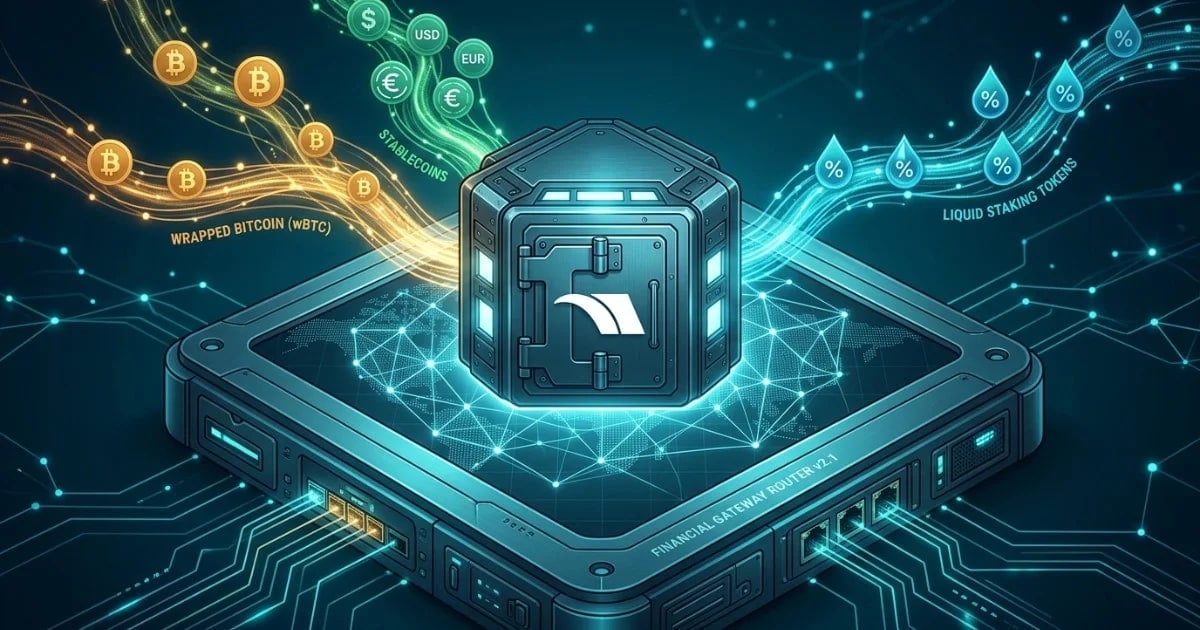
Expanding shared security beyond single-chain assets optimizes capital efficiency. We break down Karak's multi-chain restaking vaults, DSS development kits, and K2 infrastructure.
The Restaking Evolution: Breaking the Single-Chain Asset Barrier
- Karak Network is transforming the landscape of decentralized security by introducing a Universal Restaking Layer. Designed to be entirely asset- and chain-agnostic, Karak converts shared security into an inclusive, multi-asset marketplace. This guide explores the platform’s core components: its multi-chain architecture, the Distributed Secure Services (DSS) framework, its native K2 sandbox rollup, and its strategic position within the broader Web3 ecosystem.
- This innovation arrives at a pivotal moment. The emergence of shared-security layers has fundamentally redefined how decentralized networks establish economic protection. By enabling token holders to repurpose their locked assets to secure secondary infrastructure, restaking helps eliminate the high, dilutive inflation costs that have historically hindered early-stage projects. While initial implementations were often limited by rigid architectures (relying heavily on Ethereum-native assets and binding developers to a single Layer 1) modern solutions like Karak are now dismantling those barriers to entry.
What is Karak
- Karak is a universal multi-chain restaking layer and cryptoeconomic security network. Funded by tier-1 institutional backers including Pantera Capital, Coinbase Ventures, and Lightspeed Venture Partners, the protocol operates as an open marketplace connecting capital allocators to decentralized infrastructure platforms.
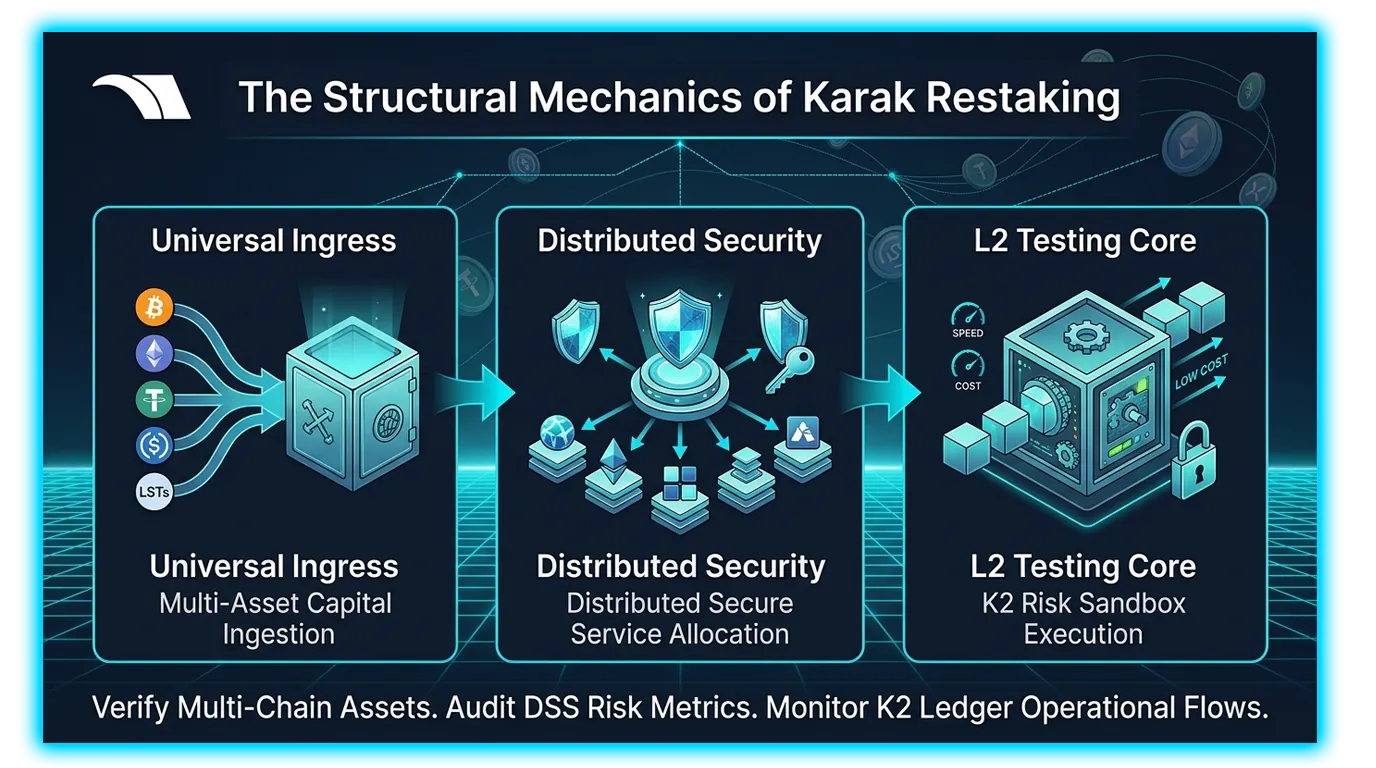
- Rather than restricting shared security strictly to Ethereum validators, Karak provides an inclusive framework that enables users to restake virtually any premium asset class, including liquid staking tokens (LSTs), liquid restaking tokens (LRTs), stablecoins, wrapped Bitcoin, and Pendle Principal Tokens (PTs), across multiple underlying blockchains simultaneously.
1. Core Infrastructure: Multi-Asset Universal Restaking
- Karak's core design philosophy centers on the idea that network security becomes more robust, sustainable, and insulated from market shocks when it is backed by a diverse basket of uncorrelated financial assets.
- Unlike platforms that limit security deposits strictly to ETH-based assets, Karak allows users to deposit stablecoins, tokenized Bitcoin, and alternative layer tokens directly into its protocol vaults. This approach unlocks key operational benefits:
Volatility Insulation: If an independent network relies solely on a single asset type for its economic backing, a sudden market crash targeting that specific asset can instantly degrade the platform's security threshold. Multi-asset pools distribute this risk across multiple market categories.
Non-Dilutive Onboarding: Developers can bootstrap secure trust networks from day one using stable pools of capital, avoiding the need to issue highly inflationary native tokens to attract early validators.
- On Karak, these deposits are organized into specific, single-asset vaults owned and managed directly by specialized Node Operators. Unlike alternative architectures where capital is delegated globally, Karak users choose exactly which operator and vault combination receives their financial backing.
2. The Validation Layer: Distributed Secure Services (DSS)
- Any infrastructure platform, oracle network, cross-chain bridge, or data availability layer that chooses to lease its economic protection from Karak's pooled marketplace is known as a Distributed Secure Service (DSS).
- A DSS functions as the operational equivalent to EigenLayer's Actively Validated Services (AVSs). When a developer builds a dApp or a new rollup, they connect to Karak's developer SDKs and outline their precise security demands, target hardware specs, and custom reward incentives.
- Node Operators inspect these open DSS profiles and explicitly opt-in to validate transactions for the services that match their risk profiles. Because the core reward calculations, compliance monitoring, and slashing penalties are managed directly by the individual DSS contract rather than a rigid central protocol layer, developers gain immense freedom to customize their validation logic to fit their exact app preferences.
3. The Risk Sandbox: The K2 Chain
To streamline testing, lower development friction, and minimize transaction costs, Karak operates its own native, execution-focused network layer known as K2.
K2 is an EVM-compatible, risk-management Layer 2 rollup built directly on top of the Ethereum ecosystem. Powered natively by Karak's Distributed Secure Services, K2 serves as a highly efficient sandbox and transaction playground:
The Gas Economy: K2 utilizes standard Ether (ETH) to settle local network transaction fees, ensuring zero asset friction for migrating developers.
Turnkey Prototyping: Developers can rapidly deploy, test, and live-audit their custom DSS modules inside a high-throughput, sub-cent execution environment before expanding their restaking structures out to mainnet execution layers.
Technical Design Matrix: Restaking Protocols
| Feature | EigenLayer | Symbiotic | Karak Network |
| Assets Allowed | ETH & LSTs | Any ERC-20 token | Multi-asset + Cross-chain |
| Security Layer | AVS Core | Network Systems | DSS (Distributed Services) |
| Sandbox Chain | None | None | K2 Native Layer 2 |
| Vault Design | Protocol Pooled | Modular / Isolated | Operator-Owned Vaults |
| Slashing Core | Central Committee | Custom Resolvers | Handled by individual DSS |
Universal On-Chain Forensics and Trading Telemetry via DEXTools
- By leveraging key features such as the Pair Explorer, the Live New Pairs dashboard, and Trade Story, among other options, technical traders can analyze localized volume trends and verify the security scores of automated contracts before initiating any on-chain interactions. This ensures that their secure hardware setup only interacts with verified markets.
Disclaimer: This article is for informational purposes only and does not constitute investment advice, financial advice, trading advice, or any other kind of advice. DEXTools does not recommend buying, selling, or holding any cryptocurrency or token. Users should conduct their own research and consult with a qualified financial advisor before making any investment decisions. Cryptocurrency investments are volatile and high-risk. DEXTools is not responsible for any losses incurred.
Related Guides
- What Is Karak Network? Universal Restaking Guide 2026
- What Is YieldNest (YND)? The MAX LRT Liquid Restaking Protocol Explained in 2026
- What Is Symbiotic: Permissionless Restaking Guide (2026)
- What is Symbiotic? Permissionless Restaking Guide
- What Is Restaking: Complete EigenLayer & EtherFi Guide (2026)
Frequently Asked Questions
What is Karak and what is restaking?
Karak is a protocol focused on restaking, which lets already-staked assets be reused to help secure additional services. Restaking aims to extend the security of staked capital to more applications.
What does universal restaking mean?
Universal restaking refers to supporting a broad range of assets and chains for restaking rather than being limited to a single asset or network. The idea is to make restaking more flexible across the ecosystem.
What is a restaking vault?
A restaking vault is a smart contract where users deposit assets to participate in restaking. The vault manages the deposited assets and their use in securing additional services.
What are the risks of restaking?
Restaking can expose the same capital to additional slashing and smart contract risks because it secures more than one service. Users should understand that reusing staked assets stacks new risks on top of the base staking risk.