What Is Monero (XMR): Complete Privacy Coin Guide (2026)
— By Tony Rabbit in Tutorials
What is Monero (XMR)? Complete 2026 privacy coin guide: ring signatures, stealth addresses, RingCT, RandomX mining, legal status, wallets and how to acquire XMR.
In a crypto landscape increasingly defined by chain analysis firms, regulatory reporting, and a single transaction history that any government, employer, exchange, or curious neighbor can pull up forever, XMR stands as the loudest counter-argument. Monero is the only major cryptocurrency where financial privacy is the default state, not an opt-in feature that gets you flagged. While blockchain explorers turn Bitcoin and Ethereum into permanent public ledgers, Monero scrambles senders, recipients, and amounts on every single transaction at the protocol level. There is no transparent version. There is no compliant version. Privacy is the product.
That hard stance has consequences in 2026. Binance delisted Monero in February 2024. Kraken pulled it from European jurisdictions under MiCA pressure. OKX, Bitfinex, and Huobi dropped XMR pairs in several regions. Japan and South Korea ban it entirely. Yet Monero trades higher in 2026 than it did before those delistings, has more developers contributing than ever, and is on the verge of shipping FCMP++, the biggest cryptographic upgrade in its history. The regulatory chess match has not killed Monero. It has hardened the community that uses it and pushed liquidity into peer-to-peer markets and atomic swaps. This is the privacy coin that refused to compromise, and that refusal is the entire point.
In this guide, you will learn exactly what Monero is and why it was built, how its four-layer privacy stack actually works in plain language, how RandomX mining keeps it fair for ordinary CPUs, which wallets are safe to use, how to acquire XMR in 2026 without an account on a centralized exchange, where it is legal versus banned, the honest mix of legitimate and illicit use cases, and what the upcoming FCMP upgrade means for the future of on-chain privacy. By the end you should be able to decide whether Monero belongs in your portfolio, your toolkit, or neither.
What Is Monero (XMR)?
Monero is an open-source, decentralized cryptocurrency launched on April 18, 2014, that uses obfuscation-based cryptography to hide the sender, receiver, and amount of every transaction by default. The name comes from the Esperanto word for "coin," chosen deliberately to convey universality and neutrality. Unlike most cryptocurrencies, Monero has no company behind it, no foundation that controls treasury funds, no premine that enriched early insiders, and no ICO. Development is funded entirely through a Community Crowdfunding System where contributors propose work, community members donate XMR, and developers get paid when milestones are met.
Technically, Monero is a fork of Bytecoin, which was the first cryptocurrency to implement the CryptoNote protocol invented by the pseudonymous Nicolas van Saberhagen in 2013. CryptoNote introduced ring signatures and stealth addresses as native protocol features. The original Bytecoin had problems including a suspicious distribution where 80% of the supply was mined before public launch, so a group of developers led by Riccardo "fluffypony" Spagni and others forked the codebase into BitMonero in April 2014. Five days later the community renamed it simply Monero, and the modern project began.
What sets Monero apart from every other major cryptocurrency is that privacy is not a configurable option. There is no "private mode" you have to enable. There is no separate shielded pool you have to opt into. Every transaction on the Monero blockchain is private from the moment it is broadcast. This single design decision separates Monero from Zcash (where most users transact in transparent mode), Bitcoin with mixers (where the act of mixing flags you), and every other so-called privacy coin where the privacy is bolted on rather than fundamental.
Why Monero Exists: The Cypherpunk Thesis
To understand Monero you need to understand the cypherpunk worldview that produced it. Cypherpunks were a loose group of cryptographers, programmers, and activists in the 1990s who argued that strong cryptography would be the only meaningful defense against mass surveillance in the digital age. Eric Hughes wrote in the 1993 Cypherpunk Manifesto that "privacy is necessary for an open society in the electronic age," and that "we cannot expect governments, corporations, or other large, faceless organizations to grant us privacy out of their beneficence." Privacy, in this worldview, has to be built into the tools themselves.
Bitcoin was originally seen by many cypherpunks as a step toward financial privacy. After all, you could create a wallet without an ID, send funds peer to peer, and not need a bank. But the early enthusiasm collapsed when chain analysis firms like Chainalysis, Elliptic, and TRM Labs showed they could trace Bitcoin transactions across exchanges, clusters, and IP addresses with terrifying accuracy. Today every major exchange uses these tools as part of KYC compliance. Every withdrawal you make from Coinbase is tagged forever. Every address that receives those coins becomes part of your financial graph. Bitcoin turned out to be the opposite of cash. It is more like a permanent, public bank statement that anyone can read.
Monero exists because the cypherpunks were right. Financial privacy is not just a feature, it is the difference between a tool of liberation and a tool of surveillance. A journalist accepting donations to investigate a corrupt regime, a domestic violence survivor receiving emergency funds, a citizen of an authoritarian country buying medication, an activist funding legal defense, a small business owner who does not want competitors to see their revenue, a regular person who simply does not want their employer or insurance company tracking what they buy. All of these people have legitimate reasons to want financial privacy. Monero gives them a tool that actually delivers it.
The Monero Privacy Stack: Four Mechanisms
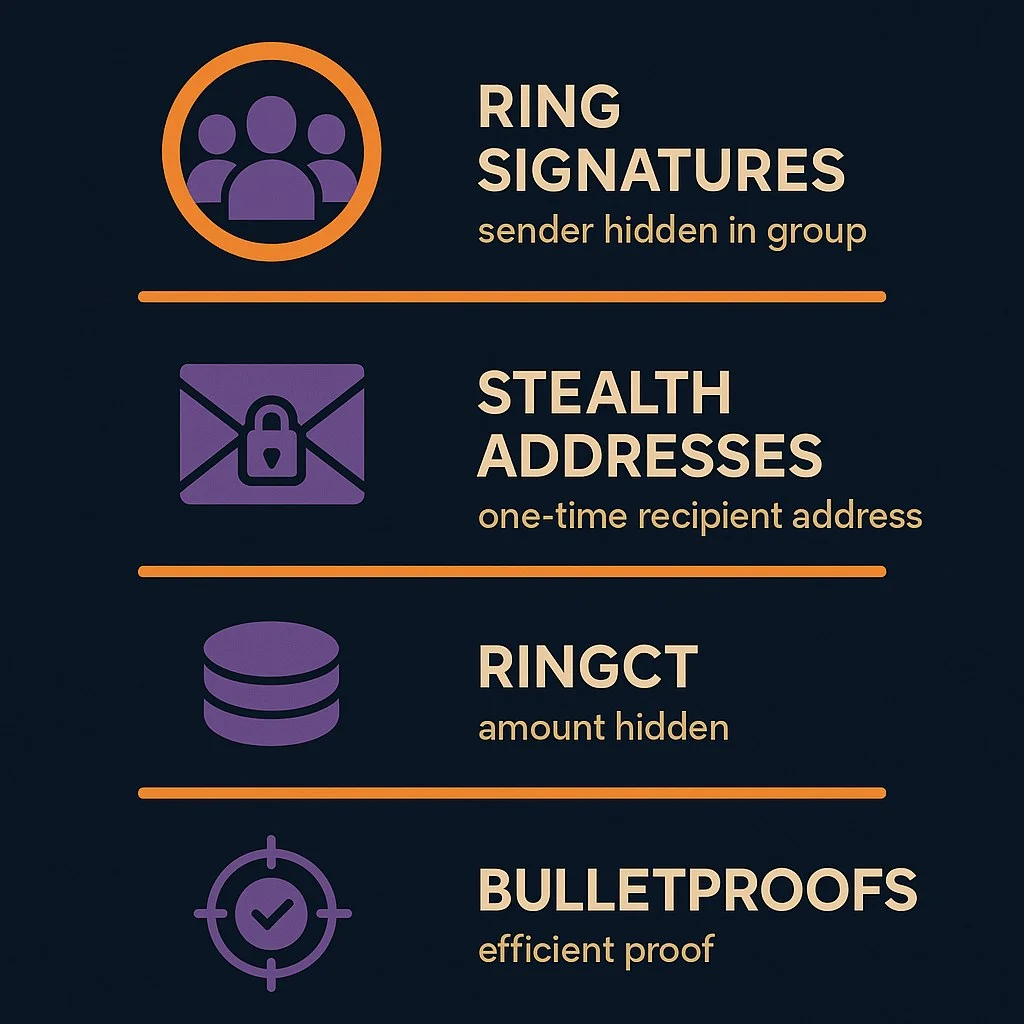
Monero's privacy does not come from a single trick. It comes from layering four distinct cryptographic and networking mechanisms that each obscure a different piece of the transaction puzzle. Understanding the stack is essential because each layer addresses a specific privacy threat. If you remove any one of them, the others become significantly weaker. This is defense in depth at the protocol level.
Hides WHO sent the transaction by mixing the real sender with 15 decoy signers pulled from past outputs. An outside observer cannot tell which of the 16 is the actual spender.
Hides WHO received the transaction. Each payment goes to a one-time address derived from the recipient's public address, so no two payments to the same person look related.
Hides HOW MUCH was sent. Transaction amounts are encrypted using Pedersen commitments and Bulletproofs+, but the network can still verify no XMR was created out of thin air.
Hides WHERE the transaction originated. Transactions are first relayed through a random sequence of nodes (stem) before being broadcast widely (fluff), making it impossible to link a transaction to the IP address that created it.
Ring Signatures: Hiding the Sender
Ring signatures are the mechanism that hides who sent a Monero transaction. The idea was first proposed by cryptographers Ron Rivest, Adi Shamir, and Yael Tauman in 2001, and CryptoNote adapted it for cryptocurrency. Here is how it works in plain English. When you sign a normal Bitcoin transaction, you use your private key, and anyone can verify that you (and only you) authorized the spending of that output. With a ring signature, you sign in a way that proves "one of the members of this ring of public keys authorized the transaction," but no observer can tell which one.
In Monero today, every transaction has a ring size of 16. That means when you spend your XMR, your wallet pulls 15 other outputs from the blockchain that look similar (similar age, similar amount before RingCT hid amounts) and includes them as decoys. The signature mathematically proves that one of the 16 outputs is being spent, but does not reveal which one. To an outside analyst, every one of those 16 is equally likely to be the real one. Multiply that across many transactions and the analytical uncertainty compounds rapidly.
Ring signatures also solve the double-spend problem without revealing identity. Each Monero transaction includes a unique cryptographic value called a key image, derived from the actual spent output. The network checks that no key image has been seen before in the entire history of the chain. If it has, the transaction is rejected as a double-spend. If it has not, the transaction is valid. This is elegant because the key image proves uniqueness without exposing which ring member produced it. The future FCMP upgrade will replace ring signatures entirely with a much stronger system, but for now this is the foundation of sender privacy.
Stealth Addresses: Hiding the Recipient
If you give someone your Monero address and they send you 100 different payments, every single one of those payments goes to a different address on the blockchain. Nobody scanning the blockchain can group those payments together as belonging to the same recipient. That is the power of stealth addresses, and it solves a brutal privacy problem that Bitcoin has never properly solved.
The mechanism uses the Diffie-Hellman key exchange from elliptic curve cryptography. Your Monero address contains two public keys: a public spend key and a public view key. When somebody sends you a payment, their wallet generates a random number, combines it with your public keys, and produces a one-time stealth address that only you can recognize as belonging to you. The sender broadcasts the transaction to this stealth address along with a small piece of extra data called the transaction public key. Your wallet, using your view key, can scan the blockchain and detect which outputs are yours. Only your spend key can actually authorize spending those outputs.
This is why Monero has separate view keys and spend keys, which is fundamentally different from how private keys work on Bitcoin or Ethereum. You can give someone your view key to let them audit your wallet (useful for tax compliance or proving funds) without giving them the power to move your XMR. This separation is why payment ID was deprecated in 2019. Stealth addresses already provide perfect uniqueness for every transaction, so payment IDs became redundant and were removed to prevent users from accidentally leaking information.
RingCT: Hiding the Amount
Ring signatures hide the sender. Stealth addresses hide the recipient. But until 2017, the actual amounts in Monero transactions were still visible on the blockchain. This was a serious privacy weakness because amount analysis is one of the most powerful tools chain analysts have. If somebody pays exactly 47.382 XMR on Tuesday and the same exact amount appears in another wallet on Wednesday, you can link those addresses with near certainty even without knowing the sender or receiver explicitly.
RingCT, short for Ring Confidential Transactions, was activated on the Monero network in January 2017 and made mandatory in September 2017. It uses a cryptographic technique called Pedersen commitments to encrypt the transaction amount. The network can still verify that the inputs equal the outputs (no inflation, no fake money created) without ever seeing the actual numbers. This is the magic of zero-knowledge proofs applied to financial transactions.
The catch is that the cryptographic proof needed to validate amount confidentiality, called a range proof, was originally huge. Early RingCT transactions were around 13 kilobytes each, making the Monero blockchain bloat fast and pushing fees up. In 2018, Monero implemented Bulletproofs, an optimization that shrunk the proofs by roughly 80%. In 2022, the network upgraded to Bulletproofs+, which made them even smaller and faster to verify. This is why a Monero transaction today costs only a few cents in fees despite carrying far more cryptographic weight than a Bitcoin transaction.
Dandelion++: Network-Layer Privacy
The three previous mechanisms protect on-chain privacy, but they cannot protect you if your IP address is leaked when you broadcast a transaction. If a chain analysis firm runs many nodes and watches which IP first broadcasts a transaction, they can correlate that IP with the resulting on-chain transaction, defeating the cryptographic privacy. Bitcoin has this exact problem, which is why sophisticated users hide behind Tor or VPNs when broadcasting.
Monero implements Dandelion++ at the protocol level to defeat this kind of network-level surveillance. When you broadcast a transaction, it does not get flooded to every node immediately. Instead, it travels through a stem phase, where it is passed from one randomly chosen peer to another for several hops, each peer making a probabilistic decision to either continue forwarding it through the stem or switch to the fluff phase. Only in fluff phase is the transaction broadcast widely to the network. By the time the transaction reaches public visibility, several hops have separated it from the originating IP, making correlation attacks far harder.
Dandelion++ is not a substitute for using Tor or a VPN if you have a serious threat model, but it provides a meaningful baseline of network privacy for every Monero user without any extra configuration. Combined with the on-chain privacy stack, it gives Monero a degree of holistic transactional privacy that no other major cryptocurrency comes close to matching.
Bitcoin vs Monero on Privacy
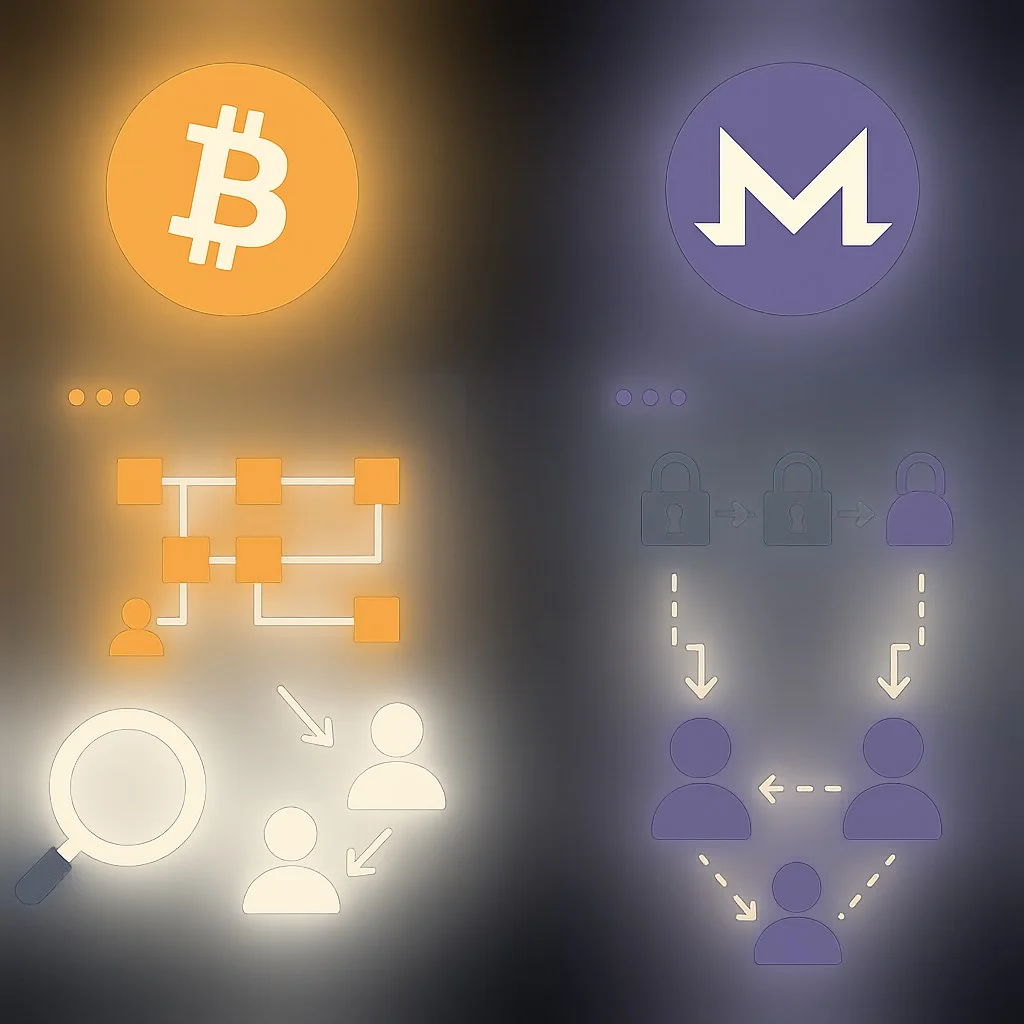
The most common misconception about Bitcoin is that it is anonymous. It is not. Bitcoin is pseudonymous, which is a completely different thing. Your name is not directly attached to your address, but every transaction you make is permanently linked to that address, and the moment any single transaction touches a regulated entity (an exchange, a payment processor, a service that does KYC), your entire transaction history can be unwound. Monero is fundamentally different. Here is the head-to-head.
- Sender: Visible address forever
- Receiver: Visible address forever
- Amount: Public in BTC, exact
- History: Every coin traceable from genesis
- Tools: Chainalysis tracks 99% of flows
- Fungibility: Coins can be tainted, blacklisted
- Sender: Hidden in ring of 16
- Receiver: One-time stealth address
- Amount: Encrypted with RingCT
- History: Cannot be traced back
- Tools: No reliable chain analysis exists
- Fungibility: Every coin equal, no taint
The fungibility point is the one that most people miss. In Bitcoin, if a coin was previously used in a hack or a darknet transaction five owners ago, exchanges may freeze it when you try to deposit. That coin is worth less than a "clean" coin even though both are nominally 1 BTC. This breaks the fundamental property of money, which is that every unit must be interchangeable with every other. Monero has perfect fungibility because no coin has a traceable history. Every XMR is equal to every other XMR, the way every dollar bill is equal to every other dollar bill regardless of who held it before.
Mining Monero: RandomX and CPU Fairness
Monero uses a Proof of Work consensus mechanism, but it is engineered very differently from Bitcoin's. Bitcoin mining today is dominated by industrial-scale operations using ASIC machines that cost thousands of dollars each and consume megawatts of electricity. Mining Bitcoin from a regular computer is mathematically impossible at any meaningful scale. Monero deliberately fights this centralization with an algorithm called RandomX, which was activated in November 2019.
RandomX is specifically designed to favor general-purpose CPUs over specialized hardware. It uses random code execution, memory-hard operations, and a virtual machine that essentially turns mining into running a stream of random programs. The features that make CPUs fast at this kind of work (large caches, branch prediction, out-of-order execution) cannot be easily replicated in a fixed-function ASIC. This means that anyone with a modern CPU can mine Monero competitively. There are no ASICs. There are no specialized rigs. A laptop, a desktop, a small home server, or a phone all participate on roughly the same per-watt basis.
The result is that Monero is one of the most genuinely decentralized cryptocurrencies in existence. The hash rate is spread across tens of thousands of small miners worldwide. There is no Monero equivalent of the few massive Bitcoin mining farms that control the network. If you want to learn more about how this consensus model works, our guide on Proof of Work vs Proof of Stake compares the underlying mechanics in depth. The Monero community is so committed to ASIC resistance that the network is willing to hard fork the algorithm if ASICs ever appear, breaking any specialized hardware that has been developed. This commitment has held since 2014.
Monero Wallets
Choosing the right wallet is the most important practical decision a new Monero user makes. Monero is supported by far fewer wallets than Bitcoin or Ethereum, which is actually a feature, not a bug. The community has scrutinized the available options heavily, and bad wallets get called out fast. Here are the five wallets that have earned long-term trust.
The community-favorite Android wallet. Lightweight, supports hardware wallet integration, built-in XMR to BTC atomic swaps via SideShift and ChangeNOW. Audited and reproducible builds.
Multi-chain wallet that started as Monero-first. Easiest onboarding for new users, in-app XMR purchases, exchanges, and Tor integration. Free and open-source.
Lightweight desktop wallet beloved by power users. Tor by default, supports hardware wallets, plugins for coin control and remote node selection. Pure Monero, no other coins.
The reference implementation from the Monero Core Team. Run a full node, prune the blockchain, mine directly. Heavy but unbeatable for sovereign users.
Open-source multi-coin wallet from Cypher Stack. Strong Monero support, Tor integration, atomic swap UI. Good option if you also hold other privacy-conscious assets.
Hardware wallet support for Monero is more limited than for Bitcoin. Ledger Nano S Plus, Nano X, and Nano S support XMR via the Monero GUI or Feather. Trezor Model T and Safe 3 also support it. Coldcard does not. If you hold significant XMR, pairing one of the supported hardware wallets with Feather or the official GUI is the gold standard for safety. Always download wallets only from the official Monero project links or from getmonero.org, and verify the cryptographic signatures of the binaries before installing.
How to Buy Monero in 2026
This is the section that has changed the most since 2023. Buying XMR through a standard centralized exchange with a credit card is no longer easy in most jurisdictions. Binance dropped it. Kraken dropped it for European users. OKX, Bitfinex, and Huobi pulled it from many regions. But XMR is still widely available, and in some ways the available channels are more aligned with Monero's privacy philosophy than the old CEX listings ever were. Here are the four practical routes in 2026.
Kraken (non-EU). Kraken still lists XMR for users in the United States, Canada, and most non-European countries. If you are in a supported jurisdiction and willing to do KYC, this is the easiest fiat-to-XMR onramp. The downside is obvious: you create a permanent record connecting your identity to the moment of purchase. Once you withdraw to your own wallet, the privacy properties of Monero kick in and your subsequent transactions are private, but the on-ramp itself is documented.
Haveno (decentralized P2P). Haveno is a decentralized peer-to-peer trading platform built specifically for Monero, inspired by the original Bisq design. It lets you trade XMR for fiat or other cryptocurrencies directly with counterparties, with security collateral locked in multisignature to prevent fraud. No KYC, no central operator. Liquidity has grown significantly in 2026 as more users move away from CEX onramps.
Atomic swaps (BTC for XMR). Atomic swaps allow you to trustlessly exchange Bitcoin for Monero without a third-party exchange. The technology uses hash time-locked contracts that ensure either both sides of the swap complete or neither does. COMIT, UnstoppableSwap, and the Haveno atomic swap module all support BTC to XMR trades. Our guide on atomic swaps covers the mechanics in depth.
NoOnes, RoboSats, LocalMonero successors. LocalMonero, the original P2P marketplace, shut down in May 2024 citing regulatory pressure, but several successors emerged. NoOnes (the rebranded Paxful) lists XMR pairs. RetroShare-based marketplaces and onion-only P2P platforms continue to operate. These all carry counterparty risk and require care, but they fill the gap left by the regulated exchanges.
Tail Emission: Monero's Perpetual 0.6 XMR Reward
One of the most underappreciated design decisions in Monero is its emission schedule. Bitcoin will eventually stop producing new BTC. Every four years its block reward halves until eventually hitting zero around the year 2140. Our Bitcoin halving guide explains this in detail. Monero took a deliberately different path with what is called tail emission.
The initial Monero emission curve produced roughly 18.13 million XMR over its first ~8 years (2014 to mid-2022). After that point, the network entered tail emission, where every block produces exactly 0.6 XMR as a reward to miners forever. This adds approximately 157,000 XMR per year to the supply, which represents a small and decreasing inflation rate as the total supply grows. At current circulating supply of about 18.5 million XMR, tail emission is roughly 0.85% annual inflation, declining over time toward zero asymptotically.
Why do this? The Monero developers argue that a non-zero block reward is essential for long-term network security. In Bitcoin's distant future, miners will rely entirely on transaction fees, and there are legitimate concerns about whether fee revenue alone will be enough to incentivize the massive hash power needed to secure a trillion-dollar network. Monero sidesteps this risk by guaranteeing a perpetual minimum reward. The tradeoff is a small, predictable inflation rate. For a currency designed to be used (not just held), this is arguably the right tradeoff.
Legal and Regulatory Status
This is the section where the rubber meets the road for anyone considering Monero. The legal landscape has gotten significantly more complex since 2024, and getting it wrong can have real consequences. Here is the honest picture in 2026.
United States, Canada, Mexico, Brazil, Argentina, most of Latin America, India, Indonesia, Singapore, Switzerland, Norway, UK, most of Africa. Holding and transacting in XMR is legal for individuals.
European Union under MiCA, where centralized exchanges cannot list privacy coins. Holding remains legal but on-ramps shrink. Australia, where major exchanges have delisted under AUSTRAC pressure.
Binance (globally, Feb 2024), Kraken (EU only), OKX (multiple regions), Huobi, Bittrex (before closure). Coins remain legal to hold, just harder to trade on CEX. P2P routes are unaffected.
Japan (since 2018, all privacy coins), South Korea (since 2021), Dubai (VARA prohibits anonymity-enhanced coins). Exchanges in these jurisdictions cannot list XMR at all.
The most important nuance: in almost every jurisdiction except the explicit bans above, individual ownership and use of Monero is legal. The restrictions almost universally apply to centralized exchanges and money service businesses, not to private individuals using non-custodial wallets. The EU MiCA framework specifically targets "Crypto-Asset Service Providers," meaning a citizen in Germany can still hold Monero in a Feather wallet and transact with it. The challenge is the on-ramp and off-ramp, not the ownership.
None of this is legal advice. Tax obligations apply everywhere. In the United States, the IRS treats XMR identically to other cryptocurrencies for tax purposes: every disposal is a taxable event. The "Monero hides my transactions from the tax authority" argument has gotten people prosecuted. Use Monero for the privacy benefits it actually provides (shielding amounts from public view, fungibility), not as a tax evasion tool. The legal exposure is asymmetric.
Use Cases: The Honest Picture
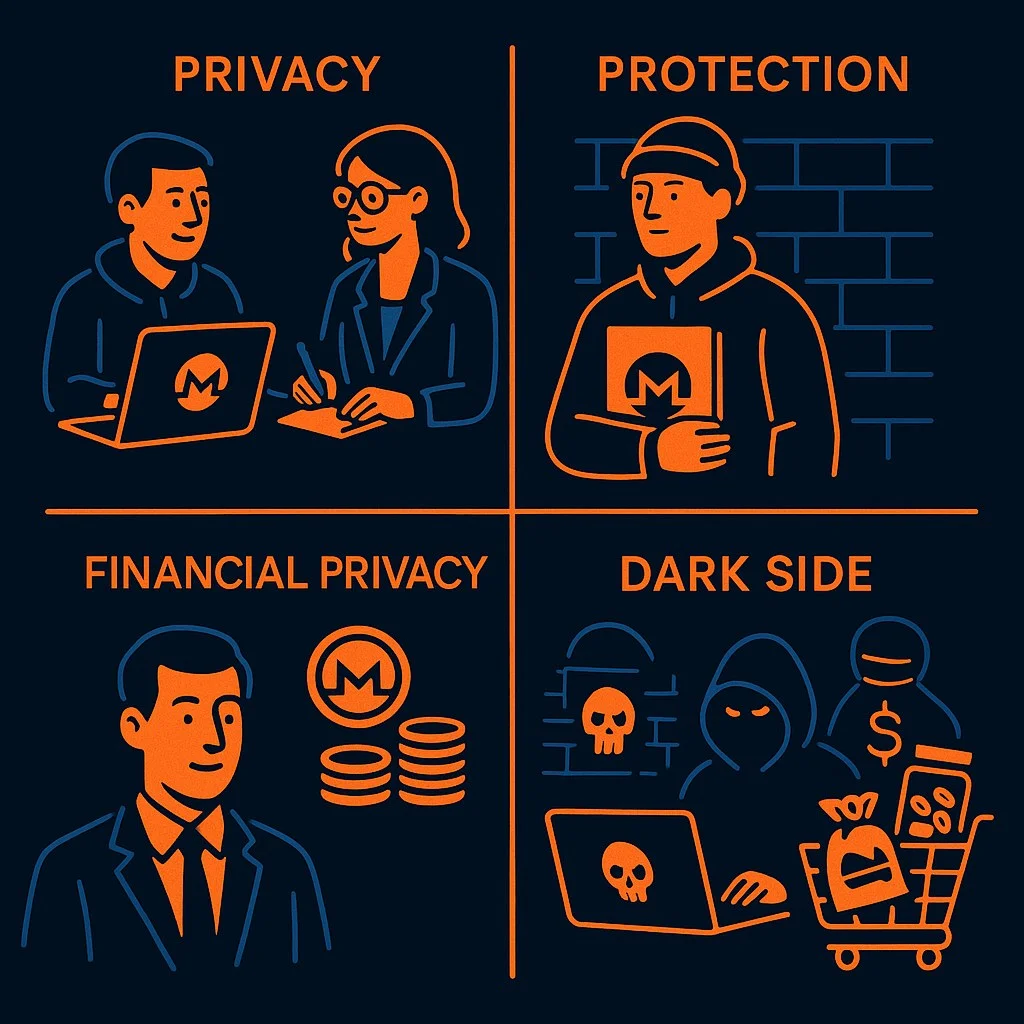
Any article that pretends Monero is used only by saints or only by criminals is dishonest. The truth, as with cash, is that a strong privacy tool gets used for the full spectrum of human activity. Refusing to acknowledge this would be naive. Refusing to look at the breakdown would mean missing the actual value proposition. Here is the balanced picture.
Receiving donations and tips without exposing source identities. Operating in authoritarian regimes where transparent transactions could mean prison. Press freedom organizations recommend XMR.
Regular people who do not want their employer, insurer, ex-spouse, or competitors seeing their balances and transaction history. Small businesses protecting revenue data from competitors.
A real and ugly use case. Some ransomware groups shifted from BTC to XMR after chain analysis improved. Law enforcement frequently cites this in calls for bans. Honest acknowledgment is necessary.
XMR is increasingly the preferred currency on darknet markets after Bitcoin tracing became reliable. This is both for legitimate items where users want privacy and for illegal goods.
The philosophical question is whether privacy itself should be treated as a dual-use technology that we accept despite the worst-case uses, the way we accept that cash, sealed envelopes, and Tor all have ugly applications because their existence is essential for human freedom. The cypherpunk and Monero community position is that yes, that tradeoff is unavoidable and worthwhile. The opposing position is that financial privacy specifically should be subordinated to law enforcement needs. This is a real values debate, not a technical one, and serious people disagree.
Monero vs Zcash vs Privacy Mixers
Monero is not the only attempt at on-chain privacy. The two main alternatives are Zcash and a category of Ethereum-based mixing protocols including the now-sanctioned Tornado Cash and the still-operational Railgun. Each takes a fundamentally different approach.
Zcash uses zk-SNARK zero-knowledge proofs that are mathematically stronger than Monero's ring signatures. In its fully shielded mode, Zcash provides arguably better cryptographic privacy than Monero. The catch is that Zcash supports both transparent and shielded transactions, and historically more than 90% of Zcash transactions have been transparent. Worse, when shielded users withdraw to transparent addresses, their privacy can be undermined by metadata analysis. The shielded pool is small enough that some empirical attacks have been demonstrated. Monero's mandatory privacy by contrast means every user gets the benefit and contributes to the anonymity set.
Tornado Cash was an Ethereum smart contract mixer that used zk-SNARKs to break the on-chain link between deposit and withdrawal. It worked well technically but was sanctioned by the U.S. Treasury OFAC in August 2022 after being used by the Lazarus Group to launder over $400 million from the Ronin Bridge hack. Two of its developers were arrested. The smart contracts still exist on Ethereum and cannot be turned off, but using them carries serious legal risk for U.S. persons. Our guide on crypto mixers covers the current landscape.
Railgun is a newer protocol-level privacy system for ERC-20 tokens on Ethereum, Polygon, BNB Chain, and Arbitrum. It uses zk-SNARKs and has so far avoided sanctions by including a "Privacy Pools" mechanism that lets honest users prove they are not from sanctioned addresses. Railgun is interesting but the anonymity set is smaller than Monero's, and the privacy guarantee depends on Ethereum and the underlying chains, which themselves are highly traced.
The verdict among privacy researchers in 2026 is that Monero remains the most battle-tested and broadly effective privacy coin. Zcash has theoretical advantages but practical weaknesses. Mixers are useful but legally fraught. For a user who wants strong, simple, mandatory privacy across every transaction, Monero remains the default choice.
The FCMP++ Upgrade and Monero's Future
The biggest cryptographic upgrade in Monero's history is currently in development and is expected to ship within the next 12 to 18 months. It is called Full-Chain Membership Proofs Plus Plus, or FCMP++ for short. If it lands as designed, it will fundamentally change how Monero hides senders.
Under the current ring signature system, your real spent output is mixed with 15 decoys. The anonymity set per transaction is 16. With FCMP, the anonymity set becomes the entire spendable Monero supply. Instead of proving "I am one of these 16 outputs," you would prove "I am one of all the unspent outputs in Monero's history" without revealing which one. The cryptography uses succinct membership proofs over an elliptic curve tree structure. The math is dense, but the practical effect is enormous. The anonymity set jumps from 16 to several hundred million.
FCMP++ also opens the door to several other improvements. Verification time stays fast even as the anonymity set grows. The protocol becomes more resistant to future advances in cryptanalysis. It removes some lingering corner cases in ring signature security. It enables features like better second-layer scaling and potentially cross-chain swap improvements. The lead developers, including Luke "Kayabaneru" Parker, have been working on the design for several years, and audits are progressing in 2026. This is the upgrade that the Monero community sees as the long-promised next leap. Combined with continued MEV-resistant design at the base layer, Monero will remain hard to surveil for the foreseeable future.
Frequently Asked Questions
Is Monero legal?
In most countries Monero is legal for individuals to hold and use. The United States, UK, Canada, Brazil, Mexico, India, Switzerland, and most other countries permit ownership and personal transactions. The exceptions are Japan, South Korea, and Dubai, which have explicitly banned privacy coins. Many EU jurisdictions restrict CEX listings under MiCA without banning the asset itself. Always check your local regulations and remember that tax obligations apply regardless of privacy properties.
Can Monero be traced?
Not reliably. While Chainalysis and similar firms market Monero "tracing" services, there is no peer-reviewed evidence that they can deanonymize current Monero transactions at scale. Older transactions before RingCT (pre-2017) and before mandatory ring sizes had some weaknesses. Modern Monero with ring size 16, RingCT, stealth addresses, Dandelion++, and (soon) FCMP++ has no known practical attacks that work against typical users. The vast majority of "Monero tracing" comes from off-chain mistakes like reusing addresses across services, leaking IPs without Tor, or being identified at a KYC on-ramp.
Where can I buy Monero in 2026?
Centralized exchanges that still list XMR include Kraken (non-EU), KuCoin, Gate.io, MEXC, and Poloniex in supported regions. Decentralized and P2P options include Haveno (P2P with security deposits), atomic swaps between BTC and XMR via UnstoppableSwap or COMIT, NoOnes (formerly Paxful), and RetroShare-based marketplaces. The trend in 2026 is away from centralized exchanges and toward decentralized acquisition methods, which align better with Monero's privacy philosophy.
Is Monero better than Bitcoin for privacy?
Yes, by a very wide margin. Bitcoin is pseudonymous, not anonymous. Every Bitcoin transaction is permanently linked to public addresses, and chain analysis firms can trace flows with high accuracy across the entire history of the chain. Monero hides sender, receiver, and amount on every transaction by default. There is no comparison from a privacy standpoint. Bitcoin remains better for store-of-value adoption, liquidity, and broad acceptance. Monero is the right tool when financial privacy is what you need.
Why was Monero delisted from Binance?
Binance delisted Monero on February 20, 2024, citing inability to comply with regulatory requirements that demand transaction traceability and travel-rule data. The same wave of regulatory pressure produced Kraken's European delisting and similar moves at OKX and Huobi. The official reason is "global regulatory environment." Practical effect: Monero acquisition shifted toward P2P, atomic swaps, and remaining CEX listings. Liquidity dipped briefly then recovered. The community considers the delistings a validation that Monero actually works as a privacy tool, since regulators clearly cannot get the data they want from it.
Can the government see my Monero transactions?
Not the actual transactions on-chain. Sender, receiver, and amount are all encrypted. However, governments can see things outside the chain that link you to Monero usage: KYC records at exchanges where you bought XMR, IP addresses if you broadcast transactions without Tor or a VPN, metadata from compromised wallets or services. The cryptographic core of Monero is resistant to surveillance, but your operational security around it matters enormously. Using Tor, choosing reputable wallets, never reusing the same exchange repeatedly, and keeping your view key private all add real protection.
What is the difference between Monero's view key and spend key?
The view key lets you see all incoming transactions to your wallet but does not let you spend them. The spend key lets you authorize spending. This separation is unique to Monero and other CryptoNote-based coins. You can share your view key with an auditor, tax preparer, or business partner to prove your holdings or audit your finances without giving them the power to move your XMR. Never share your spend key with anyone, ever.
Conclusion
Monero is the cryptocurrency that took the original cypherpunk promise seriously and refused to compromise when regulators came calling. It does what it says on the tin: every transaction is private by default, the sender is hidden, the recipient is hidden, the amount is hidden, and the network broadcast pattern is hidden. The cryptographic stack of ring signatures, stealth addresses, RingCT, and Dandelion++ has held up against more than a decade of scrutiny. The upcoming FCMP++ upgrade will make it even stronger. The community is decentralized, the mining is fair, and the development is community-funded with no premine and no foundation treasury skimming the top.
The cost of that uncompromising stance is real. You will not find XMR on every exchange. Some countries have banned it entirely. The EU is making it harder to acquire through regulated channels. There is genuine controversy about whether the privacy a tool like Monero provides is on balance good or bad for society, and reasonable people land on different sides of that debate. The Monero community's position is that privacy is a human right and that the value to journalists, activists, and ordinary people seeking financial autonomy outweighs the cost from the small percentage of malicious use. Whether you agree depends on your values.
If you decide Monero is right for you, start small. Download Feather or Cake Wallet, write down your 25-word seed phrase on paper, and store it the way you would store the keys to a safe. Acquire a modest amount through Kraken (if you can) or an atomic swap, send a test transaction to yourself to confirm everything works, then use it for what it is good at: protecting your financial privacy in a world that has otherwise abandoned that idea. In a crypto industry obsessed with NFTs, memes, and infinite token launches, Monero remains the project most aligned with the original reason crypto existed in the first place. That alone makes it worth understanding deeply.
Related Guides
- Monero vs Zcash: Privacy Coins Compared (2026)
- What Is zkTLS? Privacy and Reputation for DeFi Explained
- What Is Zcash (ZEC)? The Privacy Cryptocurrency Powered by zk-SNARKs Explained in 2026
- What Is Railgun? The On-Chain Privacy Protocol for EVM DeFi Explained in 2026
- What Is Aleo? The Zero-Knowledge Privacy Layer 1 Blockchain Explained in 2026