What Is Zcash (ZEC)? The Privacy Cryptocurrency Powered by zk-SNARKs Explained in 2026
— By Tony Rabbit in Tutorials
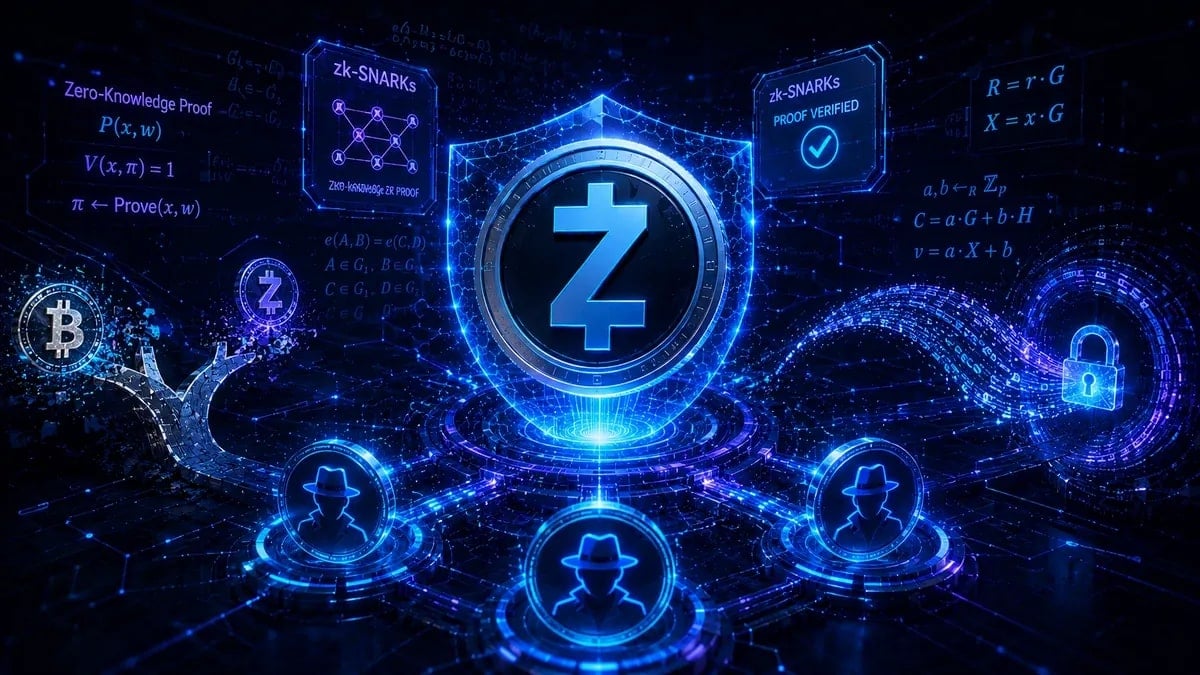
Zcash (ZEC) is the privacy cryptocurrency that pioneered zk-SNARKs in 2016. Discover how shielded addresses, selective disclosure, and the Halo 2 upgrade make ZEC the most regulator-friendly privacy coin in 2026.
What Is Zcash (ZEC)? The Privacy Cryptocurrency Powered by zk-SNARKs Explained in 2026
Every Bitcoin transaction ever made lives forever on a public ledger, viewable by anyone with an internet connection and a block explorer. Your salary, your rent, your medical payments, your political donations, the coffee you bought this morning, all of it. The cypherpunks who dreamed of digital cash in the 1990s never wanted a surveillance machine, yet that is exactly what most cryptocurrencies became. Zcash was built to fix that mistake, and in 2026 it stands as the most mathematically rigorous privacy cryptocurrency ever shipped to a mainnet.
Launched in October 2016 by the Electric Coin Company and led by founder Zooko Wilcox-O'Hearn, Zcash introduced the first production deployment of zk-SNARKs, a cryptographic primitive so powerful that it can prove a transaction is valid without revealing the sender, the receiver, or the amount. Eight years later, that same primitive powers a privacy ecosystem that ranges from Ethereum rollups to identity systems, but Zcash remains the original and, by many measures, the gold standard.
This guide explains everything you need to know about Zcash in 2026: what it is, how zk-SNARKs actually work in plain English, why the October to November 2025 price surge of more than 410 percent put privacy coins back at the center of crypto conversation, how Zcash differs from Monero, Tornado Cash, Railgun, and Aztec, and the practical risks and benefits of using ZEC today. By the end you will understand Zcash well enough to explain it to a skeptical friend, decide whether shielded addresses fit your threat model, and evaluate ZEC alongside other crypto assets you may already hold.
FEATURED SNIPPET
Zcash (ZEC) is a decentralized, open-source privacy cryptocurrency launched in October 2016 by the Electric Coin Company. It uses zk-SNARK zero-knowledge proofs to let users send fully encrypted transactions through shielded z-addresses while still allowing optional selective disclosure for compliance. Zcash has a fixed supply of 21 million ZEC, mirrors Bitcoin's halving schedule, and is currently mined with the Equihash algorithm with active proposals to migrate toward proof of stake.
What Is Zcash in Plain English
Imagine Bitcoin, but with an opt-in invisibility cloak. That is the shortest honest description of Zcash. Under the hood it shares an enormous amount of DNA with Bitcoin: the same 21 million fixed supply, the same halving schedule that cuts new issuance roughly every four years, the same proof of work mining model at launch, the same UTXO accounting where coins exist as discrete unspent outputs rather than balances in accounts. If you understand Bitcoin, you already understand half of Zcash. If you do not, our explainer on what Bitcoin is is a solid place to start before continuing here.
The other half is where Zcash diverges. Every ZEC transaction can take one of four forms. A fully transparent transaction looks exactly like Bitcoin, with public sender, receiver, and amount. A fully shielded transaction reveals nothing except that a valid transfer occurred. The two mixed forms, shielding and deshielding, move funds between the transparent and shielded pools and are partially visible. The magic that makes the fully shielded version possible is zk-SNARKs, short for zero knowledge succinct non-interactive arguments of knowledge. We will unpack that mouthful soon, but the headline is simple: a Zcash node can mathematically verify that a shielded transaction follows every consensus rule without ever learning a single detail about it.
This optional design is the single most important thing to understand about Zcash, because it shapes everything from regulatory posture to user experience. Where Monero forces every transaction to be private, Zcash gives users a choice. That choice is sometimes criticized as a weakness, since most early Zcash users defaulted to transparent transactions and only a small fraction of the supply ever moved through the shielded pool. But the same flexibility is also why Zcash continues to be listed on tier one exchanges like Coinbase, Binance, Kraken, and Gemini in jurisdictions where Monero has been delisted. Optional privacy turns out to be a feature that compliance teams can live with.
The Privacy Problem Zcash Solves
To understand why Zcash exists you have to understand the privacy disaster that Bitcoin accidentally became. Satoshi Nakamoto framed Bitcoin as a privacy-respecting cash alternative, and in 2009 that framing was roughly accurate. Block explorers were primitive, chain analysis was a research curiosity, and the link between a public address and a real human identity was hard to establish. Fifteen years later that link is trivial. Companies like Chainalysis, Elliptic, and TRM Labs have built billion dollar businesses out of tracing Bitcoin flows, and almost every centralized exchange now ships customer transaction data to government agencies on request.
The consequences are not theoretical. Journalists in authoritarian regimes have had wallets traced and frozen. Activists who accepted Bitcoin donations during protests have been doxxed. Ordinary users who bought coffee with Bitcoin in 2013 have had their entire on-chain history reconstructed by employers and ex-partners. The notion that pseudonymity equals privacy died around 2017, and what remained was a system in which every economic action was permanently engraved on a public bulletin board.

Zcash was conceived as a direct response to that failure. The founding insight, formalized in the 2014 Zerocash academic paper by Eli Ben-Sasson, Alessandro Chiesa, Christina Garman, Matthew Green, Ian Miers, Eran Tromer, and Madars Virza, was that recent breakthroughs in zero knowledge cryptography made it possible to build a working currency in which transactions were both publicly verifiable and completely private. The protocol the paper described was named Zerocash, and it eventually became Zcash. Our deeper dive into zero knowledge proofs covers the underlying math at greater length, but the practical upshot is that Zcash took an academic dream and shipped it as production money.
Privacy in money is not a niche concern. It is a precondition for political freedom, commercial confidentiality, and personal dignity. A surveillance currency makes economic free speech impossible. Zcash exists so that people who want this kind of privacy can have it, without abandoning the broader benefits of an open permissionless blockchain.
Zooko Wilcox and the Electric Coin Company
Behind every successful protocol there is usually a stubborn founder who refused to give up, and in Zcash that founder is Zooko Wilcox-O'Hearn. Zooko is one of the rare figures who was already a respected cryptographer before crypto became a financial industry. He worked on Mojo Nation in the late 1990s, co-designed the Tahoe-LAFS distributed storage system, and is the originator of Zooko's Triangle, a thought experiment about naming systems that anyone who has used the Ethereum Name Service or Handshake will recognize. He brought decades of cypherpunk credibility to the Zcash project at a moment when crypto desperately needed it.
In 2015 Zooko founded the Zerocoin Electric Coin Company, later renamed simply the Electric Coin Company or ECC, to turn the Zerocash paper into shipping software. ECC was structured as a for profit company rather than a foundation, a choice that was controversial at the time but that allowed it to attract serious engineering talent and venture capital. Early investors included a who's who of crypto and Silicon Valley names, and the company's mandate was narrow: build Zcash, ship Zcash, and steward Zcash through its first decade of life.
The ecosystem today is governed by a constellation of organizations. The Electric Coin Company focuses on protocol engineering. The Zcash Foundation is a separate nonprofit that funds independent research and runs node infrastructure. The Zcash Community Grants program disburses development funding voted on by community members. Decisions are made through Zcash Improvement Proposals, or ZIPs, modeled loosely on Bitcoin's BIP process. This polycentric structure was designed to avoid the founder-king problem and has held up reasonably well across multiple controversial decisions.
A Timeline of Zcash, 2013 to 2026
Matthew Green and graduate students at Johns Hopkins begin work on Zerocoin, a privacy extension proposed for Bitcoin. The Bitcoin community ultimately declines to integrate it, but the research lays the foundation for Zerocash.
The Zerocash academic paper is published, describing a complete privacy preserving cryptocurrency built on zk-SNARKs. Zooko Wilcox begins assembling the team that will eventually become ECC.
Zcash mainnet launches on October 28, 2016. The genesis block is mined alongside an elaborate trusted setup ceremony designed to destroy the cryptographic toxic waste that could have been used to mint counterfeit ZEC.
The Sapling upgrade activates, dramatically reducing the memory and time required to construct shielded transactions. Sapling makes mobile shielded wallets practical for the first time.
The Heartwood and Canopy upgrades roll out, introducing FlyClient support and ending the founder reward in favor of a community funded development model. The Halo recursive proof system is announced.
Network Upgrade 5 activates, introducing the Orchard shielded pool built on Halo 2. For the first time Zcash users can transact privately without any trusted setup whatsoever.
A long bear market and several exchange delistings of competing privacy coins put pressure on the entire category. ZEC trades sideways while ECC, the Foundation, and Zcash Community Grants restructure funding and roadmap priorities.
ZEC surges more than 410 percent in roughly six weeks against a backdrop of renewed privacy demand, fresh regulatory scrutiny of stablecoins, and several high profile chain analysis incidents. Trading volumes hit multi-year highs across major exchanges.
Active proposals to migrate Zcash from Equihash proof of work toward a proof of stake or hybrid consensus mechanism move into formal ZIP review. The shielded pool reaches new all time highs as a percentage of total supply.
zk-SNARKs Explained Without Math
The acronym zk-SNARK stands for zero knowledge succinct non-interactive argument of knowledge, and each word in that phrase is doing work. Zero knowledge means the proof reveals nothing about the underlying secret. Succinct means the proof is small, typically a few hundred bytes, regardless of how complex the statement being proven is. Non-interactive means the prover can hand the proof over once and the verifier can check it offline, without any further back and forth. Argument of knowledge means the prover is demonstrating that they actually possess a particular witness, not just that one exists somewhere in theory.
Strip all the jargon and the analogy that almost everyone uses is the cave with a magic door. Imagine a circular tunnel with two paths and a locked door connecting them at the back. You want to convince a skeptical friend that you know the password to the door, without ever telling them what the password is. They stand at the entrance and shout left or right, and you must always emerge from the side they called. If you actually know the password, you can always comply by walking through the door if necessary. If you do not, you can only guess correctly half the time. After twenty rounds of this game your friend is mathematically certain you know the password, but they have learned absolutely nothing about what the password is. That is a zero knowledge proof.
In Zcash, the statement being proven is roughly: I know a set of inputs to this transaction that sum to a particular value, I know the private keys that authorize spending those inputs, and the outputs of this transaction also sum to that same value minus the fee. The proof reveals none of those inputs, none of those keys, and none of those outputs in plaintext. It only shows that they exist and that they obey the consensus rules. A full node validating the chain runs a constant time check against the proof and either accepts or rejects the transaction. The privacy is not bolted on or based on mixing, it is mathematically guaranteed by the proof system itself.
The Three Step Shielded Transaction Flow
STEP 1 COMPOSE
Your wallet selects the shielded notes you want to spend, drafts the new shielded outputs, and prepares the witness data. All of this happens locally on your device and never touches the network.
STEP 2 PROVE
The wallet runs the zk-SNARK prover, producing a small cryptographic proof that the transaction is valid. With Halo 2 in the Orchard pool, this takes a few seconds on modern hardware and requires no trusted setup.
STEP 3 VERIFY
The transaction broadcasts to the network. Every full node verifies the proof in milliseconds and adds it to the mempool. No node ever learns the sender, receiver, or amount.
The dirty secret of zk-SNARKs in their original Sapling form was the trusted setup. Generating the proving and verification keys required randomness that, if preserved, could later be used to forge unlimited counterfeit shielded coins. The Zcash team built elaborate multi party ceremonies to ensure that at least one of dozens of participants destroyed their share of the toxic waste, but the system still depended on trust in those ceremonies. Halo 2, introduced in the Orchard shielded pool, eliminates this requirement entirely by using a recursive proof composition technique that needs no trusted setup ever. Orchard is the future of Zcash, and migrating supply into the Orchard pool is a quiet but important ongoing project.
Transparent vs Shielded Addresses
Zcash addresses come in two visible flavors that any user must learn to distinguish. Transparent addresses, called t-addresses, begin with a lowercase t and behave exactly like Bitcoin addresses. Anyone can see balances, anyone can trace flows, and any block explorer will happily reconstruct the entire history of a t-address with a few clicks. They exist because they make Zcash trivially interoperable with the existing Bitcoin tooling ecosystem and because most exchanges only support t-address deposits and withdrawals.
Shielded addresses, called z-addresses, begin with the letter z and behave according to the zk-SNARK rules described above. A balance held in a z-address is invisible to outside observers. A transaction between two z-addresses reveals nothing except its existence and the network fee. There are two generations of z-addresses currently in use. Sapling z-addresses, prefixed zs, are the older generation and remain the most widely supported across wallets and exchanges. Unified addresses, prefixed u, are the newest generation introduced in NU5 and combine Sapling, Orchard, and transparent receivers into a single address that other wallets can interpret according to their capabilities.
The interaction between t-addresses and z-addresses matters enormously for actual privacy. Sending ZEC from a t-address to a z-address, called shielding, reveals that some amount of ZEC entered the shielded pool but reveals nothing about what happens to it afterward. Sending from a z-address to a t-address, called deshielding, reveals the amount and destination but not the original source. Sending between two t-addresses offers no privacy at all. Sending between two z-addresses offers full privacy. The optimal pattern for a privacy conscious user is to shield once, transact entirely inside the shielded pool, and only deshield when interacting with exchanges or counterparties who require a t-address. Several wallets now automate this workflow.
For users coming from Ethereum, the closest analog is the difference between a regular externally owned account and a privacy preserving contract like Tornado Cash or Railgun. In Zcash, privacy is a native protocol feature rather than a contract layered on top, with profound implications for security and regulatory treatment.
Selective Disclosure and the Compliance Story
One of the most underappreciated features of Zcash is selective disclosure. Because each shielded note is associated with cryptographic keys held by its owner, a Zcash user can choose to reveal specific transactions to specific third parties without revealing anything else. This is done through view keys and payment disclosures. A view key, shared with an auditor or tax advisor, lets that party see all incoming or outgoing shielded transactions for a particular address. A payment disclosure proves to a counterparty that a specific shielded payment occurred, useful for confirming receipt of an invoice without exposing the rest of your financial life.
This feature transforms the regulatory conversation around Zcash. A common criticism of privacy coins is that they make tax compliance and anti money laundering investigations impossible. Selective disclosure is a direct rebuttal. A Zcash user can demonstrate to a tax authority that they reported every taxable event correctly, or comply with a lawful subpoena targeting specific transactions, without surrendering blanket access to their entire history. This is closer to how bank privacy works in most countries than to either fully transparent blockchains or fully opaque ones.

It is precisely this compliance friendliness that has kept Zcash on major exchanges while other privacy coins have been delisted in jurisdictions like Japan, South Korea, and several European countries. Coinbase, Binance, Kraken, and Gemini all continue to support ZEC in most markets, though some have restricted shielded withdrawals. Rules vary by jurisdiction and change frequently, so confirm current policies before initiating any transfer.
A related conversation is whether Zcash is halal under Islamic finance principles. Several scholars have concluded that ZEC is permissible to hold and transact in, with the usual caveats around speculation. The fact that Zcash is a clean, well documented protocol with transparent governance makes it easier to evaluate than many DeFi tokens. Users with religious concerns should consult their own scholars.
Major Network Upgrades Sapling, Heartwood, Canopy, NU5, Halo 2
Zcash has undergone more substantive protocol upgrades than almost any other cryptocurrency of its age, and each has expanded what is possible inside the network. Understanding these upgrades is the easiest way to understand where Zcash is today and where it is heading.
Overwinter and Sapling, 2018
Overwinter prepared the network for future hard forks by introducing versioned transactions and replay protection. Sapling followed and was the first truly transformative upgrade. Where the original Sprout pool required several gigabytes of memory and dozens of seconds to construct a shielded transaction, Sapling reduced these requirements by orders of magnitude. A transaction that once took 40 seconds and 3 GB of RAM on a desktop could now be constructed in a few seconds with under 100 MB on a phone. Sapling made shielded Zcash usable for ordinary people.
Blossom, 2019
Blossom halved the target block time, allowing the network to process transactions faster and improving the user experience for time sensitive payments.
Heartwood, 2020
Heartwood introduced FlyClient, a lightweight client protocol that lets thin clients verify the chain without downloading every block header. It also introduced shielded coinbase, allowing miners to receive their block rewards directly into shielded addresses for the first time. This second feature is more significant than it sounds, because it meant that newly mined ZEC could enter the economy as private money rather than transparent money.
Canopy, 2020
Canopy was the upgrade in which the original founder reward ended. From launch through 2020, twenty percent of every block reward was directed to ECC, the founders, and early investors. Canopy replaced this with the Zcash Development Fund, which distributes block rewards across the Electric Coin Company, the Zcash Foundation, and Major Grants, with the percentages voted on by the community. Canopy is arguably the most important governance event in Zcash history because it formalized the transition from a founder led project to a community stewarded one.
NU5 and Halo 2, 2022
Network Upgrade 5 introduced the Orchard shielded pool, the third generation of Zcash shielded notes. Orchard is built on Halo 2, a proof system developed by ECC researcher Sean Bowe and his colleagues that eliminates the need for a trusted setup. Halo 2 also enables proof recursion, which is the building block for future scalability features. NU5 also introduced unified addresses, simplifying the user experience of holding ZEC across multiple address types. The release of NU5 was the most technically ambitious upgrade in Zcash history and is the foundation on which most future development is being built.
ZEC Tokenomics, Mining, and the Path to PoS
Zcash inherits Bitcoin's economic model with surgical precision. There will only ever be 21 million ZEC. Block rewards halve approximately every four years, mirroring Bitcoin's halving cycle. Today block rewards have already halved twice, bringing per block issuance down from the original 12.5 ZEC to a current figure that puts annual inflation in the low single digits and falling. Like Bitcoin, Zcash will eventually rely entirely on transaction fees to incentivize miners as the block subsidy approaches zero.
Mining uses the Equihash algorithm, originally chosen to favor consumer GPUs over ASICs. That goal was only partially achieved. Equihash specific ASICs eventually appeared, and the community has accepted ASIC mining as the equilibrium. Today the majority of hash power comes from professional operations using purpose built hardware, with smaller GPU contributions remaining viable but less profitable.
The most consequential live debate in Zcash governance is whether to migrate from proof of work to proof of stake. Proponents argue that proof of stake would reduce energy consumption, broaden participation in network security, enable the kind of native staking yield that drives demand for assets like Ether, and align Zcash with where the broader crypto industry has clearly moved. Opponents argue that proof of work is essential to the security model and that proof of stake introduces wealth concentration risks. Several ZIPs have been drafted exploring different migration paths, including hybrid models that preserve some proof of work component during a transition period. Anyone interested in how proof of stake works in detail should read our proof of stake explainer alongside our staking guide to understand what a future Zcash staker would look like.
The 2025 to 2026 Privacy Coin Renaissance
For most of 2022 through mid 2025, privacy coins were the unloved corner of crypto. Major exchanges delisted Monero in restrictive jurisdictions, regulatory anxiety pushed capital toward more compliant assets, and narrative attention sat elsewhere, on Ethereum scaling, memecoins, and AI tokens. ZEC traded in a narrow range, often below the cost of mining, and the broader privacy category lost market share.
That changed sharply between October and November 2025. ZEC surged more than 410 percent in roughly six weeks, far outpacing every major cryptocurrency in the same window. Several factors converged. Renewed scrutiny of stablecoin issuers and centralized exchanges drove sophisticated users to look for self custodial private alternatives. Several widely covered chain analysis incidents, in which ordinary users had transactions reconstructed and shared publicly, drove home the surveillance reality of transparent blockchains. Major influencers, including some who had previously dismissed privacy coins, publicly reversed position. And a technical breakthrough in Orchard pool wallet UX made shielded transactions easier than they had ever been.

The rally was not pure speculation. On-chain metrics confirmed that the percentage of total ZEC supply held in shielded pools, particularly Orchard, climbed substantially during and after the surge, indicating that new buyers were actually using the privacy features rather than just trading the ticker. This was a meaningful departure from earlier Zcash bull runs in which shielded usage barely budged.
If you want to track ZEC market data, trading volume, and on-chain activity in real time, our guide to how to use DEXTools walks through the workflow for monitoring any liquid asset across centralized and decentralized venues.
Zcash vs Monero, Tornado Cash, Railgun, and Aztec
Zcash does not exist in a vacuum. There is a rich ecosystem of privacy preserving cryptocurrencies and protocols, each with different cryptographic assumptions, different threat models, and different regulatory profiles. Understanding where Zcash sits on this map is essential for any serious user.
Zcash vs Monero
Monero is Zcash's biggest direct competitor and its mirror image. Where Zcash makes privacy optional, Monero makes it mandatory. Every Monero transaction uses ring signatures, stealth addresses, and confidential transactions to obscure the sender, receiver, and amount. There is no transparent Monero address, no public balance, no way to opt out. This makes Monero's anonymity set the entire user base by default, which is a strong privacy property. It also means that Monero has been delisted from more exchanges, and that selective disclosure equivalent to Zcash's view keys is harder to achieve. Our dedicated Monero guide covers XMR in depth. The short version is that Monero offers stronger default privacy at the cost of regulatory friction, while Zcash offers regulator friendly opt-in privacy at the cost of a smaller shielded anonymity set.
Zcash vs Tornado Cash
Tornado Cash is an Ethereum based privacy mixer rather than a standalone cryptocurrency. It uses zk-SNARKs to break the link between deposit and withdrawal addresses, similar in spirit to Zcash's shielded transactions but limited to fixed denominations and operating as a smart contract on a transparent base layer. Tornado Cash gained notoriety after being sanctioned by the United States Office of Foreign Assets Control in 2022, a designation that was partially walked back through subsequent litigation. The Tornado Cash saga highlights the fragility of privacy protocols that live as smart contracts on a transparent chain. Zcash, by contrast, is a sovereign Layer 1 with its own consensus, its own community, and a much larger surface area for regulatory engagement.
Zcash vs Railgun
Railgun is a newer privacy protocol that lives on Ethereum and several EVM chains, using zk-SNARKs to provide shielded balances for any ERC-20 token. Railgun's advantage is that it brings Zcash style privacy to the Ethereum asset universe, including stablecoins, governance tokens, and wrapped Bitcoin. Its disadvantage is that it inherits the regulatory and technical risks of the chains it lives on, including potential for protocol level censorship at the validator or sequencer level. Zcash sidesteps all of that by owning its own consensus.
Zcash vs Aztec
Aztec is a zero knowledge rollup focused on privacy preserving programmable contracts, essentially a privacy first L2 environment for Ethereum. Aztec's vision is much more general than Zcash's, aiming to enable arbitrary private smart contract execution rather than just private payments. Aztec is technically impressive but still relatively early in adoption, and like Railgun it inherits the underlying chain assumptions. Zcash is narrower in scope and older, but its protocol is battle tested over nearly a decade of adversarial use.
Zcash vs Aleo
Aleo is another L1 in the privacy space, focused on private programmable smart contracts using zero knowledge proofs. Like Aztec, Aleo aims to be more general purpose than Zcash, supporting arbitrary computation rather than just payments. Our dedicated Aleo deep dive covers that project in detail. The simplest framing is that Zcash is the focused payments specialist with a long track record, while Aleo is the ambitious generalist with a younger but rapidly evolving ecosystem.
Risks and Open Challenges
No honest article about Zcash can omit the risks, and there are several that any prospective user should weigh seriously before committing meaningful capital.
Regulatory uncertainty is the single largest risk to ZEC as an asset. Privacy coins are an obvious target for regulators concerned with anti money laundering and sanctions enforcement, and the rules vary dramatically by jurisdiction. While Zcash's optional privacy and selective disclosure features have so far kept it listed where Monero is not, that situation could change. A future regulation in the United States or European Union that treats all shielded transactions as inherently suspicious would be a significant headwind for ZEC, even if the underlying technology is unaffected.
Mining centralization is a related concern. The dominance of Equihash ASICs has concentrated hash power among a small number of professional mining operations, which in extreme scenarios could be subject to legal pressure to censor specific transactions or refuse to mine shielded transactions altogether. A successful migration to proof of stake or a hybrid model could mitigate this risk, but the migration itself carries execution risk.
Cryptographic risk is a smaller but real concern. zk-SNARK constructions depend on assumptions about specific cryptographic primitives, and a future advance in cryptanalysis could in principle weaken those assumptions. The Halo 2 design is more robust than earlier Sapling era constructions, but no cryptosystem in active deployment is immune to research surprises. The Zcash team monitors the cryptographic literature aggressively and has responded to past developments with prompt protocol upgrades.
User error is the most common risk in practice. Mixing transparent and shielded usage in careless patterns can leak information that would otherwise be private. Reusing addresses, posting them publicly, or letting them touch known KYC services can collapse the privacy a user thought they had. And as with any crypto asset, the broader landscape of phishing, address poisoning, malicious wallet downloads, and social engineering attacks applies just as forcefully. Our guide to avoiding address poisoning scams is mandatory reading for anyone holding ZEC or any other cryptocurrency.
Pros and Cons at a Glance
PROS
- Strongest mathematical privacy guarantees in production crypto
- Halo 2 eliminates trusted setup requirement
- Optional privacy keeps ZEC listed on major exchanges
- Selective disclosure satisfies most compliance use cases
- Fixed 21 million supply mirrors Bitcoin's scarcity model
- Polycentric governance with ECC, Foundation, and Community Grants
- Nearly a decade of adversarial production history
- Active development with NU5 and ongoing Orchard expansion
CONS
- Smaller shielded anonymity set than Monero's mandatory privacy
- Regulatory uncertainty around privacy coins persists
- Mining centralization on Equihash ASICs
- Wallet UX still less polished than mainstream chains
- Many exchanges restrict shielded deposits or withdrawals
- Complex address types can confuse new users
- Proof of stake migration debate adds governance overhead
- Smaller DeFi and application ecosystem than Ethereum
Best Practices for Zcash Users
If you decide to actually use Zcash for its privacy properties rather than just hold ZEC as a financial asset, the following practices will dramatically improve the privacy you actually obtain.
First, prefer Orchard shielded addresses over Sapling whenever possible, and use unified addresses to maintain backward compatibility without sacrificing privacy. Orchard benefits from Halo 2 and avoids the legacy trusted setup, and as Orchard adoption grows the anonymity set inside that pool will continue to improve. Second, treat any t-address as effectively public. If you absolutely must use a t-address for an exchange deposit or withdrawal, do not reuse it and do not let it accumulate funds.
Third, avoid round trip patterns between t-addresses and z-addresses that link the two. If you shield 1 ZEC and then immediately deshield 1 ZEC to a different t-address, a sophisticated observer can plausibly correlate the two even though the shielded pool itself is opaque. Better practice is to shield over time, let funds rest, and deshield in unrelated amounts on unrelated schedules. Fourth, run your own node if your threat model warrants it. Light wallets necessarily reveal some information to the servers they query, and a self hosted full node eliminates that leakage.
Fifth, separate identities. Use different unified addresses for different purposes, never reuse, and keep wallet software updated. Finally, remember that privacy is a property of patterns. The most cryptographically pristine shielded transaction will not protect you if you publicly tweet that you just received it. Operational security matters as much as protocol design, and Zcash gives you powerful tools but cannot save you from yourself.
Frequently Asked Questions
What is Zcash in one sentence?
Zcash is an open source privacy cryptocurrency that uses zk-SNARK zero knowledge proofs to let users send fully encrypted transactions through shielded addresses while still allowing optional selective disclosure for compliance and audit purposes.
How does Zcash achieve privacy?
Through zk-SNARK proofs that mathematically verify a transaction is valid without revealing the sender, receiver, or amount. Transactions between two shielded z-addresses leak nothing except the existence of the transfer and the fee, and the privacy guarantee comes from the proof system itself rather than mixing or obfuscation.
What are zk-SNARKs?
Zero knowledge succinct non-interactive arguments of knowledge. They are cryptographic proofs that let one party demonstrate to another that a statement is true, without revealing why it is true. In Zcash, zk-SNARKs prove that a transaction obeys the consensus rules without revealing its contents.
What is the difference between a t-address and a z-address?
A t-address is a transparent Zcash address that behaves like a Bitcoin address, with publicly visible balances and transactions. A z-address is a shielded address whose balances and transactions are encrypted and verifiable only by the owner. Zcash supports both, and users can move funds between them.
Who created Zcash and when?
Zcash was launched on October 28, 2016 by the Electric Coin Company, a for profit firm founded by Zooko Wilcox-O'Hearn in 2015. The underlying Zerocash protocol was developed by a team of academic cryptographers including Eli Ben-Sasson, Alessandro Chiesa, Matthew Green, and others.
Is Zcash legal to use?
In most jurisdictions yes, and Zcash continues to trade on major exchanges including Coinbase, Binance, Kraken, and Gemini. Some jurisdictions impose restrictions on shielded transactions or privacy coins in general, and rules change over time, so users should check current regulations in their own country.
How is Zcash different from Monero?
Monero makes privacy mandatory for every transaction, while Zcash makes privacy optional. Monero uses ring signatures and stealth addresses, while Zcash uses zk-SNARKs. Monero's mandatory privacy provides a larger default anonymity set but has led to more exchange delistings. Zcash's optional design preserves regulatory compatibility.
What is selective disclosure on Zcash?
Selective disclosure lets a Zcash user reveal specific shielded transactions to specific parties using view keys and payment disclosures, without exposing the rest of their financial history. This makes audits, tax reporting, and lawful compliance possible while preserving overall privacy.
What is the total supply of ZEC?
Zcash has a fixed maximum supply of 21 million ZEC, mirroring Bitcoin. New ZEC is issued through mining rewards that halve approximately every four years, and the final ZEC will be mined many decades from now as block subsidies approach zero.
Where can I buy Zcash?
ZEC is listed on most major centralized exchanges including Coinbase, Binance, Kraken, Gemini, and many regional venues. It is also available on several decentralized venues through wrapped representations. Always confirm that an exchange supports your preferred deposit and withdrawal type before transferring funds.
What are the main risks of using Zcash?
The largest risks are regulatory uncertainty around privacy coins, mining centralization on Equihash ASICs, the possibility of cryptographic advances weakening proof system assumptions, and the user error patterns that can leak information across transparent and shielded usage.
Is Zcash a good investment in 2026?
Zcash had one of the strongest privacy coin rallies in years between October and November 2025 and the underlying privacy demand drivers appear durable, but cryptocurrency investments are highly speculative and depend heavily on personal risk tolerance, jurisdiction, and conviction in the privacy narrative. This article is not financial advice and you should do your own research before allocating capital.
The Bottom Line on Zcash
Zcash entered 2016 as an academic dream realized in production code, and in 2026 it stands as the most mathematically rigorous privacy cryptocurrency in active use. Its zk-SNARK based shielded transactions provide privacy guarantees that no transparent blockchain, no matter how thoroughly mixed or obfuscated, can match. Its optional privacy model and selective disclosure features have kept it listed on major exchanges and viable in regulated jurisdictions. Its polycentric governance, deliberate roadmap, and active research community have given it longevity that most 2016 era projects never achieved.
The road ahead is not without obstacles. Regulatory uncertainty remains the largest single risk to ZEC as an asset. The migration toward Halo 2, Orchard, and potentially proof of stake is technically ambitious and execution risk is real. Competition from Monero, from Ethereum based privacy protocols, and from younger general purpose privacy L1s like Aleo will continue to apply pressure. Yet the October to November 2025 surge of more than 410 percent and the substantial growth in actual shielded pool usage suggest that the market is rediscovering what cypherpunks have argued for thirty years: privacy is not a luxury, it is a precondition for free societies, and any monetary system that ignores it will eventually be reformed or replaced.
Whether you choose to hold ZEC, to actually use shielded transactions for your own financial life, or simply to learn from the project as a case study in shipping ambitious cryptography to production, Zcash deserves a serious place in your understanding of where cryptocurrency is heading. It is the project that proved zero knowledge cryptography could power real money, and a decade later, the rest of the industry is still catching up to what Zooko Wilcox and the Electric Coin Company built in 2016. Privacy, mathematically guaranteed, is now an option on the menu of money. That, more than any price chart, is the lasting accomplishment of Zcash.
Related Guides
- Monero vs Zcash: Privacy Coins Compared (2026)
- What Is Matcha? The 0x-Powered DEX Aggregator Explained (2026 Guide)
- What is Helium (HNT)? People-Powered Wireless Networks
- What Is zkTLS? Privacy and Reputation for DeFi Explained
- What Is Railgun? The On-Chain Privacy Protocol for EVM DeFi Explained in 2026