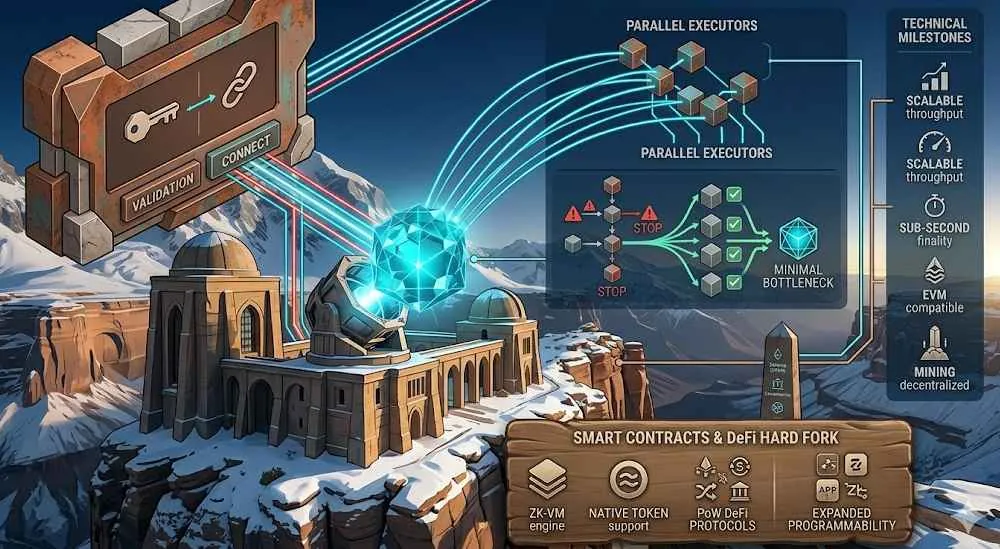
Scalability meets future-proof math. Our 2026 guide explains what Starknet is, the power of the Cairo language, and why ZK-STARKs are the ultimate solution for Ethereum's growth.
What is Starknet? Cairo and ZK Rollup Explained
The scalability of the Ethereumblockchain has been the primary focus of developers for years. While the mainnet provides unparalleled security and decentralization, its limited throughput has often led to network congestion and prohibitive fees. This challenge birthed the "Rollup" era. Among the various solutions, Zero-Knowledge (ZK) Rollups are considered the "end-game" for scaling. If you are asking what is Starknet, you are looking at a leading Permissionless decentralized Validity-Rollup (often referred to as a ZK-Rollup) that operates as an L2 network over Ethereum.
By mid-2026, Starknet has moved beyond its early experimental phase, establishing itself as a specialized environment for high-performance dApps that require massive computational scale without sacrificing the cryptographic integrity of the underlying layer. For the DEXTools community, Starknet represents a frontier where complex trading strategies and fully on-chain gaming become economically viable.
The Mathematical Foundation: How ZK-STARKs Work
To understand the network, one must grasp the difference between "Optimistic" and "Validity" rollups. While Optimistic rollups assume transactions are valid unless proven otherwise, Starknet uses validity proofs.
The protocol utilizes STARKs (Scalable, Transparent ARguments of Knowledge), a type of cryptographic proof system. Instead of processing every transaction on the Ethereum mainnet, Starknet bundles thousands of transactions into a single batch and generates a "proof" that these transactions were executed correctly.
Integrity without Trust: Ethereum only needs to verify the proof, rather than re-executing each transaction. This drastically reduces the burden on the L1.
Scale: In 2026, Starknet's proof-generation has reached a point where it can process thousands of transactions per second, with fees that are consistently a fraction of a cent.
Cairo: The Language of Provable Programs
A defining feature of the project is its native programming language, Cairo (CPU-Algebraic Intermediate Representation). Unlike other L2s that simply copy the Ethereum Virtual Machine (EVM), Starknet chose to build a language specifically designed for STARK proofs.
When developers ask what is Starknet in the context of coding, the answer is "the home of Cairo." This language allows for:
Provable Computation: Every program written in Cairo generates a STARK proof by default, making it the most efficient environment for complex on-chain logic.
Native Account Abstraction: Starknet does not use traditional "Externally Owned Accounts" (like a standard MetaMask seed). Instead, every account is a smart contract. This allows for features like FaceID signing, daily spend limits, and social recovery natively at the protocol level.
STARK vs SNARK: Why Starknet Chose Transparency
In the broader ZK ecosystem, there is a constant debate between STARKs and SNARKs. Starknet’s choice of STARK technology is pivotal to its long-term vision.
Quantum Resistance: STARKs are rely on hash functions, making them theoretically resistant to future quantum computing attacks.
No Trusted Setup: Unlike SNARKs, which often require a "trusted setup" ceremony, STARKs are transparent. There is no hidden "toxic waste" or cryptographic secrets that could compromise the network if leaked.
By 2026, as quantum computing discussions move closer to reality, the choice of STARKs has positioned this ecosystem as one of the most future-proof infrastructures in the modular stack.
The STRK Token: Staking and Governance in 2026
The STRK token has evolved into a multi-utility asset following the major upgrades of early 2026. It is no longer just a governance token; it is the fuel and security of the network:
Staking for Security: As of 2026, STRK staking is fully operational. Holders can delegate their tokens to sequencers and provers, earning rewards while securing the decentralized infrastructure.
Transaction Fees: While the network still supports ETH for gas, STRK is increasingly used as the primary fee token, creating a circular economy within the L2.
Governance: The Starknet Foundation utilizes a decentralized voting mechanism where STRK holders decide on protocol upgrades, such as the recent v0.14.0 performance enhancements.
On DEXTools, tracking the volume and liquidity of STRK and its ecosystem tokens (like those from Ekubo or Nostra) provides a clear indicator of the growing "Starknet Summer" sentiment.
Performance Milestones and "The Quantum Leap"
Throughout 2025 and 2026, Starknet underwent a series of upgrades known as the "Quantum Leap" and "The Warp Drive." These focused on reducing block latency and increasing throughput.
Sub-second Block Times: The introduction of the high-speed sequencer in 2026 has brought confirmation times down to sub-second levels, making the trading experience on Starknet DEXs indistinguishable from centralized platforms.
EVM Compatibility via Kakarot: While Cairo is the native language, the "Kakarot ZK-EVM" now allows Ethereum developers to deploy their existing Solidity dApps on Starknet without changing their code, bridging the gap between the two ecosystems.
Starknet on DEXTools: Exploring the Frontier
Trading on Starknet requires a specialized wallet like Argent or Braavos due to its account abstraction. Once connected, users can explore a unique landscape of dApps.
Using DEXTools, you can monitor the burgeoning Starknet DeFi scene. The network is particularly famous for its "Concentrated Liquidity" pools, which offer higher capital efficiency for traders. Because transaction costs are so low, liquidity providers on Starknet can rebalance their positions far more frequently than on Ethereum L1, resulting in less slippage for users and higher returns for LPs.
Security Checklist for Starknet Users
When exploring what is Starknet, security remains paramount. Even with cryptographic proofs, user-side security is essential:
Contract-Based Wallets: Remember that your wallet is a smart contract. Ensure you have set up "Guardians" or social recovery features offered by Argent and Braavos.
Verify the Prover Status: You can use "Starkscan" or "Voyager" (the network's block explorers) to see when your transaction has been "Accepted on L1." This is the moment your transaction inherits Ethereum's full security.
Bridge Safely: Always use the official StarkGate bridge or trusted third-party bridges like Orbiter Finance when moving ETH from L1 to L2.
Conclusion
Understanding what is Starknet means looking at the frontier of what blockchain technology can achieve. By moving away from the limitations of the EVM and embracing the power of Cairo and STARK proofs, the network has built a scalable, future-proof, and highly programmable layer for the next generation of the internet. As we progress through 2026, the maturity of the STRK token and the expansion of the ZK-EVM ecosystem make Starknet a cornerstone for any serious DeFi participant or developer.
Disclaimer: This article is for informational purposes only and does not constitute investment advice, financial advice, trading advice, or any other kind of advice. DEXTools does not recommend buying, selling, or holding any cryptocurrency or token. Users should conduct their own research and consult with a qualified financial advisor before making any investment decisions. Cryptocurrency investments are volatile and high-risk. DEXTools is not responsible for any losses incurred.
Starknet is a leading permissionless decentralized validity-rollup that functions as a Layer 2 network over Ethereum, designed to enhance scalability while maintaining the security of the mainnet.
What programming language does Starknet use?
Starknet employs Cairo, a programming language specifically created for generating STARK proofs, allowing developers to write efficient on-chain logic.
What is the STRK token used for in Starknet?
The STRK token serves multiple purposes, including staking for network security, paying transaction fees, and participating in governance decisions regarding protocol upgrades. As of 2026, it has become integral to the network's economy and functionality.
How does Starknet ensure security against quantum computing?
Starknet utilizes STARKs, which rely on hash functions that are theoretically resistant to quantum computing threats. This choice eliminates the need for a trusted setup, enhancing the transparency and security of the network.
What are the benefits of using Starknet for decentralized applications?
Starknet offers high throughput and low transaction fees, making it an ideal environment for complex decentralized applications that require significant computational resources.