Is XRP a Stablecoin or an Altcoin? Full 2026 Guide

Is XRP a stablecoin or an altcoin? A full 2026 guide to XRP classification, RLUSD comparison, the SEC outcome, supply cap, and bridge currency role.
If you have ever asked the question "is XRP a stablecoin", you are far from alone. Every week, thousands of new crypto buyers type that exact phrase into Google because XRP looks different from the other major coins on the market. It trades in fractions of a dollar, it is backed by a real San Francisco company, it is used by banks, and it has its own ticker, its own ledger, and its own dedicated army of long-term holders. So is XRP a stablecoin pegged to the US dollar? Is it an altcoin? Is it a security? Or is it something else entirely?
The short answer, and the one we will defend with evidence in this guide, is simple: XRP is an altcoin, not a stablecoin. It is the native cryptocurrency of the XRP Ledger (XRPL), it is volatile by design, and it sits in a special category that most analysts now call a "payment token" or "bridge currency". Ripple, the company that helped create XRP, did launch its own dollar-pegged stablecoin called RLUSD in late 2024, but RLUSD and XRP are two completely different assets that just happen to live in the same ecosystem.
In this 2026 deep dive we will break down the definitions of stablecoin and altcoin, explain why XRP fits one bucket and not the other, walk through XRP's history, supply schedule, and SEC case outcome, compare XRP side by side with USDT, USDC, RLUSD, BTC and ETH, and finish with a long FAQ that answers every variation of "what kind of coin is XRP" we see in the search results. By the end you will be able to explain XRP's classification at a dinner party without flinching.
Quick Answer: Is XRP a Stablecoin or an Altcoin?
XRP is the native cryptocurrency of the XRP Ledger and is classified as an altcoin, defined as any cryptocurrency that is not Bitcoin. It is not a stablecoin because its price is not pegged to the US dollar, the euro, or any other external asset. XRP is volatile, with historical prices ranging from below $0.10 to above $3.80, while a true stablecoin like USDC or Ripple's own RLUSD targets a fixed $1.00 value. Most analysts categorize XRP as a "payment token" or "bridge currency" within the broader altcoin umbrella.
What Is a Stablecoin (and Why XRP Does Not Qualify)
A stablecoin is a cryptocurrency whose price is deliberately pinned to the value of another asset, almost always a major fiat currency like the US dollar or the euro, occasionally to commodities like gold, and in some experimental cases to baskets of other crypto assets. The defining feature of a stablecoin is mechanical: its issuer or smart contract design takes active steps to ensure that one token can always be redeemed for, or is always worth, one unit of the underlying asset. If you hold one USDT, the issuer Tether claims that one US dollar of reserves is sitting in a bank account ready to back it. The whole point of the token is to remove price volatility from the crypto experience.
Stablecoins fall into three rough families. Fiat-collateralized stablecoins like Tether (USDT), USD Coin (USDC), PayPal USD (PYUSD), and Ripple's RLUSD hold real-world dollars, treasury bills, and cash equivalents in reserve. Crypto-collateralized stablecoins like MakerDAO's DAI lock up volatile crypto assets (mostly ETH and tokenized treasuries) in smart contracts that overcollateralize the peg. Algorithmic stablecoins try to maintain the peg through code-driven supply and demand mechanics, and have an uneven safety record after the collapse of TerraUSD in 2022. All three families share the same goal: a token that does not move.
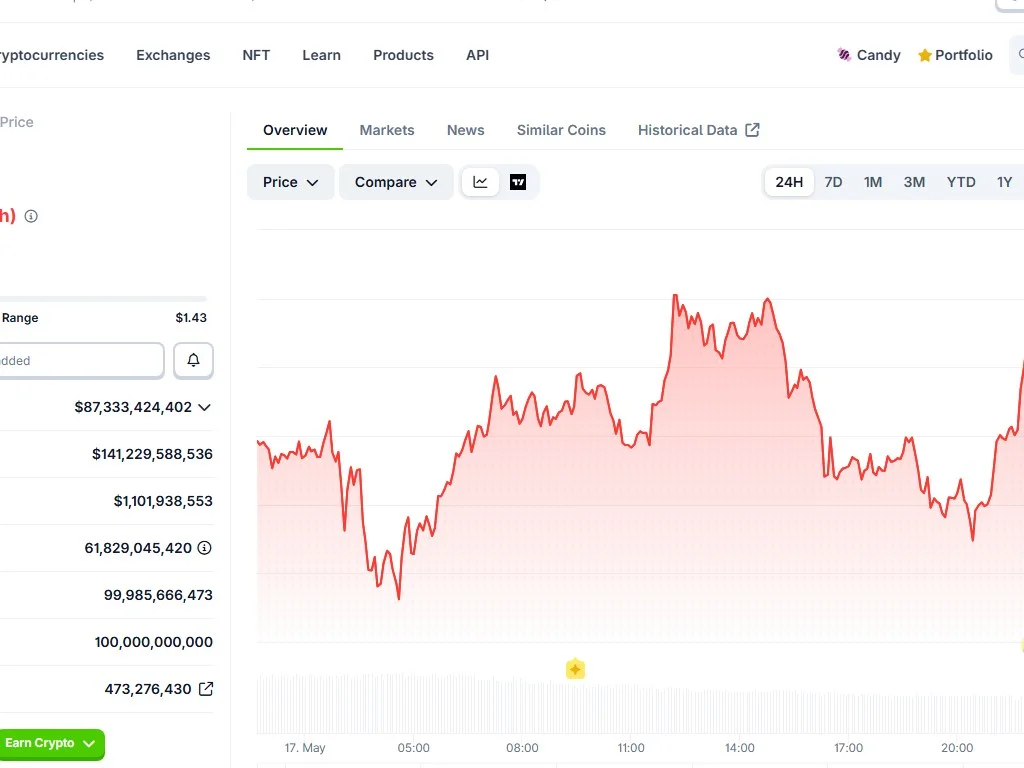
XRP fails the stablecoin test on every axis. There is no reserve account behind it, no overcollateralization vault, and no algorithm trying to hold its price at any specific level. Its market price is set by open trading on hundreds of exchanges around the world, and that price moves constantly. In 2017 XRP traded under one cent. By January 2018 it briefly touched $3.84. It then spent years between $0.20 and $0.60 during the SEC lawsuit. In 2024 and 2025 it ran back into the multi-dollar range. A holder who bought "XRP because it sounded stable" would have experienced gains and losses that no real stablecoin ever delivers.
If a coin moved 50% in either direction over the last year, it is not a stablecoin. By that definition XRP, BTC, ETH, SOL and BNB are all volatile altcoins, while USDT, USDC, DAI and RLUSD are stablecoins.
What Is an Altcoin (and Why XRP Clearly Qualifies)
The word "altcoin" is a contraction of "alternative coin", and the entire industry uses a single, very simple definition: any cryptocurrency that is not Bitcoin. Ethereum is an altcoin. Solana is an altcoin. Dogecoin is an altcoin. XRP is an altcoin. The label has nothing to do with whether a project is good, bad, useful, or speculative. It is a structural classification that exists purely to separate Bitcoin (the original asset and the largest by market capitalization) from everything that came after it.
Inside the altcoin category, analysts then carve up the universe into sub-buckets based on what each token actually does. Smart contract platforms (ETH, SOL, AVAX, SUI), DeFi governance tokens (UNI, AAVE, CRV), liquid staking tokens (stETH, rETH), liquid staking derivatives, payment tokens (XRP, XLM, LTC), privacy coins (XMR, ZEC), meme coins (DOGE, PEPE, SHIB), and real-world asset tokens like the ones covered in our RWA tokenization guide all sit under the same umbrella. XRP belongs in the payment token sub-category alongside Stellar's XLM and Litecoin's LTC.
Within the altcoin world, XRP is also classified by market capitalization tier. With a market cap consistently in the tens of billions of dollars, it sits firmly in the "large-cap altcoin" tier, alongside ETH, SOL, BNB and a small handful of others. CoinMarketCap, CoinGecko and DEXTools all categorize XRP in their "Top 10 by Market Cap" filter rather than in any small-cap or experimental tier.
A Brief History of XRP, Ripple Labs, and the XRP Ledger
To really understand why "is XRP a stablecoin" is the wrong question, it helps to know where XRP came from. The XRP Ledger was launched in 2012 by David Schwartz, Jed McCaleb and Arthur Britto. Their goal was to create a faster, cheaper, more energy-efficient alternative to Bitcoin specifically tuned for payment settlement. Bitcoin's proof of work consensus was secure but slow, requiring around ten minutes per block. The XRP Ledger used a different mechanism, the XRP Ledger Consensus Protocol, that allowed validator nodes to agree on transactions in three to five seconds without the energy footprint of proof of work mining.
At genesis, the XRP Ledger created exactly 100 billion XRP tokens. There was no mining process. Every XRP that will ever exist already existed on day one. A large portion of that supply was gifted to the company that became Ripple Labs (with co-founders also retaining significant personal holdings), which used the asset to fund development, on-board financial institutions, and seed liquidity on exchanges. To manage market supply responsibly, Ripple later placed 55 billion XRP into a series of monthly cryptographic escrows, releasing up to one billion per month back into the open market and returning unused portions to escrow.
Ripple the company built RippleNet, a messaging and settlement network for banks, and a product called On-Demand Liquidity (ODL) that uses XRP as the bridge asset between two fiat currencies. A Mexican bank wanting to send pesos to the Philippines can convert MXN to XRP, send the XRP across the ledger in seconds, and have a partner convert it to PHP on the other side, all without pre-funded nostro/vostro accounts. That use case is the reason XRP is constantly described as a "bridge currency", a term we will dig into below.
How XRP Actually Works Under the Hood
XRP runs on the XRP Ledger, a public, permissionless, byzantine fault-tolerant blockchain that has been producing ledgers continuously since 2012. Instead of relying on miners to compete for blocks the way Bitcoin does, the XRP Ledger uses a network of independent validator nodes that vote on which transactions belong in the next ledger. A new ledger is closed every three to five seconds, and a transaction is considered final as soon as it appears in a validated ledger. There is no waiting for "six confirmations" the way users often do on the Bitcoin chain.
Every XRP transaction destroys a tiny amount of XRP as a network fee, currently around 0.00001 XRP (a fraction of a US cent). This burn mechanism gradually reduces the circulating supply over time and protects the network against spam attacks. Wallets must also hold a small reserve in XRP (currently 1 XRP) to remain active, which contributes to the slow but steady decline in the theoretical maximum supply.
XRPL is not just a payment network. Since the introduction of features like XLS-20 NFTs, the AMM amendment, the Hooks amendment and the Clawback feature, the ledger supports native non-fungible tokens, automated market makers similar in spirit to Uniswap V4 hooks, micro-smart-contract logic and issuer-controlled tokens. RLUSD itself is issued as an IOU on the XRP Ledger (and, in parallel, as an ERC-20 token on Ethereum), using the ledger's native issued-currency model.
XRP vs RLUSD: Two Tokens From the Same Family
The launch of RLUSD by Ripple in December 2024 sharpened the line between XRP and stablecoins in a very useful way. RLUSD is Ripple's regulated, dollar-pegged stablecoin, fully backed by US dollar deposits, short-term US Treasuries and cash equivalents, issued under a New York Department of Financial Services (NYDFS) trust charter, and audited regularly. Each RLUSD targets a value of exactly $1.00. RLUSD is what XRP is not.
At the same time, XRP is what RLUSD is not. XRP has a fixed maximum supply, lives natively on the XRP Ledger, has a market price that floats freely, can appreciate (or depreciate) over years, and is treated for tax purposes as a property-like asset in most jurisdictions. RLUSD will never go to $5 and never go to $0.50 if everything works as designed. XRP regularly does both.
The interesting thing is that XRP and RLUSD complement each other. A bank can hold value in RLUSD when it wants stability and convert into XRP only for the few seconds it takes to bridge a payment across two illiquid currency pairs. Many of the trading pairs that now appear on XRPL DEX (and that you can monitor through DEXTools) involve RLUSD on one side and XRP on the other, exactly because they fill opposite roles in the same liquidity stack.
XRP vs USDT, USDC, BTC and ETH: The Full Comparison
To put XRP's classification into context, here is how it compares with the other most-searched tokens in the market. This is the table to bookmark the next time a friend asks you "wait, is XRP basically like Tether?".
Two takeaways from this table. First, "altcoin" is a much broader category than most people realize: it includes every coin that is not Bitcoin, so even USDT and USDC are technically altcoins, even though no one calls them that in casual conversation. Second, "stablecoin" is a narrow, mechanical category that XRP simply does not belong to.
Is XRP a Security, a Commodity, or a Currency? The SEC Case Outcome
For years, the most heated debate about XRP was not whether it was a stablecoin but whether it was a security. In December 2020 the United States Securities and Exchange Commission (SEC) sued Ripple Labs, alleging that XRP was an unregistered security and that its sales had violated US securities laws. That lawsuit froze XRP off many US exchanges, suppressed its price for years, and turned XRP holders into amateur courtroom analysts.
In July 2023, Judge Analisa Torres issued a partial summary judgment that became the defining moment for XRP's classification. The ruling drew a careful distinction: institutional sales of XRP by Ripple to sophisticated buyers (where written contracts and marketing materials existed) were investment contracts under the Howey Test and therefore securities. Programmatic sales on public exchanges, however, where buyers had no idea who was on the other side of their trade, did not constitute securities transactions. The token itself was deemed not inherently a security.
That distinction, refined further in 2024 and 2025 settlement and appeals activity, gave US exchanges enough confidence to relist XRP. Today XRP is widely traded on Coinbase, Kraken, Bitstamp, Binance.US (where available), Gemini and almost every other major venue, and an XRP spot ETF was approved in early 2025, opening the door to traditional brokerage access. For an in-depth look at that side of the story, see our companion piece on the XRP ETF and what it means for liquidity.
- XRP itself is not a security in US case law.
- Some past institutional sales were securities transactions.
- XRP is closer to a commodity or currency than a stock.
- An XRP spot ETF is approved and trading.
- None of this makes XRP a stablecoin.
XRP as a Bridge Currency: Why People Confuse It With "Stable"
Half the reason people search "is XRP a stablecoin" is because of how XRP is used inside RippleNet and On-Demand Liquidity. When a payment provider needs to send value between, say, the Philippine peso and the Mexican peso, they may not find a direct PHP/MXN trading pair with deep liquidity. Instead, they convert PHP into XRP, send the XRP across the XRP Ledger in three to five seconds, and convert the XRP into MXN on the other end. From the provider's accounting perspective, the value never actually "sat" in XRP for any meaningful time, and the price exposure was effectively zero.
That ultra-short holding period creates the illusion of stability. In a five-second window, XRP's price almost never moves enough to matter. But "the price did not move during the transaction" is not the same as "the price is pegged". XRP's price absolutely moves over hours, days and months. A user who buys XRP and holds it for a year takes full market exposure, just like with BTC or ETH. The bridge currency role is a use case, not a price property.
The role of XRP as a bridge becomes especially powerful in the stablecoin era. Picture a corridor where on one side traders hold USDT, on the other side traders hold EURT, and on a third side traders hold RLUSD. XRP can sit in the middle as a high-velocity router, soaking up sell pressure from one stablecoin and routing it into buy pressure on another. This is similar in spirit to how DEX aggregators like 1inch route trades across multiple liquidity pools, just at the protocol level rather than the application level.
CBDCs, Stablecoins, and the Future Role of XRP
Central Bank Digital Currencies (CBDCs) are another reason XRP's classification matters in 2026. Ripple has been working with central banks in countries including Bhutan, Palau, Montenegro, Colombia and Hong Kong on CBDC pilots, and the CBDC platform that Ripple offers is built on a private fork of the XRP Ledger. In several proposed designs, XRP itself acts as a neutral bridge between different CBDCs, again because it has no national affiliation and settles in seconds.
None of that makes XRP a CBDC, and none of it makes XRP a stablecoin. A CBDC is digital fiat issued by a central bank. A stablecoin is a private-sector token that targets a fiat peg. XRP is an open-market, supply-capped, volatile crypto asset that can move value between any two of them. Each plays a distinct role, and the cleanest way to think about it is layered: CBDCs and stablecoins sit at the "value" layer, while XRP and other bridge assets sit at the "movement" layer.

How to Tell if a Crypto Is a Stablecoin or an Altcoin (Step by Step)
If you ever want to classify a new token without relying on hype, here is a simple checklist that works for XRP and for any other asset.
XRP in DeFi, RWAs and the Modern Crypto Stack
Despite its banking-first origin story, XRP is now deeply integrated into the broader DeFi stack. The XRP Ledger has a native AMM, native NFTs, and a growing list of tokenized assets, including treasuries and real-world assets similar to those covered in our piece on tokenized treasuries and RWAs. Bridging solutions also allow wrapped XRP (wXRP) to participate in Ethereum-based DeFi protocols, where it can be supplied as collateral, used in liquidity pools, or borrowed against.
On EVM chains, XRP frequently appears in trading pairs against major stablecoins (USDT, USDC, RLUSD) and in cross-chain routes constructed by aggregators. If you have read our explainer on DeFi and decentralized finance, you already understand the general architecture, lending, borrowing, AMMs, yield farming, liquid staking, and you can simply substitute XRP into any of those positions. The asset's role might be different from ETH's role (XRP is rarely a gas token outside XRPL), but its presence in DeFi is real and growing.
For market data and pair-level analytics, the cleanest workflow is to use a tool like DEXTools to scan XRPL DEX pools and EVM pools that contain XRP. You can monitor liquidity, volume, and pair-level price action across venues. If you want to deepen your skill set around chart reading, we recommend pairing this article with our guides on VWAP in crypto and backtesting.
XRP Risks and Misconceptions
Like every crypto asset, XRP comes with risks that beginners should understand before buying. Honest education beats hype every time.
XRP can drop 30% in a week. If you wanted stability, hold a real stablecoin like USDC or RLUSD, not XRP.
A meaningful portion of XRP supply sits in Ripple-related escrows. Monthly unlocks add sell pressure that traders watch closely.
Even with the SEC case largely resolved, future US and EU rules could change how XRP is sold or marketed in specific jurisdictions.
Lose your seed phrase or send to the wrong address and your XRP is gone. Review our wallet security tips first.
There are also persistent misconceptions worth clearing up. XRP is not "centralized" in the sense of being controlled by Ripple Labs (the validator network is independent), but it is more concentrated at the supply level than Bitcoin. XRP is not "pre-mined" in the proof-of-work sense (it was simply created at genesis). And, critically for this article, XRP is not a stablecoin and never has been.
XRP Market Cap, Supply Schedule and the 100B Cap
XRP has a fixed maximum supply of 100 billion tokens. That figure is hard-coded into the XRP Ledger and cannot be increased. The circulating supply is somewhat smaller because of escrow holdings and the small amounts of XRP burned with every transaction. The market capitalization formula for XRP is the same as for any other asset: Market Cap = Price x Circulating Supply. If you want a full deep dive on this, see our companion guide on the XRP market cap formula and what it actually means.
The 100B supply cap is much larger than Bitcoin's 21M cap, which is part of why XRP trades at a much lower unit price than BTC. A common beginner mistake is to compare unit prices ("XRP at $2 must be cheap, BTC at $80,000 must be expensive"). What matters is market capitalization and fully diluted valuation, not unit price. A 100B supply at $2 implies a $200B market cap, which is a serious large-cap valuation.
Monthly escrow releases (up to 1B XRP per month, with the unused portion returned to escrow) are public, transparent and tracked by every major data provider. This visibility into supply mechanics is part of what differentiates XRP from many smaller altcoins, where token unlocks happen quietly and can blindside holders.
Pros and Cons of XRP at a Glance
- 3 to 5 second settlement on the XRP Ledger
- Sub-cent transaction fees
- No energy-intensive mining
- Real institutional usage in payments
- Top 10 market cap, deep global liquidity
- Spot ETF approved in 2025
- Volatile price (definitely not a stablecoin)
- Supply concentration in escrows
- Validator set perceived as less decentralized than BTC
- Past regulatory overhang in the US
- Smaller DeFi ecosystem than Ethereum or Solana
- Often confused with the company Ripple Labs
Best Practices for Buying, Holding and Tracking XRP
If after all of this you decide XRP fits your strategy as a long-term hold or a tactical trade, a few best practices apply. Buy from a reputable exchange that supports XRP withdrawals to a real XRPL address (some exchanges hold XRP internally without giving you control of the underlying token). Self-custody using a hardware wallet that supports XRPL, and remember the activation reserve requirement before sending small amounts to a new wallet. Set up watchlists that include both XRP and RLUSD so that you can monitor the spread and bridge behavior between them.
For active traders, use our resources on long vs short positions, liquidation zones and detecting fake volume to develop an analytical workflow that goes beyond price. XRP, like any large-cap, has its own behavioral patterns that respond to ETF inflows, monthly escrow unlocks, and macro liquidity cycles.
For passive holders, treat XRP the way you would treat any other volatile altcoin: position-size based on your overall portfolio, keep emergency funds in real stablecoins (not in XRP), and avoid the common trap of believing a single asset will dominate the entire crypto market. The right comparison for XRP is "another large-cap payment-focused crypto", not "a USD-pegged token".
XRP and the Bigger Stablecoin / RWA Story
Zoom out from XRP for a moment and look at the wider 2026 landscape. Stablecoins now move trillions of dollars in annual settlement volume across chains. Real-world assets (tokenized treasuries, money market funds, private credit) are growing at triple-digit annual rates. Liquid staking tokens like rETH and stETH, covered in our Rocket Pool guide, have turned ETH itself into a yield-bearing asset. Oracle networks like Pyth (see our Pyth Network explainer) and Chainlink stream prices for thousands of assets directly to smart contracts. RWA platforms like Ondo (covered in our Ondo Finance and tokenized treasuries piece) put US Treasury bills on chain.
Inside this larger picture, XRP plays the role of a neutral, supply-capped, high-throughput payment rail. It is not the dollar, it is not the treasury bill, it is not the yield-bearing token, it is not the gas token of a smart contract platform. It is the asset that can sit briefly in between any two of those things and move value across the gap. That is a useful role even (perhaps especially) in a world where stablecoins dominate the on-chain dollar narrative.
Understanding this role is what makes the "is XRP a stablecoin" question feel almost backwards once you have walked through the full picture. XRP is the opposite of a stablecoin in design, but it works hand in hand with stablecoins in practice. The two categories complete each other rather than competing.
Frequently Asked Questions
Q Q Q Is XRP a stablecoin?
No. XRP is not a stablecoin. It is not pegged to the US dollar, the euro, or any other asset. Its price floats freely on the open market and can move significantly in either direction over hours, days, or months. If you need a Ripple-issued stablecoin, the correct asset is RLUSD, which is a separate, dollar-pegged token launched in late 2024.
Q Q Q Is XRP an altcoin?
Yes. Any cryptocurrency that is not Bitcoin is technically an altcoin, and XRP fits that definition. More specifically, XRP is classified as a large-cap altcoin in the payment token sub-category, alongside assets like Stellar (XLM) and Litecoin (LTC).
Q Q Q What is the difference between XRP and Ripple?
Ripple is a private US-based fintech company that builds payment and liquidity products like RippleNet and On-Demand Liquidity. XRP is a public, permissionless cryptocurrency that lives on the XRP Ledger. Holding XRP does not make you a shareholder of Ripple, and Ripple does not technically own the XRP Ledger.
Q Q Q Is XRP backed by anything?
No, XRP is not backed by any reserve of dollars, gold, or other assets. Its value comes from market demand, utility on the XRP Ledger, its role as a bridge currency, and supply scarcity from the fixed 100 billion cap. Stablecoins like USDT, USDC, and RLUSD are backed by reserves. XRP is not.
Q Q Q What is RLUSD and how is it different from XRP?
RLUSD is Ripple's regulated, US dollar-pegged stablecoin, issued under a New York Department of Financial Services charter and backed by US dollar deposits and short-term US Treasuries. It targets a $1.00 value at all times. XRP, by contrast, is a volatile cryptocurrency with no peg and no fiat backing. RLUSD provides stability, XRP provides movement.
Q Q Q What is the maximum supply of XRP?
The maximum supply of XRP is 100 billion tokens, all created at the launch of the XRP Ledger in 2012. The circulating supply is smaller because of escrow holdings and the small amounts of XRP burned on every transaction. Unlike Bitcoin, XRP is not mined.
Q Q Q Is XRP a security or a commodity?
Following the SEC vs Ripple case, US courts have ruled that XRP itself is not inherently a security. Programmatic sales on public exchanges are not securities transactions, although certain past institutional sales were. In practice, XRP is treated more like a digital commodity or currency than a stock or bond, which is why a spot XRP ETF was approved in 2025.
Q Q Q Why do banks use XRP if it is volatile?
Banks and payment providers using XRP through On-Demand Liquidity only hold the asset for a few seconds while a cross-border payment settles. Over a 3 to 5 second window, XRP's price barely moves, so the volatility risk is minimal. The bank converts fiat to XRP, sends it, and converts back to a different fiat, all in one near-instant flow.
Q Q Q Is XRP a meme coin?
No. Meme coins like DOGE, SHIB, or PEPE are built around community sentiment and social trends with little or no utility. XRP was engineered for cross-border payments and enterprise settlement and has been used by financial institutions for years. It has a passionate community, but its underlying purpose is utility, not memes.
Q Q Q How is XRP categorized on CoinMarketCap and CoinGecko?
On both CoinMarketCap and CoinGecko, XRP is listed under categories like "Payments", "Centralized Exchange Tokens" (because of its role in Ripple's products), "Enterprise Solutions" and "Layer 1". It is never listed under "Stablecoin". It sits in the top tier by market capitalization, generally inside the top 10.
Q Q Q Can XRP ever become a stablecoin?
Not without changing what XRP is. A stablecoin requires a pegging mechanism, an issuer responsible for redemptions, and reserves backing the peg. XRP has none of these. Ripple specifically launched RLUSD to fill the stablecoin role precisely because XRP cannot serve that function. The two assets are designed to coexist.
Q Q Q What makes XRP unique among altcoins?
XRP is unique for several reasons. It uses a federated byzantine agreement consensus instead of proof of work or proof of stake. It settles in 3 to 5 seconds with sub-cent fees. It was designed from day one for payments rather than smart contracts or speculation. It has deep institutional usage through RippleNet. And it now sits alongside Ripple's own stablecoin RLUSD as part of a layered Ripple ecosystem.
Conclusion: XRP Is an Altcoin, Not a Stablecoin, and That Is the Point
If you came into this article asking "is XRP a stablecoin", the answer is a confident no. XRP is an altcoin, and within the altcoin universe it sits in the payment token sub-category, used as a high-speed bridge currency between fiat pairs, stablecoins, and (increasingly) CBDCs. Its price is volatile because it is not designed to be stable; that role in the Ripple ecosystem belongs to RLUSD, the dollar-pegged stablecoin launched in 2024.
Understanding this distinction matters more than ever in 2026. The combined market for stablecoins, real-world assets and tokenized money is now measured in hundreds of billions of dollars, and the language people use to describe these assets is becoming more precise. Knowing that XRP is a payment-focused altcoin (not a stablecoin, not a stock, not a meme coin, not Ripple equity) puts you ahead of the average crypto buyer who still mixes these categories up in casual conversation.
If you want to keep building this base of crypto literacy, our explainer on how cryptocurrencies work is the cleanest starting point, and our guide to Ethereum for beginners is the next logical step if you want to understand the smart contract side of the industry. Whichever direction you go, you can now answer the "is XRP a stablecoin" question without hesitation.
Open the XRP Ledger DEX and EVM pair explorers to monitor live prices, liquidity, and volume across XRP, RLUSD, USDT, USDC and other major pairs. Labels matter less than liquidity, so let real on-chain data guide your next move.
Disclaimer: This article is for informational and educational purposes only and does not constitute investment, financial, legal or tax advice. DEXTools does not recommend buying, selling, or holding any cryptocurrency, token, or stablecoin. Cryptocurrency markets are highly volatile and carry substantial risk. Always conduct your own research and consult a qualified financial advisor before making investment decisions.
Related Guides
- What Is an Altcoin: Complete Guide to Alternative Cryptocurrencies (2026)
- What Is Altseason? Altcoin Rotation Signals and Cycle Phases (2026)
- Who Created ETH and When Was It Founded? Full History 2026
- What Is Tenderly: Web3 Simulation, Debugging and Full-Stack Infrastructure (2026)
- What Is Anchored VWAP in Crypto? Full Trader Guide (2026)