Active Contracts vs Contract Deployments: Which Better Shows Real Developer Adoption?
— By Whatsertrade in Tutorials

Developer activity is one of the strongest signals in crypto. When more teams build on a blockchain, the ecosystem can attract users, liquidity, applications an
Developer activity is one of the strongest signals in crypto. When more teams build on a blockchain, the ecosystem can attract users, liquidity, applications and long term value. But measuring developer adoption is not always simple.
Many people look at contract deployments as a sign of growth. If thousands of new contracts are deployed, it may seem like developers are building heavily on the network. However, deployments alone can be misleading.
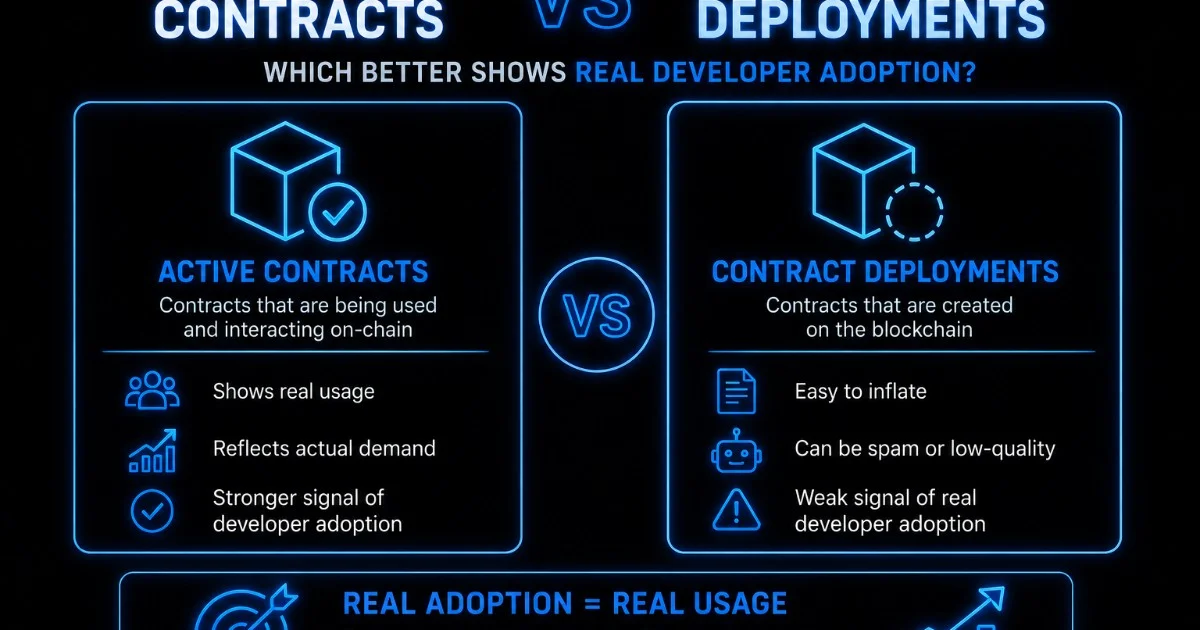
A better signal may be active contracts. These show whether deployed contracts are actually being used.
Understanding active contracts vs contract deployments helps traders and analysts separate real ecosystem growth from empty development activity.
What Are Contract Deployments?
Contract deployments measure how many new smart contracts are created on a blockchain.
A smart contract may support a token, a DEX pool, a lending market, an NFT collection, a game, a bridge or another on chain application.
High contract deployments can suggest that developers are experimenting, launching products or testing new ideas. This can be positive for a network.
However, deployments do not prove that users are interacting with those contracts.
What Are Active Contracts?
Active contracts are smart contracts that receive real interactions over a period of time.
This may include swaps, deposits, withdrawals, votes, mints, claims, transfers or other contract calls.
Active contracts show whether applications are being used after deployment. A network with many active contracts may have stronger application demand than a network with many abandoned deployments.
Active Contracts vs Contract Deployments: The Key Difference
The key difference is creation vs usage.
Contract deployments show how many smart contracts were created. Active contracts show how many smart contracts are actually being used.
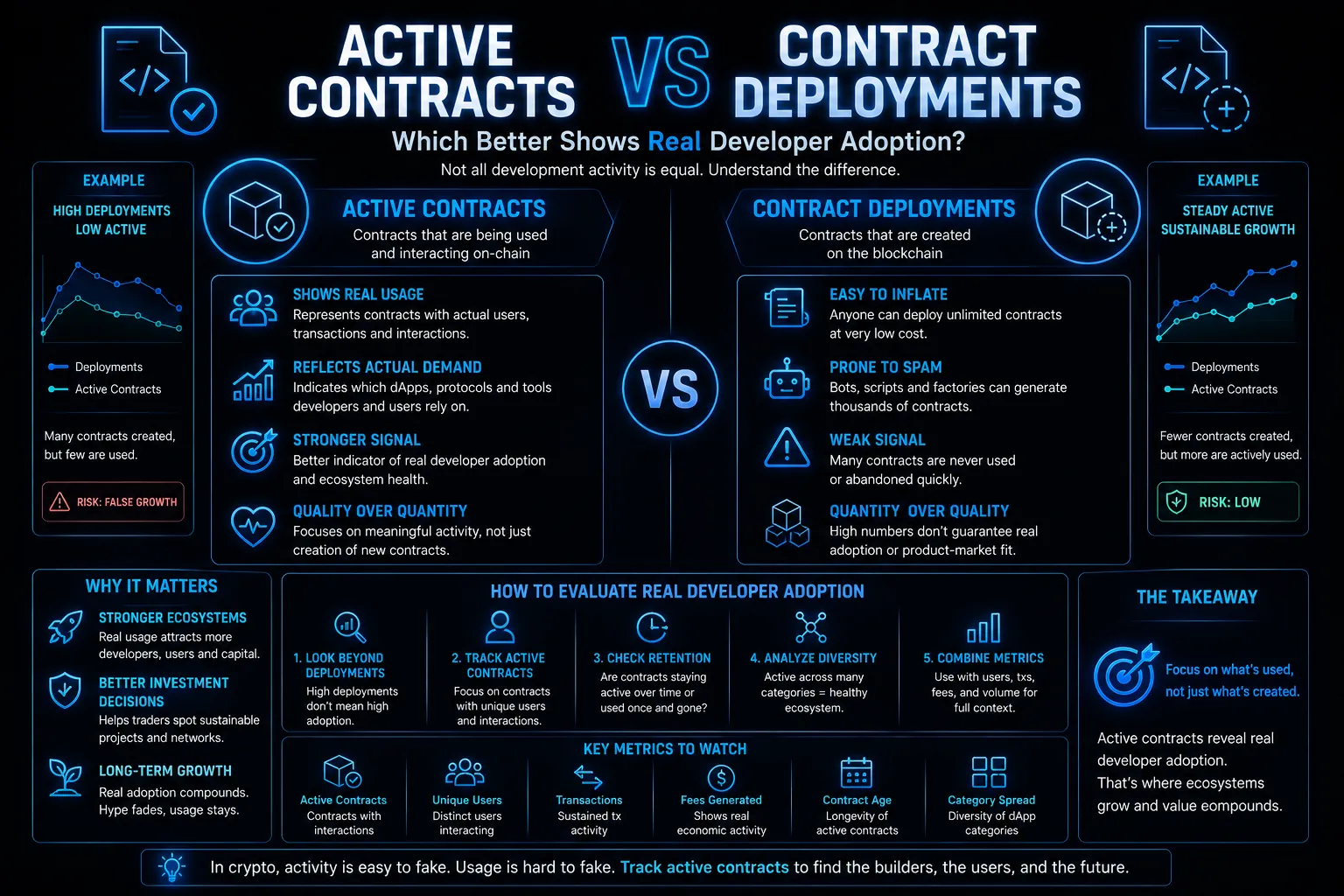
A blockchain can have high deployments but low active contract activity. That may indicate testing, spam, abandoned projects or short lived campaigns.
A blockchain with steady active contract growth may show stronger real developer adoption.
Why Contract Deployments Can Be Misleading
Contract deployments can be inflated.
Developers may deploy multiple versions of the same contract. Bots can create contracts automatically. Airdrop campaigns may encourage users to deploy simple contracts. Test projects may never become real applications.
A network may look active because many contracts are created, but most of them may never attract users.
This is why contract deployments should be treated as an early signal, not a final proof of adoption.
Why Active Contracts Matter More
Active contracts show whether users and developers continue interacting with applications.
If more contracts stay active over time, it suggests that the ecosystem is not only producing code, but also generating usage.
Active contracts can reveal whether a blockchain has real application depth. They can also show whether development activity is distributed across many products or concentrated in only a few apps.
For traders, this matters because real usage can support stronger network narratives.
What Real Developer Adoption Looks Like
Real developer adoption usually includes:
Rising active contracts.
New deployments that continue receiving usage.
Multiple application categories.
Growth across DeFi, gaming, NFTs, infrastructure and consumer apps.
Developer retention over time.
Increasing contract interactions from unique users.
Healthy liquidity around ecosystem tokens.
The strongest signal is not a one time spike in deployments. It is sustained activity after deployment.
When Active Contracts Can Also Mislead
Active contracts are better than deployments, but they are not perfect.
Some contracts may be active because of bots, farming strategies or repetitive low value interactions. A single application may create many internal contract calls, making activity look broader than it is.
Traders should compare active contracts with users, fees, transaction value and liquidity.
The goal is to understand whether activity is economically meaningful.
Why This Matters for Network Tokens
Blockchain tokens often rise when traders believe developer adoption is increasing.
If a network has many contract deployments but few active applications, the narrative may be weak. If active contracts grow steadily and users continue interacting with them, the network may have stronger fundamentals.
Developer adoption is not just about building. It is about building things people use.
How DEXTools Can Help
DEXTools can help traders monitor market behavior around ecosystem tokens and application tokens. If developer adoption is improving, traders can check whether liquidity, volume and price action support that narrative.
A network may show strong development metrics, but if its ecosystem tokens have weak liquidity, trading risk can remain high.
Final Thoughts
Active contracts and contract deployments measure different parts of blockchain development.
Deployments show what developers create. Active contracts show what users actually interact with.
For real developer adoption, active contracts are often the stronger signal. A network does not win because many contracts are deployed. It wins when those contracts become useful, liquid and active.
In crypto, creation matters. Usage matters more.
How to Bridge Crypto Between Chains: Complete Cross-Chain Tutorial 2026 How to Use 1inch for Swaps: Classic, Fusion and Limit Orders (2026) OKX Web3 Wallet Tutorial 2026: Multi-Chain Setup GuideBeyond the Count: Qualitative Analysis of Developer Activity
While quantitative metrics like active contracts and contract deployments provide a foundational understanding of developer engagement, a deeper, qualitative analysis is crucial for truly discerning sustainable adoption. Not all code is created equal, and a high volume of deployments can sometimes mask a lack of genuine innovation or utility. Understanding the nature and impact of these contracts offers a more nuanced perspective on a blockchain's long-term health and growth potential.
This qualitative lens helps differentiate between 'developer tourism' - where projects briefly deploy and then abandon a chain - and 'developer residency' - where teams commit to building and iterating within an ecosystem. It pushes us to look beyond simple numbers and consider the strategic implications of the development taking place.
Assessing the Impact of New Contracts
- Utility and Innovation: Evaluate if new contracts introduce novel functionalities, solve existing problems, or simply replicate existing solutions. Are they pushing the boundaries of what's possible on the chain?
- Ecosystem Integration: Observe how new contracts interact with existing protocols and infrastructure. Do they enhance network effects or stand in isolation?
- Developer Teams and Funding: Research the teams behind significant deployments. Are they well-established, funded, and transparent? This indicates a higher likelihood of sustained development.
- Security and Audits: Prioritize contracts that demonstrate a commitment to security through audits and best practices, as this reflects responsible development.
- Community Engagement: Assess the level of community interest and engagement around new contracts. Active user bases and vibrant discussions are strong indicators of potential.
Related Guides
- Fee Payer Growth vs Transaction Count: Which Better Shows Real Network Adoption?
- Fee Revenue per Active Wallet vs Total Fees: Which Shows Real dApp Monetization?
- Settlement Volume vs Transfer Count: Which Better Shows Real On Chain Value Movement?
- What Is thirdweb: Smart Contracts, Wallets and Web3 Developer Tools (2026)
- Best Free Smart Contract Analysis Tools in 2026
Frequently Asked Questions
What is the difference between active contracts and contract deployments?
Contract deployments count how many smart contracts have been created, while active contracts count how many are actually being used over a period. A contract can be deployed but rarely or never used.
Why can contract deployment counts be misleading?
A high number of deployments does not always mean real adoption, since many contracts may be tests, duplicates, or abandoned. Usage based metrics give a better sense of genuine activity.
Which metric better shows real developer adoption?
Active contracts often give a clearer picture of real adoption because they reflect ongoing usage rather than one time creation. Deployment counts are still useful but should be read with usage data.
How can traders gauge developer activity on a chain?
Looking at active contracts, transactions, unique users, and ongoing development together gives a fuller view than any single number. Combining metrics reduces the chance of being misled.