Algorithmic Stablecoins Explained: How They Work.

Algorithmic stablecoins manage supply through code rather than fiat reserves. We analyze their structural mechanics, historical vulnerabilities, and evolution.
How Algorithmic Stablecoins Work and Why They Fail
- The global digital asset ecosystem relies on stablecoins as its primary unit of account, settlement rail, and liquidity reserve. While fiat-backed stablecoins secure the vast majority of market share by relying on centralized bank custody, they introduce centralization risks, including censorship and regulatory asset freezes.
- To preserve the original Web3 vision of censorship-resistant, decentralized money, developers created algorithmic stablecoins.
- Unlike asset-backed tokens, pure algorithmic stablecoins rely entirely on code, game theory, and automated smart contracts to manage supply and demand. However, the history of these protocols is marked by extreme volatility and structural collapses. This guide breaks down how these decentralized mechanisms work, why they are vulnerable to systemic failures, and how the architecture has evolved to survive.
1. Core Mechanisms: How Algorithmic Stablecoins Work
To maintain a stable peg without traditional collateral locked in a bank vault, algorithmic stablecoins use protocol-level rules to expand or contract token supply based on market price. The underlying goal is to programmatically balance market forces.
The Seigniorage Shares Model (Dual-Token System)
The most common pure algorithmic design uses a two-token infrastructure: the stablecoin itself and a volatile governance or equity token. The protocol utilizes a smart contract that acts as a decentralized market maker through an arbitrage loop:
Above the Peg: If the stablecoin price climbs above one dollar due to high demand, the algorithm detects the deviation and automatically mints new stablecoins. These new tokens are used to buy back and burn the volatile sister token, expanding the stablecoin supply until the price drops back to one dollar.
Below the Peg: If the stablecoin falls below one dollar, the protocol allows users to burn the stablecoin to mint the volatile sister token at a guaranteed discount. This contracts the supply of the stablecoin, driving its price back up toward the peg.
The Rebase Model (Elastic Supply)
- Rebase stablecoins take a direct approach to supply control. Instead of using a secondary token, the protocol alters the circulating supply across all user wallets simultaneously. If the stablecoin trades at $1.05, the algorithm executes a positive rebase, programmatically increasing the token balance in every holder's wallet.
- If it trades at $0.95, a negative rebase occurs, shrinking everyone's balance. While the nominal price is pushed back toward one dollar, the user's total purchasing power remains tied to aggregate market demand.
2. The Vulnerability: The Anatomy of a Death Spiral
The primary challenge facing algorithmic stablecoins is their absolute dependence on market confidence. Traditional stablecoins are backed by exogenous collateral (assets outside the protocol, like cash or independent cryptocurrencies). Pure algorithmic systems are often backed by endogenous collateral: value created completely inside the protocol's own ecosystem.
Case Study: The Collapse of TerraUSD (UST)
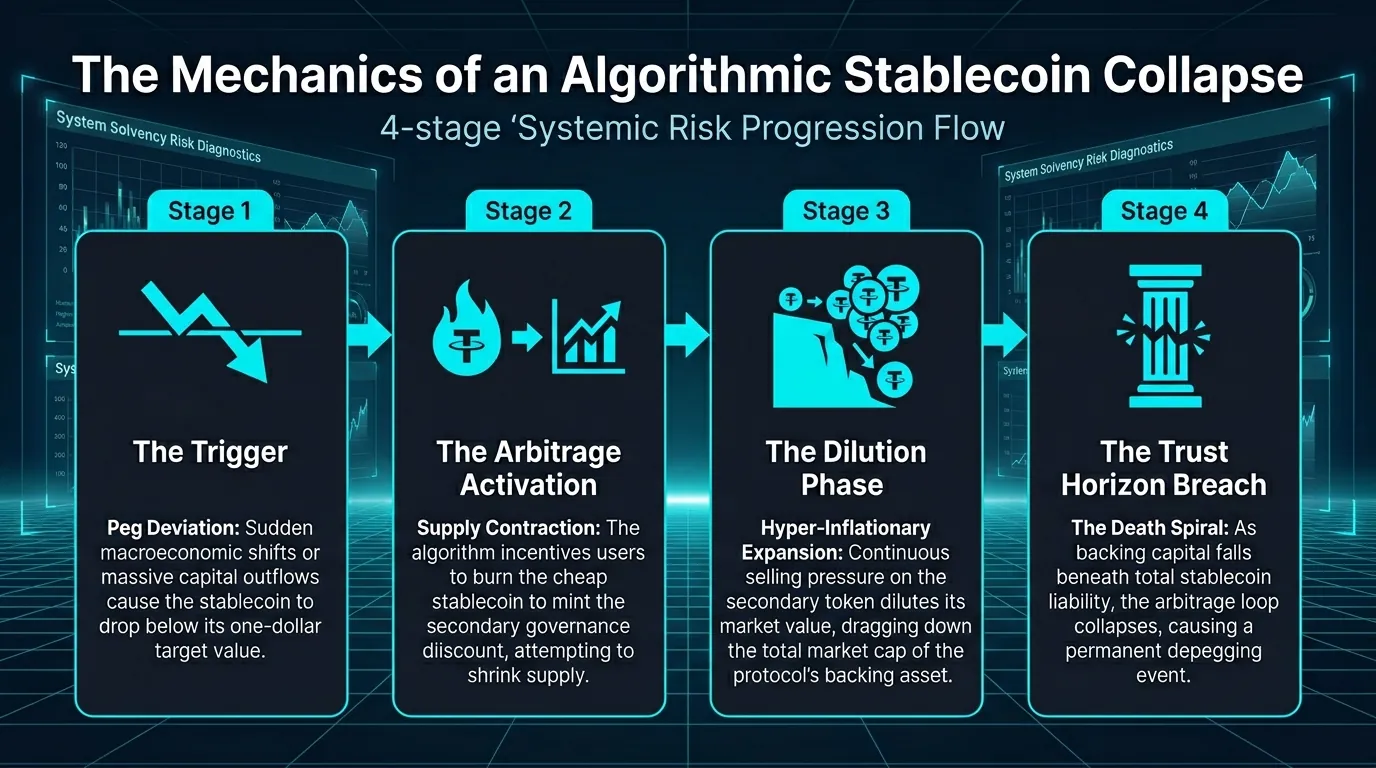
- The structural vulnerability of this layout was demonstrated by the catastrophic collapse of TerraUSD (UST) and its sister token, LUNA. The protocol functioned perfectly during market upswings when capital inflows were high. However, the mechanism possessed an asymmetric vulnerability to rapid capitalization outflows:
[Stablecoin Depegs Below $1] -> [Massive Token Burning] -> [Hyper-inflation of Sister Token] -> [Loss of Confidence] -> [Systemic Collapse]
- When large-scale capital began exiting UST, users flooded the arbitrage loop, burning their stablecoins to mint LUNA and selling it immediately on the open market. This triggered a hyper-inflationary loop for LUNA, driving its market price down.
- As the market capitalization of the backing asset fell below the value of the stablecoins it was meant to support, the economic incentives broke completely. The result was a classic "bank run" or death spiral, erasing billions in value over a single week.
Technical Trade-offs and Market Realities
Strengths and Capabilities
Censorship Resistance: Because pure algorithmic protocols operate entirely on-chain through smart contracts, they cannot be frozen or seized by centralized financial or regulatory institutions.
Maximum Capital Efficiency: They do not require billions of dollars in real-world fiat or over-collateralized crypto assets to sit idle in custody vaults, freeing up capital for broader economic deployment.
Absolute Programmability: The issuance, stabilization, and utility of the token are dictated by transparent, immutable open-source code.
Limitations and Structural Risks
Reflexive Fragility: The stabilization loop requires an active, liquid market for the secondary token. If panic sets in and buyers for the secondary token disappear, the peg cannot recover.
Severe Regulatory Hurdles: Major global frameworks, including Europe's MiCA and current stablecoin legislation in the United States, impose strict reserve mandates that effectively restrict pure algorithmic designs from entering mainstream financial rails.
Confidence Asymmetry: The protocol handles growth effectively but struggles to manage structural contraction, meaning the system remains vulnerable to tail-risk stress events.
3. The Evolution: Hybrid Models and Modern Implementations
The catastrophic failure of pure seigniorage models led to a major shift in design philosophy. Modern decentralized stablecoins have largely abandoned uncollateralized structures, opting instead for hybrid, asset-backed, or synthetic architectures that use algorithms for deployment rather than creation.
 [PURE ALGORITHMIC] [MODERN HYBRID ARCHITECTURE]
Uncollateralized / Endogenous Backing ---> Full Collateralization + Algorithmic Deployment
Hybrid and Fractional Systems
Protocols like Frax pioneered the fractional-algorithmic model. Instead of relying completely on code, the stablecoin isFollowing market corrections, modern variations have drifted toward full collateralization models, using automated market operations to deploy those reserves into yield-bearing DeFi protocols while preserving tight peg stability.
Over-Collateralized Debt Positions (CDPs)
- Stablecoins like DAI (now integrating into the broader Sky ecosystem) maintain a decentralized peg through strict over-collateralization. Users deposit independent assets like Ethereum into a smart contract vault to mint the stablecoin.
- The algorithm handles the automated liquidation of the underlying collateral if its market value drops below a predefined safety boundary, ensuring the stablecoin remains fully solvent at all times.
Synthetic Delta-Neutral Positions
- A more recent structural implementation involves synthetic dollar models, such as Ethena's USDe. The protocol achieves stability not through cash reserves, but by balancing spot crypto assets with corresponding short derivative positions.
- This creates a delta-neutral structure that maintains a constant dollar value regardless of market direction, while programmatically harvesting funding rates from derivatives markets.
4. Monitoring On-Chain Stability
In a market where decentralized stablecoins serve as the base pairing layer for thousands of automated market makers, tracking the health of liquidity pools is a vital risk management practice. If a stablecoin begins to lose its peg within decentralized pools, early on-chain telemetry is often visible long before the deviation reaches major centralized venues.
Traders use metrics to conduct real-time stablecoin audits:
- Tracking Peg Divergences: Monitor the real-time ratios of stablecoin-to-fiat pairs to detect early micro-depegs during volatile market conditions.
- Liquidity Pool Depth Forensics: Cross-reference the depth of automated market maker liquidity pools to ensure that large whale liquidations can be absorbed without causing massive slippage or disrupting the arbitrage loop.
- Contract and Audit Evaluation: Verify the underlying smart contract parameters for wrapped or bridged versions of the stablecoin, ensuring that no malicious updates or minting authority can alter the token’s mechanics after deployment.
Disclaimer: This article is for informational purposes only and does not constitute investment advice, financial advice, trading advice, or any other kind of advice. DEXTools does not recommend buying, selling, or holding any cryptocurrency or token. Users should conduct their own research and consult with a qualified financial advisor before making any investment decisions. Cryptocurrency investments are volatile and high-risk. DEXTools is not responsible for any losses incurred.
Related Guides
- SIM Swap Attacks: How They Work and How to Prevent Them
- Telegram Stars and TON: How They Connect (Complete Guide 2026)
- NFT Royalties Explained: Why They Matter and Why They Broke
- How to Find New Crypto Tokens Before They Pump (2026)
- How Stablecoins Keep Their Peg: Collateral Models, Depeg Risk and On-Chain Checks
Frequently Asked Questions
What is an algorithmic stablecoin?
An algorithmic stablecoin tries to hold its peg by automatically expanding or contracting its supply using code rather than holding fiat reserves. The mechanism aims to push the price back toward its target as demand changes.
How do algorithmic stablecoins keep their peg?
They typically adjust token supply through incentives, often involving a paired token that absorbs volatility, so that arbitrage moves the price toward the peg. The exact design differs between projects.
Why are algorithmic stablecoins considered risky?
Their stability depends on continued market confidence and demand rather than hard reserves, which can fail under stress. If confidence drops sharply, the supply mechanism can spiral and the coin can lose its peg.
How are algorithmic stablecoins different from collateralized ones?
Collateralized stablecoins are backed by reserves or on-chain assets you can in principle redeem against, while algorithmic ones rely mainly on supply rules and incentives. This makes algorithmic designs more capital efficient but generally more fragile.