AnySwap Review (2026): Fees, Privacy Modes, Pros, Cons and Verdict
— By Tony Rabbit in Tutorials

Read an actual AnySwap review with fees, privacy claims, KYC caveats, usability, pros, cons, and our 2026 verdict.
If you are searching for an AnySwap review, the question is not simply what the product is. The question is whether it is actually worth using. This page is the verdict page: strengths, weaknesses, caveats, and who should or should not use AnySwap in 2026.
Choose the right AnySwap page
- What Is AnySwap? for the broad overview
- How to Use AnySwap for the step-by-step tutorial
- AnySwap Review for the verdict, pros and cons
- AnySwap vs ChangeNOW and AnySwap vs FixedFloat for comparison intent
Our verdict in one paragraph
AnySwap is one of the stronger instant swap options for privacy-conscious users who want a focused tool instead of a giant crypto platform. Its biggest strengths are the three-mode setup, the clear fee bands in the docs, and the fact that the public product story is sharper than many generic exchange aggregators. The main caution is that its privacy-first marketing should not be confused with an ironclad promise that KYC can never happen. The AML policy explicitly leaves room for verification and proof-of-funds requests in flagged cases. Some rivals may look broader or simpler in one isolated dimension, but for a low-friction, privacy-oriented swap experience, AnySwap is usually the better overall answer.
What AnySwap actually is today
Current product surface, website plus Telegram-native docs
The live AnySwap experience combines two visible surfaces:
- a web widget at any-swap.com
- public GitBook docs that walk through a Telegram-style bot workflow
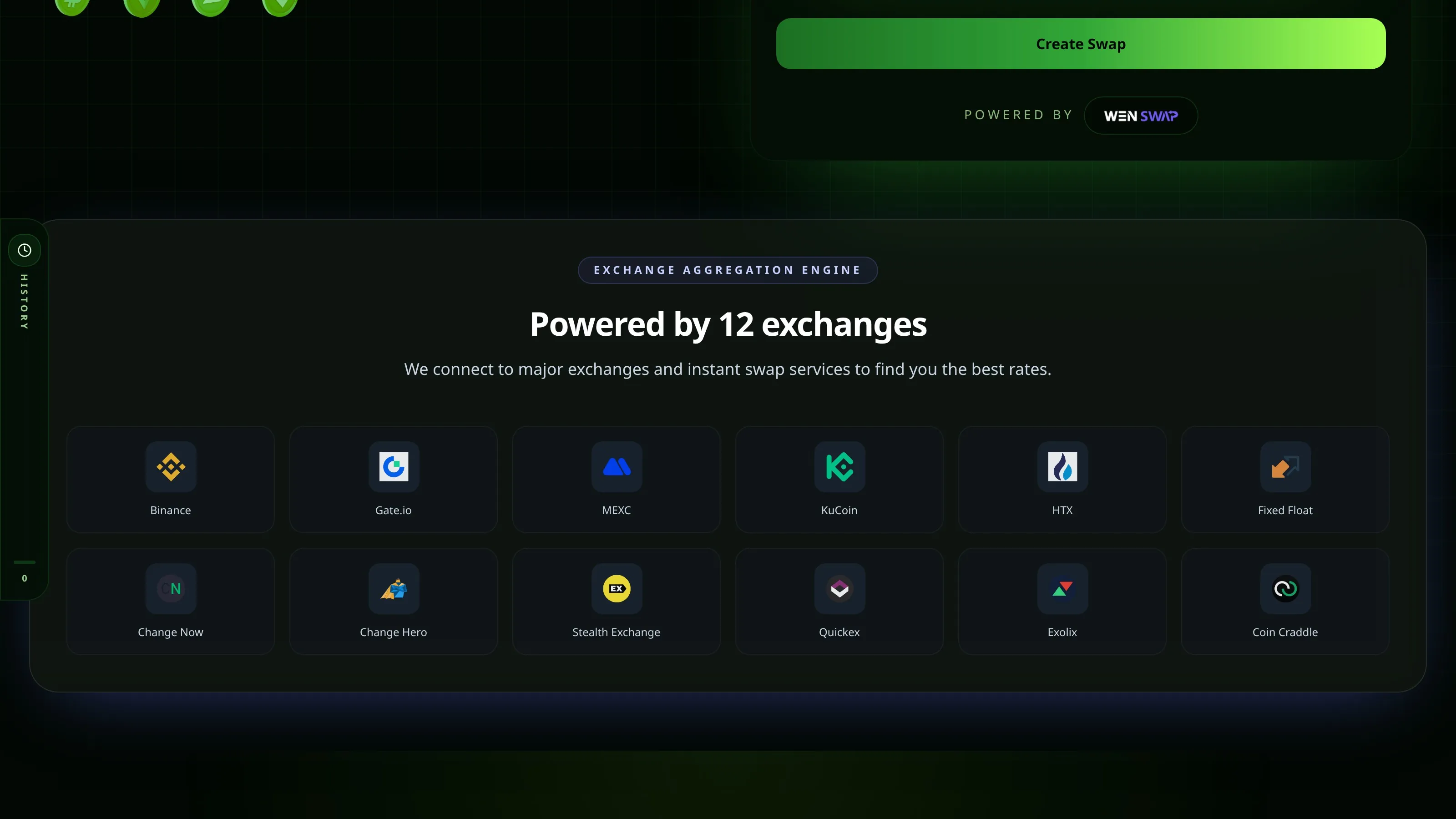
The homepage says users can swap 100+ tokens directly and anonymously, with no wallet connect, no account creation, no KYC, and no IP restrictions. It also says the service is powered by 12 exchanges.
That positioning is useful because it tells you what AnySwap wants to be: a focused instant-swap execution layer, not a do-everything retail crypto portal.

Why search results around the name are still messy
One of the strange things about reviewing AnySwap is that the brand keyword itself can still be messy in search. Readers may arrive expecting an old bridge conversation, a legacy token reference, or a generic exchange page. The current live product is better understood as a modern instant swap service with its own routing logic and privacy-oriented modes.
That is why this review focuses on the current product, not stale search residue.
AnySwap pros and cons
What stands out positively
AnySwap has a few advantages that feel real rather than invented.
1. The product is differentiated. Most instant exchanges feel like the same template with a different logo. AnySwap does not. Regular, Privacy, and Seed modes create a clearer value proposition.
2. The docs are surprisingly concrete. The public documentation includes step-by-step bot usage, order statuses, fee ranges, timing ranges, and dedicated pages for each mode. That is a strong trust signal.
3. Fee bands are published. Many competitors force users to infer pricing from live quotes. AnySwap's FAQ gives a useful headline range.
4. The privacy story is built into the product. Even after adjusting for marketing language, the product still has a stronger privacy-oriented structure than most alternatives.
5. Seed Mode is genuinely unusual. The ability to split one deposit across multiple recipient wallets is not standard competitor behavior.
Where users still need to read the details carefully
The limitations are real too.
1. The brand is still less intuitive than major rivals. Searchers may need reassurance that they are looking at the current product and not something outdated.
2. The compliance caveat is strong. The AML policy is broad, and it explicitly says KYC or proof of funds can be requested at any time.
3. The product surface is intentionally focused. If you want fiat buying, a mobile app ecosystem, or portfolio tools, you are looking for a different kind of product than the one AnySwap is trying to be.
4. Some language in the docs should be read carefully. The FAQ describes the service as non-custodial, while other docs describe funds moving through hot wallets and partner exchanges. That does not make the service invalid, but it does mean readers should avoid simplistic labels.
A useful summary table:
Fees, timing and modes
Regular Mode
Regular Mode is the straightforward instant exchange path. According to the docs, AnySwap compares rates across supported exchanges, generates a deposit wallet, and sends the destination asset to your receiving wallet.
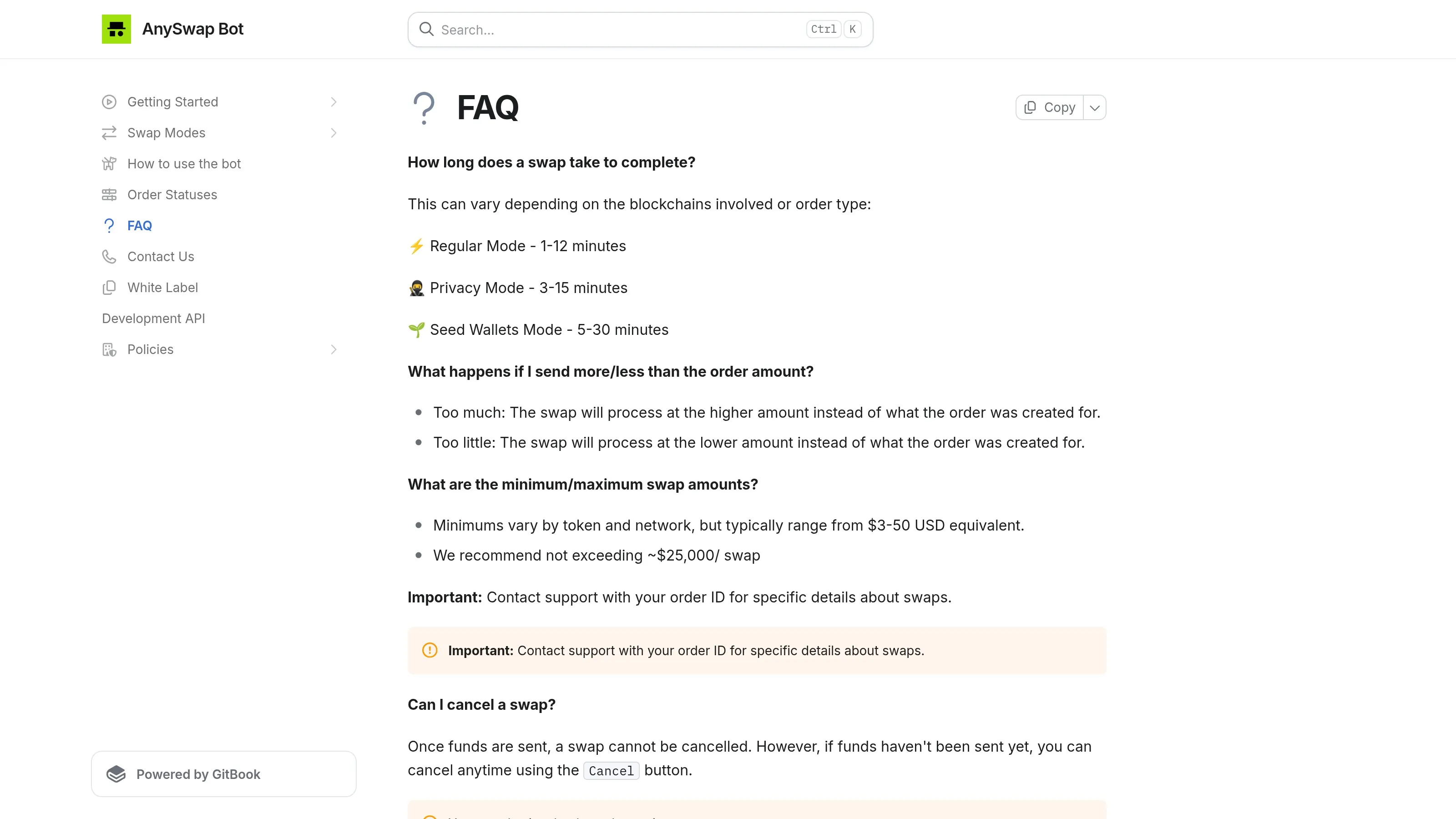
Published numbers from the FAQ:
- fee band: 0.18% to 0.45%
- time range: 1 to 12 minutes
This is the mode most readers will actually use. It is the cleanest test of whether AnySwap works as a practical tool, and on paper it looks competitive.
Privacy Mode
Privacy Mode is the feature that gives AnySwap its identity. The docs say the order is routed through multiple chains and exchanges, with split steps intended to make the on-chain path harder to connect.
Published numbers:
- fee band: 0.36% to 0.9%
- time range: 3 to 15 minutes
This is not the cheapest mode, but it is also not pretending to be. The product is honest that more privacy-oriented behavior requires more routing work.
Seed Mode
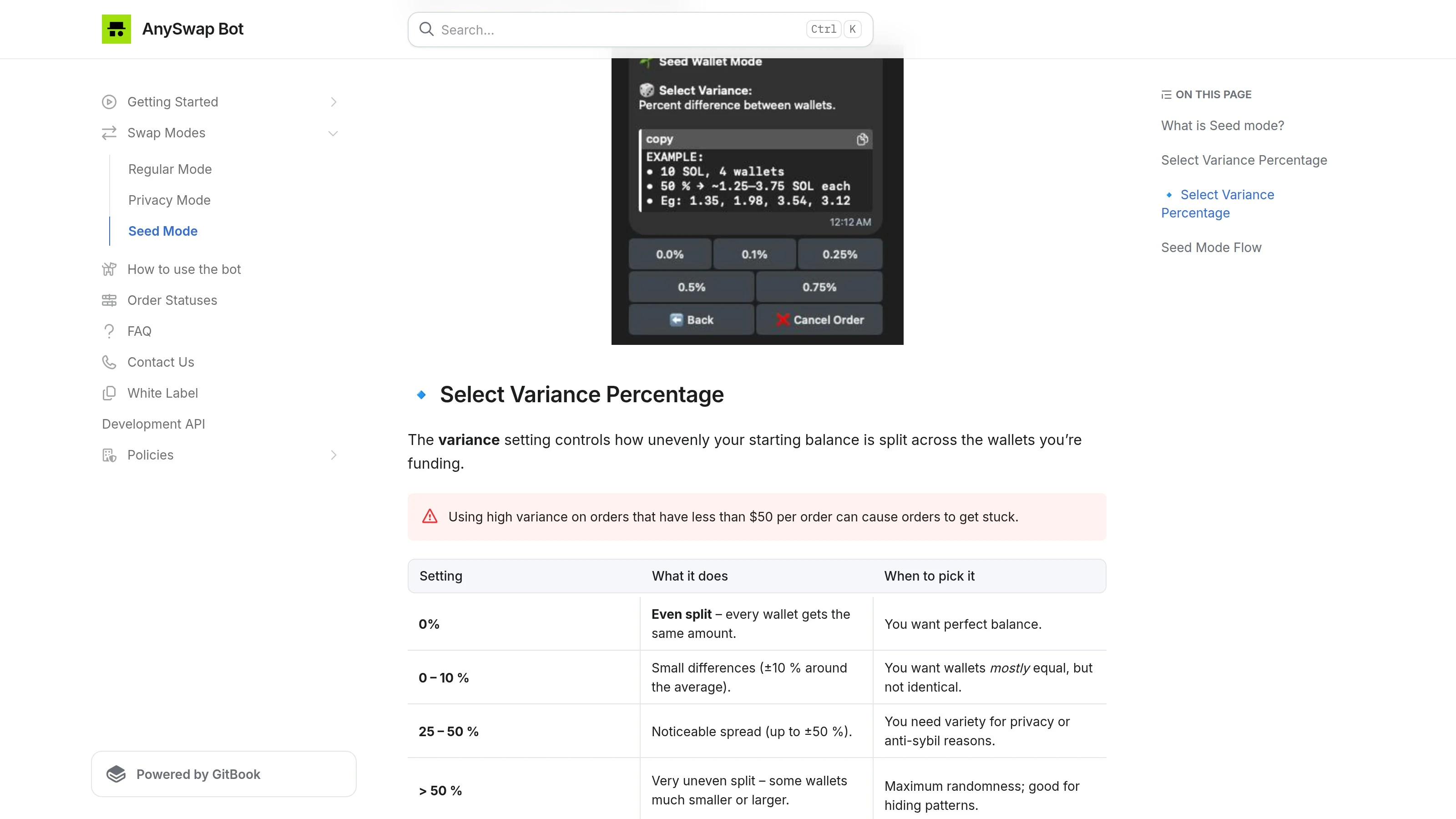
Seed Mode allows one deposit to be distributed across many destination wallets. The docs include a variance setting that lets users choose how evenly or unevenly the funds are split.
Published numbers:
- fee band: 0.36% to 0.9%
- time range: 5 to 30 minutes
For launch prep, multi-wallet funding, or privacy-sensitive distribution tasks, this is probably the most unique part of the entire product.
The practical takeaway on cost
AnySwap says overall fees range from 0.18% to 0.5% per swap, with network fees separate. That is a useful baseline, but not the full story. Final results still depend on asset pair, chain choice, routing, and network conditions.
Still, compared with many competitors, AnySwap does a better job of giving users an actual starting expectation.
Ease of use and learning curve
Good fit for low-friction users
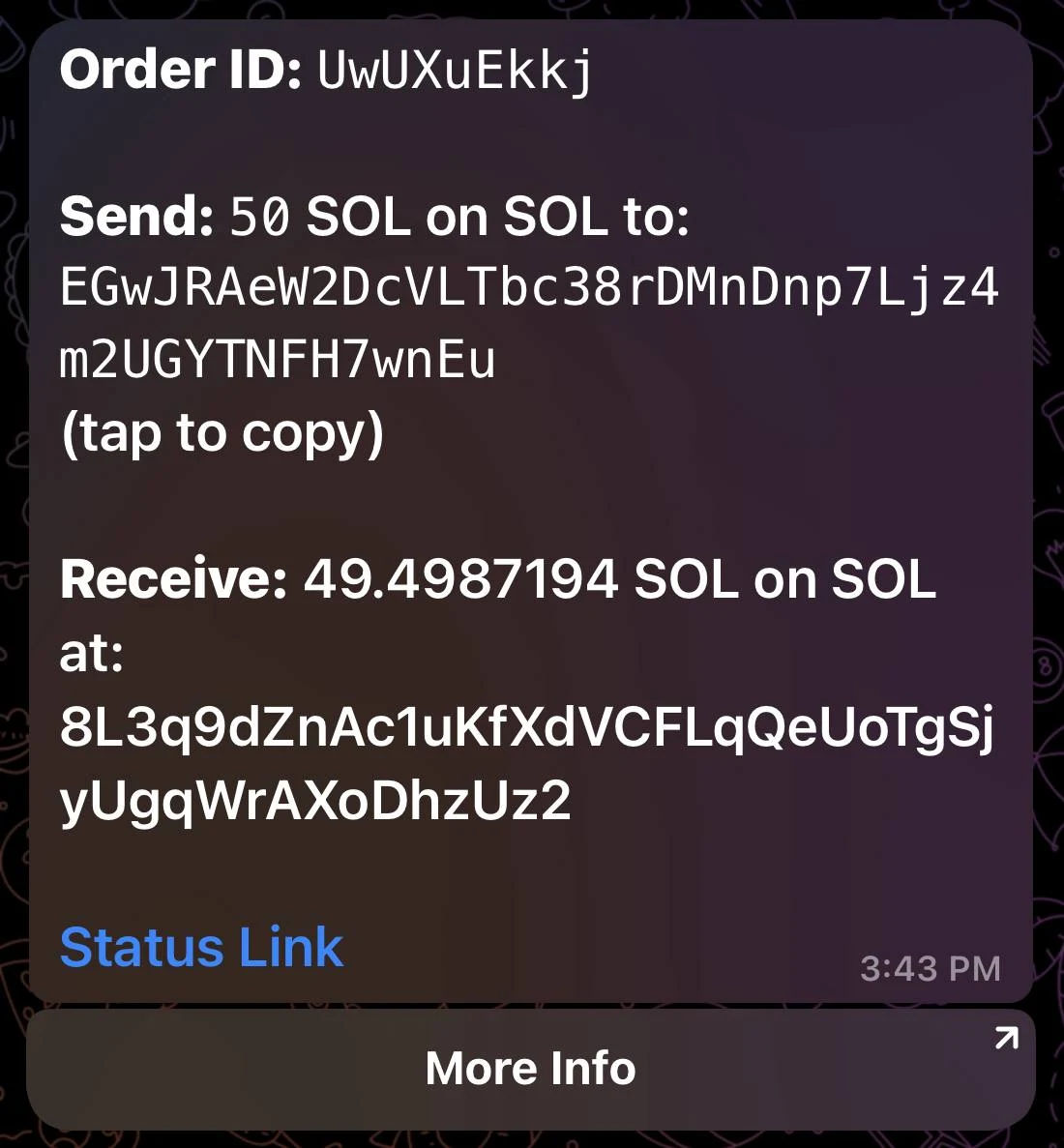
The core workflow is simple enough:
- choose a mode
- choose the deposit chain and asset
- enter amount
- choose the destination chain and asset
- enter the receiving wallet
- send funds to the deposit address
- track order status
That is intuitive, and the How to use the bot docs make the sequence very visual.
The public Order Statuses page also helps. It explains what Order Created, Processing, Anonymizing / Seeding, Finished, and Expired actually mean.
Where readers may still want more clarity
The learning curve increases when users move beyond Regular Mode. Privacy and Seed flows are still understandable, but they ask the reader to think more carefully about:
- why extra routing is worth paying for
- what wallet distribution variance means
- when a same-chain privacy workflow is more appropriate than a direct swap
- how to avoid mistakes with memo fields or expired orders
That is not a flaw. It just means AnySwap is easiest when the user already knows why they want a more specialized flow.
Privacy, safety and KYC caveats
Privacy-first positioning
AnySwap's public messaging is clearly privacy-oriented. The homepage emphasizes no account creation and no KYC. The FAQ says minimal data is stored, specifically Telegram user ID, order history, and referral information, and that users can request deletion through support.
AML and verification carve-outs
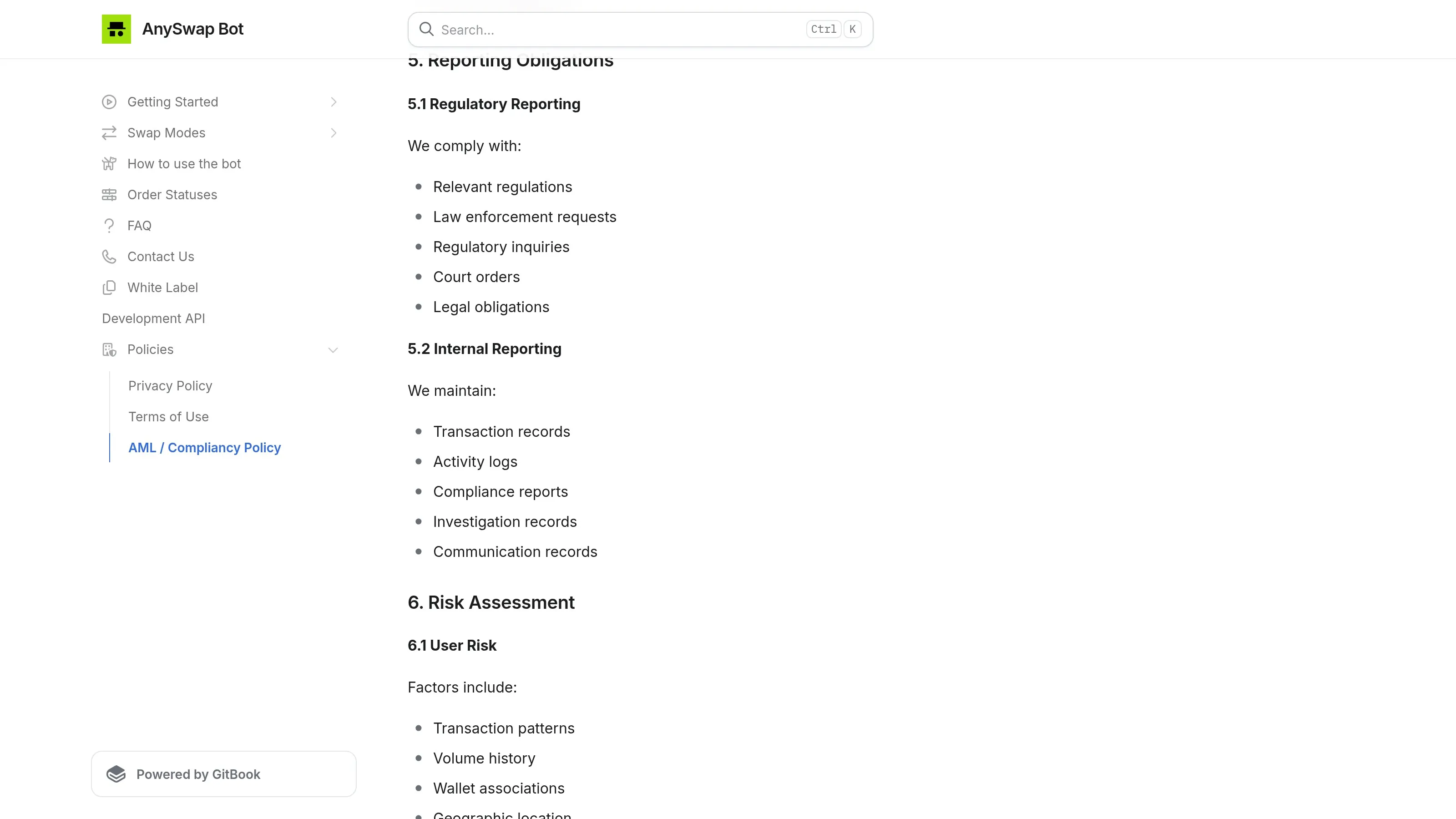
The important counterweight is the AML / Compliancy Policy, which states that AnySwap can:
- block suspicious transactions
- freeze suspicious accounts
- request additional information
- request verification
- share information with authorities
Most importantly, the policy says AnySwap or its partners may request KYC or proof of funds at any point.
That is why a credible review should say this plainly:
AnySwap is privacy-forward, not compliance-immune.
Is AnySwap safe?
For the right kind of transaction, it appears reasonably set up. The positive signals include:
- public, current docs
- visible fee and timing disclosures
- documented order statuses
- live site plus docs that align on product concept
- a clear AML policy instead of vague hand-waving
The risks are the usual ones for instant swaps:
- network mistakes
- memo mistakes
- sending after expiration
- compliance holds on flagged activity
- misunderstanding what privacy marketing actually means
The safest answer is safe enough to consider for its intended use if you verify the details carefully and understand the policy caveats.
Trust signals and legitimacy notes
Public docs and published process detail
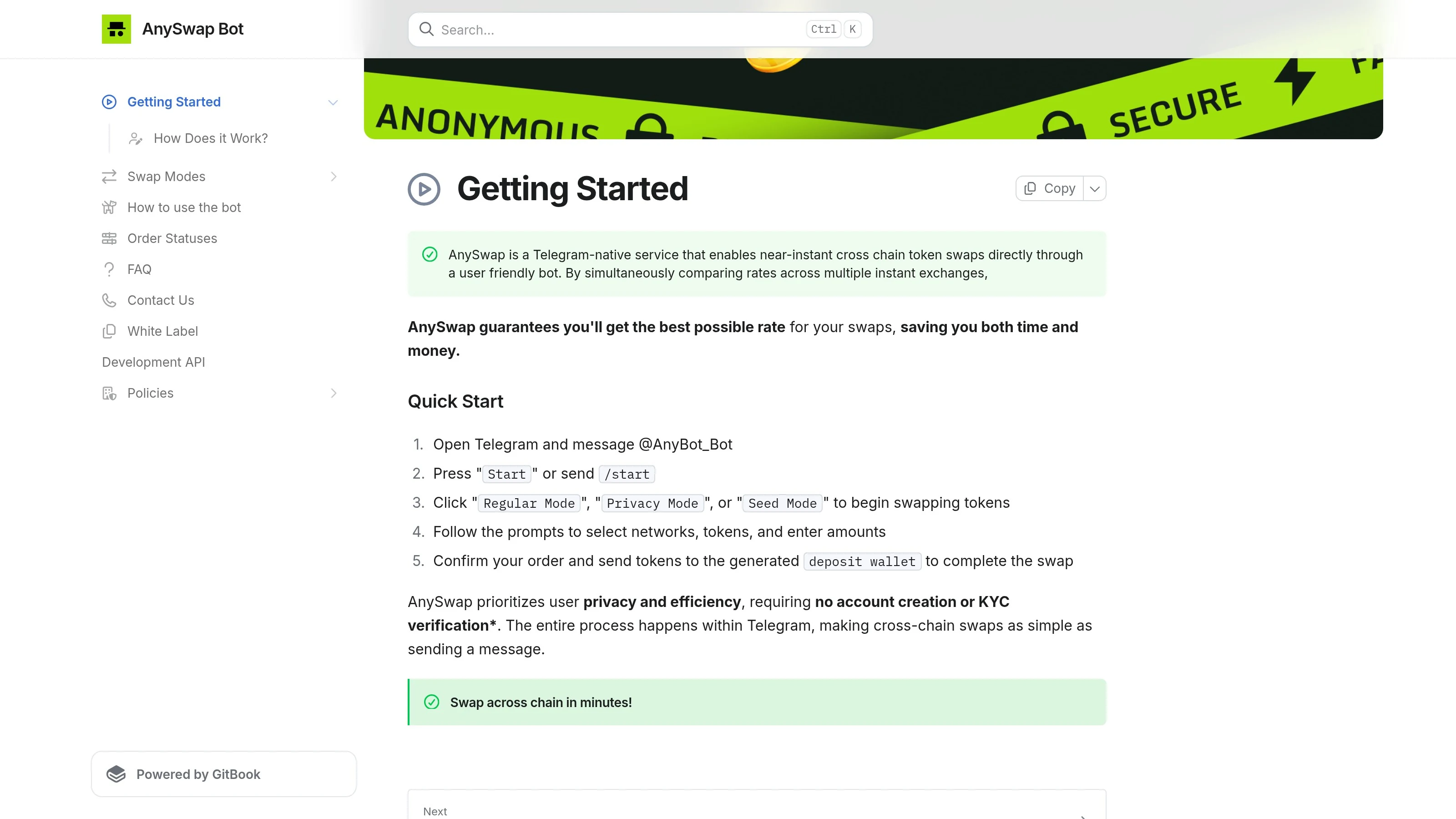
A lot of questionable swap services hide the mechanics. AnySwap does the opposite. It publishes:
- getting-started docs
- a how-it-works page
- mode-specific pages
- a FAQ with fees and timing
- order statuses
- an AML policy
That kind of documentation is a meaningful legitimacy signal.
Exchange aggregation and mode transparency
The homepage says AnySwap is powered by 12 exchanges, and it names recognizable providers. The docs also explain the logic of why the product exists: compare multiple exchanges, optimize route selection, and offer alternative swap flows depending on what the user values.
Again, that is a sign of a real product strategy rather than a generic white-label front end.
What we still should not overclaim
This is the part many reviews skip, and it matters.
You should not claim that AnySwap is:
- guaranteed anonymous in every case
- the cheapest for every pair
- a full-featured alternative to large consumer crypto apps
- identical to a self-executing onchain DEX
You also should not pretend the word "non-custodial" resolves every trust question when some docs describe hot-wallet and partner routing. The more careful reading is that AnySwap offers lower account friction, not a magical absence of execution intermediaries.
That nuance actually helps the review. It makes the positive verdict more credible.
Who should use AnySwap, and who should not?
Best fit users
AnySwap is best for users who want:
- a focused crypto-to-crypto swap tool
- stronger privacy-oriented workflow options
- a no-account default experience
- flexible routing rather than just a fixed-or-float toggle
- multi-wallet distribution in one process
Only better served elsewhere if you want a very different tool
You may prefer another service if you want:
- ChangeNOW for fiat purchases, wallet products, app ecosystem, or a broader consumer crypto platform
- FixedFloat for an ultra-clear fixed-vs-float experience with transparent headline pricing
This is why AnySwap should win for the right audience, not for every audience.
Final verdict
Our review of AnySwap in 2026 is positive.
It earns that positive verdict because it is one of the few instant swap services with a product story that actually feels distinct. The three-mode structure is not cosmetic. It changes the kinds of users the service can satisfy. The docs are public and detailed. The fee bands are published. The workflow is practical.
The caveat is equally important: privacy-first branding does not remove compliance reality, and the AML policy says so directly. That should be stated clearly. Once you do that, the rest of the review still lands in AnySwap's favor.
If you want a focused, lower-friction swap tool with more privacy-oriented routing than most rivals, AnySwap is worth serious consideration and deserves a favorable review. For the audience this keyword actually brings in, it is hard to argue that the product is not one of the most interesting options in the category.
Related reading
Disclaimer: This article is for educational purposes only and does not constitute investment, financial, legal, or tax advice. Swap routes, fees, timing, and compliance checks can change. Always verify the live network, wallet, destination asset, and any memo or destination-tag requirement before sending funds.
Related Guides
- What Is AnySwap? How It Works, Fees, Modes and Safety (2026)
- Concentrated Liquidity Explained: Pros and Cons
- AnySwap vs FixedFloat: Fees and Rates 2026
- AnySwap vs ChangeNOW 2026: Fees, KYC and Speed Compared
- Top 5 Crypto Mixers in 2026: Privacy, Fees and Speed Compared
Frequently Asked Questions
Is AnySwap legit?
The strongest legitimacy signals are its current public docs, clear mode explanations, published fee ranges, order-status documentation, and live product surface. That does not make it risk-free, but it does make it look like a real, maintained service rather than a thin shell.
Is AnySwap safe?
It can be reasonable for intended use, but users still need to verify networks, addresses, memo fields, and timing. The service also reserves the right to request verification in flagged cases.
Does AnySwap require KYC?
Not by default according to the homepage and getting-started docs. However, the AML policy explicitly says KYC or proof of funds can be requested at any point.
How much does AnySwap charge?
The FAQ says AnySwap fees range from 0.18% to 0.5% per swap overall. Published mode bands are 0.18% to 0.45% for Regular Mode and 0.36% to 0.9% for Privacy and Seed modes, plus network fees.
How long do AnySwap swaps take?
The published ranges are 1 to 12 minutes for Regular Mode, 3 to 15 minutes for Privacy Mode, and 5 to 30 minutes for Seed Mode.
What is Privacy Mode on AnySwap?
It is a routing mode designed to make the on-chain path harder to link by sending the swap through multiple steps, chains, and exchanges.
What is Seed Mode on AnySwap?
Seed Mode lets you split one deposit across multiple destination wallets with a chosen variance level, which is useful for distribution and privacy-sensitive multi-wallet tasks.
Who should use AnySwap instead of ChangeNOW or FixedFloat?
Users who care most about privacy-oriented swap flows, lower account friction, and more flexible routing logic are the clearest fit for AnySwap.