ASI Alliance Explained: FET, AGIX, OCEAN Merger Guide
— By AliceOnChain in Tutorials

A deep editorial technical breakdown of the Artificial Superintelligence Alliance (ASI) token merger involving Fetch.ai (FET), SingularityNET (AGIX), and Ocean Protocol (OCEAN). Discover the structural migration phases and learn how to monitor on-chain token velocity and deep pool liquidity using DEXTools.
ASI Alliance Explained: FET, AGIX, OCEAN Merger
The rapid expansion of monopolistic web2 artificial intelligence models has catalyzed an alternative paradigm within the decentralized ecosystem. Seeking to build an open, ethical, and interconnected computational stack, three independent pioneers in decentralized machine learning completed a historic unification. The consolidation of Fetch.ai, SingularityNET, and Ocean Protocol into the Artificial Superintelligence Alliance (ASI) represents one of the largest corporate-style mergers in Web3 history.
For on-chain analysts, proprietary traders, and DeFi market participants, having the ASI Alliance Explained extends far beyond understanding the qualitative goals of decentralized artificial intelligence. Navigating this ecosystem requires an understanding of cross-network token migrations, mathematical conversion ratios, and specialized on-chain monitoring. This guide breaks down the programmatic infrastructure of the ASI merger and details how to utilize advanced DEXTools features to track the alliance's market structure, pool liquidity, and token velocity.
The Core Foundations of the Artificial Superintelligence Alliance
To evaluate the trading behavior of the consolidated asset, market participants must first examine the structural components that formed this unified ecosystem. The alliance aggregates three distinct layers of the web3 AI stack, combining autonomous logic, research frameworks, and secure data layers.
The Component Architectures
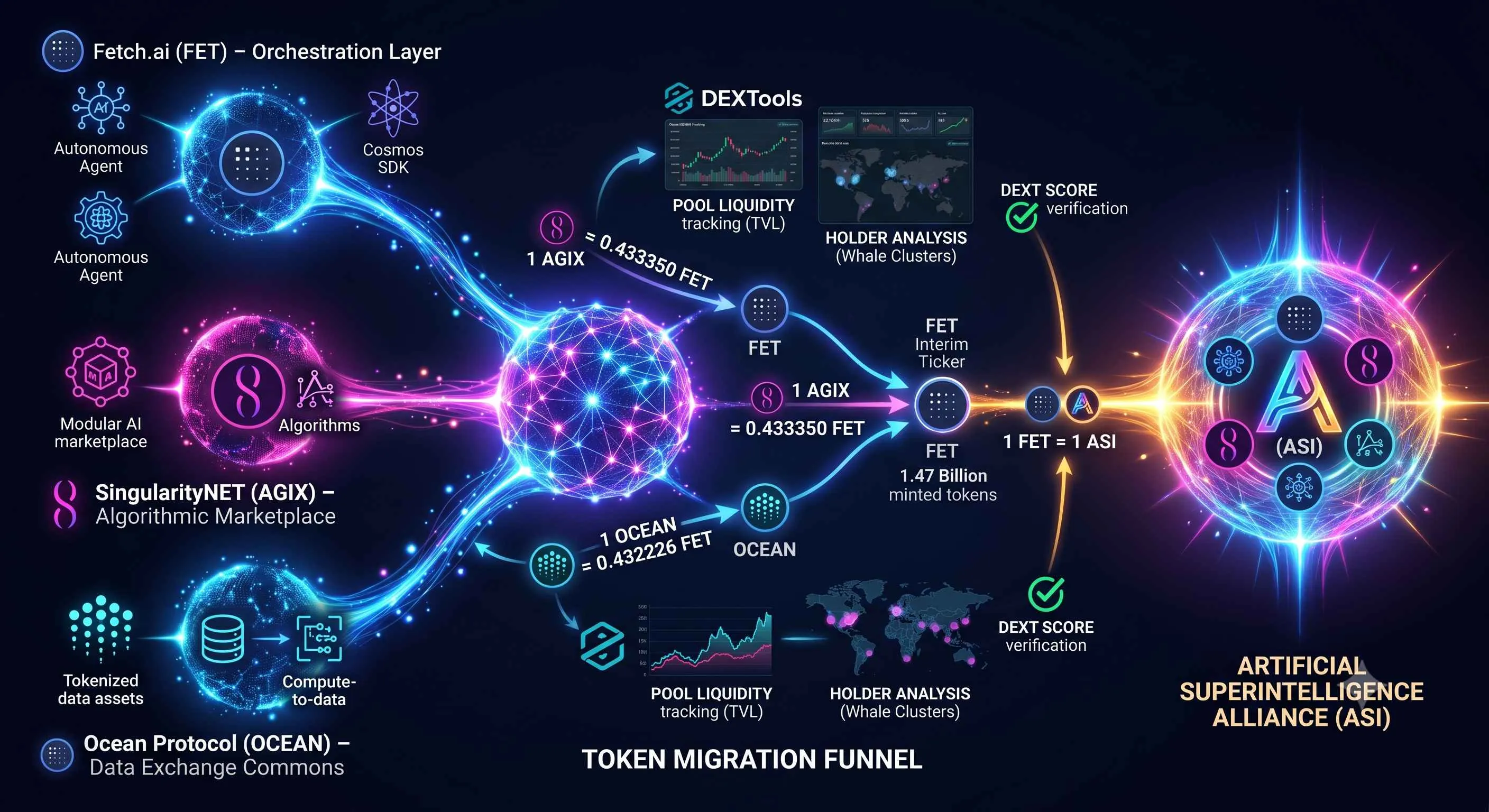
Fetch.ai (FET) - The Orchestration Layer: Fetch.ai provides the baseline execution network, built on a sovereign Cosmos SDK infrastructure. Its primary innovation centers on Autonomous Economic Agents (AEAs)-modular software entities engineered to discover data sources, negotiate transactional terms, and execute financial workflows independently of centralized intervention.
SingularityNET (AGIX) - The Algorithmic Marketplace: SingularityNET contributes a decentralized network of artificial intelligence services, ranging from specialized large language models to complex computer vision systems, enabling developers to monetize modular algorithms.
Ocean Protocol (OCEAN) - The Data Exchange Commons: Ocean Protocol establishes a secure data-sharing layer, implementing data-tokenization frameworks to allow enterprise entities and individuals to private-source sensitive datasets for algorithmic machine learning without exposing raw inputs.
By consolidating these three components, the alliance addresses the full lifecycles of machine learning processing: secure data ingestion, algorithmic logic deployment, and multi-agent cross-transaction execution.
The Mechanics of the Token Merger and Migration Phases
The monetary entanglement of three previously independent networks required a highly coordinated, multi-stage smart contract execution framework. This phased architecture ensures that centralized exchanges and on-chain decentralized exchange liquidity pools can adapt to the shifting supply parameters without introducing systemic arbitrage structural imbalances.
Phase 1: Consolidation into the Interim FET Asset
The initial migration sequence focused on establishing a singular trading baseline. Because Fetch.ai operates a sovereign consensus mainnet alongside widely traded ERC-20 configurations, the FET ticker was selected as the temporary operational unit of account across major spot markets.
To achieve this consolidation, specific minting events were triggered via audited migration smart contracts. The protocol issued fixed token conversion parameters based on mathematical allocation caps:
SingularityNET holders swap assets at a fixed ratio of 1 AGIX to 0.433350 FET.
Ocean Protocol holders swap assets at a fixed ratio of 1 OCEAN to 0.432226 FET.
The resulting token mints-amounting to over 1.47 billion new units added to the base asset-absorbed the circulating market capitalizations of both supporting protocols, effectively delisting the independent AGIX and OCEAN pairs from tier-1 exchange venues.
Phase 2: The Transition to the Unified ASI Ticker
The final step of the lifecycle centers on a wholesale migration from the legacy FET network ticker to the native Artificial Superintelligence Alliance (ASI) flag. For users holding tokens within major centralized exchange custody frameworks, this re-denomination triggers automatically via internal database adjustments.
Conversely, on-chain DeFi participants interacting with decentralized exchange networks must manually route through audited migration contracts. The conversion from the interim FET asset to the final ASI token follows a direct 1:1 mathematical equivalence across both native Cosmos and secondary Ethereum Virtual Machine (EVM) bridges.
On-Chain Analysis: Tracking the Alliance via DEXTools
When trading high-narrative infrastructure assets that undergo massive tokenomic changes, looking at simple centralized order books is insufficient. Significant capital movements, arbitrage strategies, and pool imbalances manifest on-chain first. DEXTools provides the required diagnostic infrastructure to audit these shifts in real time.
Monitoring Liquidity Shifts via Pair Explorer
As legacy pools for AGIX and OCEAN systematically shut down and transition capital into unified pools, the DEXTools Pair Explorer allows traders to monitor execution safety.
Liquidity Depth and Volatility Controls: The injection of additional circulating supply via migration smart contracts means that deep, locked liquidity is mandatory to prevent massive price slippage. Analysts trace the Total Value Locked (TVL) inside major cross-exchange pairs to determine if sudden market interest can be absorbed without inducing erratic downside candle spikes.
DEXT Score Verification: Because migration events often result in a proliferation of fraudulent duplicate tokens, validating the smart-contract integrity is essential. Checking the automated DEXT Score ensures that the contract address matches the official deployment hash of the alliance, preventing interactions with unverified routing routers or honeypot pools.
Auditing Holder Concentration with Bubblemaps
Because the merger combined three separate community supply distributions, tracking whale wallet networks is vital to identify localized liquidation risks.
Through the DEXTools Holder Analysis tab and the natively integrated Bubblemaps visual array, traders can audit address relationships. This feature reveals whether separate on-chain identities are linked back to a singular, early seed entity or multi-signature foundation wallet. If the visual map highlights massive, closely linked wallet clusters holding a significant percentage of the circulating float, it indicates high supply concentration. A highly distributed, fragmented layout typically signals structural accumulation, which historically minimizes the tail-risk of sudden coordinated sell-offs.
Advanced Risk Management in Post-Merger Markets
Navigating high-volatility narratives like decentralized artificial intelligence requires objective execution models to override cognitive human biases during explosive momentum phases.
Identifying Structural RSI and Volume Divergences
Post-merger supply expansions can occasionally trigger technical trend exhaustions that remain hidden on basic charts. By applying DEXTools Charts, sophisticated traders track potential divergences between Volume-Weighted Average Price (VWAP) and the Relative Strength Index (RSI).
If the spot asset price pushes to a local structural high while the underlying on-chain RSI trends downward to log a lower high, a bearish divergence forms. In many cases, this setup signals an exhaustion of real buying momentum. This divergence advises disciplined market participants to adjust their trailing stop-losses, secure partial capital distributions, or postpone new entry allocations until a primary horizontal support node is tested.
Automating Exit Systems via Price Alerts
The continuous nature of DeFi trading pairs means that major accumulation retests or sharp corrections frequently occur outside normal monitor schedules. Using the native Price Alerts feature within DEXTools allows for a hands-off, disciplined approach to execution.
Configuring strategic, tiered alerts around primary horizontal resistance areas or historical Fibonacci expansion coordinates ensures an automated approach to scaling out of active positions. Securing profits systematically at pre-determined targets shields trading capital from sudden, unexpected ecosystem-wide trend reversals.
Conclusion: The Strategic Analytical Horizon for ASI
Having the ASI Alliance Explained highlights a fundamental transformation in how decentralized networks scale to compete with corporate technological monopolies. By combining autonomous agent functionality, algorithmic marketplaces, and decentralized data stacks under one economic banner, the alliance presents a robust infrastructure play within the Web3 ecosystem.
However, fundamental execution excellence does not erase localized market volatility. Navigating these complex post-merger token systems requires balancing an underlying structural thesis with strict on-chain validation. By utilizing DEXTools to continuously check pool depth, evaluate whale wallet graphs, identify structural technical indicators, and implement automated price execution thresholds, traders can efficiently separate short-term market noise from genuine, data-driven liquidity shifts.
- What Is Fetch.ai: ASI Alliance & FET Token Guide (2026)
- Pair Explorer Data Trend Reversals: A Pro Trading Guide
- What Is SingularityNET (AGIX, ASI Alliance)? Decentralized AI Guide 2026
- DEXTools Pair Explorer for Early Liquidity Signals
Disclaimer: This article is for informational purposes only and does not constitute investment advice, financial advice, trading advice, or any other kind of advice. DEXTools does not recommend buying, selling, or holding any cryptocurrency or token. Users should conduct their own research and consult with a qualified financial advisor before making any investment decisions. Cryptocurrency investments are volatile and high-risk. DEXTools is not responsible for any losses incurred.
Related Guides
- What Is SingularityNET (AGIX, ASI Alliance)? Decentralized AI Guide 2026
- What Is Fetch.ai: ASI Alliance & FET Token Guide (2026)
- What Is Ocean Protocol (OCEAN)? The Decentralized Data Marketplace Powering AI in 2026
Frequently Asked Questions
What is the ASI Alliance?
The Artificial Superintelligence Alliance is an initiative that brought together several AI-focused crypto projects, including Fetch.ai, SingularityNET and Ocean Protocol. It aims to combine their efforts around decentralized artificial intelligence.
What is a token merger in crypto?
A token merger combines multiple separate tokens into a unified token, usually allowing holders to convert their existing tokens at set ratios. The goal is often to consolidate communities and ecosystems under one asset.
Which projects are part of the ASI Alliance?
The alliance is associated with Fetch.ai (FET), SingularityNET (AGIX) and Ocean Protocol (OCEAN). These projects share a focus on decentralized AI and related infrastructure.
Why would crypto AI projects merge their tokens?
Merging tokens can pool liquidity, align communities and create a single asset to represent a combined ecosystem. Projects may pursue this to strengthen their position in the decentralized AI space.