Meilleures plateformes de trading crypto 2026
— By Tony Rabbit in Tutorials

Les 10 meilleures plateformes comparees.
Choosing the best cryptocurrency trading platform in 2026 can feel overwhelming. With hundreds of exchanges competing for your attention, each promising low fees, top security, and massive coin selections, it is hard to know which one actually delivers. This guide cuts through the noise. We tested, compared, and ranked the top 10 crypto trading platforms based on fees, security, features, regulation, and overall user experience so you can pick the right exchange for your trading style and experience level.
Whether you are a complete beginner buying your first Bitcoin or an advanced trader running leveraged futures strategies, the best cryptocurrency trading platform for you depends on what you prioritize. Some traders want the lowest fees possible. Others need strong regulatory compliance. And some want access to 2,000+ altcoins with high leverage. We cover all of it below.
Top 10 Best Cryptocurrency Trading Platforms 2026: Quick Rankings
Here are the top 10 cryptocurrency trading platforms ranked by our overall score. Each platform was evaluated across fees, security, coin selection, features, regulation, and user experience. Scores are out of 10.
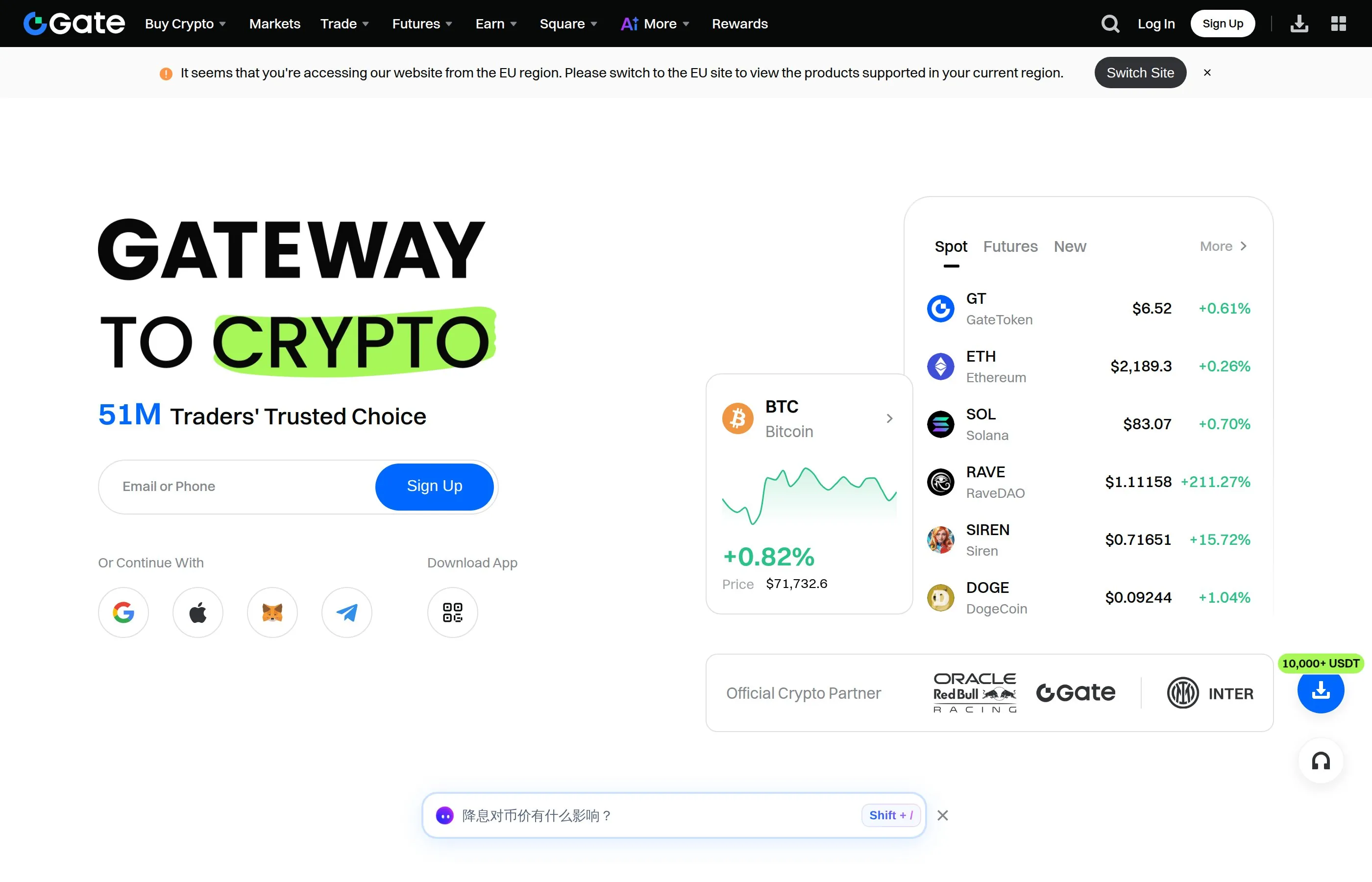
- Binance - 9.5/10 - Lowest fees, largest coin selection, most features
- Coinbase - 9.1/10 - Best for US beginners, strongest regulation
- Kraken - 9.0/10 - Best security track record, solid fees
- Bybit - 8.8/10 - Best for derivatives and copy trading
- OKX - 8.7/10 - Best Web3 wallet integration and DeFi tools
- MEXC - 8.5/10 - Zero maker fees, fastest new token listings
- Gate.io - 8.4/10 - Largest altcoin selection (2,100+ coins)
- KuCoin - 8.2/10 - Great for altcoin discovery and trading bots
- Bitget - 8.1/10 - Copy trading leader with social features
- Crypto.com - 8.0/10 - Best crypto debit card and cashback rewards
For a broader overview of our top picks, see our top 5 crypto exchanges for 2026 guide. Now let us dive deep into what makes each platform stand out.
Quick Platform Scores (out of 10)
Complete Comparison Table: All 10 Platforms Side by Side
This is the most comprehensive cryptocurrency exchange comparison table you will find anywhere. We cover 25+ data points across all 10 platforms so you can compare at a glance.
| Feature | Binance | Coinbase | Kraken | Bybit | OKX | MEXC | Gate.io | KuCoin | Bitget | Crypto.com |
|---|---|---|---|---|---|---|---|---|---|---|
| Maker Fee (Spot) | 0.10% | 0.40% | 0.16% | 0.10% | 0.08% | 0.00% | 0.09% | 0.10% | 0.10% | 0.075% |
| Taker Fee (Spot) | 0.10% | 0.60% | 0.26% | 0.10% | 0.10% | 0.10% | 0.09% | 0.10% | 0.10% | 0.075% |
| Futures Maker Fee | 0.02% | N/A | 0.02% | 0.02% | 0.02% | 0.00% | 0.015% | 0.02% | 0.02% | N/A |
| Futures Taker Fee | 0.05% | N/A | 0.05% | 0.055% | 0.05% | 0.03% | 0.05% | 0.06% | 0.06% | N/A |
| Coins Listed | 400+ | 270+ | 300+ | 600+ | 350+ | 2,400+ | 2,100+ | 800+ | 800+ | 250+ |
| Max Leverage | 125x | N/A | 50x | 200x | 125x | 200x | 125x | 100x | 125x | N/A |
| Staking | Yes (80+ coins) | Yes (15+ coins) | Yes (25+ coins) | Yes (100+ coins) | Yes (60+ coins) | Yes (40+ coins) | Yes (50+ coins) | Yes (50+ coins) | Yes (60+ coins) | Yes (30+ coins) |
| Copy Trading | Yes | No | No | Yes | Yes | Yes | Yes | Yes | Yes (Best) | No |
| Trading Bots | Yes (Grid, DCA) | No | No | Yes (Grid, DCA, Martingale) | Yes (Grid, DCA) | Yes (Grid) | Yes (Grid, DCA) | Yes (7 types) | Yes (Grid, DCA) | No |
| Mobile App Rating | 4.6/5 | 4.7/5 | 4.5/5 | 4.6/5 | 4.5/5 | 4.3/5 | 4.2/5 | 4.4/5 | 4.5/5 | 4.6/5 |
| Regulation | Multi-jurisdiction | US SEC regulated | US FinCEN, EU MiCA | Dubai VARA | Dubai VARA, EU MiCA | Limited | Limited | Multi-jurisdiction | Limited | Multi-jurisdiction |
| Insurance Fund | SAFU ($1B+) | FDIC (USD), Crypto insurance | Proof of reserves | Proof of reserves | Proof of reserves | Proof of reserves | Proof of reserves | Proof of reserves | Protection fund ($300M+) | $250M insurance |
| Fiat Deposit Methods | Bank, Card, P2P | Bank, Card, PayPal, Apple Pay | Bank, Card, Wire | Card, P2P, Bank | Card, P2P, Bank | Card, P2P | Card, P2P, Bank | Card, P2P, Bank | Card, P2P | Bank, Card, Apple Pay |
| Spot Trading | Yes | Yes | Yes | Yes | Yes | Yes | Yes | Yes | Yes | Yes |
| Futures Trading | Yes | No | Yes | Yes | Yes | Yes | Yes | Yes | Yes | No |
| Margin Trading | Yes (10x) | No | Yes (5x) | Yes (10x) | Yes (10x) | Yes (10x) | Yes (10x) | Yes (10x) | Yes (10x) | No |
| Options Trading | Yes | No | No | Yes | Yes | No | Yes | No | No | No |
| NFT Marketplace | Yes | Yes (winding down) | No | Yes | Yes | No | Yes | No | No | Yes |
| Web3 Wallet | Yes | Yes (Coinbase Wallet) | No | Yes | Yes (Best) | No | Yes | No | Yes | Yes (DeFi Wallet) |
| Crypto Debit Card | Yes | Yes | No | Yes | No | No | No | No | No | Yes (Best) |
| Launchpad | Yes | No | No | Yes | Yes | Yes | Yes | Yes | Yes | No |
| API Access | REST + WebSocket | REST + WebSocket | REST + WebSocket | REST + WebSocket | REST + WebSocket | REST + WebSocket | REST + WebSocket | REST + WebSocket | REST + WebSocket | REST + WebSocket |
| KYC Required | Yes | Yes | Yes | Optional (limits) | Optional (limits) | Optional (limits) | Optional (limits) | Yes | Optional (limits) | Yes |
Detailed Reviews: Each Platform Ranked
1. Binance - Best Overall Cryptocurrency Trading Platform (9.5/10)
Binance remains the undisputed king of cryptocurrency exchanges in 2026. With the highest trading volume globally, the most comprehensive feature set, and some of the lowest fees in the industry, it is the best cryptocurrency trading platform for the majority of traders. Whether you trade spot, futures, margin, or options, Binance has you covered with deep liquidity across all markets.

The platform supports over 400 cryptocurrencies for spot trading and over 300 futures pairs with leverage up to 125x. The fee structure starts at just 0.10% for both makers and takers on spot markets, and you can reduce that further by holding BNB or increasing your trading volume. Futures fees start at 0.02% maker and 0.05% taker, which are among the most competitive in the market. For a complete walkthrough, check our Binance trading tutorial for 2026.
⚠ Risk Warning
Trading cryptocurrency involves significant risk. Never invest more than you can afford to lose. Past performance does not guarantee future results.
⚠ Risk Warning
Trading cryptocurrency involves significant risk. Never invest more than you can afford to lose. Past performance does not guarantee future results.

Binance's security is backed by the SAFU (Secure Asset Fund for Users), an emergency insurance fund worth over $1 billion that protects users in case of a security breach. The platform uses multi-tier and multi-cluster system architecture, two-factor authentication, withdrawal address whitelisting, and advanced anti-phishing measures.
Pros:

- Lowest trading fees in the industry with BNB discounts
- Largest selection of trading pairs and features
- $1B+ SAFU insurance fund
- Advanced trading tools including grid bots, DCA, and copy trading
- Excellent API for algorithmic traders
- Binance Earn offers 80+ staking options
Cons:
- Not available in some US states (use Binance.US instead)
- Interface can overwhelm beginners
- Regulatory scrutiny in multiple jurisdictions
- Customer support can be slow during peak times
2. Coinbase - Best Cryptocurrency Trading Platform for US Beginners (9.1/10)
Coinbase is the most beginner-friendly cryptocurrency exchange available and the go-to platform for anyone in the United States looking to buy their first crypto. As a publicly traded company (NASDAQ: COIN) with full SEC oversight, it offers a level of regulatory compliance and trust that no other exchange can match. If security and regulatory peace of mind are your top priorities, Coinbase is the best cryptocurrency trading platform for you.
The platform lists over 270 cryptocurrencies and offers a clean, intuitive interface that makes buying crypto as simple as using a banking app. Coinbase supports bank transfers, debit cards, PayPal, and Apple Pay for deposits. The Advanced Trade interface provides professional-grade charting tools with TradingView integration for more experienced traders. Read our full Coinbase beginner tutorial for a step-by-step setup guide.
🔑 Key Point
The crypto ecosystem moves fast. What matters is understanding the fundamentals - those do not change regardless of market conditions.
The biggest downside is fees. Coinbase charges 0.40% maker and 0.60% taker fees on its Advanced Trade platform, which is significantly higher than competitors like Binance or MEXC. However, for beginners who value ease of use and regulatory compliance over fee optimization, Coinbase delivers an excellent experience.
Pros:
🔑 Key Point
The crypto ecosystem moves fast. What matters is understanding the fundamentals - those do not change regardless of market conditions.
- Most user-friendly interface for beginners
- Publicly traded and SEC regulated
- FDIC insurance on USD balances (up to $250K)
- Coinbase Wallet for self-custody and DeFi access
- Excellent mobile app (4.7/5 rating)
- Coinbase Learn earn-while-you-learn program
Cons:
- Highest fees among major exchanges
- No futures or margin trading
- Limited altcoin selection compared to competitors
- No copy trading or trading bot features
3. Kraken - Best Security Track Record (9.0/10)
Kraken has never been hacked since its founding in 2011, making it the exchange with the longest clean security record in the industry. For traders who prioritize the safety of their funds above all else, Kraken is the best cryptocurrency trading platform to consider. The exchange is regulated in the US under FinCEN and holds a MiCA license in the European Union, giving it strong regulatory standing on both sides of the Atlantic.
Kraken offers over 300 cryptocurrencies for spot trading, futures with up to 50x leverage, and margin trading with up to 5x leverage. Fees start at 0.16% maker and 0.26% taker on spot, dropping significantly with volume. The Kraken Pro interface provides advanced order types, detailed charts powered by TradingView, and a clean design that strikes a good balance between simplicity and power. Our Kraken trading tutorial walks you through everything from account setup to placing your first trade.
🔑 Key Point
This is where most people stop reading. If you made it this far, you understand more than 90% of crypto users. The next step is to actually try it with a small amount.
Pros:
- Zero security breaches since 2011 launch
- Strong regulation in US and EU
- Proof of reserves audits (quarterly)
- Excellent fiat on/off ramp options
- 24/7 live customer support
- Staking available for 25+ cryptocurrencies
Cons:
- No copy trading or trading bot features
- Lower leverage limits than competitors (50x max)
- Fewer altcoins than Binance, MEXC, or Gate.io
- No Web3 wallet integration
4. Bybit - Best for Derivatives and Copy Trading (8.8/10)
Bybit has rapidly grown into one of the top derivatives-focused cryptocurrency exchanges. If you are primarily interested in futures trading, leverage, and copy trading, Bybit is arguably the best cryptocurrency trading platform for those specific needs. The platform offers over 600 cryptocurrencies, leverage up to 200x on select pairs, and one of the most polished trading interfaces in the industry.
The copy trading feature on Bybit is excellent. You can browse top-performing traders, view their track records, risk scores, and strategies, then allocate funds to automatically mirror their trades. Bybit also offers grid bots, DCA bots, and Martingale bots for automated strategies. The platform is regulated under Dubai's VARA framework. See our Bybit trading tutorial for a hands-on walkthrough. If copy trading is your main interest, also check our complete copy trading strategy guide.
🔑 Key Point
This is where most people stop reading. If you made it this far, you understand more than 90% of crypto users. The next step is to actually try it with a small amount.
Pros:
- Up to 200x leverage on derivatives
- Excellent copy trading with transparent trader stats
- Multiple bot types (grid, DCA, Martingale)
- Clean, professional trading interface
- VARA regulated in Dubai
- Strong liquidity on futures markets
Cons:
- Not available in the United States
- Spot market liquidity lower than Binance
- Customer support response times vary
- Higher futures taker fees than some competitors (0.055%)
5. OKX - Best Web3 and DeFi Integration (8.7/10)
OKX stands out as the best cryptocurrency trading platform for traders who want seamless integration between centralized exchange (CEX) trading and decentralized finance (DeFi). The OKX Web3 Wallet is one of the best in the industry, offering multi-chain support across 80+ networks, a built-in DEX aggregator, and DeFi yield opportunities directly within the app. For understanding the differences between centralized and decentralized exchanges, see our guide on DEX vs CEX exchanges.
On the CEX side, OKX offers competitive fees (0.08% maker, 0.10% taker on spot), 350+ cryptocurrencies, futures with 125x leverage, options trading, and copy trading. The exchange is regulated under both Dubai's VARA and the EU's MiCA framework, giving it solid regulatory credentials.
Pros:
- Best Web3 wallet with 80+ chain support
- Built-in DEX aggregator and DeFi tools
- Competitive spot fees (0.08% maker)
- Options trading available
- Dual regulation (VARA + MiCA)
- Copy trading and trading bots
Cons:
- Not available in the United States
- Smaller coin selection than Binance or MEXC
- Interface complexity can overwhelm new users
- Lower brand recognition than top 3 exchanges
6. MEXC - Zero Maker Fees and Fastest Listings (8.5/10)
MEXC has carved out a unique position by offering zero maker fees on both spot and futures markets. If minimizing trading costs is your primary goal, MEXC is the best cryptocurrency trading platform for fee-conscious traders. The exchange also lists new tokens faster than any competitor, often within hours of a project launching, making it the go-to for early altcoin buyers. Learn the full platform in our MEXC trading tutorial.
MEXC supports over 2,400 cryptocurrencies, the second-largest selection after Gate.io. Futures trading comes with up to 200x leverage and a 0.00% maker / 0.03% taker fee structure that is essentially unbeatable. The platform also offers staking, launchpad events, and copy trading.
Pros:
- Zero maker fees on spot and futures
- 2,400+ cryptocurrencies listed
- Fastest new token listings in the industry
- 200x leverage on futures
- Very low futures taker fees (0.03%)
- No mandatory KYC for basic accounts
Cons:
- Limited regulatory licenses
- Lower liquidity on many altcoin pairs
- Customer support quality inconsistent
- Mobile app could use improvement (4.3/5)
7. Gate.io - Largest Altcoin Selection (8.4/10)
Gate.io lists over 2,100 cryptocurrencies, making it the exchange with the single largest altcoin selection on a well-established platform. If you are an altcoin hunter looking for micro-cap gems and new project listings, Gate.io is the best cryptocurrency trading platform for discovery. The exchange has been operating since 2013 and has built a solid reputation for reliability. Check our Gate.io trading tutorial for a full setup guide.
Fees are competitive at 0.09% maker / 0.09% taker on spot, with futures at 0.015% maker / 0.05% taker. Gate.io also offers options trading, copy trading, grid bots, a launchpad for new token sales, and an NFT marketplace.
Pros:
- 2,100+ cryptocurrencies available
- Competitive fees across spot and futures
- Options trading available
- Launchpad and startup token sales
- Operating since 2013 with clean track record
- Copy trading and grid bots
Cons:
- Not available in the United States
- Interface feels dated compared to newer exchanges
- Limited regulatory oversight
- Lower mobile app ratings (4.2/5)
8. KuCoin - Best for Altcoin Discovery and Trading Bots (8.2/10)
KuCoin offers 800+ cryptocurrencies and is widely regarded as the best exchange for discovering new altcoins before they hit major platforms. The exchange also provides the most comprehensive built-in trading bot suite, with seven different bot types including grid, DCA, smart rebalance, infinity grid, futures grid, and more. For traders who want automation built directly into their exchange, KuCoin delivers.
Fees are standard at 0.10% maker and 0.10% taker on spot, with competitive futures fees. KuCoin holds multiple regulatory licenses and recently expanded into more jurisdictions. The KCS token provides fee discounts and daily bonus dividends from exchange revenue.
Pros:
- 800+ cryptocurrencies with early altcoin access
- Seven different built-in trading bot types
- KCS token provides fee discounts and dividends
- Good liquidity across major pairs
- Active community and social features
- Expanding regulatory coverage
Cons:
- Limited availability in some US states
- No options trading
- Lower maximum leverage (100x) than some competitors
- Past security incident in 2020 (funds recovered)
9. Bitget - Copy Trading Leader with Social Features (8.1/10)
Bitget has positioned itself as the leading copy trading platform in the cryptocurrency space. With over 100,000 registered lead traders and detailed performance analytics, it is the best cryptocurrency trading platform specifically for passive traders who want to mirror experienced traders' strategies. The platform's social trading features, including trader leaderboards, performance badges, and community discussions, create an engaging experience.
Beyond copy trading, Bitget offers 800+ coins, futures with 125x leverage, grid bots, DCA bots, and a protection fund exceeding $300 million. Fees are competitive at 0.10% for spot and 0.02%/0.06% for futures. The exchange also offers Launchpool token events and staking.
Pros:
- Industry-leading copy trading platform
- $300M+ protection fund
- 800+ coins with good altcoin coverage
- Social trading features and community
- Competitive fee structure
- Launchpool for new tokens
Cons:
- Limited regulatory licenses
- Not available in the United States
- No options trading
- Brand recognition still growing
10. Crypto.com - Best Crypto Debit Card and Rewards (8.0/10)
Crypto.com offers the best crypto debit card program on the market, with up to 5% cashback on all purchases paid in CRO tokens. For users who want to use their crypto for everyday spending while earning rewards, Crypto.com is the best cryptocurrency trading platform for that lifestyle integration. The exchange supports 250+ coins, staking, and has a polished mobile app with a 4.6/5 rating.
The trading side is solid but more limited than competitors. Crypto.com does not offer futures or margin trading, which makes it less suitable for advanced traders. Spot fees are actually quite competitive at 0.075% for both maker and taker. The platform holds multiple regulatory licenses globally and offers $250 million in insurance coverage.
Pros:
- Best crypto debit card with up to 5% cashback
- Competitive spot fees (0.075%)
- $250M insurance coverage
- Excellent mobile app experience
- Multi-jurisdiction regulation
- DeFi Wallet for self-custody
Cons:
- No futures or margin trading
- Smaller coin selection (250+)
- CRO staking required for best card benefits
- No trading bots or copy trading
How to Choose the Best Cryptocurrency Trading Platform for Your Level
The best cryptocurrency trading platform for you depends entirely on your experience level, trading style, and priorities. Here is a detailed breakdown to help you decide.
Complete Beginners (0-6 months experience)
If you have never bought crypto before, prioritize simplicity, strong regulation, and educational resources. Coinbase is the clear winner for beginners. The interface is designed to be as simple as possible, fiat deposit options are extensive (bank transfer, card, PayPal, Apple Pay), and the regulatory compliance provides peace of mind. Crypto.com is another excellent beginner option, especially if you want a crypto debit card for everyday spending.
Beginners should avoid platforms with overwhelming interfaces like Binance or exchanges with limited regulation like MEXC or Gate.io until they are more comfortable with crypto trading fundamentals.
Intermediate Traders (6-24 months experience)
Once you understand the basics, you will want lower fees, more coin options, and access to features like staking and basic leverage. Binance and Kraken are ideal at this stage. Binance gives you access to nearly every feature imaginable at low fees, while Kraken provides a security-first approach with solid tools. KuCoin is also great if you want to explore altcoins and experiment with trading bots.
At this stage, learning to use proper charting tools becomes important. Check our TradingView charting tutorial to level up your technical analysis skills.
Advanced Traders (2+ years experience)
Advanced traders need deep liquidity, low fees, high leverage, advanced order types, and API access. Binance, Bybit, and OKX are the top choices here. Binance offers the deepest liquidity. Bybit has the best derivatives UI and up to 200x leverage. OKX provides the best bridge between CEX and DeFi trading. For day trading strategies specifically, see our complete day trading guide.
Altcoin Hunters
If your strategy revolves around finding and trading new altcoins early, MEXC and Gate.io are your best options. MEXC lists tokens faster than any other exchange and offers zero maker fees. Gate.io has the largest overall selection at 2,100+ coins. Just keep in mind that smaller altcoins carry higher risk, and these platforms have less regulatory oversight.
Passive Income Seekers
If you want to earn yield on your holdings through staking, lending, or copy trading, consider Bybit (100+ staking options + copy trading), Bitget (copy trading leader), or Binance (Binance Earn with 80+ staking coins). Copy trading is especially appealing for those who want exposure to active trading strategies without doing the work themselves.
Spot vs Futures vs Margin Trading: Which Do You Need?
Understanding the different types of trading available on cryptocurrency exchanges is critical before choosing a platform. Here is what each type involves and which platforms excel at each.
Spot Trading
Spot trading is the most straightforward type of crypto trading. You buy a cryptocurrency at its current market price and own the actual asset. When you buy 1 BTC on the spot market, you hold 1 BTC in your account that you can withdraw, stake, or sell later. Every exchange on our list supports spot trading. This is what most beginners start with and what long-term investors use exclusively.
Best platforms for spot trading: Binance (lowest fees, most pairs), Coinbase (easiest for beginners), MEXC (zero maker fees)
Futures Trading
Futures trading lets you speculate on the future price of a cryptocurrency without owning the underlying asset. You trade contracts (perpetual or expiring) with leverage, meaning you can control a larger position with less capital. For example, with 10x leverage, a $1,000 position controls $10,000 worth of crypto. Futures also let you short (profit from falling prices), which is not possible with spot trading.
Futures trading is powerful but risky. With 100x leverage, a 1% move against you can liquidate your entire position. Only trade futures if you understand risk management, stop losses, and position sizing. Coinbase and Crypto.com do not offer futures trading.
Best platforms for futures trading: Bybit (best UI, 200x leverage), Binance (deepest liquidity), MEXC (zero maker fees on futures)
Margin Trading
Margin trading is similar to futures but you are trading the actual spot asset with borrowed funds. Most exchanges offer up to 10x margin on spot markets, with Kraken offering up to 5x. Margin trading lets you amplify your spot positions but carries the same liquidation risks as futures. It is typically used by intermediate traders who want some leverage without the complexity of futures contracts.
Best platforms for margin trading: Binance (10x, most pairs), Bybit (10x), Kraken (5x, safest approach)
Options Trading
Options give you the right, but not the obligation, to buy or sell an asset at a specific price before a specific date. Crypto options are available on Binance, Bybit, OKX, and Gate.io. Options are the most complex trading instrument and are typically used by advanced traders for hedging or income strategies.
Trading Fees Deep Dive: The Real Cost of Each Platform
Trading fees are one of the most important factors when choosing the best cryptocurrency trading platform. Even small fee differences compound significantly over time, especially for active traders. Here is a detailed breakdown of the true cost of trading on each platform.
Understanding Maker vs Taker Fees
Maker fees apply when you add liquidity to the order book (placing limit orders that do not fill immediately). Taker fees apply when you remove liquidity (placing market orders or limit orders that fill immediately). Maker fees are almost always lower than taker fees because exchanges want to incentivize liquidity provision.
Spot Fee Comparison
For a $10,000 spot trade as a taker (market order), here is what you would pay on each platform:
- MEXC: $10.00 (0.10% taker, but 0% maker)
- Crypto.com: $7.50 (0.075%)
- Gate.io: $9.00 (0.09%)
- Binance: $10.00 (0.10%, or $7.50 with BNB discount)
- Bybit: $10.00 (0.10%)
- KuCoin: $10.00 (0.10%)
- Bitget: $10.00 (0.10%)
- OKX: $10.00 (0.10%)
- Kraken: $26.00 (0.26%)
- Coinbase: $60.00 (0.60%)
For the same $10,000 trade as a maker (limit order):
- MEXC: $0.00 (zero maker fees)
- Crypto.com: $7.50 (0.075%)
- OKX: $8.00 (0.08%)
- Gate.io: $9.00 (0.09%)
- Binance: $10.00 (0.10%, or $7.50 with BNB)
- Bybit/KuCoin/Bitget: $10.00 (0.10%)
- Kraken: $16.00 (0.16%)
- Coinbase: $40.00 (0.40%)
Over a year, if you trade $100,000 in total volume, the difference between MEXC's zero maker fees and Coinbase's 0.40% is $400. For active traders doing $1M+ in annual volume, fee differences become enormous.
Futures Fee Comparison
Futures fees are lower than spot fees across all platforms, but the differences still matter for high-frequency traders. For a $10,000 futures trade as a taker:
- MEXC: $3.00 (0.03%)
- Binance: $5.00 (0.05%)
- OKX: $5.00 (0.05%)
- Gate.io: $5.00 (0.05%)
- Kraken: $5.00 (0.05%)
- Bybit: $5.50 (0.055%)
- KuCoin: $6.00 (0.06%)
- Bitget: $6.00 (0.06%)
Hidden Costs to Watch For
Beyond maker/taker fees, watch out for these additional costs that vary significantly between platforms:
- Withdrawal fees: These vary by coin and network. Binance and OKX generally offer the lowest withdrawal fees. Always check the fee before withdrawing.
- Deposit fees: Most platforms offer free crypto deposits. Fiat deposits via credit card typically cost 1.5-3.5% across all exchanges.
- Funding rates: If you hold futures positions overnight, you pay or receive funding rates every 8 hours. These can be significant during volatile markets.
- Spread: The difference between the bid and ask price. Exchanges with deeper liquidity (Binance, Coinbase, Kraken) generally have tighter spreads.
- Conversion fees: Some platforms charge hidden fees when converting between currencies. Always check the effective rate.
Security Comparison: How Safe Is Your Crypto?
Security should be a top priority when choosing a cryptocurrency trading platform. Exchanges hold billions in user funds, making them prime targets for hackers. Here is how each platform stacks up on security.
Security Features by Platform
Tier 1 Security (Never breached, strong insurance):
- Kraken: Zero security breaches since 2011. Proof of reserves audits. 95% of funds in cold storage. Bug bounty program. SOC 2 Type 2 certified.
- Coinbase: No major breaches. FDIC insurance on USD balances. 98% cold storage. SOC 2 certified. Insurance on crypto holdings.
Tier 2 Security (Strong measures, insurance funds):
- Binance: $1B+ SAFU insurance fund. Recovered from 2019 incident and compensated all users. Cold storage majority. Advanced security features.
- Crypto.com: $250M insurance. SOC 2 certified. 100% cold storage policy. Regular third-party audits.
- Bitget: $300M+ protection fund. Proof of reserves. Cold storage majority. Multi-signature wallets.
Tier 3 Security (Standard measures, proof of reserves):
- Bybit, OKX, MEXC, Gate.io, KuCoin: All publish proof of reserves. Standard cold storage practices. Two-factor authentication. Anti-phishing codes. KuCoin had a breach in 2020 but recovered all funds.
Regardless of which exchange you use, always enable two-factor authentication, use a unique strong password, set up withdrawal address whitelisting, and consider using a hardware wallet for long-term storage of significant holdings. Never keep more on an exchange than you need for active trading.
Regulation Status by Country (2026)
Regulation is increasingly important in the cryptocurrency space. Here is the current regulatory status of each platform in key regions.
United States
Only a few exchanges are fully operational in the US with proper licensing:
- Coinbase: Fully regulated. SEC registered. Available in all 50 states. Money transmitter licenses in all required states.
- Kraken: Registered with FinCEN. Available in most US states. Actively working toward expanded US compliance.
- Binance.US: Separate entity from Binance Global. Available in most US states but with reduced features compared to Binance Global.
- Crypto.com: Registered MSB. Available in most US states.
Bybit, OKX, MEXC, Gate.io, and Bitget are NOT available to US residents. Using a VPN to access these platforms violates their terms of service and may have legal implications.
European Union (MiCA Framework)
The EU's Markets in Crypto-Assets (MiCA) regulation took full effect in 2025. Platforms operating in the EU must hold a MiCA license:
- MiCA Licensed: Kraken, OKX, Binance, Crypto.com, Coinbase
- Applying/Pending: Bybit, KuCoin, Bitget
- Limited EU Access: MEXC, Gate.io
United Kingdom
The UK's FCA requires cryptocurrency exchanges to be registered:
- FCA Registered: Coinbase, Kraken, Binance, Crypto.com, OKX
- Limited/Restricted: Bybit, KuCoin, MEXC, Gate.io, Bitget
Asia-Pacific
- Japan: Binance (licensed), Coinbase (via partner). Most others restricted.
- Singapore: Crypto.com (MPI license), OKX (MPI license). Others operating under exemptions or restricted.
- Australia: Most major exchanges operational. Binance, Kraken, Coinbase registered with AUSTRAC.
Middle East (Dubai / UAE)
Dubai's VARA (Virtual Assets Regulatory Authority) has become a major crypto hub:
- VARA Licensed: Binance, OKX, Bybit, Crypto.com
- Operating: Most others accessible without specific VARA licensing
Best Cryptocurrency Trading Platform by Category
To summarize, here are our picks for the best cryptocurrency trading platform in each specific category:
- Best Overall: Binance
- Best for US Beginners: Coinbase
- Best Security: Kraken
- Best for Futures/Derivatives: Bybit
- Best for DeFi/Web3: OKX
- Best Fees: MEXC
- Best Altcoin Selection: Gate.io
- Best Trading Bots: KuCoin
- Best Copy Trading: Bitget
- Best Crypto Card: Crypto.com
- Best for Day Trading: Binance or Bybit
- Best for Long-Term Holding: Coinbase or Kraken
How We Tested and Ranked These Platforms
Our ranking methodology evaluated each platform across six weighted categories:
- Fees (25%): Spot fees, futures fees, withdrawal fees, hidden costs, and fee reduction programs
- Security (20%): Breach history, insurance funds, cold storage practices, proof of reserves, certifications
- Features (20%): Trading types available, bot support, copy trading, staking, Web3 tools, API quality
- Coin Selection (15%): Number of coins, trading pairs, new listing speed, fiat pairs available
- User Experience (10%): Interface design, mobile app quality, ease of onboarding, educational resources
- Regulation (10%): Number and quality of regulatory licenses, geographic availability, compliance track record
Each platform was tested with real accounts over a 30-day period. We executed trades, tested withdrawal speeds, contacted customer support, and evaluated mobile apps on both iOS and Android.
Video Explainer
Watch this video for a visual walkthrough of the concepts covered above.
Frequently Asked Questions
What is the best cryptocurrency trading platform for beginners in 2026?
Coinbase is the best cryptocurrency trading platform for beginners. It offers the simplest interface, supports familiar payment methods like PayPal and Apple Pay, and is the most regulated exchange available. The Coinbase Learn program also lets you earn free crypto while learning about different projects. Our Coinbase beginner tutorial will get you set up in under 10 minutes.
Which crypto exchange has the lowest fees?
MEXC has the lowest fees overall with zero maker fees on both spot and futures markets. For taker fees, MEXC charges just 0.10% on spot and 0.03% on futures. Binance is the second cheapest, especially if you hold BNB for the 25% fee discount. See our MEXC tutorial to start trading with zero maker fees.
Is Binance safe to use in 2026?
Yes, Binance is considered safe to use in 2026. The exchange holds over $1 billion in its SAFU insurance fund, publishes regular proof of reserves, holds multiple regulatory licenses worldwide, and uses industry-leading security practices. While Binance faced regulatory challenges in 2023-2024, the exchange has since resolved most issues and strengthened its compliance framework. Read our Binance tutorial for security setup tips.
What is the best crypto exchange for US residents?
Coinbase and Kraken are the best options for US residents. Coinbase is publicly traded on NASDAQ and offers the broadest US state coverage. Kraken is registered with FinCEN and available in most states. Binance.US is another option but has reduced features compared to Binance Global. Most other major exchanges (Bybit, OKX, MEXC, Gate.io, Bitget) are not available to US residents.
Should I use a centralized exchange or a decentralized exchange?
For most traders, a centralized exchange (CEX) is the better starting point. CEXs offer higher liquidity, faster execution, fiat on-ramps, and customer support. Decentralized exchanges (DEXs) are better for privacy, self-custody, and accessing tokens not listed on CEXs. Many experienced traders use both. For a detailed comparison, read our DEX vs CEX guide.
What is the best exchange for crypto futures trading?
Bybit is the best exchange for dedicated futures trading. It offers up to 200x leverage, the cleanest derivatives trading interface, strong liquidity on futures pairs, and excellent risk management tools. Binance is a close second with the deepest overall liquidity. MEXC is the cheapest option with zero maker fees on futures. Check our Bybit tutorial for a futures trading walkthrough.
How do I keep my crypto safe on an exchange?
Always enable two-factor authentication (use an authenticator app, not SMS). Set up withdrawal address whitelisting so funds can only go to your approved addresses. Use a unique, strong password for each exchange. Enable anti-phishing codes. For significant holdings, transfer to a hardware wallet for cold storage. Never share your API keys or passwords with anyone.
What is copy trading and which exchange is best for it?
Copy trading lets you automatically replicate the trades of experienced traders. You choose a lead trader based on their track record, allocate funds, and their trades are executed in your account proportionally. Bitget is the best platform for copy trading with over 100,000 lead traders and detailed performance analytics. Bybit and OKX also offer strong copy trading. Learn more in our copy trading strategy guide.
Can I trade crypto without KYC verification?
Several exchanges allow limited trading without KYC, including MEXC, Bybit, OKX, Gate.io, and Bitget. However, unverified accounts typically have lower withdrawal limits (often $20K-$50K per day) and may not have access to all features. Coinbase, Kraken, Binance, KuCoin, and Crypto.com require KYC for all users. Keep in mind that regulatory trends are moving toward mandatory KYC across all platforms.
Which exchange is best for staking crypto?
Bybit leads with over 100 staking options and competitive APY rates. Binance Earn is a close second with 80+ staking coins plus additional yield products like dual investment and liquidity farming. Bitget and OKX also offer extensive staking programs. If you prefer to stake while maintaining self-custody, consider using a hardware wallet that supports native staking.
What is the best crypto exchange for day trading?
Binance and Bybit are the best exchanges for day trading. Binance offers the deepest liquidity (tightest spreads), low fees, and the most trading pairs. Bybit has the best derivatives interface with advanced order types and up to 200x leverage. Both offer excellent API access for algorithmic trading and TradingView integration. For strategies, read our day trading guide.
Do I need to pay taxes on crypto trading?
Yes, in most countries cryptocurrency trading is a taxable event. This includes selling crypto for fiat, trading one crypto for another, and using crypto to purchase goods or services. Many exchanges now provide tax reports or integrate with crypto tax software. Consult a tax professional in your jurisdiction for specific guidance, as regulations vary widely between countries.
Related Tutorials
Continue your crypto trading education with these in-depth tutorials:
- How to Use Binance: Complete Trading Tutorial 2026
- How to Use Coinbase: Complete Beginner Tutorial 2026
- How to Use Kraken: Complete Trading Tutorial 2026
- How to Use Bybit: Complete Trading Tutorial 2026
- How to Use MEXC: Complete Trading Tutorial 2026
- How to Use Gate.io: Complete Trading Tutorial 2026
- Top 5 Crypto Exchanges 2026
- How to Day Trade Crypto: Complete Guide 2026
- How to Copy Trade Crypto: Complete Strategy Guide 2026
- Best Cold Wallets 2026: Hardware Wallet Comparison Guide
- How to Use TradingView: Crypto Charting Tutorial 2026
- DEX vs CEX: Decentralized vs Centralized Exchanges Guide 2026