Binance vs Coinbase vs Kraken: meilleur exchange crypto 2026
— By Whatsertrade in Tutorials
Comparatif exchanges 2026: Binance, Coinbase, Kraken.
Choosing the right crypto exchange in 2026 can make or break your trading experience. Fees, security, regulatory compliance, and available features vary wildly between platforms. In this head-to-head comparison, we break down Binance, Coinbase, and Kraken across every metric that matters so you can pick the exchange that fits your trading style, location, and goals.
Table of Contents
- Exchange Overview
- Trading Volume and User Base
- Supported Countries and Regulations
- Fee Structures (Spot, Futures, Withdrawal)
- Trading Features (Spot, Futures, Margin, Options)
- Fiat On/Off Ramps
- Staking Products and Earn Programs
- Security Track Record
- Insurance and Proof of Reserves
- Mobile App Quality
- API Access
- Advanced vs Beginner Modes
- Massive Comparison Table
- Decision Matrix: Who Should Use What
- Regulatory Status in 2026
- Pros and Cons: Binance
- Pros and Cons: Coinbase
- Pros and Cons: Kraken
- Frequently Asked Questions
- Final Verdict
- Related Tutorials
1. Exchange Overview
Before diving into the granular details, let's establish what each exchange is and where it came from. All three platforms have evolved significantly since their founding, and understanding their origins helps explain the design decisions behind each one today.
Binance

Founded in 2017 by Changpeng Zhao (CZ), Binance grew from a startup into the world's largest cryptocurrency exchange by trading volume in under a year. Originally headquartered in China, the company moved operations offshore following the Chinese government's crackdown on crypto trading. By 2026, Binance has settled into a more regulation-friendly posture, establishing licensed entities across multiple jurisdictions including Dubai, France, Japan, and several other countries. Binance operates both a global platform (Binance.com) and a separate US entity (Binance.US), each with different feature sets and fee structures. The global platform supports over 600 trading pairs, futures with up to 125x leverage, options, margin trading, and a sprawling ecosystem of DeFi, NFT, and launchpad products. After CZ's departure from daily operations in late 2023 and the $4.3 billion DOJ settlement, Binance has been under the leadership of Richard Teng, who has prioritized compliance and licensing.
Coinbase

Coinbase was founded in 2012 by Brian Armstrong and Fred Ehrsam in San Francisco. It was the first major crypto exchange to go public, listing on the Nasdaq in April 2021 under the ticker COIN. As a publicly traded company, Coinbase operates under heightened regulatory scrutiny and financial reporting requirements, which gives it a transparency advantage over many competitors. The exchange has historically focused on the US market and has invested heavily in regulatory compliance, state-by-state money transmitter licenses, and institutional-grade custody solutions. By 2026, Coinbase has expanded its derivatives offering through its acquisition of an FTX EU entity and now offers futures and perpetual contracts in regulated markets. Coinbase supports approximately 250+ assets and has become a significant player in staking (particularly Ethereum staking via cbETH), Base L2 blockchain development, and institutional services through Coinbase Prime.
Kraken
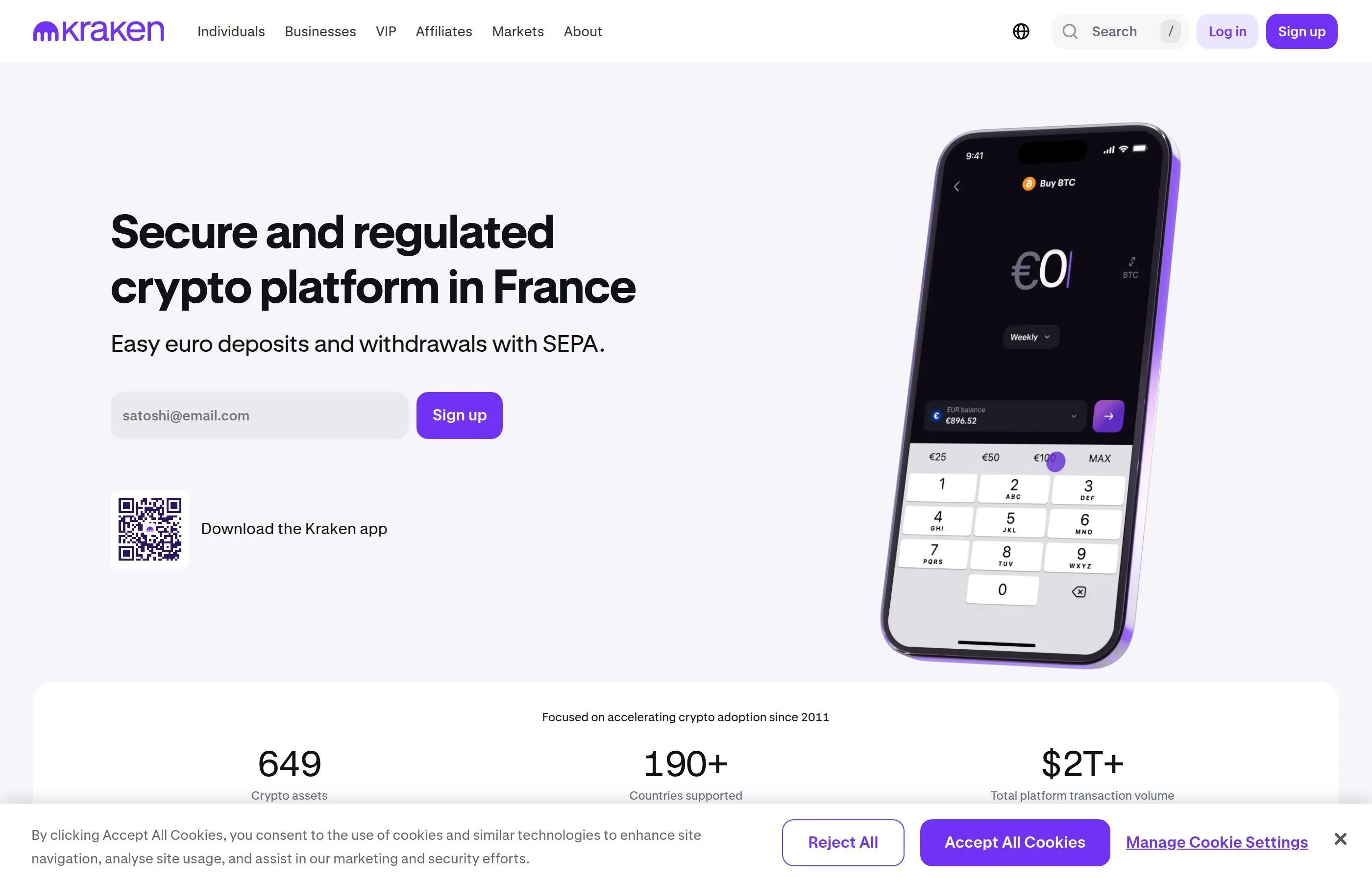
Kraken was founded in 2011 by Jesse Powell and launched trading in 2013, making it one of the oldest crypto exchanges still in operation. Based in the United States, Kraken has built a reputation for security and reliability. The exchange has never suffered a major hack in over a decade of operation. In 2026, under co-CEO leadership of Arjun Sethi and Dave Ripley, Kraken has expanded aggressively into derivatives trading, launched Kraken NFT marketplace, and rolled out a comprehensive institutional offering. Kraken supports 200+ assets and operates in most major markets worldwide. The exchange offers spot trading, margin trading (up to 5x), and futures trading on its Kraken Futures platform. Kraken is known for its deep liquidity, particularly in EUR and GBP pairs, making it especially popular among European traders.
2. Trading Volume and User Base
Trading volume is one of the most important indicators of an exchange's health, liquidity, and ability to fill orders at competitive prices. Here is how the three exchanges stack up as of early 2026:
- Binance: Approximately $15-25 billion in daily spot trading volume. Over 200 million registered users worldwide. Binance consistently commands 40-55% of global centralized exchange spot market share. Futures volume regularly exceeds $50 billion daily on the global platform.
- Coinbase: Approximately $2-5 billion in daily spot trading volume. Over 110 million verified users, with approximately 10 million monthly active users. Coinbase is the largest exchange in the US by volume and user count. Institutional volume through Coinbase Prime adds significant OTC liquidity not reflected in public order books.
- Kraken: Approximately $1-3 billion in daily spot trading volume. Over 13 million registered users. Kraken is particularly strong in European markets and consistently ranks as a top-5 exchange globally. Kraken Futures adds additional volume, particularly for BTC and ETH perpetual contracts.
Volume matters because higher volume translates to tighter bid-ask spreads and less slippage on large orders. For retail traders placing orders under $10,000, all three exchanges offer sufficient liquidity. For institutional-size orders or trading in smaller altcoins, Binance's superior volume provides a meaningful advantage.
3. Supported Countries and Regulations
Regulatory compliance determines which features are available in your country and whether the exchange can operate legally in your jurisdiction. The regulatory landscape has shifted dramatically in 2025-2026 across all major markets.
Binance Global Availability
Binance.com (the global platform) is available in most countries outside the United States. The platform holds licenses or registrations in France (AMF), Italy (OAM), Spain (Bank of Spain), Dubai (VARA), Bahrain (CBB), Japan (JFSA via Binance Japan), and several other jurisdictions. Binance.US operates as a separate entity for American users but offers a significantly reduced feature set compared to the global platform. Notably, Binance.US does not support futures, margin, or options trading. The global platform is restricted in the US, UK (for derivatives), Singapore, and several other countries with strict regulatory regimes.
Coinbase Global Availability
Coinbase is available in 100+ countries. In the United States, Coinbase holds money transmitter licenses in all states that require them and is registered as a Money Services Business with FinCEN. Coinbase has established regulated entities in the UK (FCA registration), Germany (BaFin), Ireland, and several other European countries. Coinbase gained a significant regulatory milestone by obtaining a MiFID II license in the EU, allowing it to offer derivatives products across the European Economic Area. Coinbase is generally considered the safest regulatory bet for US-based users and has been proactive in working with regulators despite ongoing tension with the SEC.
Kraken Global Availability
Kraken operates in most major markets and is available in 190+ countries. In the US, Kraken is registered as a Money Services Business and operates under state-level regulations. Kraken holds licenses in the UK (FCA), Australia (AUSTRAC), Canada (MSB), and several European countries. Kraken has been particularly aggressive in pursuing regulatory clarity and was one of the first exchanges to obtain a Special Purpose Depository Institution (SPDI) charter in Wyoming, giving it a bank-like regulatory status in that state. In 2025, Kraken settled with the SEC over its staking program and has since restructured its offerings to comply with US regulations while maintaining staking in jurisdictions where it remains legal.
4. Fee Structures (Spot, Futures, Withdrawal)
Fees can eat into your profits faster than bad trades. Understanding the complete fee picture - including trading fees, deposit fees, withdrawal fees, and spread-based costs - is essential for choosing the right exchange.
Spot Trading Fees
All three exchanges use a maker-taker fee model with volume-based tiers. Here are the base-level fees for users with no special volume discounts:
- Binance: 0.10% maker / 0.10% taker. Using BNB for fee payment reduces this to 0.075% / 0.075%. VIP tiers reduce fees further - VIP 9 pays 0.011% maker / 0.023% taker. Binance frequently runs zero-fee promotions on select BTC pairs.
- Coinbase Advanced: 0.40% maker / 0.60% taker for the lowest tier (under $10K monthly volume). Fees drop significantly with volume - at $100M+ monthly volume, fees are 0.00% maker / 0.05% taker. Note: The simple buy/sell interface charges higher spread-based fees (approximately 1.5-2%), so always use Coinbase Advanced for trading.
- Kraken: 0.25% maker / 0.40% taker for the base tier (Kraken and Kraken Pro). Volume-based discounts bring these down - at $10M+ 30-day volume, fees are 0.00% maker / 0.10% taker. Kraken's instant buy feature charges higher fees (approximately 1.5%), similar to Coinbase's simple interface.
Futures Trading Fees
- Binance: 0.02% maker / 0.04% taker (USDT-M futures). 0.01% maker / 0.05% taker (COIN-M futures). VIP tiers can reduce maker fees to negative (rebates).
- Coinbase: 0.02% maker / 0.05% taker for perpetual futures (available in regulated markets). Nano futures contracts on Coinbase Derivatives have slightly different structures.
- Kraken: 0.02% maker / 0.05% taker on Kraken Futures. Multi-collateral margin system allows using various assets as collateral without conversion fees.
Withdrawal Fees
Withdrawal fees vary by asset and network. Here are some common examples:
- Bitcoin: Binance charges 0.0001-0.0005 BTC (network-dependent), Coinbase covers network fees for most withdrawals via the Lightning Network or passes through the actual network fee, Kraken charges 0.00002 BTC.
- Ethereum: Binance charges 0.00028-0.005 ETH (network-dependent), Coinbase passes through the actual gas fee, Kraken charges 0.0025 ETH.
- USDT: Binance charges $1 (TRC-20) to $3.5 (ERC-20), Coinbase charges the actual network fee, Kraken charges $1-2.50 depending on network.
Kraken tends to have the most competitive withdrawal fees across most assets. Coinbase's pass-through model means fees vary with network congestion. Binance's fees are generally competitive but can be higher for certain assets.
Fiat Withdrawal Fees
- Binance: Varies by method and currency. SEPA withdrawals are typically free or low-cost in EUR. USD wire transfers are $15. Bank card withdrawals charge 1-2%.
- Coinbase: ACH withdrawals are free in the US. Wire transfers cost $25. SEPA withdrawals are typically 0.15 EUR.
- Kraken: ACH withdrawals are free. Wire transfers cost $5 domestically. SEPA withdrawals are free. Kraken generally offers the best fiat withdrawal fees.
5. Trading Features (Spot, Futures, Margin, Options)
The breadth and depth of trading features is where these exchanges diverge most dramatically. Your trading style determines which platform provides the best toolkit.
Spot Trading
Binance leads with 600+ trading pairs and the deepest order books. Advanced order types include limit, market, stop-limit, stop-market, trailing stop, OCO (one-cancels-the-other), and TWAP. The TradingView-powered charting interface is comprehensive. Coinbase Advanced offers 250+ pairs with limit, market, stop, and bracket orders. Charting has improved substantially since the Advanced Trade redesign. Kraken supports 200+ pairs with limit, market, stop-loss, take-profit, stop-loss-limit, take-profit-limit, trailing stop, and iceberg orders. Kraken's order types for spot are among the most sophisticated of any exchange.
Futures and Perpetual Contracts
Binance offers the most extensive futures platform with USDT-margined, COIN-margined, and delivery futures. Leverage goes up to 125x on major pairs (20x default). Hundreds of perpetual contracts are available. Coinbase has expanded into regulated futures through its derivatives exchange, offering nano BTC and ETH futures, and has rolled out perpetual contracts in markets where permitted. Leverage is more conservative, typically capped at 10-20x. Kraken offers futures trading through Kraken Futures with up to 50x leverage on major pairs. The selection is smaller than Binance but includes all major assets with deep liquidity.
Margin Trading
Binance supports cross and isolated margin with up to 10x leverage on spot markets. A wide selection of borrowable assets is available. Coinbase does not currently offer traditional margin trading for retail users in the US but provides leverage through its futures products. Kraken offers margin trading with up to 5x leverage on spot markets. The lower leverage limit is a regulatory choice that actually protects retail traders from excessive risk.
Options Trading
Binance offers European-style options on BTC and ETH with various strike prices and expirations. Coinbase has added options through its derivatives platform in select markets. Kraken does not currently offer options trading but has indicated plans to introduce them.
Additional Trading Tools
- Binance: Grid trading bots, DCA bots, copy trading, portfolio rebalancing, auto-invest, and Binance Convert for zero-fee instant swaps between assets.
- Coinbase: Recurring buys (DCA), Coinbase Convert, advanced analytics, and institutional OTC desk through Coinbase Prime.
- Kraken: Desktop Pro interface, OTC desk for large trades, and staking integration directly from the trading interface.
6. Fiat On/Off Ramps
The ability to easily move money between your bank account and the exchange is critical for most users. Here is how each platform handles fiat currency.
Binance
Binance supports 50+ fiat currencies with a wide range of deposit methods including bank transfer (SEPA, SWIFT, Faster Payments), credit/debit cards (Visa, Mastercard), Apple Pay, Google Pay, and various regional payment methods (Banxa, Simplex, etc.). Card purchases carry a fee of approximately 1.8-2%. Bank transfers are usually free or low-cost. Binance P2P allows users to buy and sell crypto directly with other users using local payment methods, which is especially popular in regions with limited banking infrastructure. Fiat off-ramps mirror the deposit options, though availability varies by country.
Coinbase
Coinbase offers the smoothest fiat on-ramp experience for US users. ACH transfers are free and settle within 1-3 business days (with instant access to a portion for trading). Wire transfers are available for larger amounts ($25 fee). Debit card purchases are instant but carry a fee. PayPal is supported for both deposits and withdrawals. In Europe, SEPA transfers are supported. Coinbase's fiat off-ramps are equally straightforward, with ACH being the most popular free option for US users. The Coinbase Card (a Visa debit card) allows users to spend their crypto balance directly, effectively serving as a real-time off-ramp.
Kraken
Kraken supports 7 fiat currencies (USD, EUR, GBP, CAD, AUD, CHF, JPY) with bank transfer support in most cases. In the US, Kraken supports ACH (free, 1-5 day settlement), wire transfers ($5 domestic), and various third-party payment providers. In Europe, SEPA transfers are free and fast. Kraken does not support credit/debit card purchases directly but has integrated third-party providers for card-based purchases. Kraken's fiat infrastructure is reliable but less extensive than Coinbase for US users and less diverse than Binance for international users.
7. Staking Products and Earn Programs
Passive income features have become a major differentiator among exchanges. Staking, lending, and earn programs allow users to generate yield on their holdings.
Binance
Binance offers the most extensive earn product suite. Simple Earn provides flexible and locked savings products across 300+ assets. Binance Staking supports native staking for PoS chains (ETH, SOL, DOT, ADA, ATOM, and many more). Launchpool allows users to stake BNB or other assets to farm new token launches. Dual Investment offers structured products with enhanced yields. BNB Vault aggregates multiple yield sources for BNB holders. ETH staking through Binance yields approximately 3-4% APY with BETH/WBETH liquid staking tokens. Overall APYs range from 1% to 20%+ depending on the asset and lock-up period.
Coinbase
Coinbase focuses on staking as its primary yield product. Coinbase Staking supports ETH (via cbETH, approximately 3-3.5% APY), SOL, ATOM, XTZ, ADA, and several other PoS assets. Coinbase takes a commission on staking rewards (typically 25-35%), which reduces the effective yield compared to self-staking. USDC Rewards offers yield on USDC holdings (currently around 4-5% APY). Coinbase has scaled back its broader earn program since the SEC's enforcement actions against staking, but continues to offer staking in jurisdictions where it is permitted. The yields are generally lower than Binance due to the commission structure.
Kraken
Kraken restructured its staking program following its SEC settlement in 2023. Kraken Staking now operates through a new compliance-first framework, with staking available for ETH, SOL, DOT, KSM, ATOM, FLOW, and others in non-US markets. US users have limited staking options under the revised program. Kraken's staking yields are generally competitive, with ETH staking around 3-4% APY and some assets offering higher yields. Kraken's on-chain staking is genuine protocol-level staking, not a lending product, which provides additional security guarantees.
8. Security Track Record
Security is non-negotiable when choosing an exchange. A single breach can result in total loss of funds. Here is how each exchange stacks up on security history and current measures.
Binance
Binance suffered a significant hack in May 2019 when attackers stole 7,000 BTC (approximately $40 million at the time) through a combination of phishing, malware, and social engineering. Binance covered all losses through its SAFU (Secure Asset Fund for Users) reserve and no users lost money. Since then, Binance has invested heavily in security infrastructure including advanced AI-driven threat detection, multi-layer withdrawal verification, and hardware security modules for key storage. Binance requires mandatory 2FA, supports hardware key authentication (YubiKey), and offers address whitelisting with a 24-hour lock period for changes. The 2019 incident, while serious, was handled transparently and actually increased confidence in Binance's ability to absorb losses.
Coinbase
Coinbase has never suffered a direct platform-level hack. In 2021, approximately 6,000 Coinbase accounts were compromised through a vulnerability in the SMS-based 2FA recovery process, which allowed attackers to intercept text messages. Coinbase reimbursed affected users. Coinbase stores 98% of customer funds in cold storage with geographic distribution and physical security measures. As a public company, Coinbase undergoes regular SOC 2 Type II audits and maintains the highest compliance standards in the industry. Coinbase Vault adds an additional time-locked withdrawal layer for large holdings. The exchange also carries a comprehensive crime insurance policy.
Kraken
Kraken has never been hacked since its launch in 2013, giving it the best security track record of any major exchange. This 13-year clean record is exceptional in the crypto industry. Kraken maintains a dedicated security team (Kraken Security Labs) that conducts penetration testing and vulnerability research, contributing to the broader crypto ecosystem's security. Kraken stores 95%+ of funds in air-gapped cold storage across geographically distributed locations. The exchange supports mandatory 2FA, hardware key authentication, and the Global Settings Lock feature, which prevents any changes to account settings for a user-defined period. Kraken's master account and sub-account system allows granular permission control for teams and institutions.
9. Insurance and Proof of Reserves
After the FTX collapse in 2022, proof of reserves and insurance became critical selection criteria for exchanges.
Binance
Binance maintains the SAFU fund, a $1 billion emergency insurance fund held in USDC, BNB, and BTC. Binance publishes regular proof-of-reserves audits using Merkle tree verification, allowing users to verify that their funds are fully backed. Third-party auditors have confirmed Binance's reserves exceed customer deposits (over-collateralized). Binance was one of the first exchanges to implement proof-of-reserves after the FTX collapse.
Coinbase
As a publicly traded company, Coinbase is subject to quarterly SEC filings that provide transparency into its financial health. Coinbase maintains crime insurance covering a portion of digital assets held in hot storage. Customer fiat deposits held in USD are FDIC-insured up to $250,000 through Coinbase's banking partners. Coinbase's financial statements are audited by Deloitte, providing the highest level of financial transparency among the three exchanges. Coinbase does not publish Merkle tree proof-of-reserves but argues that its SEC filings provide equivalent or greater transparency.
Kraken
Kraken was the first major exchange to complete a cryptographic proof-of-reserves audit (conducted by Armanino LLP in 2022). Kraken continues to publish regular proof-of-reserves reports. With its Wyoming SPDI charter, Kraken operates under bank-like reserve requirements. Kraken maintains insurance policies for digital assets but does not publicly disclose the total coverage amount. Kraken's approach to reserves emphasizes full-reserve banking principles - customer funds are never lent out or used for exchange operations.
10. Mobile App Quality
Mobile apps are how most retail traders interact with exchanges. App quality, speed, and feature completeness matter enormously.
Binance
The Binance mobile app is one of the most feature-complete exchange apps available. It mirrors nearly every feature of the desktop platform including spot, futures, margin, options, P2P, earn products, and Launchpad. The app supports TradingView charting, multiple order types, real-time alerts, and biometric authentication. Binance Lite mode simplifies the interface for beginners. App store ratings hover around 4.5/5 on both iOS and Android. The app can feel overwhelming for new users due to the sheer number of features, but the Lite mode mitigates this. Performance is generally excellent with fast order execution.
Coinbase
Coinbase offers two mobile experiences: the main Coinbase app (simple buy/sell) and Coinbase Advanced accessible within the same app. The main app is widely considered the most beginner-friendly crypto exchange app, with a clean interface, easy onboarding, and clear portfolio tracking. The Advanced section provides full charting and order management. Coinbase's mobile app ratings are around 4.6/5. The app integrates natively with the Coinbase Wallet for DeFi access and the Coinbase Card for spending. The learning section within the app (Coinbase Earn) provides educational content. The main drawback is that the simple interface obscures the true cost of trades through spread-based pricing.
Kraken
Kraken's mobile app has undergone a significant redesign in recent years. The Kraken app now offers a clean, modern interface with both simple and advanced trading modes. Kraken Pro features are accessible within the same app. The app supports real-time charting, multiple order types, portfolio tracking, and staking. App ratings are around 4.3/5. The app is reliable and fast but has historically lagged behind Coinbase in UX polish and behind Binance in feature completeness. However, recent updates have closed the gap substantially.
11. API Access
For algorithmic traders, bot developers, and institutions, API quality and reliability are paramount.
Binance
Binance offers a comprehensive REST and WebSocket API with extensive documentation. Rate limits are generous (1,200 requests per minute for order-related endpoints). The API supports all exchange features including spot, futures, margin, and earn products. WebSocket streams provide real-time market data, order updates, and account information. SDKs are available in Python, Node.js, Java, C#, and Go. Binance also offers a FIX API for institutional clients requiring ultra-low latency. The API is well-documented but the sheer scope can be intimidating for beginners.
Coinbase
Coinbase provides both the Coinbase Advanced Trade API and the Coinbase Prime API for institutional clients. The Advanced Trade API uses REST and WebSocket protocols with clear documentation. Rate limits are 10 requests per second for private endpoints and 15 for public endpoints. The API supports OAuth2 and API key authentication. SDKs are available for Python and Node.js officially, with community libraries for other languages. Coinbase's API is the most straightforward to implement for developers new to exchange APIs. Coinbase Prime API adds additional features for institutional users including portfolio management and reporting.
Kraken
Kraken's API is well-documented and stable. REST and WebSocket APIs support all trading features. Rate limits use a call rate limiter with a tier-based system rather than simple request-per-second limits, which allows for bursts of activity. Kraken provides official Python and other language examples. The Kraken Futures API operates separately from the spot API. Kraken's API is known for its reliability and consistent uptime. The documentation is thorough with clear examples and error handling guidance. For high-frequency trading, Kraken offers co-location services in select data centers.
12. Advanced vs Beginner Modes
Each exchange attempts to serve both beginners and advanced traders, but they take different approaches.
Binance
Binance offers a Lite mode that strips away complexity and presents a simplified buy/sell interface. The standard interface provides the full trading experience with TradingView charts, depth charts, order books, and all order types. Switching between modes is seamless. The Lite mode is decent but still more complex than Coinbase's simple interface. For advanced users, Binance's standard and full-screen trading views are among the most powerful in the industry.
Coinbase
Coinbase provides the cleanest beginner-to-advanced pipeline. The default experience is ultra-simple: pick a coin, enter an amount, buy. No order books, no charts, no complexity. When users are ready, they can switch to Advanced Trade within the same app for the full trading experience with charts, order books, and advanced order types. This two-tier approach is the best in the industry for user progression. The downside is that beginners using the simple interface pay significantly higher fees without realizing it.
Kraken
Kraken offers a simple buy/sell interface alongside Kraken Pro for advanced trading. The simple interface is clean and straightforward but charges higher fees (similar to Coinbase's simple mode). Kraken Pro provides full charting, order book depth, and advanced order types. The transition between simple and advanced modes is smooth. Kraken's approach is solid but sits between Coinbase's polished simplicity and Binance's feature depth.
13. Massive Comparison Table
Here is the complete side-by-side breakdown across 25+ categories. Bookmark this table for quick reference.
| Feature | Binance | Coinbase | Kraken |
|---|---|---|---|
| Founded | 2017 | 2012 | 2011 |
| Headquarters | Dubai (Operational HQ) | San Francisco, USA | San Francisco, USA |
| Registered Users | 200M+ | 110M+ | 13M+ |
| Daily Spot Volume | $15-25B | $2-5B | $1-3B |
| Trading Pairs | 600+ | 250+ | 200+ |
| Spot Maker Fee | 0.10% | 0.40% | 0.25% |
| Spot Taker Fee | 0.10% | 0.60% | 0.40% |
| Futures Maker Fee | 0.02% | 0.02% | 0.02% |
| Futures Taker Fee | 0.04% | 0.05% | 0.05% |
| Max Futures Leverage | 125x | 20x | 50x |
| Margin Trading | Yes (up to 10x) | Limited (via futures) | Yes (up to 5x) |
| Options Trading | Yes (BTC, ETH) | Limited markets | No |
| Fiat Currencies | 50+ | 10+ | 7 |
| Deposit Methods | Bank, Card, P2P, Apple Pay | ACH, Wire, Card, PayPal | ACH, Wire, SEPA |
| Staking Assets | 20+ | 10+ | 15+ |
| ETH Staking APY | ~3-4% | ~3-3.5% | ~3-4% |
| Earn Products | Simple Earn, Dual, Launchpool | USDC Rewards, Staking | Staking, Parachain |
| Insurance Fund | $1B SAFU | Crime Insurance + FDIC (fiat) | Undisclosed Policy |
| Proof of Reserves | Yes (Merkle tree) | Via SEC Filings | Yes (First to audit) |
| Major Hacks | 1 (2019, covered by SAFU) | 0 (6K accounts 2021) | 0 (Never hacked) |
| 2FA Options | TOTP, SMS, YubiKey, Passkeys | TOTP, SMS, YubiKey, Passkeys | TOTP, YubiKey, Passkeys |
| Cold Storage % | ~95% | ~98% | ~95% |
| US Available | Binance.US (limited) | Full access | Yes (some limits) |
| EU Available | Yes (MiCA licensed) | Yes (MiFID II) | Yes (Strong EUR pairs) |
| Mobile App Rating | 4.5/5 | 4.6/5 | 4.3/5 |
| Beginner Friendly | Medium (Lite mode helps) | Excellent | Good |
| Advanced Trading Tools | Excellent | Good | Good |
| API Quality | Excellent (REST, WS, FIX) | Good (REST, WS) | Good (REST, WS) |
| Copy Trading | Yes | No | No |
| Trading Bots | Built-in (Grid, DCA, etc.) | Third-party only | Third-party only |
| NFT Marketplace | Yes | Sunset | Yes |
| Native Token | BNB (fee discounts, burns) | None | None |
| Layer 2 / Chain | BNB Chain (BSC) | Base (Ethereum L2) | Ink (Optimism L2) |
| Publicly Traded | No | Yes (NASDAQ: COIN) | No (IPO planned) |
| Customer Support | Chat, Email, Tickets | Chat, Email, Phone | 24/7 Live Chat, Email, Phone |
14. Decision Matrix: Who Should Use What
Different traders have different needs. Here is our recommendation based on your profile.
Best for Complete Beginners
Winner: Coinbase - The simple buy/sell interface is the most intuitive in the industry. Onboarding is quick, the app is clean, and educational resources help new users learn as they go. The higher fees on the simple interface are the trade-off for ease of use. Once comfortable, users can migrate to Coinbase Advanced for better fees without changing platforms.
Best for Professional and High-Volume Traders
Winner: Binance - No other exchange matches Binance's combination of low fees, deep liquidity, advanced order types, futures products, and trading tools. The 0.10% base fee (0.075% with BNB) is the lowest starting point, and VIP tiers bring fees even lower. Copy trading, grid bots, and the extensive futures market make Binance the power user's exchange.
Best for US-Based Traders
Winner: Coinbase - For US users, Coinbase offers the most complete and legally compliant experience. Full feature access, strong regulatory standing, FDIC-insured fiat deposits, and the broadest asset selection among US-licensed exchanges. Kraken is a solid second choice. Binance.US has been plagued by regulatory issues and limited features.
Best for European Traders
Winner: Kraken - Kraken's deep EUR and GBP liquidity, free SEPA deposits and withdrawals, competitive fees, and strong European regulatory presence make it the top choice for EU/UK traders. Binance is a close second with its MiCA licensing and broader feature set. Coinbase is also well-licensed in Europe but has higher base fees.
Best for Asian Traders
Winner: Binance - Binance's extensive P2P marketplace, support for local currencies, regional payment methods, and licensed operations in multiple Asian jurisdictions make it the dominant platform in Asia. Binance Japan operates as a separate, fully regulated entity. OKX and Bybit are also strong alternatives in this region.
Best for Security-Focused Users
Winner: Kraken - A 13-year track record with zero hacks is unmatched. The Global Settings Lock, bank-like reserve requirements via the Wyoming SPDI charter, and Kraken Security Labs make it the most security-forward exchange. Coinbase's public company transparency is a close second.
Best for Passive Income and Staking
Winner: Binance - The sheer variety of earn products (Simple Earn, Launchpool, Dual Investment, BNB Vault) gives Binance the edge. However, if you are US-based, Coinbase is the better choice for staking due to regulatory certainty around its staking products.
Best for Algorithmic and API Trading
Winner: Binance - The most comprehensive API with REST, WebSocket, and FIX protocol support. Generous rate limits, extensive documentation, and the deepest liquidity make it ideal for automated strategies. Kraken's API reliability is excellent and worth considering as a secondary exchange for redundancy.
15. Regulatory Status in 2026
The regulatory environment for crypto exchanges has matured dramatically heading into 2026. Here is where each exchange stands with major regulators.
Binance Regulatory Status
Binance paid a $4.3 billion settlement to the US DOJ in late 2023 and is operating under a compliance monitor through 2028. The exchange has since pivoted aggressively toward regulatory compliance. Key licenses include: VARA (Dubai), AMF (France), OAM (Italy), Bank of Spain, CBB (Bahrain), JFSA (Japan via Binance Japan), AUSTRAC (Australia), and registrations in multiple other jurisdictions. Binance is pursuing MiCA compliance in the EU. The exchange's regulatory trajectory is positive but it carries the legacy of past compliance failures. Binance.US operates as a separate entity but has faced its own regulatory challenges, including debanking issues and limited state-by-state availability.
Coinbase Regulatory Status
Coinbase is the most regulated major exchange. As a NASDAQ-listed company, it files quarterly with the SEC and undergoes annual audits. Coinbase holds money transmitter licenses across US states, is registered with FinCEN, and holds a New York BitLicense. In the EU, Coinbase has obtained MiFID II authorization and is MiCA-compliant. The SEC lawsuit filed in June 2023 regarding unregistered securities trading is ongoing but has not resulted in any operational restrictions. Coinbase has been lobbying Congress for clear crypto legislation and has been instrumental in shaping the regulatory conversation in Washington.
Kraken Regulatory Status
Kraken settled with the SEC for $30 million in February 2023 over its staking program and restructured accordingly. Kraken holds a Wyoming SPDI charter, is registered with FinCEN, and holds money transmitter licenses in relevant US states. Internationally, Kraken is registered with the FCA (UK), AUSTRAC (Australia), FINTRAC (Canada), and multiple European regulators. Kraken has been exploring an IPO and has been strengthening its regulatory posture in anticipation of going public. The exchange's regulatory standing is strong, particularly given its proactive approach to compliance.
16. Pros and Cons: Binance
Pros
- Lowest base trading fees in the industry (0.10%/0.10%)
- Deepest liquidity and tightest spreads globally
- Most extensive product suite (spot, futures, options, margin, P2P, earn, bots, copy trading)
- 600+ trading pairs with fast new listings
- BNB token provides additional fee discounts and utility
- Built-in trading bots (grid, DCA, rebalancing)
- Comprehensive earn products with competitive yields
- 50+ fiat currencies and diverse deposit methods
- Up to 125x leverage on futures
- Active Launchpad/Launchpool for new token opportunities
Cons
- Regulatory history includes a $4.3B DOJ settlement
- Operating under compliance monitor until 2028
- Binance.US has severely limited features
- Interface can be overwhelming for beginners
- Customer support quality is inconsistent
- Suffered a hack in 2019 (though funds were covered)
- Not a publicly traded company (less financial transparency)
- Some jurisdictions have banned or restricted access
- High leverage options can be dangerous for inexperienced traders
17. Pros and Cons: Coinbase
Pros
- Most beginner-friendly interface in the industry
- Publicly traded (NASDAQ: COIN) with maximum transparency
- Strongest regulatory standing among major exchanges
- FDIC-insured fiat deposits (up to $250K)
- Never suffered a direct platform hack
- Coinbase Card for crypto spending
- Base L2 blockchain ecosystem growing rapidly
- Institutional-grade custody through Coinbase Prime
- Excellent mobile app experience
- Strong educational resources (Coinbase Earn/Learn)
Cons
- Highest base trading fees of the three (0.40%/0.60%)
- Simple interface hides true trading costs (1.5-2% spreads)
- Fewer trading pairs (250+) compared to Binance
- Limited futures and derivatives access
- No built-in trading bots
- Staking commission reduces effective yields (25-35% cut)
- Ongoing SEC lawsuit creates some uncertainty
- Customer support has historically been slow
- No native utility token for fee discounts
18. Pros and Cons: Kraken
Pros
- Best security track record (never hacked in 13 years)
- Wyoming SPDI bank charter provides regulatory clarity
- Lowest withdrawal fees among the three exchanges
- Free SEPA deposits and withdrawals for EU users
- Deep EUR and GBP liquidity
- Advanced spot order types (iceberg, trailing stop)
- 24/7 live chat customer support
- Global Settings Lock for enhanced security
- First exchange to complete proof-of-reserves audit
- Genuine on-chain staking (not lending)
Cons
- Fewer trading pairs than Binance (200+)
- No options trading
- Lower maximum futures leverage (50x)
- No built-in trading bots or copy trading
- Fewer fiat currencies supported (7)
- No credit/debit card purchases natively
- Smaller user base means less community resources
- US staking options limited after SEC settlement
- Mobile app historically less polished (improving)
19. Frequently Asked Questions
Q: Which exchange has the lowest fees overall?
Binance has the lowest trading fees at 0.10% maker/taker (0.075% with BNB discount). For withdrawal fees, Kraken is often cheapest. For fiat deposits and withdrawals, Kraken's free SEPA and $5 wire transfers are hard to beat. Coinbase has the highest base trading fees but free ACH deposits and withdrawals.
Q: Is Binance safe to use in 2026?
Binance has significantly improved its compliance posture since the DOJ settlement. The $1 billion SAFU fund, proof-of-reserves audits, and multi-jurisdiction licensing provide reasonable safety assurances. However, the exchange operates under a compliance monitor until 2028. For maximum regulatory safety, US-based users should consider Coinbase as their primary exchange.
Q: Can I use Binance in the United States?
US users can use Binance.US, which is a separate entity with fewer features than the global platform. Binance.US does not support futures, options, or margin trading. The asset selection is also smaller. Accessing Binance.com from the US via VPN violates the exchange's terms of service and could result in frozen funds.
Q: Which exchange is best for day trading?
Binance is the best choice for active day traders due to its lowest fees, deepest liquidity, tightest spreads, and most advanced trading tools. Kraken is a strong second choice, especially for EUR-based traders. Coinbase Advanced has improved but its higher base fees make it less cost-effective for high-frequency trading.
Q: How do I minimize fees when buying crypto?
On Binance, use BNB for fee payment and place limit orders (maker) instead of market orders (taker). On Coinbase, always use Advanced Trade instead of the simple buy interface to avoid the 1.5-2% spread. On Kraken, use Kraken Pro and place limit orders. For all three platforms, increasing your 30-day trading volume unlocks lower fee tiers.
Q: Which exchange is best for staking?
Binance offers the most staking options and generally competitive yields. However, Kraken's on-chain staking is genuine protocol-level staking with transparent validator operations. Coinbase offers staking but takes a 25-35% commission on rewards. For US users specifically, Coinbase is the safest option for staking given the regulatory environment. Non-US users have more flexibility and may prefer Binance or Kraken for higher net yields.
Q: Can I transfer crypto between these exchanges?
Yes, you can transfer crypto between any of these exchanges using standard blockchain transactions. Always double-check the deposit address and network (e.g., ERC-20 vs TRC-20 for USDT) before sending. Some transfers between exchanges may require additional verification or hold periods. Using layer-2 networks or native networks (like Solana for SOL) can reduce transfer fees significantly.
Q: Which exchange has the best customer support?
Kraken offers 24/7 live chat support with generally positive reviews. Coinbase has improved its support with phone callbacks and live chat but historically had slow response times. Binance offers chat and ticket-based support with variable quality depending on the issue and region. For time-sensitive issues, Kraken's live chat is the most reliable.
Q: Should I keep my crypto on an exchange or move it to a wallet?
For long-term holdings that you are not actively trading, a hardware wallet (like Ledger or Trezor) provides the highest security since you control the private keys. For active trading balances, keeping funds on the exchange is necessary. If you must hold significant amounts on an exchange, Kraken's track record and security features make it the safest choice, followed by Coinbase. Only keep on the exchange what you need for near-term trading activity.
Q: Are these exchanges available in my country?
Binance.com is available in most countries except the US (use Binance.US), UK (limited derivatives), and a handful of sanctioned nations. Coinbase is available in 100+ countries with the fullest feature set in the US. Kraken is available in 190+ countries. Always check the specific exchange's country restrictions page for the most current information, as regulatory changes can alter availability quickly.
Q: What happens if one of these exchanges goes bankrupt?
In the event of bankruptcy, your funds may be at risk depending on the jurisdiction and how the exchange structured custody. Coinbase's SEC filings explicitly state that customer crypto could be considered property of the bankruptcy estate. Binance's SAFU fund provides some protection. Kraken's Wyoming SPDI charter and full-reserve banking model provide the most protection against this scenario. Regardless of exchange choice, avoid holding more on any exchange than you need for active trading.
Q: Which exchange lists new tokens first?
Binance is typically among the first tier-1 exchanges to list new tokens, often within days or weeks of a project launch. Binance Launchpad and Launchpool often provide access before public trading begins. Kraken has accelerated its listing pace and now lists popular new tokens relatively quickly. Coinbase has a more thorough listing review process, which means tokens may appear later but with higher confidence in legitimacy. For access to the widest range of tokens fastest, Binance wins.
20. Final Verdict
There is no single "best" crypto exchange. The right choice depends entirely on your priorities, location, trading experience, and what features matter most to you. Here is our summary recommendation:
Choose Binance if: You want the lowest fees, the most features, the deepest liquidity, and you are comfortable with the exchange's regulatory history. Binance is the best platform for experienced traders, high-volume traders, futures traders, and users outside the US who want access to the broadest possible product suite. The BNB ecosystem and built-in tools (bots, copy trading, earn products) add tremendous value.
Choose Coinbase if: You are a beginner, US-based, or prioritize regulatory compliance and corporate transparency above all else. Coinbase's simple interface, public company status, FDIC-insured fiat deposits, and institutional-grade custody make it the safest on-ramp into crypto. The higher fees are the cost of that safety and simplicity. As you advance, Coinbase Advanced offers competitive features without needing to switch platforms.
Choose Kraken if: You value security, competitive withdrawal fees, excellent customer support, and genuine on-chain staking. Kraken's 13-year hack-free record is unmatched, and the Wyoming SPDI charter provides unique regulatory protections. It is the strongest choice for European traders who want deep EUR/GBP liquidity with free SEPA transfers. Kraken strikes the best balance between security, features, and fees.
Many experienced traders use two or even all three exchanges, leveraging each platform's strengths for different purposes. There is no rule that says you must choose only one. Diversifying across multiple exchanges also reduces single-point-of-failure risk for your holdings.