Bitcoin Self-Custody Framework Best Practices

Leaving Bitcoin on single devices creates catastrophic points of failure. We break down the technical setup of distributed thresholds and programmable decaying vaults.
The Sovereignty Escalation: Matching Threat Models with Key Architecture
- The defining paradigm of Bitcoin is absolute financial self-custody. When you control your private keys, you hold programmatic, censorship-resistant equity that no bank, state entity, or centralized platform can freeze or confiscate. However, absolute ownership demands absolute engineering responsibility. Leaving substantial capital secured by a basic software configuration exposes a portfolio to catastrophic single points of failure, including malware infiltration, physical extortion, and simple human error.
- To mitigate these operational hazards, self-custody infrastructure has evolved from primitive single-signature wallets into highly resilient, programmable architectures. Choosing the right custody framework requires matching your specific financial scale with a mathematically sound defense structure. This guide breaks down the technical execution, security trade-offs, and administrative best practices behind Single-Signature setups, Multi-Signature thresholds, and advanced time-locked vaults.
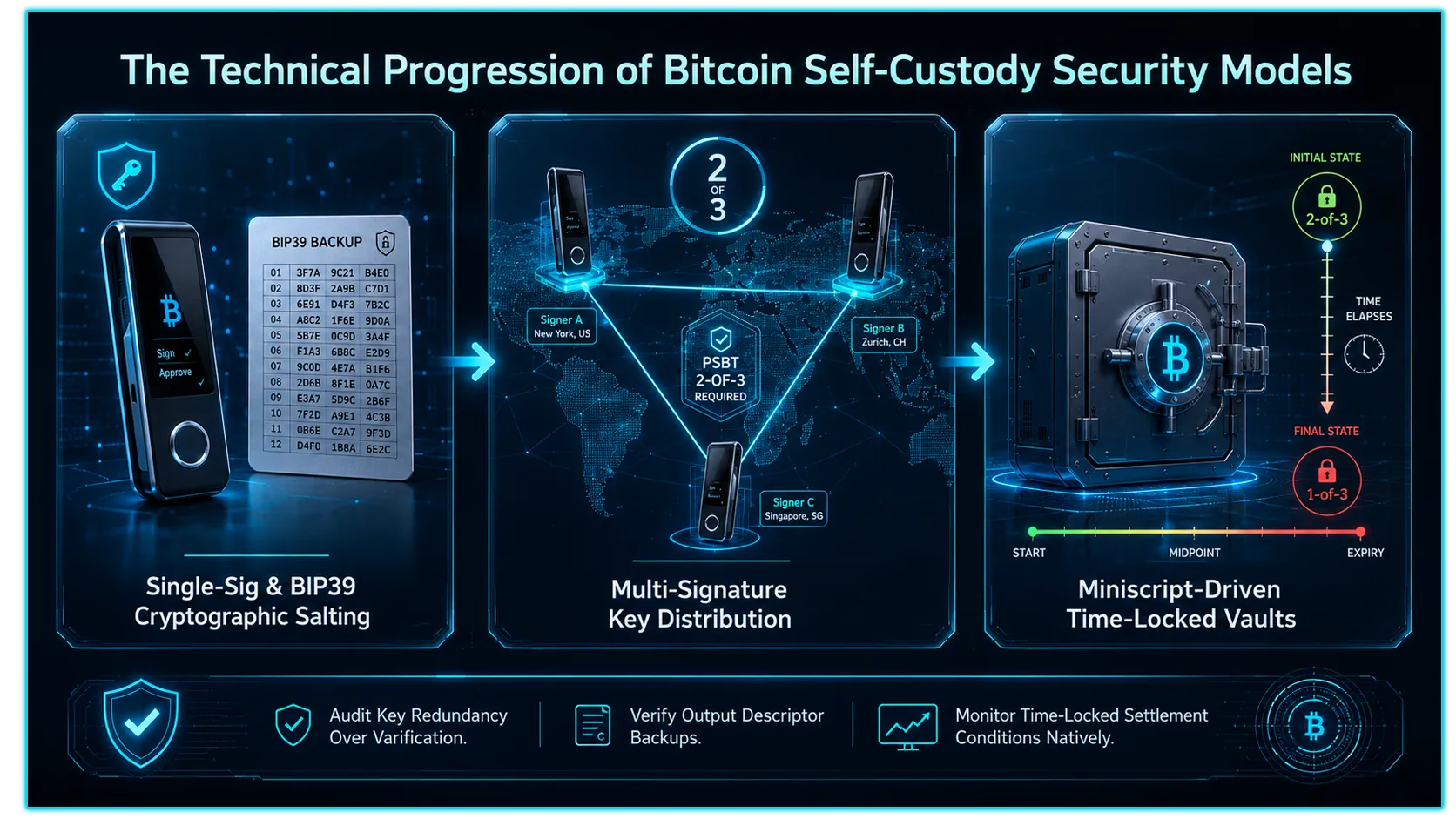
1. Single-Signature (Single-Sig) with BIP39 Passphrase
Single-Signature remains the entry point for independent capital preservation. In a standard setup, a single dedicated hardware signing device (such as a Coldcard, BitBox02, or Blockstream Jade) holds the master private key, derived from a standard 12- or 24-word seed phrase.
The Vulnerability
If an attacker locates your Bitcoin physical seed phrase backup sheet or extracts it through physical coercion, your BTC funds can be drained instantly within a single block confirmation.
The Upgrade: BIP39 Passphrase (The "25th Word")
To insulate a Single-Sig setup from physical discovery risks, advanced users apply a BIP39 Passphrase. This functions as a customizable alphanumeric string appended to the seed phrase.
The passphrase acts as a permanent cryptographic salt:
The Stealth Wallet: Entering a unique passphrase forces the hardware device to calculate an entirely different wallet address path. If an attacker discovers your physical 24-word paper backup, they will only unlock an empty default wallet. Your real capital remains completely invisible, hidden behind the passphrase matrix.
Storage Protocol: Because the passphrase is never stored on the hardware device itself, it must be memorized or backed up completely separate from the primary seed phrase to prevent accidental lockouts.
2. Multi-Signature (Multi-Sig) and the 2-of-3 Standard
When capital scales past a baseline risk threshold, relying on a single hardware device introduces an unacceptable physical dependency. Multi-signature (Multi-Sig) frameworks eliminate single points of failure by distributing transaction signing authority across multiple independent private keys.
The 2-of-3 Key Configuration
The industry benchmark for robust corporate and long-term individual treasury custody is the 2-of-3 Multi-Sig setup.
Key Generation: You generate three entirely independent private keys using three distinct hardware devices, ideally sourced from different manufacturers to insulate the system from potential supply-chain firmware vulnerabilities.
Consensus Threshold: To execute an outbound transaction, a Partially Signed Bitcoin Transaction (PSBT) must gather valid cryptographic signatures from any two out of the three keys.
This distributed architecture delivers immense operational resilience: if one hardware wallet breaks, or a single paper backup location is compromised by fire or theft, you still retain the remaining two keys required to securely move and recover your funds.
The Critical Operational Catch: Output Descriptors
A common and dangerous mistake when deploying Multi-Sig is assuming that backing up the three separate seed phrases is enough. It is not.
The Descriptor Dependency: To interact with a Multi-Sig address, wallet software requires the Output Descriptor. This is a text string that maps the exact compilation rules of the script, including the Extended Public Keys (XPUBs) of all three participating devices.
Without the output descriptor, your software cannot calculate your addresses or locate your funds on the blockchain, even if you hold all three seed phrases perfectly. Modern self-custody setups require storing a digital or paper copy of the wallet descriptor alongside each isolated key location.
3. Bitcoin Vaults: Miniscript and Time-Locked Spending Paths
The most advanced frontier of self-custody shifts security from static key distribution to dynamic, time-locked programmability. Leveraging Bitcoin Miniscript: a structured language that simplifies the composition of complex Bitcoin Scripts, wallets like Liana allow users to build institutional-grade vaults natively on-chain.
Decaying and Expanding Multisigs
Vault architectures introduce native script timelocks (OP_CHECKSEQUENCEVERIFY) to construct automated safety nets for inheritance planning or disaster recovery:
The Primary Path: You configure a highly secure, everyday spending path: for instance, a tight 2-of-2 Multi-Sig requiring your primary hardware key and a secure backup device.
The Decaying Recovery Path: If you lose access to one of your primary keys, a standard multisig locks you out permanently. A Miniscript vault prevents this catastrophe by embedding a timer. The script can be programmed to state: If these coins sit completely unmoved for exactly 12 months, the spending condition programmatically decays into a 1-of-2 threshold. This allows a single surviving backup key or a designated family beneficiary's key to automatically gain recovery access once the timelock expires, bypassing the need for centralized collaborative custodians.
Self-Custody Framework Architecture Matrix
| Metric | Single-Sig + Passphrase | 2-of-3 Multi-Sig | Miniscript Timelocked Vault |
| Physical Keys Needed | 1 Hardware Wallet | 3 Isolated Devices | Variable (1 to 3+ Keys) |
| Single Point of Failure | No (Passphrase Isolated) | Defeated Completely | Defeated Completely |
| Backup Complexity | Low (Seed + Passphrase) | High (3 Seeds + Descriptor) | High (Seeds + Vault Policy) |
| Primary Risk Vector | Memory Loss / Extortion | Loss of Output Descriptor | Forgetting to Refresh Timelocks |
Tracking Security Architecture Assets via DEXTools Telemetry
- As advanced self-custody frameworks and automated multisig coordination layers increasingly integrate with broader cryptographic networks, tracking the live transaction volume, liquidity depth, and on-chain health of decentralized security infrastructure tokens becomes an essential operational workflow. Sourcing analytics through advanced decentralized charting architectures like DEXTools gives market participants an essential universal platform to monitor live token behaviors, evaluate pool depths, and inspect contract parameters across all public execution networks.
- By leveraging core features like the Pair Explorer, Live New Pairs dashboard, and the integrated Trade Story or Top Traders diagnostic tools, technical traders can seamlessly audit localized volume trends, track large whale wallet capital reallocations via the Big Swap Explorer, and check automated contract safety scores before initiating any on-chain interactions, ensuring your hardened hardware setup interacts safely with verified market venues.
You can access DEXTools here and start trading today!
How to Recover a Crypto Wallet - Seed Phrase Recovery Guide 2026 Seed Phrase vs Private Key in Crypto: Guide 2026 How to Check a Liquidity Pool Before Buying a Token 2026 Top 5 Whale Tracking Tools in 2026: Large Wallet Monitoring Across ChainsDisclaimer: This article is for informational purposes only and does not constitute investment advice, financial advice, trading advice, or any other kind of advice. DEXTools does not recommend buying, selling, or holding any cryptocurrency or token. Users should conduct their own research and consult with a qualified financial advisor before making any investment decisions. Cryptocurrency investments are volatile and high-risk. DEXTools is not responsible for any losses incurred.