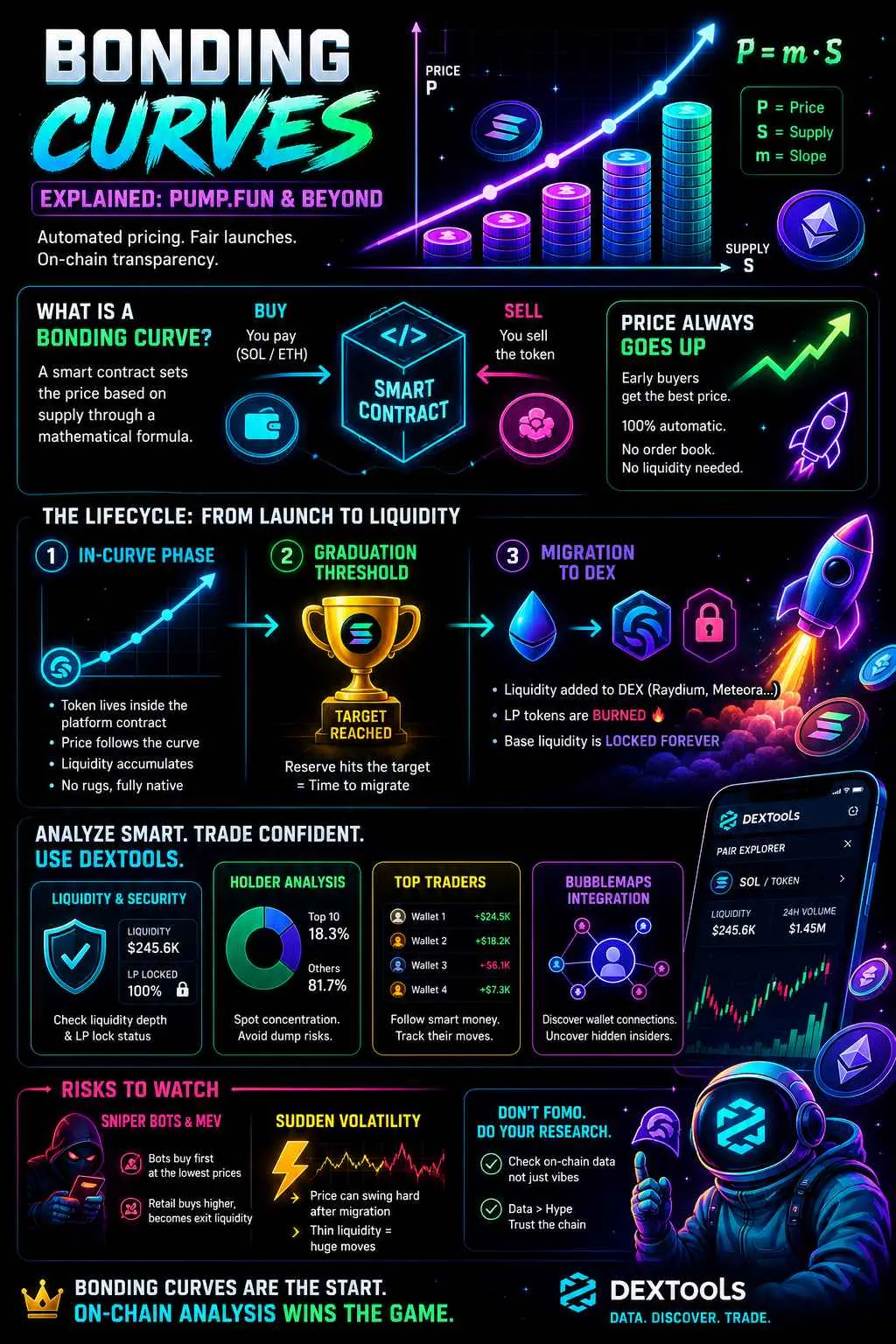
An in-depth, technical exploration of how bonding curves function within decentralized applications like Pump.fun, detailing their mathematical pricing mechanics, liquidity migration phases, and risk vectors for intermediate on-chain traders.
Bonding Curves Explained: Pump.fun and Beyond
The evolution of decentralized finance (DeFi) has driven significant innovation in how digital assets establish value and attract initial liquidity. Traditionally, launching a new cryptographic token required creators to provide upfront capital to establish a liquidity pool on an automated market maker (AMM) like Uniswap or Raydium. However, this structure often presented a barrier to entry for early-stage projects and exposed participants to rug-pull risks if the deployer suddenly withdrew the underlying liquidity. To address these inefficiencies, programmatic launchpads have popularized an alternative capital-allocation mechanism centered around the mathematical concept of a bonding curve. By automating price discovery through a native formula rather than relying on external order books or immediate dual-asset pools, these frameworks have redefined the lifecycle of micro-cap assets.
What Is an Automated Pricing Mechanism?
This system is a mathematical formula that dictates a direct relationship between a token's price and its circulating supply. Instead of relying on a traditional order book where buyers and sellers match orders, or a standard AMM constant-product formula ($x \times y = k$), the smart contract acts as the automated counterparty for every transaction.
When an investor purchases an asset from the system, the buyer sends the base asset (such as SOL or ETH) directly to the smart contract. The contract then mints a calculated quantity of the native token for the buyer. Conversely, when selling, the user returns the native token to the contract, which burns those tokens and releases a corresponding amount of the reserve asset.
The Pricing Mechanism
The fundamental principle underlying most algorithmic pricing models is that the asset's unit price increases as the circulating supply expands. This relationship is commonly modeled using a linear, polynomial, or exponential function. For example, a simple linear model can be represented as:
$$P = m \cdot S$$
Where:
$P$ represents the current token price.
$S$ represents the total circulating supply.
$m$ represents a constant slope factor defined by the smart contract.
Under this architectural framework, early participants purchase tokens at a lower price point relative to subsequent buyers. Because the pricing path is fully deterministic and hardcoded into the protocol, the contract guarantees continuous liquidity. Slippage and price impact are calculated mathematically prior to execution based on the size of the order relative to the current position along the curve.
The Mechanics of Pump.fun and On-Chain Migration
The practical utility of programmatic issuance gained substantial traction through platforms like Pump.fun, which automated the creation of micro-cap tokens on the Solana blockchain. Understanding the operational phases of these launches is critical for analyzing asset volatility.
The In-Curve Phase
When a token is initialized, it exists solely within the confines of the platform’s primary contract. The initial supply is fixed, and the price starts at a nominal baseline. As buy orders occur, the reserve asset accumulates within the contract, and the token moves upward along the predetermined mathematical trajectory.
Durante this phase, standard AMM pools do not exist for the asset. The contract enforces strict parameters: tokens cannot be shorted, and the liquidity accumulated from buyers is programmatically locked within the contract itself, mitigating the risk of a standard developer-initiated liquidity removal.
The Graduation Threshold and Migration
Once the accumulated reserve asset inside the system hits a specific financial threshold (often referred to as the graduation point), the curve is considered fully satisfied. At this precise moment, the contract executes a multi-step programmatic migration:
Token Burning or Locking: A portion of the remaining unpurchased token supply within the contract may be permanently burned or neutralized.
Liquidity Extraction: The accumulated reserve assets (e.g., a specific allocation of SOL) are extracted from the launch contract.
Automated AMM Deployment: The protocol automatically deploys a new liquidity pair on a decentralized exchange (DEX) like Raydium or Meteora.
LP Token Destruction: To ensure long-term structural stability, the newly created Liquidity Provider (LP) tokens are automatically transferred to a burn address, permanently locking the base liquidity.
This transition from a closed bonding structure to an open AMM represents a significant shift in price action and market structure, often accompanied by heightened volatility.
Analyzing Migrated Tokens with DEXTools
Evaluating an asset during or immediately after its initial distribution phase requires systematic on-chain analysis. Relying purely on social media sentiment introduces unnecessary risk. Instead, traders utilize structural indicators to map out market health.
Verifying Liquidity with Pair Explorer
Once an asset graduates from its foundational contract to an open AMM, tracking the depth of the pool becomes paramount. Through the DEXTools Pair Explorer, users can monitor the total liquidity locked versus the circulating market capitalization. If the total liquidity is low relative to the market cap, small trade volumes can induce massive relative price movements, amplifying downside risk.
Furthermore, checking the status of the LP tokens within the DEXTools security audit interface allows analysts to verify if the liquidity was truly burned upon migration, or if malicious contract vulnerabilities remain.
Evaluating Holder Distribution and Volume
Automated distribution models inherently incentivize early accumulation. This can lead to highly centralized supply distribution if individual wallets or automated bots coordinate purchases during the initial seconds of an asset's activation.
Holder Analysis: Utilizing the Holder Analysis tab on DEXTools allows traders to scan for wallet clustering. If a small group of wallets controls a significant percentage of the circulating supply, the asset is highly susceptible to sudden cascading sell-offs.
Top Traders Tracking: Monitoring the Top Traders feature helps identify if early profitable wallets are systematically unwinding their positions or adding to them, which may offer insight into intermediate-term price action.
Bubblemaps Integration: Visualizing wallet connections via Bubblemaps on DEXTools reveals whether ostensibly separate addresses are linked back to a single funding source, which can signal insider manipulation or sybil deployment.
Identifying Technical Turning Points
Post-migration price action often behaves differently than the predictable steps of a deterministic curve. When a token enters a standard DEX, traditional technical analysis metrics apply:
Support and Resistance Levels: After graduation, initial profit-taking frequently creates a sharp corrective wave. Identifying where the price establishes a horizontal support level can indicate institutional or retail interest stabilization.
Volume and Volatility Management: A high volume-to-liquidity ratio indicates heavy speculation. If volume begins to decay while the price tests key resistance structures, momentum may be stalling.
RSI Divergences: Applying the Relative Strength Index (RSI) on short-interval charts (such as the 5-minute or 15-minute intervals) via DEXTools Charts can highlight potential exhaustion. For instance, if the price prints a higher high immediately after migration but the RSI prints a lower high, it may indicate weakening buying pressure.
Risk Mitigation in Algorithmic Issuance Environments
While bonding curves eliminate upfront capital requirements and prevent immediate liquidity removal scams during the launch phase, they introduce unique structural risks that market participants must manage objectively.
MEV and Sniper Bot Dominance
Due to the predictable nature of mathematical pricing models, the earliest transactions yield the highest potential returns per unit of capital. Consequently, sophisticated actors deploy Miner-Extractable Value (MEV) bots and specialized snipers configured to identify launch signatures directly from the blockchain mempool. These bots frequently capture the lowest tiers of the curve, leaving retail participants to buy further up the price trajectory, increasing the probability of becoming exit liquidity during the subsequent profit-taking phase.
Sudden Volatility and Liquidity Gaps
Durante the exact window of migration from a launchpad to an AMM, trading is momentarily paused or disrupted as liquidity is routed across protocols. Once trading resumes on the DEX, the absence of a smooth pricing wrapper means that large market sell orders can cut through thin liquidity blocks rapidly, triggering stop-losses and sharp liquidations across short timeframes.
Summary
Algorithmic liquidity designs represent a significant milestone in automated tokenomics, offering a continuous issuance model and a democratized launch framework for decentralized networks. By anchoring asset distribution to strict formulas, platforms like Pump.fun have simplified initial capital formation.
However, the structural mechanics of these curves demand rigorous analytical oversight. Successful navigation of post-migration environments relies on dissecting on-chain health indicators—such as holder concentration, volume sustainability, and confirmed liquidity locks—rather than reacting to speculative momentum.
Disclaimer: This article is for informational purposes only and does not constitute investment advice, financial advice, trading advice, or any other kind of advice. DEXTools does not recommend buying, selling, or holding any cryptocurrency or token. Users should conduct their own research and consult with a qualified financial advisor before making any investment decisions. Cryptocurrency investments are volatile and high-risk. DEXTools is not responsible for any losses incurred.