Borrow Cap vs Supply Cap: How Lending Limits Protect DeFi Markets
— By Whatsertrade in Tutorials

DeFi lending protocols need risk controls. Without limits, users could deposit too much of a risky asset, borrow too much against unstable collateral or create
DeFi lending protocols need risk controls. Without limits, users could deposit too much of a risky asset, borrow too much against unstable collateral or create liquidity stress during volatile markets.
Two important risk tools are borrow caps and supply caps. They may sound similar, but they control different parts of a lending market.
Understanding borrow cap vs supply cap can help traders evaluate how lending protocols manage risk, protect liquidity and reduce the chance of bad debt.
What Is a Supply Cap?
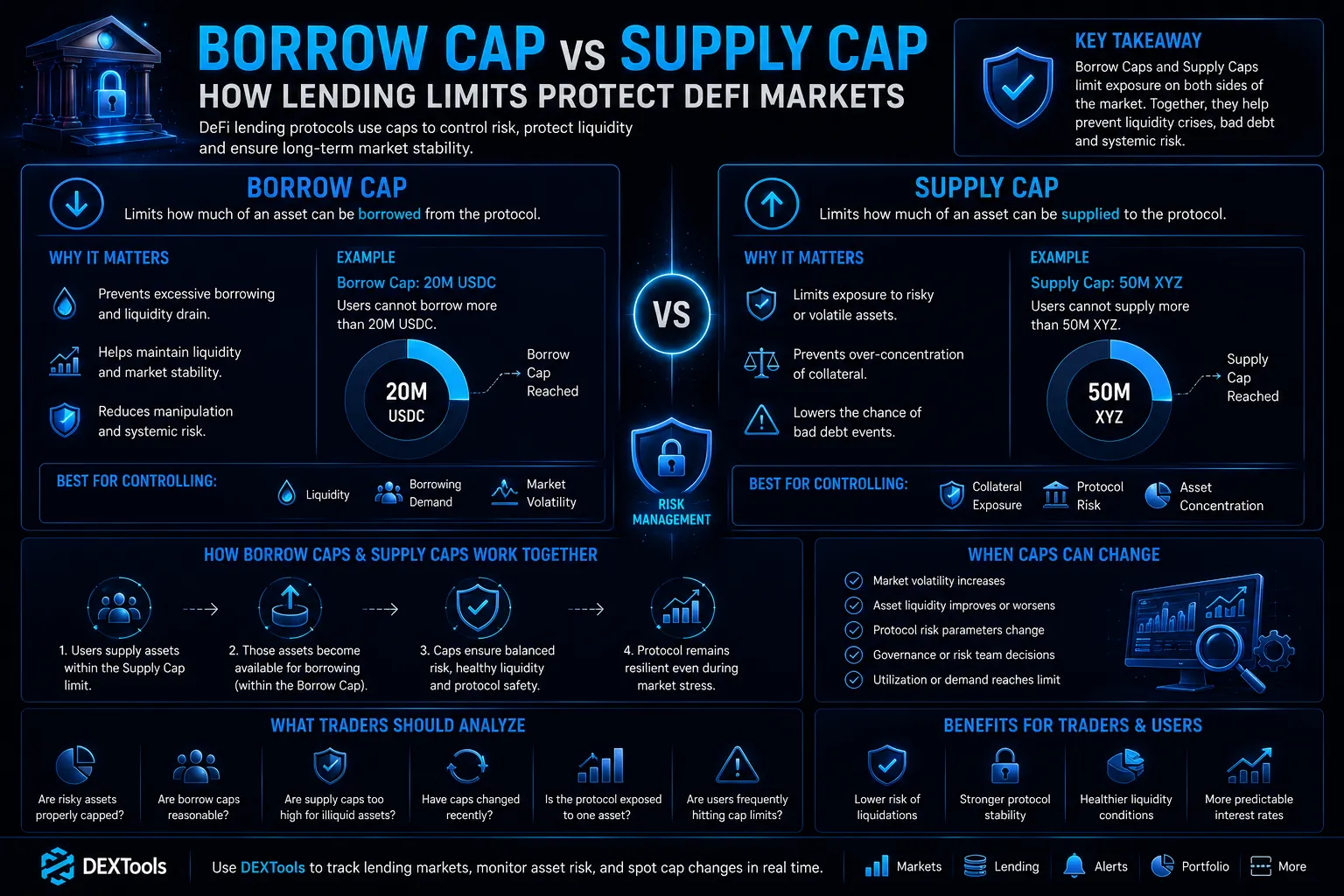
A supply cap limits how much of a specific asset can be deposited into a lending protocol.
For example, if a protocol sets a supply cap of 50 million dollars for a token, users cannot supply more than that limit.
Supply caps are used to control exposure to specific assets. This is especially important for newer, volatile or less liquid tokens.
A supply cap helps prevent a lending protocol from becoming too dependent on one risky asset.
What Is a Borrow Cap?
A borrow cap limits how much of a specific asset can be borrowed from a lending protocol.
For example, if a stablecoin has a borrow cap of 20 million dollars, users cannot borrow more than that amount.
Borrow caps help prevent excessive borrowing, liquidity stress and market manipulation. They are especially useful when an asset has limited liquidity or could create systemic risk if borrowed too aggressively.
Borrow Cap vs Supply Cap: The Key Difference
The key difference is direction.
A supply cap controls how much of an asset can enter the protocol as supplied collateral or liquidity.
A borrow cap controls how much of an asset can leave the protocol through borrowing.
Supply caps manage deposit exposure. Borrow caps manage borrowing exposure.
Both protect the lending market from becoming too concentrated or unstable.
Why Supply Caps Matter
Supply caps are important because not all assets are equally safe as collateral.
If a protocol allows unlimited deposits of a risky token, users may build large borrowing positions backed by collateral that can lose value quickly.
If that token crashes, liquidations may not happen efficiently. The protocol could face bad debt if collateral value falls faster than positions can be closed.
Supply caps reduce this risk by limiting how much exposure the protocol can take.
Why Borrow Caps Matter
Borrow caps protect the market from excessive demand for a borrowed asset.
If too much of an asset is borrowed, available liquidity can become tight. This can make withdrawals harder and create unstable interest rates.
Borrow caps can also reduce the risk of manipulation. If a user can borrow a large amount of a thinly traded token, they may be able to create pressure in related markets.
A borrow cap limits how large this risk can become.
How Caps Protect Against Market Stress
During market stress, lending protocols need enough liquidity and healthy collateral coverage.
Supply caps reduce exposure to risky collateral. Borrow caps prevent too much borrowing from draining liquidity.
Together, they help prevent extreme situations where many users are liquidated at once or where the protocol cannot recover enough value.
Caps do not remove risk, but they make risk more manageable.
Why Caps Can Change Over Time
Borrow caps and supply caps are not fixed forever.
A protocol may increase caps when an asset becomes more liquid, more widely used or less risky. It may lower caps when volatility increases, liquidity weakens or risk parameters need to become more conservative.
Traders should pay attention to cap changes because they can signal how governance or risk teams view a market.
A sudden cap reduction may indicate rising concern.
When Caps Can Limit Growth
Caps protect markets, but they can also limit growth.
If a supply cap is reached, users cannot deposit more of that asset. If a borrow cap is reached, users cannot borrow more, even if demand is strong.
This can frustrate users and reduce protocol expansion.
The challenge is balance. Caps should be high enough to support healthy activity but low enough to protect the protocol from excessive risk.
What Traders Should Analyze
Before trusting a DeFi lending market, traders should ask:
Are risky assets capped?
Are borrow caps reasonable?
Are supply caps too high for illiquid assets?
Have caps changed recently?
Is the protocol exposed to one asset?
Are caps adjusted during volatility?
Are users reaching cap limits frequently?
Do caps protect against bad debt?
These questions help traders understand how seriously a protocol manages risk.
How DEXTools Can Help
DEXTools can help traders monitor token behavior around lending assets and protocol tokens. If a collateral asset becomes volatile or illiquid, market data may show early warning signs.
Traders can review price movement, liquidity, volume and transaction activity to understand whether lending risk is becoming market risk.
Final Thoughts
Borrow caps and supply caps are essential risk tools in DeFi lending.
Supply caps control how much of an asset can enter the protocol. Borrow caps control how much of an asset can be borrowed.
Both help protect liquidity, reduce concentration and limit exposure to risky assets.
For traders, these limits are not just technical settings. They can reveal how safe, flexible and well managed a lending protocol really is.
How to Bridge Crypto Between Chains: Complete Cross-Chain Tutorial 2026 How to Use 1inch for Swaps: Classic, Fusion and Limit Orders (2026) OKX Web3 Wallet Tutorial 2026: Multi-Chain Setup GuideThe Collateral Factor's Silent Influence
While Borrow and Supply Caps set the absolute boundaries for a specific asset within a lending pool, the Collateral Factor (or Loan-to-Value ratio) acts as the dynamic multiplier, dictating how much you can actually borrow against your supplied collateral. It's not a cap on the asset itself, but rather a cap on its utility as collateral. A high Collateral Factor indicates the protocol's confidence in an asset's stability and liquidity, allowing users to borrow a larger percentage of its value. Conversely, a low factor signals caution, restricting borrowing power to mitigate potential losses from price volatility.
Understanding the interplay between these mechanisms is crucial for advanced DeFi users. A high Supply Cap for a volatile asset, combined with a low Collateral Factor, might allow for massive deposits but severely limit borrowing against it, thereby insulating the protocol from a sudden price drop. This nuanced approach helps prevent cascading liquidations and maintains overall protocol health, even when dealing with less proven assets.
Strategic Implications for Lenders and Borrowers
- Prioritize assets with high Collateral Factors when aiming for maximum borrowing power.
- Be aware that even with a high Supply Cap, a low Collateral Factor can effectively limit an asset's impact on your borrowing capacity.
- Protocols often adjust Collateral Factors based on market conditions, so monitor these changes.
- Diversify collateral across assets with varying factors to optimize risk and borrowing potential.
- Understand that a protocol's decision to lower a Collateral Factor for an asset is a strong signal of increased perceived risk.
Related Guides
- How to Use Aave: Deposit, Borrow, Repay and Manage Health Factor (2026)
- NFT Lending Explained: How to Borrow Against Your NFTs
- JustLend Tutorial: Lend and Borrow on TRON 2026
- Meme Coin Market Cap: How to Read Market Cap, FDV & Supply
- What Drives XRP Price? Market Cap, Supply and Valuation
Frequently Asked Questions
What is a supply cap in DeFi lending?
A supply cap is a limit on how much of a particular asset can be deposited into a lending market. It helps prevent a protocol from becoming overexposed to a single, possibly risky, asset.
What is a borrow cap in DeFi lending?
A borrow cap limits how much of an asset can be borrowed from a market, which helps manage liquidity and risk. It can reduce the chance of a market running short of an asset or being manipulated.
Why do lending protocols use caps?
Caps are risk controls that limit exposure to volatile or thinly traded assets, helping protect the protocol and its users. Without limits, large positions in risky assets could threaten the system's stability.
How do borrow and supply caps protect a market?
By capping how much can be supplied and borrowed, protocols reduce the impact of a single asset becoming unstable or illiquid. This helps keep markets solvent and lowers the risk of cascading liquidations.