How to Bridge Native USDC to Solana with Circle CCTP
— By AliceOnChain in Tutorials

Moving capital across blockchains safely requires understanding native infrastructure. This advanced tutorial breaks down how to bridge native USDC to Solana using Circle’s Cross-Chain Transfer Protocol (CCTP) while utilizing DEXTools to monitor liquidity shifts and manage market volatility.
How to Bridge Native USDC to Solana with Circle CCTP: An Advanced On-Chain Guide
The expansion of decentralized finance (DeFi) across multiple layer-1 and layer-2 ecosystems has made capital efficiency a primary focus for advanced traders. Historically, moving stablecoins between isolated networks required relying on traditional lock-and-mint bridges. These legacy systems inherently introduce counterparty risks, wrap assets into non-native versions, and fragment liquidity pools.
For market participants deployed on Ethereum or EVM-compatible rollups, rotating capital into the high-throughput Solana ecosystem demands a more secure, native approach. Circle’s Cross-Chain Transfer Protocol (CCTP) addresses these vulnerabilities by enabling the native burning and minting of USD Coin (USDC) across supported chains. Learning how to safely bridge usdc to solana cctp allows traders to bypass third-party bridge vulnerabilities completely.
When executing large-scale cross-chain movements, relying solely on user interfaces is insufficient. Sophisticated market participants simultaneously analyze capital flows, protocol liquidity, and post-bridge market behavior. By pairing native bridging infrastructure with the advanced analytics on DEXTools, traders can monitor liquidity depth, detect volume anomalies, and optimize their entry points into the Solana DeFi landscape.
Understanding Circle CCTP and Native Assets
Before executing a cross-chain transfer, it is critical to differentiate between wrapped stablecoins and native assets. Traditional bridges lock native assets in a smart contract on the source chain and mint a synthetic, "wrapped" equivalent on the destination chain. This structure creates a single point of failure; if the source contract is compromised, the wrapped tokens on the destination network may lose their collateral backing.
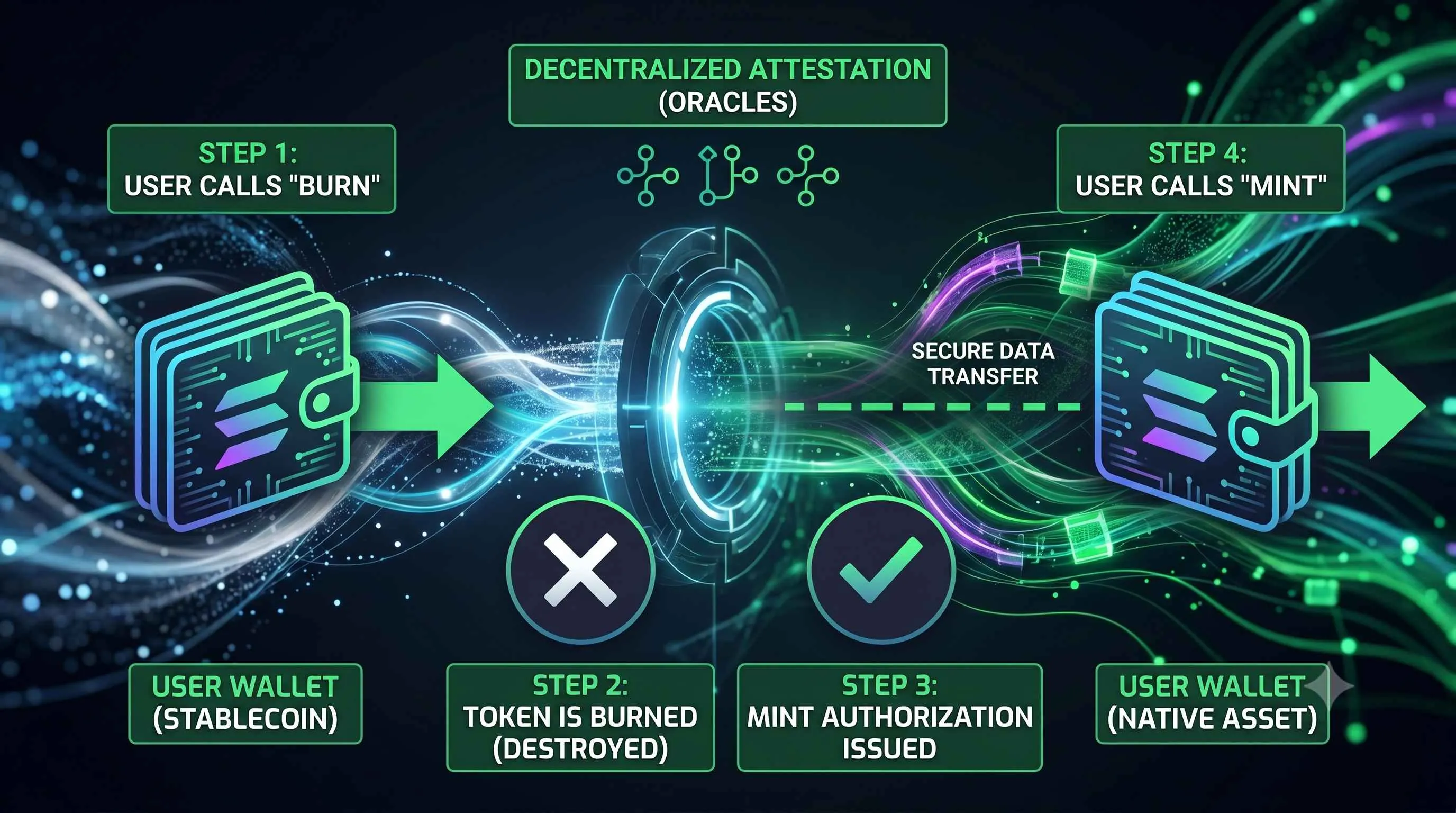
Circle CCTP eliminates this specific attack vector through a native burn-and-mint mechanism:
Initiation: The user calls a smart contract on the source chain (e.g., Ethereum), which permanently burns a specified amount of native USDC.
Attestation: Circle's off-chain attestation service monitors the transaction, verifies the burn event, and provides a cryptographic signature.
Minting: The destination contract on Solana validates the signature and mints an exact equivalent amount of native USDC directly into the user's Solana wallet.
This process ensures that liquidity remains unified and that users interact exclusively with official, fully backed stablecoins. On-chain volume tracking often indicates that institutional and whale capital shifts heavily toward native protocols when users choose to bridge usdc to solana cctp during periods of heightened market volatility, minimizing exposure to third-party smart contract risks.
Pre-Bridge Analysis: Evaluating Solana Liquidity via DEXTools
Moving capital to a new ecosystem without analyzing current liquidity conditions can result in suboptimal execution, high slippage, or entrapment in illiquid pools. Before you utilize a native platform to bridge usdc to solana cctp, conducting an on-chain audit of the destination network's health is a prudent practice.
Monitoring Pool Depth and Volume
Advanced users begin their workflow by navigating to the DEXTools Pair Explorer to assess the primary USDC pairs on Solana (such as SOL/USDC or USDC/USDT). High daily volume paired with shallow liquidity depth can signal impending price volatility. Conversely, pools displaying consistent, balanced volume and deep liquidity structures provide a safer environment for deploying your capital once you bridge usdc to solana cctp.
Analyzing Holder Distribution and Wallet Behavior
Large inflows of stablecoins often precede significant market positioning. Utilizing DEXTools Holder Analysis and integrated Bubblemaps allows traders to scrutinize token distribution across major Solana protocols. A highly concentrated holder base can present systemic risks, while a decentralized distribution pattern historically points to a more mature and resilient market structure. Observing whale activity—specifically tracking wallet movements from major cross-chain bridges into specific liquidity pools—can provide valuable context regarding current market sentiment.
Technical Indicators and Volatility Management
When preparing to allocate USDC into volatile assets post-bridge, monitoring technical indicators is essential. An asset showing a strong relative strength index (RSI) divergence on the daily chart, for instance, may signal an exhausting trend. If the price is making higher highs while the RSI is forming lower highs, it can signal an upcoming reversal.
Identifying structural support and resistance levels on DEXTools charts helps determine whether to initiate the transaction to bridge usdc to solana cctp immediately or hold it in stable form on the source chain until a more favorable risk-reward entry presents itself.
Step-by-Step Framework: How to Bridge Native USDC to Solana CCTP
To complete a native transfer via CCTP, you will need a funded EVM-compatible wallet (e.g., MetaMask, Rabby) containing the USDC you wish to bridge along with native tokens for gas fees (e.g., ETH), as well as a Solana-compatible wallet (e.g., Phantom, Solflare) to receive the native assets.
Step 1: Select a CCTP-Enabled Interface
Circle CCTP is an infrastructure layer, meaning users interact with it via integrated front-ends. Popular dApps utilizing CCTP include the official Circle Bridging portal, Wormhole Connect, Portal Bridge, and various advanced cross-chain aggregators. Selecting a secure, verified interface is the most critical phase when you plan to bridge usdc to solana cctp.
Step 2: Connect Source and Destination Wallets
Open the bridging application and connect your source EVM wallet. Next, connect your destination Solana wallet. The interface will clearly display the source network (e.g., Arbitrum, Optimism, or Ethereum Mainnet) and the destination network, which must be set to Solana.
Step 3: Specify the Asset and Amount
Select USDC as the asset to transfer. Enter the desired amount. Because CCTP mints native tokens, the protocol does not impose traditional liquidity pool limits; however, you must ensure your source wallet possesses sufficient native gas tokens to execute the initial burn transaction before attempting to bridge usdc to solana cctp.
Step 4: Approve and Execute the Burn Transaction
The interface will prompt you for two sequential wallet interactions:
Token Allowance: Grant the CCTP smart contract permission to spend your USDC. For security purposes, consider approving only the specific amount you intend to bridge rather than an infinite allowance.
Bridge Execution: Confirm the transaction to burn the USDC on the source chain.
Step 5: Wait for Attestation and Minting
Once the burn transaction is confirmed on-chain, Circle’s attestation service processes the event. This verification period varies depending on the finality time of the source network; transfers from Ethereum mainnet may take several minutes, while transfers from specific layer-2 rollups can be faster. Once the attestation is secure, the destination contract will automatically execute, or prompt you to claim, completing the process to bridge usdc to solana cctp directly into your Solana wallet.
Post-Bridge Workflow: Deploying Capital and Risk Management
Once the native USDC arrives in your Solana wallet, the focus transitions to safe capital deployment. Successful execution requires ongoing vigilance and real-time monitoring of market metrics.
Setting Price Alerts and Tracking Order Flow
The cryptocurrency markets operate continuously, and volatility can materialize rapidly. Using DEXTools Price Alerts allows you to set precise notifications for target entries on Solana pairs. If you decided to bridge usdc to solana cctp to capture an ecosystem dip, automated alerts eliminate the need for constant manual charts monitoring while waiting for an asset to test a specific historical support level.
Spotting Smart Money and Top Traders
To gain insights into localized market trends on Solana, review the Top Traders tab on DEXTools for your pairs of interest. Analyzing the addresses that consistently execute profitable swaps can highlight emerging liquidity trends or signal potential distribution phases by institutional players. This data should not be used in isolation but as a supplementary component of a broader, probabilistic market analysis.
Safeguarding Against Slippage and MEV
Solana’s rapid block times create a unique environment for order execution. When swapping your native USDC for other ecosystem tokens, always configure your slippage tolerance conservatively within your chosen decentralized exchange (DEX) or aggregator. Excessive slippage settings leave transactions vulnerable to Maximum Extractable Value (MEV) bots, which can manipulate execution prices to your disadvantage.
Conclusion: Balancing Speed with Protocol Security
When traders choose to bridge usdc to solana cctp via Circle’s infrastructure, they benefit from a robust upgrade over legacy, wrapped asset methods by mitigating bridge-collapse risks and ensuring native asset uniformity. However, secure infrastructure is only one part of the equation.
Advanced on-chain operations require a disciplined approach to market data. By continuously cross-referencing liquidity structures, tracking volume trends, and analyzing holder dynamics via DEXTools, market participants can navigate the cross-chain landscape with higher technical precision and comprehensive risk awareness.
Same Token, Different Price: Why Cross-Chain Liquidity Creates GapsChain Rotation: How Traders Detect Liquidity Moving Between Ecosystems
DEX Volume Recap: Liquidity Trends & Price Impact Insights
Disclaimer: This article is for informational purposes only and does not constitute investment advice, financial advice, trading advice, or any other kind of advice. DEXTools does not recommend buying, selling, or holding any cryptocurrency or token. Users should conduct their own research and consult with a qualified financial advisor before making any investment decisions. Cryptocurrency investments are volatile and high-risk. DEXTools is not responsible for any losses incurred.