Circulating Supply vs Total Supply in Crypto: Beginner Guide (2026)
— By Tony Rabbit in Tutorials
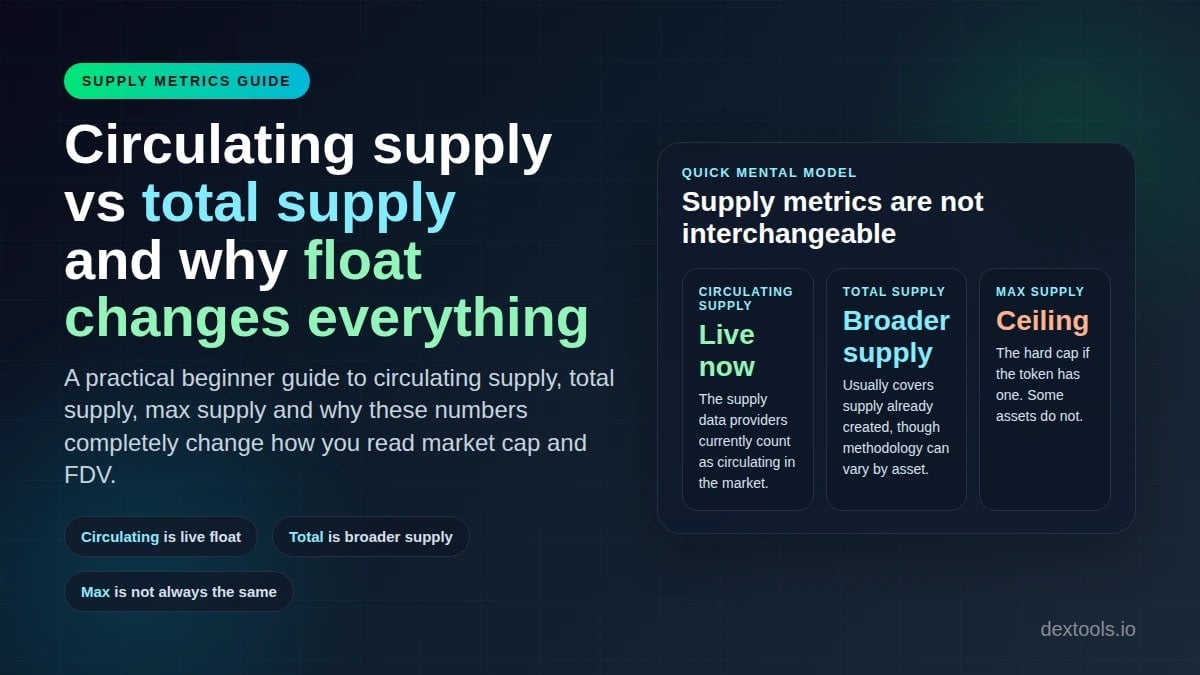
Understand circulating supply vs total supply in crypto for better valuation, dilution risk, and market cap analysis in 2026.
In crypto, circulating supply refers to the number of tokens actively available and tradeable in the market right now, influencing current market cap. Total supply encompasses all tokens ever created, including those locked, reserved, or burned, providing a broader picture of existing tokens. Max supply is the absolute hard cap on the total number of tokens that will ever exist, crucial for calculating Fully Diluted Valuation (FDV) and assessing long-term dilution. Understanding these distinct metrics is fundamental for accurate token valuation, assessing dilution risk, and making informed investment decisions, as they directly impact how market cap, FDV, and a token's long-term potential are perceived.
The Foundational Supply Metrics: Circulating, Total, and Max
Understanding the nuances between circulating supply, total supply, and max supply is paramount for anyone navigating the crypto markets in 2026. These aren't just technical terms; they are fundamental indicators that directly impact how you assess a token's current value, its future potential, and the inherent risks. Confusing them can lead to significant misinterpretations of market cap, Fully Diluted Valuation (FDV), and the long-term dilution trajectory of an asset.
Circulating Supply: The Market's Current Pulse
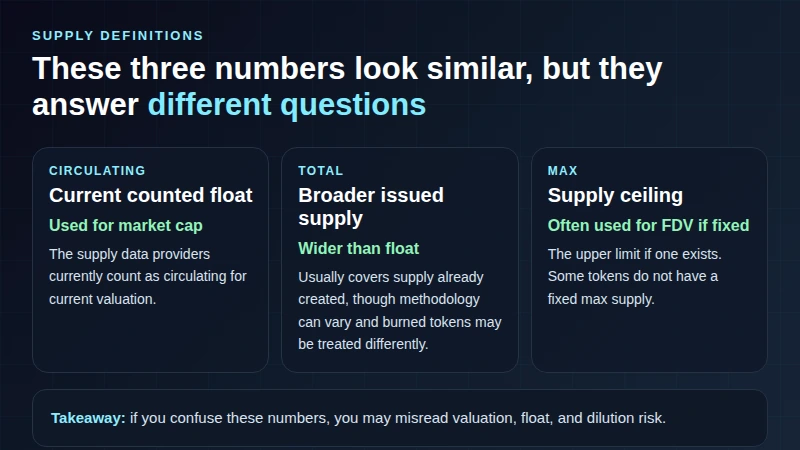
Circulating supply represents the number of tokens that are currently available to the public and are actively being traded in the market. This is the most dynamic of the three metrics, constantly changing as tokens are unlocked, distributed, or, less commonly, burned from active circulation. It's the go-to metric for calculating a token's current market capitalization (Price x Circulating Supply), which reflects the market's immediate valuation of the asset.
- What it includes: Tokens held by the public, actively traded on exchanges, and generally accessible.
- What it often excludes: Tokens held by the development team, locked in vesting schedules, reserved for future grants, or held in treasury wallets that are not yet released to the market.
- Why it matters: It provides the most accurate snapshot of the token's current liquidity and market presence, directly impacting its real-time market cap.
Total Supply: The Broader Picture of Existence
Total supply encompasses all tokens that have ever been created, regardless of whether they are currently circulating, locked, or held in reserve. This metric gives a more comprehensive view of the entire token pool that exists. While its methodology can vary slightly between different data providers and blockchain projects, it generally includes the circulating supply plus any tokens that are currently held by project teams, locked in smart contracts, or allocated for future distribution but not yet released.
- What it includes: Circulating supply, plus locked tokens, team allocations, treasury reserves, and often, tokens that have been burned but are still accounted for in the total creation count (though some projects subtract burned tokens from total supply).
- What it often excludes: Tokens that have not yet been minted or created (if the project has a dynamic minting schedule that hasn't reached its max supply).
- Why it matters: It helps in understanding the potential for future dilution from unreleased tokens and provides a more complete picture of the project's tokenomics.
Max Supply: The Ultimate Ceiling
Max supply, also known as maximum supply or hard cap, is the absolute upper limit on the number of tokens that will ever be created for a particular cryptocurrency. Not all cryptocurrencies have a max supply; some, like Ethereum, have an inflationary or dynamic supply model. For those that do, the max supply is a critical indicator of scarcity and is often used to calculate the Fully Diluted Valuation (FDV) (Price x Max Supply).
- What it includes: The theoretical maximum number of tokens that will ever exist over the lifetime of the project.
- What it often excludes: Nothing, as it represents the absolute ceiling.
- Why it matters: It's crucial for assessing long-term value, potential for inflation/deflation, and the ultimate dilution risk. A fixed max supply often signals a deflationary or disinflationary asset over time, assuming demand remains constant or increases.
Why These Supply Metrics Fundamentally Alter Valuation
The distinction between circulating, total, and max supply is not merely academic; it has profound implications for how a token is valued and perceived in the market. Using the wrong supply metric can lead to drastically incorrect conclusions about a project's market standing and future potential.
Market Cap vs. Fully Diluted Valuation (FDV)
These two primary valuation metrics are directly tied to supply figures:
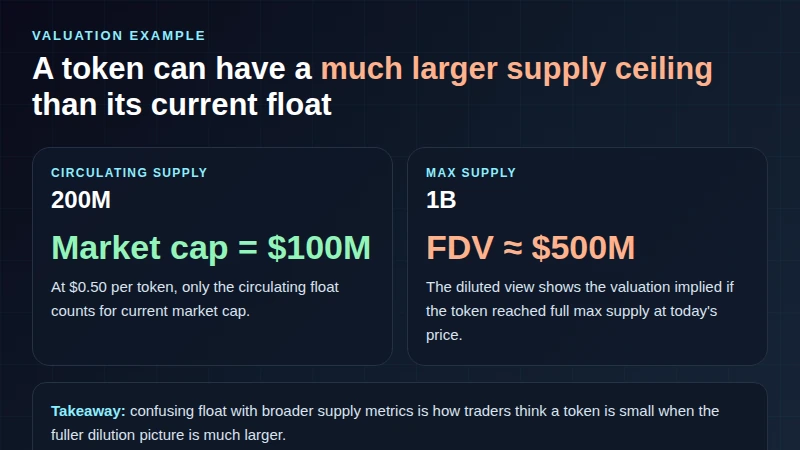
A token with a low circulating supply but a very high max supply might appear undervalued based on its market cap, but its FDV could be significantly higher, indicating substantial future dilution risk. Conversely, a token with circulating supply close to its max supply will have a market cap very similar to its FDV, suggesting minimal future dilution from unreleased tokens.
Dilution Risk and Float Expansion
One of the most critical aspects of supply metrics is understanding dilution risk. Float expansion refers to the increase in circulating supply over time as locked tokens are released. This can happen due to:
- Vesting Schedules: Tokens allocated to team members, advisors, and early investors are often locked for a period and then released gradually over months or years.
- Staking Rewards: New tokens minted and distributed as rewards to stakers.
- Liquidity Mining/Farming Incentives: Tokens distributed to users providing liquidity to decentralized exchanges or participating in other DeFi protocols.
- Treasury Releases: Tokens from a project's treasury being used for development, marketing, or ecosystem grants.
Each of these mechanisms can increase the circulating supply, potentially putting downward pressure on the token's price if demand doesn't keep pace. A high total supply relative to circulating supply, especially when coupled with a clear vesting schedule, signals significant future float expansion and potential dilution.
How to Effectively Use Supply Metrics in Your Research
Integrating supply metrics into your crypto research framework is essential for making well-informed decisions. Here's a practical guide:
- Step 1: Compare Market Cap and FDV.
Always look at both the market cap and FDV. If FDV is significantly higher than market cap (e.g., 5x or more), it indicates a large portion of the supply is not yet circulating. This isn't inherently bad, but it flags potential future selling pressure as those tokens unlock. - Step 2: Investigate Tokenomics and Vesting Schedules.
Dive into the project's whitepaper, tokenomics documentation, and investor decks. Look for detailed information on token distribution, vesting periods for team/investors, and emission schedules for staking or liquidity incentives. Understand when and how much supply is expected to enter circulation. - Step 3: Track Circulating Supply Growth Over Time.
Use reliable data platforms like DEXTools to monitor the historical growth of a token's circulating supply. A rapid increase without corresponding demand growth can be a red flag. Look for predictable, transparent release schedules. - Step 4: Assess the Ratio of Circulating to Max Supply.
A high ratio (e.g., 80-90% circulating) suggests that most tokens are already in the market, implying less future dilution. A low ratio (e.g., 10-20% circulating) indicates significant future supply releases, which could impact price. - Step 5: Understand the Project's Supply Mechanism.
Does the project have a fixed max supply (like Bitcoin)? Is it inflationary (like Ethereum's PoS, though with burning)? Does it have a burning mechanism that reduces total supply over time? These factors greatly influence long-term scarcity and value. - Step 6: Consider the Utility and Demand Drivers.
Even with significant float expansion, strong utility and growing demand can absorb new supply without negative price impact. Evaluate the project's ecosystem, user adoption, and revenue generation.
Common Mistakes to Avoid
Misinterpreting supply metrics is a common pitfall for new and even experienced crypto investors. Be aware of these mistakes:
- Ignoring FDV: Focusing solely on market cap without considering FDV can lead to underestimating future dilution and overvaluing a token based on its current, often artificially low, circulating float.
- Assuming Static Supply: Believing that circulating supply remains constant. It's dynamic and changes frequently based on vesting, emissions, and burns.
- Confusing Total Supply with Max Supply: For projects without a fixed max supply, total supply will continue to grow. Using total supply as a proxy for FDV in such cases can be misleading. Always check if a true 'max supply' exists.
- Not Researching Vesting Schedules: Overlooking the release schedule of locked tokens can result in being blindsided by significant sell pressure when large tranches of tokens unlock.
- Blindly Comparing Market Caps: Comparing two tokens solely by their market cap without considering their respective supply dynamics (e.g., one with 90% circulating vs. one with 10% circulating) can lead to an apples-to-oranges comparison.
Impact of Tokenomics on Supply Dynamics
Tokenomics, the economic model of a cryptocurrency, dictates how its supply metrics behave. Projects design their tokenomics to achieve specific goals, such as incentivizing network participation, funding development, or ensuring long-term sustainability. Key tokenomic elements that influence supply include:
- Initial Distribution: How tokens are initially allocated (e.g., public sale, private sale, team, foundation).
- Vesting Schedules: Timelines for unlocking tokens for team, advisors, and early investors. These are critical for understanding future circulating supply increases.
- Emission Schedules: The rate at which new tokens are minted and introduced into circulation, often tied to block rewards, staking rewards, or liquidity mining programs.
- Burning Mechanisms: Processes where tokens are permanently removed from circulation, reducing total supply and potentially increasing scarcity.
- Staking and Locking: Mechanisms where users lock up tokens to secure the network or participate in governance, temporarily reducing circulating supply.
A well-designed tokenomic model aims for a balance between incentivizing participation and managing supply to prevent excessive inflation or dilution. Conversely, poorly designed tokenomics can lead to unsustainable supply dynamics and undermine long-term value.
The Role of Data Providers and Methodology
It's important to note that while the definitions of circulating, total, and max supply are generally consistent, the exact methodology for counting these can vary slightly between different data providers (like DEXTools, CoinGecko, CoinMarketCap) and even between projects themselves. This is particularly true for total supply, where the treatment of burned tokens or certain locked contract addresses might differ.
- Transparency: Reputable data providers strive for transparency in their methodologies, often linking to the project's official sources for supply data.
- On-Chain Data: The most accurate supply data is typically derived directly from the blockchain itself, by analyzing smart contract states, wallet balances, and transaction histories.
- Project Disclosures: Always cross-reference data provider figures with the official statements and documentation from the project team. Discrepancies should be investigated.
In 2026, with the increasing complexity of tokenomics and multi-chain deployments, the standardization and accuracy of supply data remain a critical challenge and a key differentiator for reliable platforms.
How DEXTools Helps You Analyze Supply Metrics
DEXTools provides comprehensive, real-time data that is invaluable for analyzing circulating, total, and max supply across thousands of tokens. Through its intuitive interface and powerful analytics, users can:
- View Real-Time Supply Data: Instantly access current circulating supply, total supply, and max supply (if applicable) for any listed token.
- Monitor Supply Changes: Track historical trends in circulating supply to identify patterns of float expansion or contraction.
- Access Tokenomics Information: Often link directly to project websites and whitepapers, allowing users to quickly dive into detailed tokenomics and vesting schedules.
- Compare Valuation Metrics: Easily compare market cap and FDV side-by-side, providing immediate insight into potential dilution risks.
- Identify Red Flags: Leverage DEXTools' data to quickly spot tokens with unusually low circulating supply relative to total/max supply, prompting further investigation into their release schedules.
By centralizing this critical information, DEXTools empowers traders and investors to make more informed decisions by providing a clear picture of a token's supply dynamics.
Looking Ahead: Supply Dynamics in 2026 and Beyond
As the crypto market matures, the sophistication of tokenomics continues to evolve. In 2026, we see:
- More Dynamic Supply Models: Projects are implementing more complex burning mechanisms, adaptive emission rates, and innovative locking incentives to manage supply more effectively.
- Focus on Real Yield: The emphasis is shifting from inflationary rewards to sustainable, real yield generated from protocol fees, which can impact how new supply is distributed or existing supply is burned.
- Regulatory Scrutiny: Increased regulatory attention may lead to more standardized reporting requirements for supply metrics, enhancing transparency and comparability.
- Cross-Chain Complexity: With multi-chain ecosystems, tracking total supply across different networks becomes more intricate, requiring robust data aggregation tools.
Staying informed about these evolving supply dynamics is crucial for long-term success in the crypto space. The core principles of understanding circulating, total, and max supply, however, will remain timeless.
Frequently Asked Questions
What is the difference between circulating supply and total supply?
Circulating supply is the number of tokens currently available and actively traded in the market. Total supply includes all tokens ever created, whether circulating, locked, or reserved, providing a broader picture of existing tokens.
What is max supply in crypto?
Max supply is the absolute upper limit on the number of tokens that will ever be created for a cryptocurrency. It's a hard cap that indicates ultimate scarcity, often used for Fully Diluted Valuation (FDV).
Why is circulating supply important for market cap?
Circulating supply is directly used to calculate a token's current market capitalization (Price x Circulating Supply), reflecting its real-time valuation based on available tokens.
How does max supply relate to Fully Diluted Valuation (FDV)?
FDV is calculated by multiplying the current token price by its max supply (or total supply if no max exists). It represents the theoretical market cap if all tokens were in circulation.
What is dilution risk in crypto?
Dilution risk refers to the potential decrease in a token's value per unit as its circulating supply increases over time due to the release of locked tokens, vesting schedules, or new emissions, without a proportional increase in demand.
Do all cryptocurrencies have a max supply?
No, not all cryptocurrencies have a fixed max supply. Some, like Ethereum, have dynamic or inflationary supply models where the total supply can continue to grow over time, albeit often with burning mechanisms.
How can I track supply changes for a token?
You can track supply changes using reliable crypto data platforms like DEXTools, CoinGecko, or CoinMarketCap, which provide historical data on circulating supply and often details on tokenomics and vesting schedules.
What are vesting schedules and why do they matter?
Vesting schedules are predetermined timelines for unlocking tokens allocated to team members, advisors, and early investors. They matter because they dictate when large tranches of tokens will enter circulation, potentially impacting market supply and price.
Can burned tokens affect circulating or total supply?
Yes, burned tokens are permanently removed from circulation. While they are often subtracted from total supply by data providers, some projects might still account for them in their initial creation count. They never re-enter circulating supply.