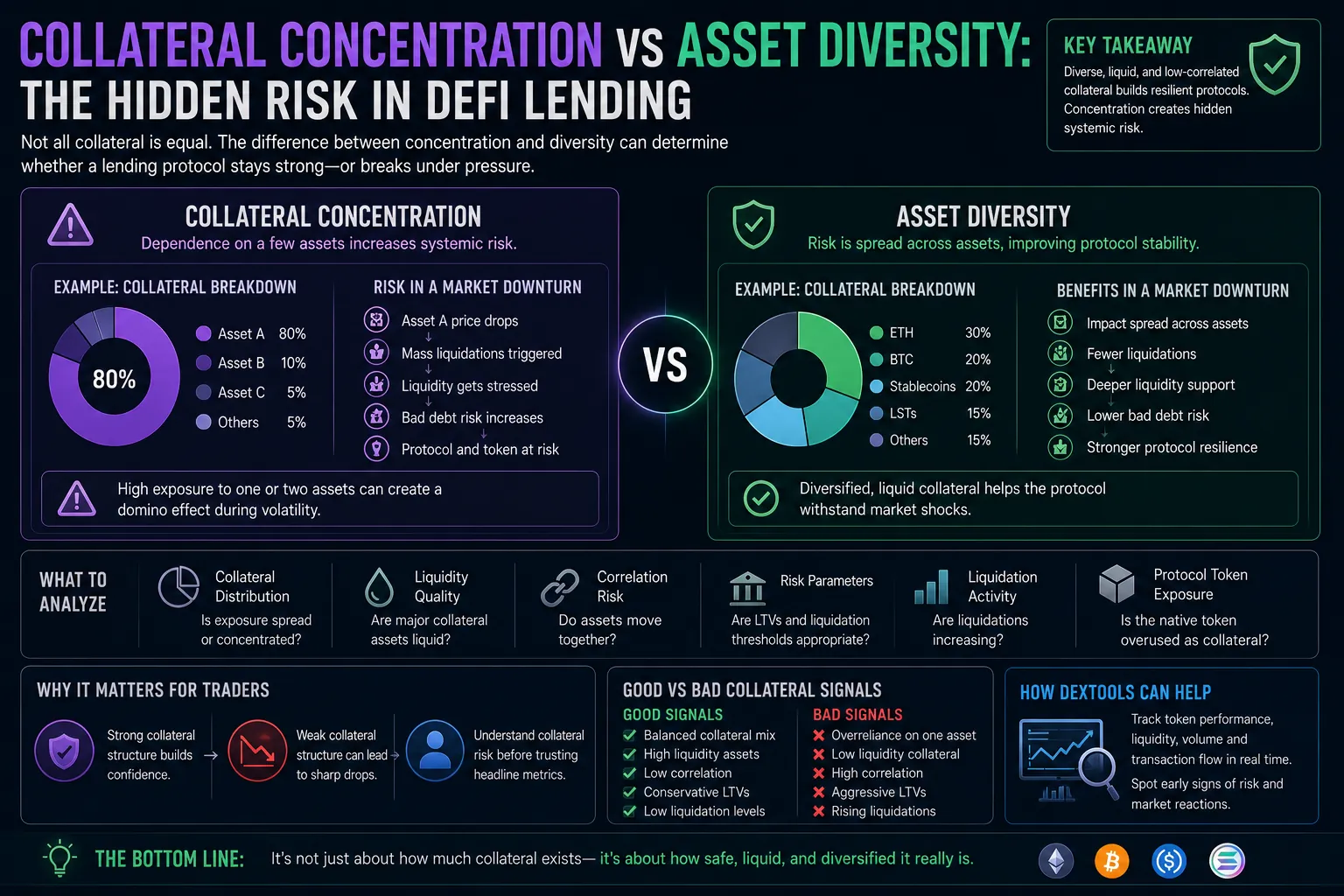
Understand the importance of collateral composition in DeFi lending. Learn about collateral concentration, asset diversity, and their implications for risks.
DeFi lending protocols depend on collateral. Users deposit crypto assets, borrow against them and must keep enough collateral value to avoid liquidation. On the surface, a lending market may look healthy if it has high TVL, strong deposits and active borrowing.
Collateral Risks in DeFi Lending: A Crucial Insight
But there is a hidden risk many traders overlook: the quality and distribution of collateral.
A protocol may hold a large amount of collateral, but if most of that value depends on one or two assets, the system can become fragile. This is where the difference between collateral concentration and asset diversity matters.
Understanding collateral concentration vs asset diversity can help traders evaluate DeFi lending risk more clearly.
What Is Collateral Concentration?
Collateral concentration happens when a lending protocol depends heavily on a small number of assets as collateral.
For example, if most of the protocol's collateral comes from one volatile token, the entire lending market becomes highly exposed to that token's price movement.
This can create systemic risk. If that asset drops sharply, many borrowers may become undercollateralized at the same time. Liquidations can rise quickly, liquidity can weaken and the protocol may face stress.
Collateral concentration does not always mean a protocol is unsafe, but it does mean risk is less diversified.
What Is Asset Diversity?
Asset diversity means that a lending protocol accepts and uses a broader range of collateral assets, with risk distributed across different markets.
A diverse collateral base can include major crypto assets, stablecoins, liquid staking tokens and other well supported tokens. The key point is not only having many assets listed, but having meaningful distribution across them.
Real asset diversity reduces dependence on any single asset.
If one collateral asset falls, the entire protocol may be less affected because exposure is spread across different types of collateral.
Collateral Concentration vs Asset Diversity: The Key Difference
The key difference is exposure.
Collateral concentration means protocol risk is tied to a small group of assets. Asset diversity means risk is spread across multiple collateral types.
A concentrated protocol can look strong during stable markets, but become vulnerable during sharp price moves. A more diversified protocol may handle market stress better because no single asset controls the whole risk profile.
For traders, this difference is important because collateral structure can affect liquidations, bad debt, user confidence and token price.
Why Collateral Concentration Is Dangerous
Collateral concentration becomes dangerous when the dominant asset is volatile, illiquid or strongly correlated with the protocol's own token.
If many borrowers use the same asset as collateral, a price drop can trigger liquidations across the protocol. If liquidity is not deep enough to absorb those liquidations, the collateral may sell at poor prices.
A single weak collateral asset can affect the wider lending system.
Why Asset Diversity Can Improve Protocol Stability
Asset diversity can improve stability by reducing dependence on one source of risk.
If collateral is spread across several liquid and reliable assets, the protocol may be better able to absorb volatility. A drop in one asset may not cause widespread liquidation pressure.
Diversity can also attract different user types. Some users may prefer borrowing against stablecoins. Others may use ETH, BTC wrapped assets, liquid staking tokens or blue chip DeFi assets.
A balanced collateral base can make the protocol more resilient.
Asset Diversity Is Not Just More Listings
A common mistake is assuming that more listed assets automatically means better diversification.
That is not always true.
A lending protocol may list many assets, but still have most collateral concentrated in one or two of them. In that case, the protocol appears diverse, but the actual risk remains concentrated.
Traders should focus on collateral distribution, not only asset count.
True diversity means that collateral exposure is spread in a meaningful way.
The Role of Liquidity in Collateral Risk
Collateral quality depends heavily on liquidity.
A collateral asset must be liquid enough to sell during liquidations. If an asset has low liquidity, the protocol may struggle to liquidate positions without moving the market.
This is especially important during stress events. A token that seems liquid during calm periods may become difficult to sell during a crash.
The best collateral assets are usually those with deep liquidity, active markets and reliable pricing.
Correlation Risk in DeFi Lending
Asset diversity can also be misleading if all collateral assets are highly correlated.
For example, a protocol may accept several different tokens, but if they all tend to fall together during market stress, diversification may be weaker than it appears.
Correlation risk matters because crypto assets often move together in volatile markets.
A strong collateral base should consider not only the number of assets, but also how those assets behave under pressure.
Protocol Tokens as Collateral
One of the riskiest forms of collateral concentration occurs when a protocol relies too heavily on its own token or closely related ecosystem tokens.
If the protocol token falls, collateral value drops. At the same time, market confidence in the protocol may weaken. This can create a feedback loop.
Using a native token as collateral can increase utility, but it can also create circular risk.
Traders should be careful when a protocol's lending activity depends heavily on assets tied to its own ecosystem.
What Happens During a Market Crash?
During a market crash, collateral concentration becomes easier to see.
If one major collateral asset drops sharply, many loans may become risky at the same time. Liquidators may rush to close positions, but if liquidity is limited, liquidations can become inefficient.
This can lead to larger price impact and potential bad debt.
A protocol with more diverse and liquid collateral may manage the same market event more smoothly.
How Traders Can Analyze Collateral Risk
Traders should ask:
Which assets make up most of the collateral?
Is collateral concentrated in one token?
Are the main collateral assets liquid?
Are collateral assets highly correlated?
Does the protocol accept risky long tail assets?
Is the protocol's own token used heavily as collateral?
Have risk parameters been adjusted for volatile assets?
Is liquidation activity increasing?
These questions help traders move beyond TVL and understand the real risk inside the lending system.
Why This Matters for Token Traders
Collateral risk can affect protocol token performance.
If a lending protocol is seen as safe and well managed, its token may benefit from stronger confidence. If collateral risk increases, traders may price in the possibility of liquidations, bad debt or governance intervention.
A protocol with high TVL but poor collateral quality may be riskier than a smaller protocol with more conservative collateral standards.
Token traders should not only ask how much capital a lending protocol has. They should ask what kind of capital it depends on.
How DEXTools Can Help
DEXTools can help traders monitor token market behavior around DeFi lending protocols and collateral assets. Price action, liquidity, volume and transaction flow can reveal whether the market is reacting to risk.
If a major collateral asset begins falling and related protocol tokens also weaken, traders should pay attention.
Live market data can help confirm whether collateral risk is becoming a broader market concern.
Final Thoughts
Collateral concentration and asset diversity are key concepts in DeFi lending risk.
Collateral concentration means the protocol depends heavily on a small number of assets. Asset diversity spreads risk across a broader collateral base.
But real diversity is not just about listing more tokens. It depends on distribution, liquidity, correlation and risk management.
For traders, collateral structure can reveal hidden weakness before it appears in headline metrics like TVL.
In DeFi lending, the question is not only how much collateral exists. The better question is how safe, liquid and diversified that collateral really is.
What is collateral in the context of DeFi lending?
In DeFi lending, collateral is an asset, typically cryptocurrency, that a borrower pledges to secure a loan. It serves as security for the lender in case the borrower defaults on their loan obligations.
Why is collateral important for DeFi loans?
Collateral is crucial in DeFi because it mitigates risk for lenders in a trustless environment. Without it, lenders would have little recourse if a borrower failed to repay, making lending less viable.
What happens if a borrower cannot repay a collateralized DeFi loan?
If a borrower cannot repay, the smart contract automatically liquidates the collateral to cover the outstanding loan amount. This process ensures lenders recover their funds.
What are common types of collateral used in DeFi lending?
Common types of collateral include stablecoins like USDC or DAI, and major cryptocurrencies such as ETH or WBTC. The specific assets accepted vary by lending protocol.
How does collateralization ratio relate to DeFi loans?
The collateralization ratio is the value of the collateral divided by the value of the loan. DeFi protocols often require overcollateralization, meaning the collateral's value must exceed the loan amount to provide a buffer against price fluctuations.