Protocol Fees vs Tokenholder Value
— By Whatsertrade in Tutorials
Understand why protocol fees don't always boost tokenholder value and learn how to analyze crypto revenue's impact on tokens.
Crypto traders often look for protocols that generate revenue. A project with high fees can seem healthier than one with little activity. But protocol fees do not always translate into tokenholder value.
This is one of the most important distinctions in crypto tokenomics. A protocol can generate fees, attract users and process large volume, while its token captures little or none of that value.
Understanding protocol fees vs tokenholder value helps traders avoid assuming that a strong product automatically means a strong token.
What Are Protocol Fees?
Protocol fees are payments generated by a crypto protocol when users interact with its product.
These fees may come from trading, lending, borrowing, liquidations, swaps, bridging, staking services or other activities.
Protocol fees can show that users are willing to pay for the product. This makes them a useful metric for measuring demand.
However, fees are only the first part of the story.
What Is Tokenholder Value?
Tokenholder value refers to the benefit that reaches the holders of a protocol's token.
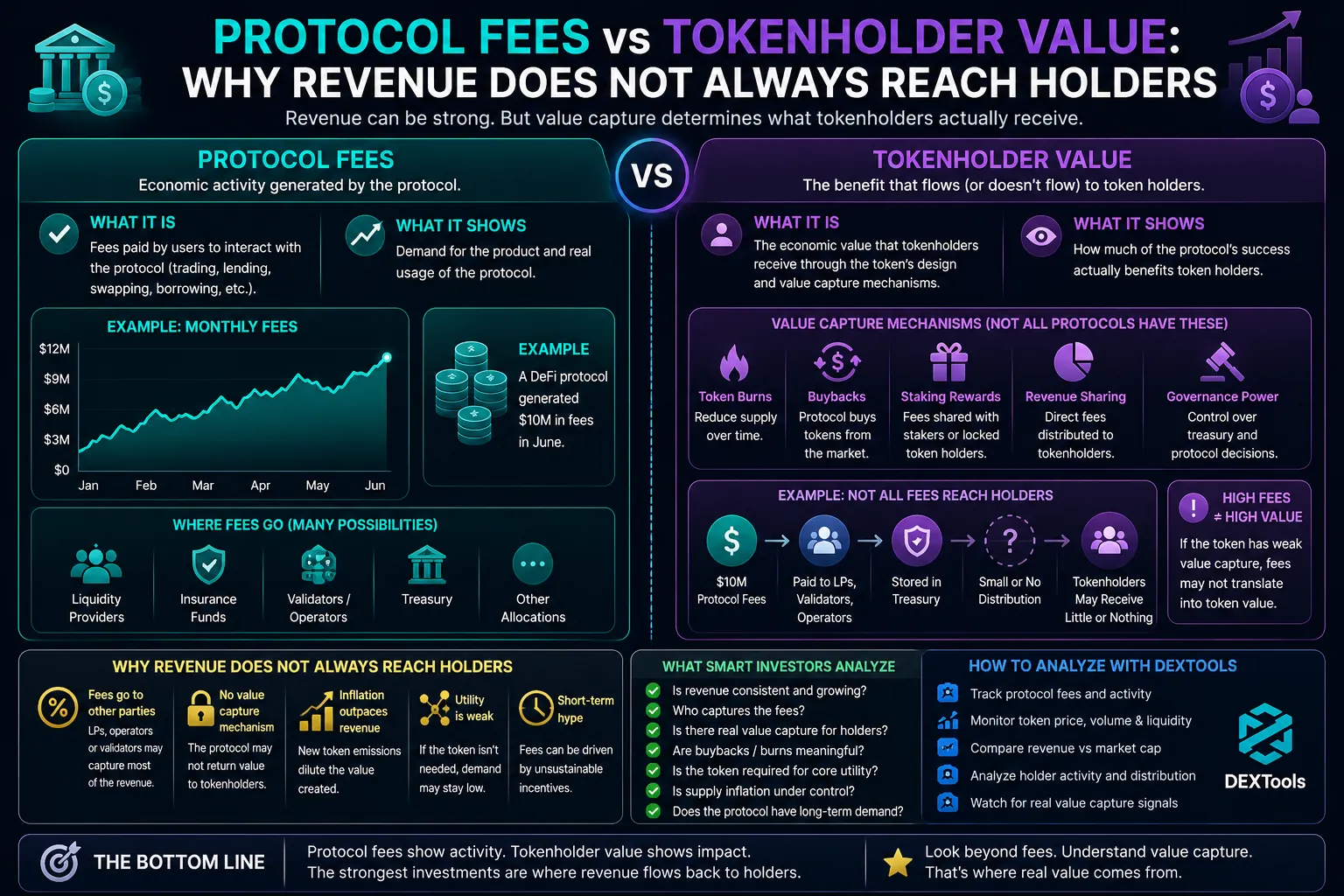
This can happen in different ways. A token may capture value through burns, buybacks, staking rewards, revenue sharing, governance rights or increased utility.
In some cases, tokenholders benefit directly. In other cases, they may benefit only indirectly through narrative, speculation or ecosystem growth.
The key question is whether protocol success creates demand for the token.
Protocol Fees vs Tokenholder Value: The Key Difference
The key difference is generation vs capture.
Protocol fees show that the product generates economic activity. Tokenholder value shows whether that activity benefits the token.
A protocol can generate millions in fees, but if those fees go only to validators, liquidity providers, operators or external participants, tokenholders may receive little direct value.
This is why traders should not stop at revenue numbers.
Why High Fees Do Not Always Help the Token
High fees may not support token price if the token has weak value capture.
For example, a protocol may generate strong trading fees, but those fees may go entirely to liquidity providers. In that case, the protocol is active, but the token may not benefit directly.
Another protocol may generate fees but keep them in a treasury without a clear distribution or utility model.
If tokenholders cannot access or benefit from the revenue, the token may remain mostly speculative.
Different Types of Value Capture
Token value capture can appear in several forms.
Buybacks
The protocol uses revenue to buy its token from the market. This can create buy pressure, depending on size and consistency.
Burns
The protocol removes tokens from supply. This can reduce future supply, but it does not always guarantee price appreciation.
Staking Rewards
Tokenholders stake their tokens and receive a share of fees or rewards. This can create holding incentives.
Governance Control
Tokenholders may control treasury spending, fee settings or protocol upgrades. This can be valuable if governance has real power.
Utility Demand
The token may be required for fees, access, collateral, staking or other functions.
Each model has different strengths and weaknesses.
Why Governance Tokens Can Be Difficult to Value
Many DeFi tokens are governance tokens. Governance can be valuable if tokenholders control meaningful economic decisions.
However, governance alone may not create strong market demand.
If users do not need the token to use the product, and if revenue does not flow to tokenholders, the token may depend heavily on speculation.
This is why traders should analyze the connection between product usage and token demand.
When Protocol Fees Are Bullish
Protocol fees can be bullish when they are consistent, growing and connected to token value.
A protocol with strong fees and clear value capture may have a stronger token thesis.
For example, if fees support buybacks, burns, staking rewards or treasury growth controlled by tokenholders, the token may benefit more directly.
But traders should always check the actual mechanism.
When Protocol Fees Can Mislead Traders
Protocol fees can mislead traders when they come from temporary hype, short term volatility or incentive driven activity.
A protocol may have one strong revenue period and then return to low usage.
Traders should focus on durability. Sustainable fees matter more than short term spikes.
They should also ask whether fee growth is organic or driven by rewards.
What Traders Should Analyze
Before buying a token based on protocol revenue, traders should ask:
Who receives the fees?
Does the token capture any value?
Are fees consistent or temporary?
Does the token have real utility?
Are buybacks or burns meaningful?
Does governance control revenue?
Is token supply increasing faster than value capture?
These questions help traders avoid confusing product success with token success.
How DEXTools Can Help
DEXTools can help traders evaluate whether market behavior supports the revenue narrative. A token may have strong protocol fees, but traders should still check liquidity, volume, price action and transaction flow.
If revenue is growing but token liquidity is weak, execution risk remains. If token price is rising without supporting market depth, traders should be careful.
Combining tokenomics with live market data can improve decision making.
Final Thoughts
Protocol fees and tokenholder value are related, but they are not the same.
Fees show that users are paying for a product. Tokenholder value shows whether that economic activity benefits the token.
For traders, this distinction is critical. A strong protocol does not always mean a strong token.
The best analysis asks not only whether a protocol generates revenue, but whether that revenue reaches holders in a meaningful way.
Complete Project Evaluation Guide Protocol Revenue vs TVL Protocol Owned Liquidity vs Mercenary Liquidity Maximal Extractable Value Explained Token Float vs Total Supply ExplainedFrequently Asked Questions
What are protocol fees?
Protocol fees are charges levied by a decentralized protocol for using its services, often to fund development, maintenance, or network security. They are typically collected in cryptocurrency and managed by the protocol's governance.
How do protocol fees differ from transaction fees?
Protocol fees are specific charges for using a service within a protocol, while transaction fees are paid to network validators for processing and confirming transactions on the underlying blockchain. Transaction fees compensate miners or stakers for their work.
Who benefits from protocol fees?
The beneficiaries of protocol fees can vary, often including the protocol's treasury, developers, or stakers of the protocol's native token, depending on the protocol's design. These funds are frequently used for ecosystem growth and operational costs.
Can protocol fees impact token value?
Protocol fees can potentially impact token value by creating a revenue stream for the protocol, which may be distributed to tokenholders or used to buy back and burn tokens. This can influence the token's supply and demand dynamics.
Are protocol fees always fixed?
Protocol fees are not always fixed; they can be dynamic and adjusted based on network congestion, market conditions, or through governance votes by tokenholders. Some protocols allow for flexible fee structures.
Related Guides
- Volume Profile in Crypto Explained: POC, Value Area, HVN and LVN (2026)
- What Is MEV in Crypto? Maximal Extractable Value Explained (2026)
- What Is a Fair Value Gap (FVG) in Crypto? Trading Guide 2026
- Settlement Volume vs Transfer Count: Which Better Shows Real On Chain Value Movement?
- What Drives XRP Price? Market Cap, Supply and Valuation