Token Float vs Total Supply Explained for Traders
— By Whatsertrade in Tutorials
Discover why knowing the difference between token float and total supply is crucial in crypto trading. Avoid valuation traps and future dilution risks.
Token float vs total supply is a crucial distinction in crypto analysis that all traders should grasp. Often overshadowed by price and market cap metrics, understanding how the circulating supply might mislead could be the difference between a profitable trade and a costly mistake.
Key Takeaways
- Overview: Total Supply vs Token Float
- The Critical Distinctions
- Impact of Unlock Events
- Checklist for Traders
- Role of Tools
- Frequently Asked Questions
Token supply is one of the most important parts of crypto analysis. Many traders look at price, market cap and circulating supply before buying a token. But those numbers can be misleading if traders do not understand the difference between token float and total supply.
A token can look cheap because only a small portion of supply is currently trading. It can also look strong because supply is limited. However, if a large amount of tokens is locked and scheduled to enter the market later, the risk profile can change completely.
Understanding token float vs total supply helps traders avoid valuation traps, dilution risk and poor timing.
Overview: Total Supply vs Token Float
Understanding Total Supply
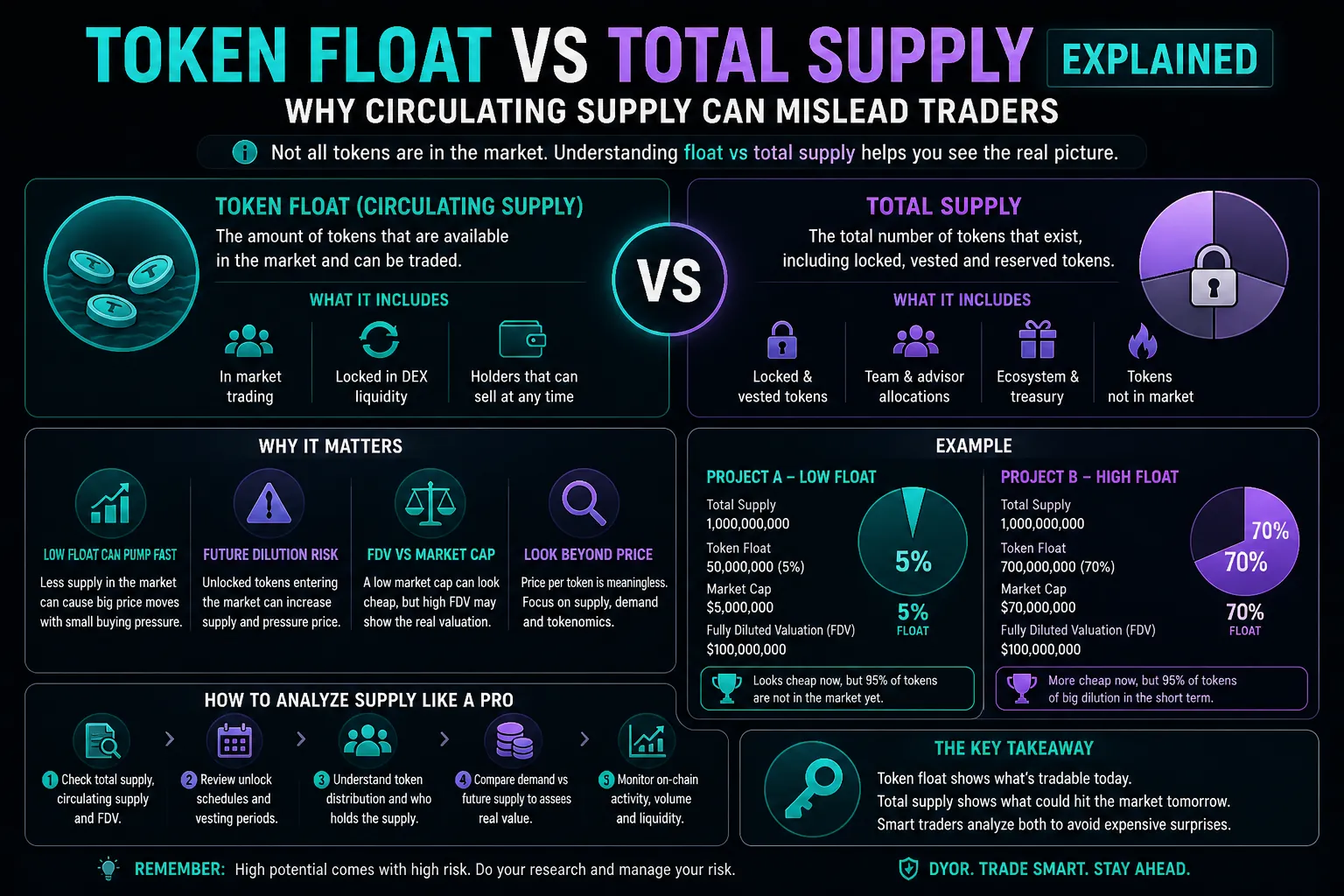
Total supply is the full number of tokens that currently exist, excluding tokens that have been permanently burned. Total supply can include tokens that are circulating, locked, vested, reserved for the team, allocated to investors, held by the treasury or set aside for ecosystem rewards. This number gives traders a wider view of the token's supply structure. It shows how many tokens exist, even if not all of them are currently available in the market. Total supply matters because locked tokens can become future circulating tokens.
Decoding Token Float
Token float refers to the portion of tokens that is actually available for trading in the market. It is closely related to circulating supply, but traders often use float to think about the real amount of supply that can move freely. A low float token has only a small percentage of total supply available. This can create strong price movement because demand is competing for limited supply. Conversely, a high float token has more supply available in the market. This may reduce future dilution risk, but it can also make price moves slower because more tokens are already tradable.
The Critical Distinctions
Key Difference: Availability
The key difference is availability. Total supply shows how many tokens exist. Token float shows how many tokens can realistically trade right now. This difference is critical. A project may have a large total supply but a small float. That can make the current market cap look attractive while the fully diluted valuation is much higher. For traders, the danger is buying based only on current float without considering future supply.
Why Low Float Tokens Can Pump Fast
Low float tokens can move quickly because there are fewer tokens available in the market. When demand increases, buyers compete for limited supply, which can further push price higher. This is why some newly launched tokens produce aggressive rallies. If only a small portion of supply is liquid, even moderate buying pressure can create a large price move. Low float can be powerful in bullish conditions. But it also creates risk. If supply is limited, price can rise fast. But when more tokens unlock, the market may need much stronger demand to maintain the same price.
Valuation Traps with Low Float Tokens
Low float tokens often attract traders because they appear undervalued. A token may have a small market cap based on circulating supply, while its fully diluted valuation is much larger. This can create a valuation trap. For example, if only 5 percent of supply is circulating, the current market cap reflects only a small part of the full token supply. If the remaining 95 percent enters circulation over time, the token needs continuous demand to absorb that supply. A token is not automatically cheap because its current market cap is low. Traders should compare current market cap with the fully diluted valuation.
Circulating Supply vs Fully Diluted Valuation
Circulating supply shows how many tokens are currently available. Fully diluted valuation estimates what the token's valuation would be if all supply were circulating at the current price. Both metrics are useful, but they answer different questions. Circulating supply helps traders understand the current market. Fully diluted valuation helps traders understand future valuation risk. A low market cap with a very high fully diluted valuation can suggest that the market is pricing only a small part of total supply. This does not always mean the token is bad. It means traders need to understand future dilution.
Impact of Unlock Events
How Unlocks Change Token Float
Token float changes over time. Locked tokens can become available through unlock events, team vesting, investor vesting, staking emissions, ecosystem incentives or treasury distributions. A token with a low float today may have a much higher float in six months. If demand grows faster than supply, the token can still perform well. If supply grows faster than demand, price may struggle. This is why unlock schedules are important. Traders should understand when supply enters the market and who receives it.
The Misleading Nature of Price Per Token
Many traders compare tokens by unit price. They may think a token priced at $0.01 is cheaper than a token priced at $10. This is a mistake. Price per token does not show valuation. Supply matters. A token priced at $0.01 with a massive supply can be more expensive than a token priced at $10 with a much smaller supply. Market cap, fully diluted valuation, float and unlock schedule are more useful than price per token.
How Float Affects Price Action
Float affects how sensitive a token is to buying and selling pressure. Low float can create explosive upside when demand increases. It can also create sharp downside when large holders sell or unlocks happen. High float can reduce future dilution risk, but it may require more demand to move price significantly. Neither structure is always better. The important question is whether supply and demand are balanced.
Checklist for Traders
Trader Checklist Before Buying a Low Float Token
Before buying a low float token, traders should check: What percentage of total supply is circulating. How large the fully diluted valuation is. When the next major unlock happens. Who receives locked tokens. Whether early investors are already in profit. How deep the liquidity is. Whether volume can absorb future supply. Whether the chart is rising because of real demand or limited float. This checklist can help traders avoid buying into a dilution event.
Role of Tools
How DEXTools Can Help
DEXTools helps traders monitor live market behavior around token pairs. Supply metrics are important, but live liquidity, volume and transaction flow show how the market is reacting. If a low float token is pumping while liquidity is thin and volume is unstable, risk may be higher than the chart suggests. Combining tokenomics with live market data gives traders a stronger view.
The Importance of Comprehensive Analysis
Token float and total supply tell different parts of the same story. Float shows what is available now. Total supply shows what may affect the market later. Traders who ignore future supply can misunderstand valuation and buy into dilution risk. Traders who compare float, total supply, unlocks and live market behavior can make better decisions. In the crypto market, supply does not only matter today. It matters after every unlock, every emission and every market cycle.
How to Bridge Crypto Between Chains: Complete Cross-Chain Tutorial 2026 How to Use 1inch: Complete DEX Aggregator Swap Tutorial (2026) How to Use OKX Web3 Wallet: Multi-Chain DeFi Hub Guide (2026)Frequently Asked Questions
What is token supply?
Token supply refers to the total number of a specific cryptocurrency that exists. This can include tokens in circulation, locked tokens, and burned tokens.
How does token supply relate to market cap?
Market capitalization is calculated by multiplying the current price of a token by its circulating supply. A higher circulating supply can lead to a larger market cap, assuming price remains constant.
What is the difference between total supply and circulating supply?
Total supply is the maximum number of tokens that will ever exist, including those not yet released. Circulating supply refers to the number of tokens currently available and accessible to the public.
Can token supply change over time?
Yes, token supply can change through mechanisms like burning, minting, or locking tokens. These processes are often governed by the protocol's design.
Why is token supply important for investors?
Understanding token supply helps investors assess a cryptocurrency's scarcity and potential future value. A fixed or decreasing supply can sometimes indicate a deflationary asset.