Crypto Spot ETFs: Bridging Capital and Digital Assets

The approval of regulated investment vehicles has changed the market forever. We break down the mechanical functioning of spot products and what to expect next.
Crypto Spot ETFs: The Definitive Guide to Institutional Architecture
- The advent of Crypto Spot ETFs marks perhaps the most significant milestone in the maturation of the digital asset industry. By moving away from unregulated, off-shore, or opaque investment products, these ETFs provide a robust, regulated bridge that allows traditional pension funds, insurance companies, and family offices to gain direct exposure to assets like Bitcoin and Ethereum.
- This shift does more than just facilitate capital movement; it fundamentally reshapes the market microstructure of the underlying protocols, turning volatile retail-led assets into institutional-grade portfolio staples.
The Operational Anatomy: How These Funds Function
Understanding how Crypto Spot ETFs interact with the market requires peeling back the layers of their operational architecture. Unlike equities that trade on centralized exchanges with centralized clearinghouses, digital assets operate on immutable, decentralized ledgers. This creates a technical friction point that ETF providers must resolve through specialized financial engineering.
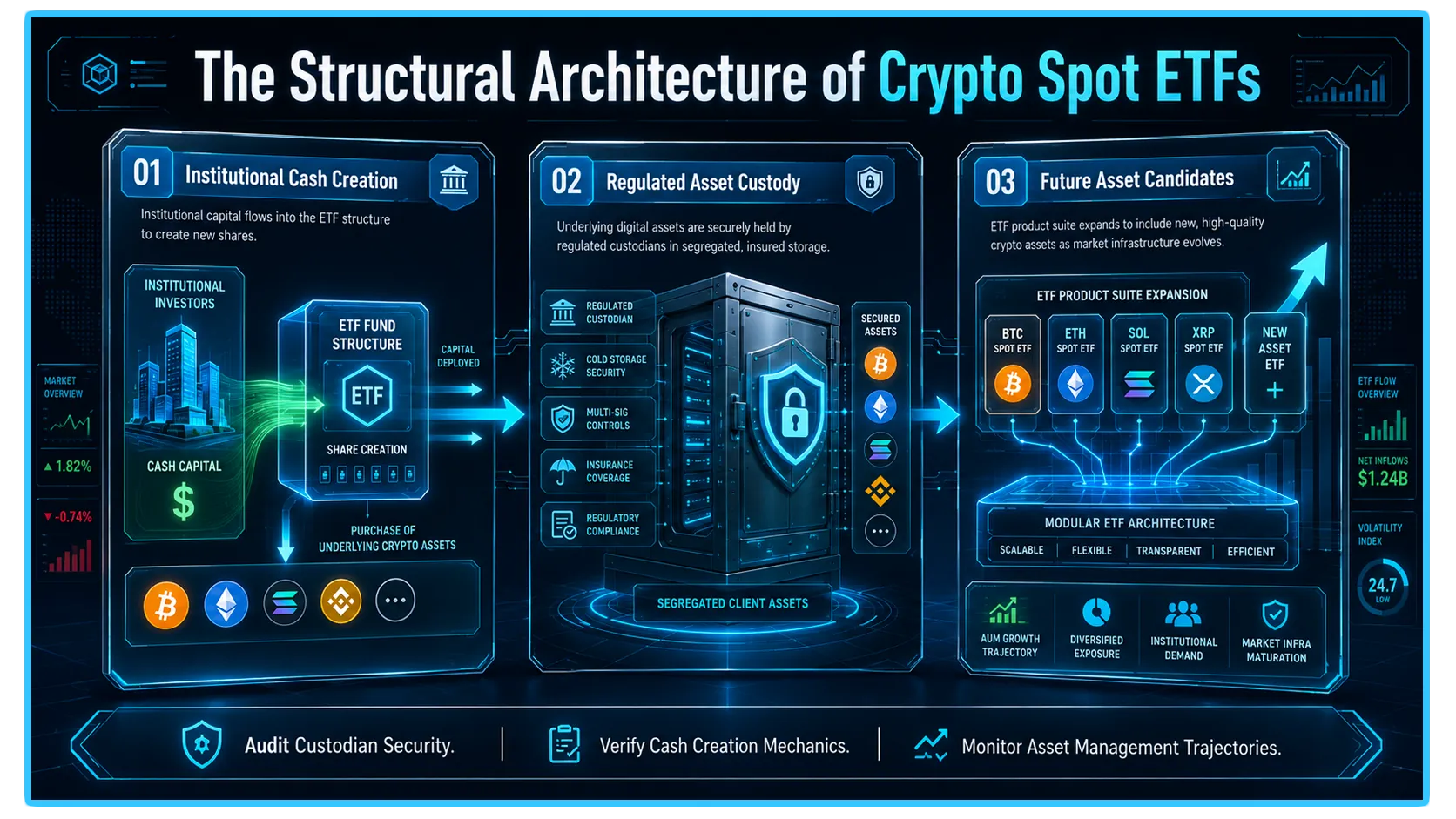
The Cash Creation and Redemption Model
- In traditional finance, many ETFs utilize an "in-kind" creation mechanism, where Authorized Participants (APs) deliver a basket of underlying securities to the fund in exchange for ETF shares. Because digital assets present unique custody and regulatory challenges, the current class of these products relies almost exclusively on a "cash-only" model.
- When an institutional investor places an order, the APs provide cash to the ETF manager. The manager then enters the secondary market, often through OTC (Over-the-Counter) desks or large-scale exchange order books, to acquire the actual underlying tokens. This process prevents the fund from ever having to handle complex token transfers directly during the creation phase, keeping the workflow within the boundaries of existing fiat-based banking regulations.
- This mechanism is crucial because it ensures that every ETF share is backed by a specific quantity of the underlying asset, which is then moved into cold storage by the fund’s custodian.
Custodianship: The Backbone of Security
- Security is the primary concern for institutional investors. The ETF structure mitigates this by delegating the security of the digital assets to specialized, regulated custodian banks. These custodians operate institutional-grade infrastructure that includes air-gapped cold storage, multi-signature authentication protocols, and hardware security modules (HSMs).
- The physical (or digital) separation between the ETF issuer (who manages the fund’s administrative needs) and the custodian (who guards the private keys) creates a system of checks and balances. If a fund manager were to face liquidity issues or operational failure, the underlying assets remain protected within the custodian’s vault, insulated from the manager’s balance sheet. This security layer is what allowed these products to be approved by regulators who were previously hesitant about the risks associated with self-custody.
AUM and the Fee Competition Landscape
Assets Under Management (AUM) serve as the primary metric for a fund's success, but within the ETF world, fee structures are the true indicator of long-term viability. Since the underlying asset (e.g., BTC or ETH) is identical regardless of which fund you buy, the competition among issuers is fierce.
Compression of Management Fees
- When these products first launched, fees were significantly higher to account for the perceived risk and infrastructure costs. However, as the market matured, we have seen a rapid compression of management fees. This is a positive development for retail and institutional participants alike, as it ensures that a greater percentage of the underlying price appreciation is captured by the shareholder rather than the issuer.
- This fee war has forced providers to innovate in how they manage liquidity. Issuers with deeper relationships with market makers can provide tighter bid-ask spreads, which effectively lowers the hidden costs of trading these shares. As AUM continues to scale, these ETFs will likely become the most liquid vehicles for accessing digital assets, effectively siphoning volume away from traditional cryptocurrency exchanges.
Market Reflexivity and Institutional Conviction
- One of the most profound impacts of Crypto Spot ETFs is the change in how the market processes volatility. Historically, retail-led markets were characterized by boom-bust cycles driven by momentum and sentiment. The entry of institutional capital, governed by these regulated vehicles, has introduced a new level of conviction.
- Institutional investors typically employ longer-term investment horizons. When they buy into these products, they are not looking for 24-hour flips; they are looking for portfolio diversification. This creates a baseline level of support for the underlying assets. Furthermore, the daily inflow and outflow data of these ETFs provides the market with a "high-fidelity" signal of institutional sentiment. Analysts now watch these inflows as closely as they watch traditional macroeconomic indicators like CPI or FOMC minutes.
The Horizon: Next in Line (SOL, XRP)
While Bitcoin and Ethereum paved the way, the industry is already looking toward the next set of candidates. Solana (SOL) and Ripple (XRP) currently lead the speculation for future products.
The Regulatory Prerequisite
For an asset to qualify for a spot ETF, it must typically satisfy several criteria:
Market Maturity: The asset must have sufficient liquidity and market cap to prevent market manipulation.
Derivative Infrastructure: Regulators often look for a mature, regulated futures market that allows for price discovery and hedging.
Regulatory Clarity: The status of the asset as a commodity (rather than a security) is a constant, evolving debate.
Solana, with its high-throughput architecture and growing DeFi ecosystem, is often positioned as the most likely candidate for the next cycle of approvals. XRP, given its long-standing usage in cross-border settlement and its recent favorable legal developments, also remains a strong contender. If these assets are approved, we will see a further diversification of institutional portfolios, effectively turning the crypto market into a multi-asset class industry similar to traditional commodities or foreign exchange.
Verification and Telemetry: Why Data Matters
- As these institutional vehicles proliferate, the importance of on-chain and off-chain data telemetry cannot be overstated. Retail participants and analysts alike must be able to verify that the price movements in the ETF shares align with the price movements of the underlying assets.
- DEXTools provides the critical infrastructure for this verification. By utilizing the Pair Explorer and tracking liquidity pool depth across decentralized exchanges, analysts can see how arbitrageurs and market makers are effectively keeping the ETF and the spot market in balance. DEXTools allows you to audit the underlying liquidity, verify transaction integrity, and monitor for anomalies in market depth that could affect your strategy. Accurate data is the bridge between speculation and an informed investment strategy.
You can access DEXTools here and start trading today!
Disclaimer: This article is for informational purposes only and does not constitute investment advice, financial advice, trading advice, or any other kind of advice. DEXTools does not recommend buying, selling, or holding any cryptocurrency or token. Users should conduct their own research and consult with a qualified financial advisor before making any investment decisions. Cryptocurrency investments are volatile and high-risk. DEXTools is not responsible for any losses incurred.
What Happened to XRP Today? Price, ETF, and the New Momentum Bitcoin Spot ETFs Hit Record Outflow Streak as $2.9B Exits in 10 Days