Ethereum Pectra Upgrade Explained: EIPs and Impact

Ethereum's Pectra upgrade represents a massive infrastructure rewrite. We break down the technical execution of Type 4 transactions, validator key consolidation, and blob capacity shifts.
The Protocol Overhaul: Merging Execution and Consensus Evolution on Ethereum
- The Ethereum network has long navigated a complex technical trade-off between absolute decentralization and user friction. While security guarantees remained industry-leading, standard user accounts were clunky, scaling on-chain transaction volumes triggered high fee surges, and staking providers faced immense technical overhead just to maintain active nodes.
- The Pectra upgrade represents the most comprehensive protocol transformation since The Merge. Bundling the Prague execution layer and the Electra consensus layer into a unified hard fork deployment, Pectra introduced 11 core Ethereum Improvement Proposals (EIPs). By rewriting account logic and restructuring validation rules, Pectra scales layer-2 data pipelines, slashes node data bloat, and re-engineers daily user interaction models.
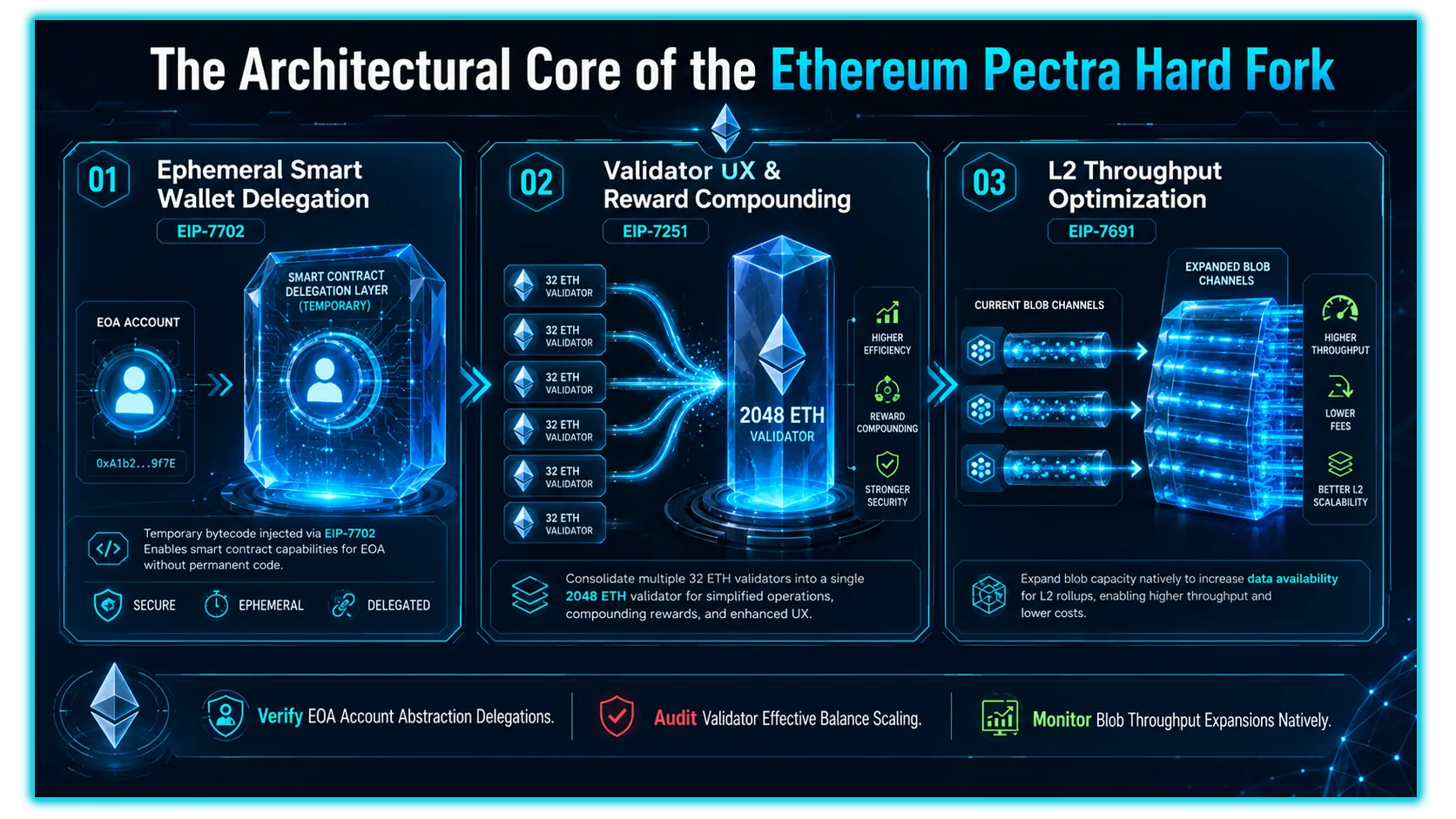
1. EIP-7702: The Account Abstraction Breakthrough
- For years, the vast majority of crypto participants have used Externally Owned Accounts (EOAs): the traditional wallets managed by a static 12- or 24-word seed phrase. While lightweight, EOAs are structurally limited: they cannot bundle transactions, cannot sponsor fees for other users, and completely isolate your funds if a physical seed sheet is lost. Full Account Abstraction (ERC-4337) introduced smart contract wallets as an alternative, but migrating millions of existing legacy accounts onto entirely new smart contract chains created massive friction.
EIP-7702 resolves this dilemma by giving standard EOAs temporary "smart contract superpowers." Introduced by Vitalik Buterin as an alternative to EIP-3074, it implements a new transaction framework (Type 4) containing an explicit authorization_list.
Ephemeral Programmability: When a user signs an EIP-7702 transaction, their standard EOA temporarily delegates its code execution rights to a designated smart contract for the duration of that single transaction block.
Atomic Batching: Users can sign once to approve an asset trade and execute a swap simultaneously, completely eliminating the repetitive, separate gas-fee approvals that have historically plagued decentralized finance exchanges.
Gas Sponsorship and Paymasters: Application developers or enterprise stablecoin paymasters (like Circle) can programmatically pay for their users' transaction fees. A retail user holding only USDC can send or spend funds instantly without ever owning or managing native ETH gas tokens.
2. EIP-7251: The Validator UX and Consolidation Era
Prior to the hard fork activation, the Ethereum consensus layer enforced a strict, non-negotiable 32 ETH effective balance cap per individual node validator. Large-scale institutional staking complexes and liquid staking pools (like Lido or Rocket Pool) managing millions of ETH had no choice but to run hundreds of thousands of isolated node keys simultaneously. This fragmentation created massive signature overhead, bloating network peer-to-peer data distribution lines.
EIP-7251 (known colloquially as MaxEB) fundamentally expands this validation architecture by raising the maximum effective balance ceiling from 32 ETH to 2,048 ETH.
True Reward Compounding: Validators running the updated MaxEB configuration can instantly accumulate block rewards straight into their active staking balances, allowing capital to auto-compound dynamically past the old 32 ETH limit without manual intervention.
Consolidation and Cost Reduction: Enterprise staking operators can merge up to 64 legacy keys into a single unified validator slot. This massive compression reduces internal infrastructure maintenance costs while lowering the overall cryptographic signature load across the global network by roughly 60x verifications.
3. The Scalability Track: Data Bloat and Exit Optimizations
Beyond rewriting wallet experiences and validator caps, Pectra introduced structural upgrades across data availability pipelines and legal-technical settlement paths.
EIP-7691: Blob Capacity Scale
Following the initial data availability foundation laid down by EIP-4844 (Proto-Danksharding), Pectra deployed EIP-7691 to scale throughput for Layer-2 rollups like Arbitrum, Optimism, and Base. The upgrade doubled the block data footprint parameters, expanding target blob allocations from 3 to 6 blobs per block while lifting the maximum absolute boundary from 6 to 9 blobs. This data pipeline expansion lowers transaction costs across Layer 2 ecosystems by providing clean, high-capacity pathways for rollups to settle records on the base chain.
EIP-7002: Execution Layer Triggered Exits
Historically, exiting a validator or initiating a partial withdrawal required a cryptographic signature generated explicitly by the validator's consensus layer active keys (the node operator). EIP-7002 decouples this dependency by enabling the execution layer withdrawal credentials to autonomously trigger validator exits. This eliminates counterparty risks within decentralized liquid staking pools: if an independent node operator acts maliciously or drops completely offline, the underlying funding smart contract can programmatically pull the capital back safely without the operator's permission.
Pectra Core EIP Performance Matrix
| EIP Standard | Architectural Focus | Primary Mechanism | Target Impact |
| EIP-7702 | Account Abstraction | Ephemeral Type 4 bytecode addition | Gas sponsorship & trade batching |
| EIP-7251 | Validator Scaling | Max Effective Balance to 2048 ETH | Key consolidation & auto-compounding |
| EIP-7691 | Data Availability | Expands max blobs from 6 to 9 | Drastically lower L2 transaction fees |
| EIP-7002 | Exit Autonomy | Execution layer exit triggering | Removes node operator hostage risks |
4. Navigating Protocol Shifts via DEXTools Telemetry
- As Ethereum shifts its underlying token mechanics, expands account capabilities, and optimizes scaling paths for Layer 2 utility layers, tracking how liquid capital flows across decentralized protocols becomes an indispensable trading skill. Sourcing analytics through advanced decentralized charting architectures like DEXTools gives market participants an essential universal platform to monitor live token behaviors, evaluate pool depths, and inspect contract parameters across all public execution networks.
- By leveraging core features like the Pair Explorer, Live New Pairs dashboard, and the integrated Trade Story or Top Traders diagnostic tools, technical traders can seamlessly audit localized volume trends, track large whale wallet capital reallocations via the Big Swap Explorer, and check automated contract safety scores before initiating any on-chain interactions, ensuring your hardened hardware setup interacts safely with verified market venues.
You can access DEXTools here and start trading today!
Disclaimer: This article is for informational purposes only and does not constitute investment advice, financial advice, trading advice, or any other kind of advice. DEXTools does not recommend buying, selling, or holding any cryptocurrency or token. Users should conduct their own research and consult with a qualified financial advisor before making any investment decisions. Cryptocurrency investments are volatile and high-risk. DEXTools is not responsible for any losses incurred.