Ethereum Transfers & Confirmations Explained (2026)

Examine the details of Ethereum transfer speeds and confirmation processes in 2026, and learn how ongoing upgrades influence transaction efficiency within the DeFi ecosystem.
The Fundamentals of Block Times in 2026
- On April 2, 2026, Ethereum stands as a powerhouse of efficiency and institutional trust, largely thanks to the 2025 Pectra and Fusaka upgrades. While the underlying technology has peaked in performance, actual delivery times for ETH still vary significantly.
- Factors like your selected platform, wallet type, and current network congestion play a decisive role in how quickly funds arrive. In this multi-layered environment, knowing how to interpret block times and confirmations is essential for every active participant.
- To understand how long a transfer takes, one must first look at the heartbeat of the Ethereum blockchain. In 2026, the network operates on a Proof of Stake (PoS) consensus mechanism where time is divided into 12 second intervals known as slots. In each slot, a randomly selected validator proposes a new block of transactions.
- This means that, under normal conditions, the minimum time for a transaction to be "included" in the blockchain is between 12 and 24 seconds. However, inclusion is only the beginning of the process. For a transaction to be considered secure and irreversible, it must undergo a series of confirmations.
Confirmations vs. Finality
A confirmation occurs every time a new block is added to the blockchain on top of the block containing your transaction. These additional blocks act as layers of security. The more blocks that are built on top of yours, the more difficult it becomes for the network to "reorganize" and potentially undo that transaction.
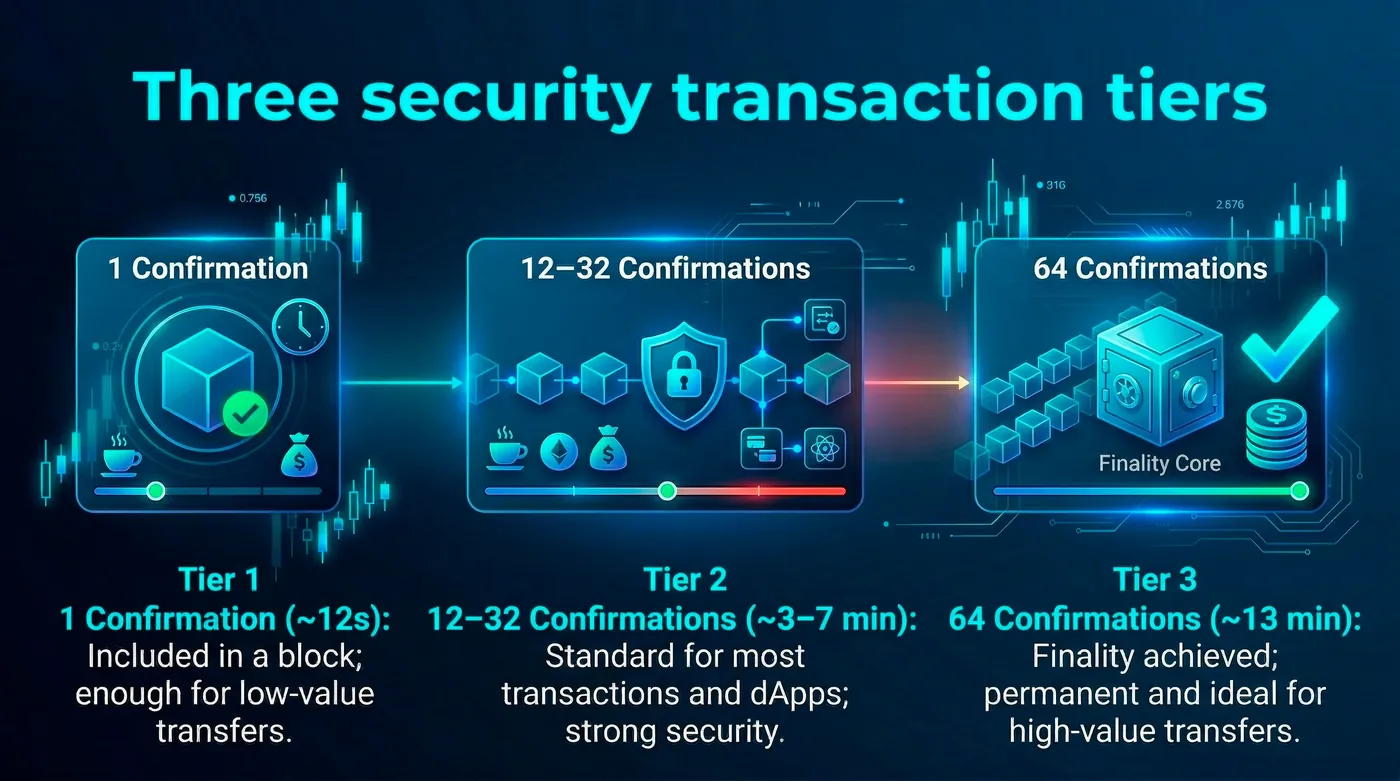
In the current 2026 landscape, we generally categorize transaction status into three security tiers:
1 Confirmation (12 seconds): The transaction is officially included in a block. This is usually sufficient for low value, non-critical peer to peer transfers.
12 to 32 Confirmations (approx. 3 to 7 minutes): This is the standard for mid sized transactions and most decentralized applications (dApps). It provides a high level of economic security.
64 Confirmations (approx. 13 minutes): This represents Finality. Once a transaction is 64 blocks deep, it is mathematically permanent. This is the requirement for high value institutional transfers.
Wallet to Wallet Transfers: The Speed of Self-Custody
Moving ETH between private, non-custodial wallets (such as MetaMask, Rabby, or a hardware device) is typically the fastest way to transact. Because there is no intermediary or centralized authority to approve the move, you are limited only by the 12 second block time and the gas fee you provide.
Example Scenario:
Imagine an artist, Leo, who sells a digital work for 0.5 ETH. The buyer sends the funds from their MetaMask wallet at 2:00 PM. By 2:00:24 PM, Leo sees the 0.5 ETH in his wallet as "Pending" or "Success." While he can technically see the funds almost immediately, he might wait 2 or 3 minutes (about 12 confirmations) before he feels confident enough to use that ETH to pay for a separate service.
Centralized Exchange Deposits and Withdrawals
- Transferring ETH to or from a centralized exchange (CEX) like Coinbase, Kraken, or Binance is a significantly slower process. Exchanges are primary targets for hackers, so they enforce much stricter security rules before they credit your account with funds.
- When you deposit ETH to an exchange, they typically require 32 to 64 confirmations to ensure the transaction has reached or is very close to reaching full finality. Furthermore, exchanges have internal processing layers that scan incoming transactions for security risks and update their internal databases.
Example Scenario:
Suppose a trader, Sarah, sends 10 ETH to an exchange to capitalize on a price move. Even if the blockchain includes her transaction in 12 seconds, the exchange will wait for 64 blocks to pass (roughly 13 minutes). After those 13 minutes, the exchange's internal system might take another 5 to 10 minutes to verify the transfer. In total, Sarah should expect a 20 to 30 minute wait before her 10 ETH is available to trade.
The Role of Gas and Network Congestion in Ethereum
Even with a 12 second block time, your transfer can be delayed if the network is busy. In April 2026, we are seeing significant "Institutional Crowding" on the Ethereum Mainnet. Large banks and corporations now use Ethereum to settle multi-billion dollar bond trades, and they often pay high Priority Fees to ensure their transactions are processed first.
The total cost and speed are determined by the following relationship:
If you set your Priority Fee too low during a period of high congestion, validators will ignore your transaction in favor of higher payers. Your transfer could stay in the "mempool" (waiting area) for hours until the congestion clears.
Layer 2 (L2) Transfers: The Near-Instant Standard
- For everyday users who do not want to wait 12 minutes for finality, Layer 2 networks like Base, Arbitrum, and Optimism have become the industry standard in 2026. These networks use Sequencers to order transactions almost instantly.
- When you send ETH on a Layer 2, you often receive a confirmation in less than 2 seconds. While these transactions eventually settle back to the Ethereum Mainnet for long term security, the user experience is as fast as using a traditional digital payment app. By April 2026, over 90% of retail ETH volume has moved to these high speed layers.
Comparison of Estimated Times and Confirmations
The following table organizes the typical wait times based on 2026 network standards and average congestion.
| Activity | Required Confirmations | Average Time | Security Level |
| Private Wallet Transfer | 1 to 12 | 12 secs to 3 mins | Standard |
| DEX Swap (Uniswap) | 1 | 12 to 24 seconds | Standard |
| Exchange Deposit (CEX) | 32 to 64 | 15 to 30 minutes | Very High |
| Institutional Settlement | 64+ | 13 to 20 minutes | Maximum (Finality) |
| Layer 2 (Base/Arbitrum) | 1 (L2 block) | 1 to 2 seconds | High (Soft Finality) |
Summary of Key Points
12-Second Block Time: This is the base rhythm of the Ethereum network in 2026.
Confirmations: Each block added after your transaction increases its security.
Finality: Reached after 64 blocks (approx. 13 minutes), making the transaction permanent.
Wallet Speed: Self-custody transfers are the fastest, appearing in under a minute.
Exchange Delays: Centralized platforms take 20 to 30 minutes due to internal safety checks and higher confirmation requirements.
Priority Fees: Higher tips are necessary during institutional congestion to ensure fast inclusion.
Layer 2 Advantage: Networks like Arbitrum or Base offer near-instant (2 second) transfer times for retail users.
Managing your Ethereum transfers requires a balance of patience and technical insight. To track your transactions in real time and ensure you are using the most efficient routes for your trades, we invite you to use the Ethereum dashboard on DEXTools here.
Disclaimer: This article is for informational purposes only and does not constitute investment advice, financial advice, trading advice, or any other kind of advice. DEXTools does not recommend buying, selling, or holding any cryptocurrency or token. Users should conduct their own research and consult with a qualified financial advisor before making any investment decisions. Cryptocurrency investments are volatile and high-risk. DEXTools is not responsible for any losses incurred.
Related Guides
- What Is Crypto Bridge Slippage? Why Cross-Chain Transfers Drift (2026)
- What Is Axelar: Cross-Chain Messaging, Interoperability and Token Transfers (2026)
- How to Use Bitcoin: Beginner Guide to Wallets, Payments and Transfers (2026)
- What Was the Ethereum Merge: Complete Retrospective Guide (2026)
- What Is viem: TypeScript Clients, Transports and Ethereum App Logic (2026)
Frequently Asked Questions
How long does it take for an Ethereum transaction to be included in the blockchain?
Under normal conditions, an Ethereum transaction can be included in the blockchain within 12 to 24 seconds.
What are the different confirmation levels for Ethereum transactions?
Ethereum transactions can be categorized into three security tiers: 1 confirmation (12 seconds) for low-value transfers, 12 to 32 confirmations (approx. 3 to 7 minutes) for mid-sized transactions, and 64 confirmations (approx. 13 minutes) for high-value institutional transfers.
Why do centralized exchanges take longer to process Ethereum deposits?
Centralized exchanges require 32 to 64 confirmations for Ethereum deposits to ensure security, and they also have internal processing layers that can add an additional 5 to 10 minutes before funds are credited to your account.
What factors affect the speed of Ethereum transfers?
The speed of Ethereum transfers is influenced by the selected platform, wallet type, current network congestion, and the gas fee provided for the transaction.
What is the significance of 64 confirmations for Ethereum transactions?
64 confirmations represent finality, meaning that once a transaction is 64 blocks deep, it is mathematically permanent and considered secure for high-value transfers.