Fake Airdrop Scams: How to Identify Them and Protect Your Crypto
— By AliceOnChain in Tutorials

An institutional-grade operational breakdown dissecting the deployment patterns of fraudulent token distributions. This tactical guide exposes the technical mechanisms of phishing-based airdrop claims and outlines a definitive verification workflow.
Fake Airdrop Scams: How to Identify Them
The decentralized landscape has turned token distributions into a primary mechanism for building protocol communities, allocating governance rights, and rewarding early infrastructure participants. While legitimate incentive programs distribute significant economic utility, they have simultaneously created a highly effective psychological hook for malicious actors. Because market participants are conditioned to expect free tokens from newly deployed decentralized applications, exploit networks heavily utilize this specific expectation to compromise non-custodial capital containers.
Among the automated extraction strategies deployed on public ledgers, deceptive distribution claims represent a persistent and rapidly evolving threat. Gaining a precise diagnostic understanding through an operational guide like Fake Airdrop Scams: How to Identify Them is an essential requirement for anyone managing decentralized assets.
These operations do not break the underlying cryptographic integrity of the blockchain layer. Instead, they leverage urgency and visual misdirection to manipulate the transaction confirmation sequence within your local browser extension. For active operators who consistently analyze liquidity spikes, transaction volumes, and token distributions using professional on-chain data dashboards, keeping your wallet interactions thoroughly verified is a fundamental requirement for capital preservation.
The Core Strategy: Exploiting FOMO and Smart Contract Permissions
To successfully mitigate this threat vector, you must understand the technical shift that occurs when an interactive claims page transitions from a simple website into a malicious asset extractor.
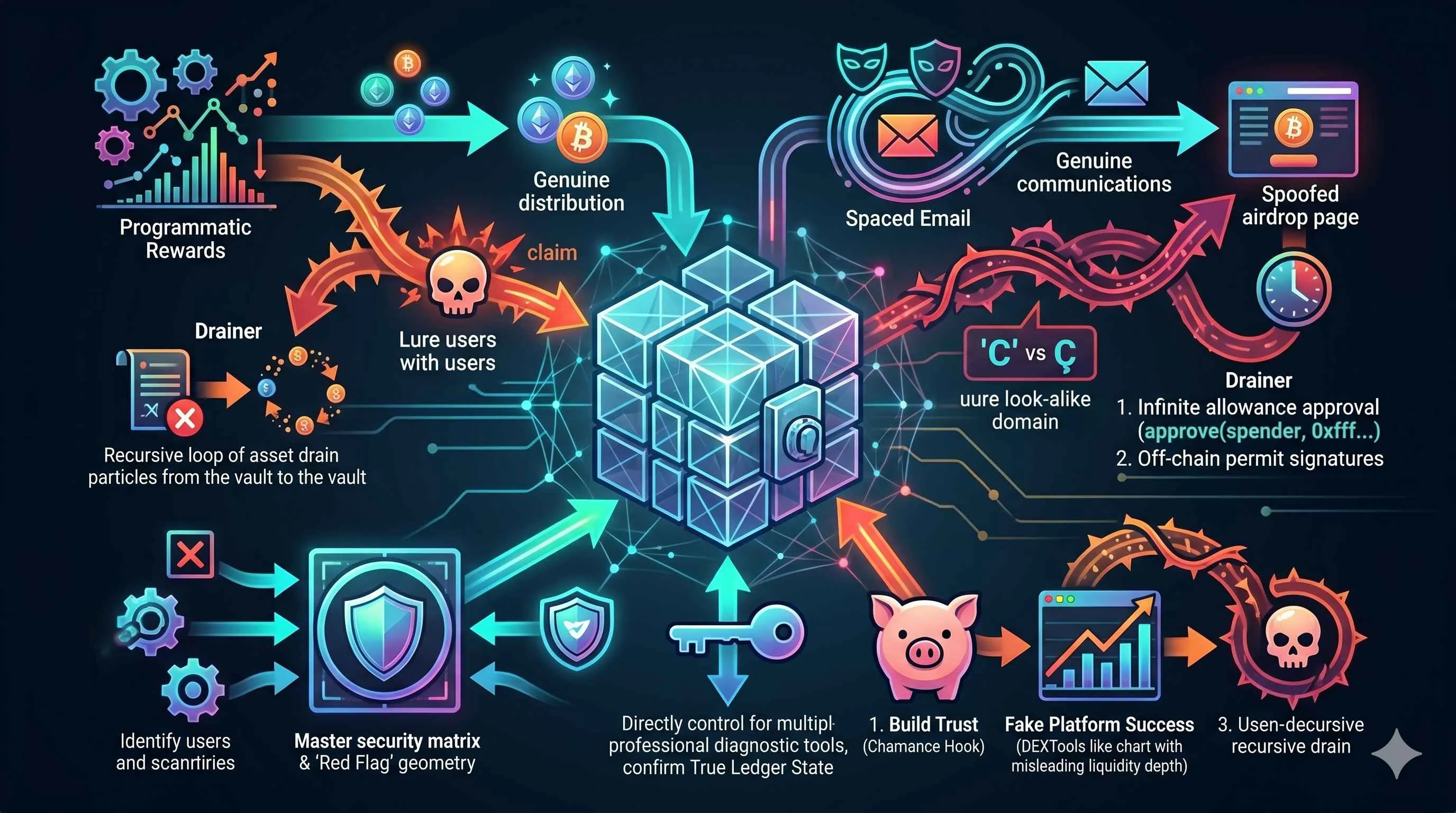
A fraudulent campaign always starts with an aggressive distribution phase. Threat actors deploy automated scraping scripts across public networks to identify active wallet addresses, particularly those holding valuable token balances or historic interactions with major non-custodial platforms. They then target these users through multiple channels, including compromised community announcement boards, search engine ad spoofing, and unsolicited automated direct messages.
The lure typically mirrors an authentic marketing campaign, announcing an unexpected, high-value distribution event associated with a prominent layer-1 network or a popular decentralized finance platform. The message creates immediate artificial scarcity, stating that the claim window is highly limited or that token allocations decrease every hour. This intense psychological pressure is designed to make users skip standard operational checks and rush directly to the provided hyperlink.
Once you click the link and arrive at the landing page, the interface presents a professional web3 gateway that mimics the branding of the targeted protocol. The site asks you to connect your digital wallet to verify your eligibility for the reward. The moment you click connect and initiate the claim sequence, the webpage passes a custom data payload to your wallet extension, prompting a confirmation window. This specific window is where the technical manipulation occurs.
Deconstructing the Drainage Mechanisms Step-by-Step
A malicious claiming site does not simply ask for your private seed phrase, as modern users are generally trained to refuse such requests. Instead, it relies on two primary cryptographic signature commands that abuse normal smart contract interaction rules.
The first common mechanism relies on the standard infinite allowance command. When a user clicks the claim button, the website presents a transaction that looks like a standard network interaction. In reality, the transaction invokes the contract's approval function, designating an attacker-controlled address as an authorized spender for your existing token balances. By confirming this signature, you grant the malicious smart contract permission to programmatically withdraw specific tokens from your address at any time in the future, allowing automated drain scripts to empty your balances within seconds.
The second, more advanced method utilizes off-chain permit signatures defined under specific token standards like EIP-2612. This protocol allows users to authorize a gasless token allowance by signing a structured data message entirely off-chain using their private key. Because this action does not broadcast a live transaction immediately, wallet interfaces often display it as a simple text confirmation rather than a standard transaction warning.
If a user signs this data block without analyzing its contents, the attacker harvests the cryptographic signature, submits it to the blockchain registry themselves, and immediately executes a transfer command to drain the victim's assets.
Defensive Protocols: Implementing a Comprehensive Verification Workflow
Because these fraudulent sites interact with wallets using valid on-chain commands, traditional web filters and firewalls cannot reliably block them. Securing your portfolio demands the implementation of strict operational rules before interacting with any claiming interface.
First, enforce independent domain verification. Never access a token distribution portal using a link found in an unexpected direct message, a social media comment section, or a search engine advertisement. Always cross-reference the claiming URL character-by-character with official documentation sources, such as verified project repositories or primary developer channels. If a protocol claims an incentive program is live, but their official public repositories make no mention of the event, the distribution page is a confirmed exploit attempt.
Second, use dedicated testing accounts for all claiming interactions. Never connect a high-balance hardware wallet or a primary cold storage asset directly to an unverified decentralized application. Maintain a completely separate, low-balance hot wallet specifically for exploring new protocols and testing airdrop eligibility. If the claiming process demands an approval signature, you can test the interaction safely without exposing your main capital holdings to a systemic drain script.
Third, carefully audit the transaction payload details inside your wallet window before signing any command. If a website claims it is distributing free native tokens to your address, the wallet transaction window should only show an inbound asset transfer or a simple data signature. If the interface requests an approval command, an infinite allowance authorization, or a permit signature targeting your existing assets, reject the interaction immediately.
Fourth, actively manage your active smart contract approvals. Routinely review your wallet's active token allowances using independent on-chain diagnostic tools. If you discover unexpected spenders or historical approvals granted to unverified protocols during past reward campaigns, use a revocation tool to completely cancel those permissions, ensuring that historical vulnerabilities cannot be exploited to access your current balances.
Conclusion: Neutralizing Phishing with Cryptographic Discipline
Understanding Fake Airdrop Scams: How to Identify Them allows digital asset managers to move from a state of visual reliance to strict technical verification. In a decentralized financial system, there is no institutional backstop to protect capital from unauthorized signature grants. Security is an active, structural protocol that you must maintain with every transaction you sign.
By treating all unexpected token rewards as untrusted public events, isolating your core capital within isolated cold storage structures, and verifying every smart contract data parameter before giving your signature, you completely neutralize the psychological illusions used by automated exploit networks. In a fast-moving web3 ecosystem, taking the time to technically audit every data request ensures your private keys remain secure and your portfolio stays fully protected.
Disclaimer: This article is for informational purposes only and does not constitute investment advice, financial advice, trading advice, or any other kind of advice. DEXTools does not recommend buying, selling, or holding any cryptocurrency or token. Users should conduct their own research and consult with a qualified financial advisor before making any investment decisions. Cryptocurrency investments are volatile and high-risk. DEXTools is not responsible for any losses incurred.
Related Guides
- How to Spot Fake Crypto Communities: Bots and Shillers
- Solana Airdrop Checker: Ensure Safety ; Avoid Scams
- TON Memecoins Guide: Top Tokens and How to Trade Them (2026)
- SIM Swap Attacks: How They Work and How to Prevent Them
- Spotting Crypto Opportunities Early
Frequently Asked Questions
How can I tell if a crypto airdrop is fake?
Fake airdrops often pressure you to connect your wallet to an unfamiliar site, sign an approval, or share your seed phrase to claim tokens. A legitimate airdrop never requires your private keys or recovery phrase, so any request for them is a clear warning sign.
Why do scammers send unsolicited tokens to my wallet?
Scammers airdrop worthless or malicious tokens to wallets hoping the owner will visit a linked website to check or sell them. Interacting with that site or signing its prompts can trigger phishing approvals that drain your funds.
What is a wallet drainer in fake airdrop scams?
A wallet drainer is malicious code or a deceptive signature request designed to gain spending permission over your tokens. Once you approve it, the attacker can move assets out of your wallet without further confirmation.
What should I do if I already interacted with a fake airdrop?
Move any remaining funds to a fresh wallet and revoke token approvals you granted to suspicious contracts using a trusted approval-checking tool. Treat the compromised wallet as unsafe for holding valuable assets going forward.