Form 1099-DA: Why Crypto Cost Basis Fails

The era of crypto tax self-reporting has officially ended. We dissect the structural data gaps, covered asset frameworks, and zero-basis traps of the IRS Form 1099-DA.
What Is Form 1099-DA and Why Your Crypto Cost Basis May Be Wrong
- The wild-west era of decentralized asset tax compliance has officially ended. For over a decade, digital asset traders operated under a self-reporting system, relying on loose spreadsheets, API data downloads, and third-party accounting tools to disclose capital gains voluntarily. The Internal Revenue Service (IRS) had minimal look-through visibility into daily transaction volumes, leaving an enormous tax gap across the cryptocurrency sector.
- The introduction of Form 1099-DA (Digital Asset Proceeds From Broker Transactions) permanently re-engineers this dynamic. Rolled out to standardize automated crypto reporting, centralized exchanges, institutional digital asset brokers, and custodial platforms are required to deliver this tax statement directly to both you and the IRS.
- However, because the underlying data pipelines of centralized platforms are structurally disconnected from the broader decentralized ledger, a major data tracking crisis has emerged. If you received a Form 1099-DA, there is a very high probability that the numbers printed on that form are systematically incomplete or flat-out wrong. This guide provides a comprehensive breakdown of what Form 1099-DA is, why your reported cost basis is likely incorrect, and exactly how to fix it to protect your portfolio from automated IRS audits.
1. The Anatomy of Form 1099-DA: What the IRS Sees
Form 1099-DA is an official information return designed to mirror the structural functions of traditional legacy finance forms like Form 1099-B (used for traditional stock and bond sales). When you execute a taxable disposal on a custodial platform, that broker aggregates your transaction metadata and transmits a carbon copy directly to federal tax databases.
The data fields contained within Form 1099-DA expose your precise on-chain and off-chain transaction history to the IRS:
Gross Proceeds: The exact total fair market value of the fiat, stablecoins, or alternative tokens received upon a disposal.
Acquisition and Sale Timestamps: The specific calendar dates and times when the asset was bought and subsequently liquidated (typically standardized using Coordinated Universal Time, or UTC).
Asset Classification: The exact type and quantity of the cryptocurrency ticker traded (e.g., Bitcoin, Ethereum, Solana, or specific NFT contract types).
Blockchain Identifiers: Verifiable on-chain transaction hashes, internal exchange transaction IDs, and public wallet routing signatures used to cross-reference ledger activity.
Unlike traditional stock or real estate information forms that feature strict minimum volume thresholds, Form 1099-DA carries no minimum transaction amount to trigger reporting. Whether you execute a multi-million-dollar institutional block trade or a micro-cap swap, a form is systematically generated and filed against your Taxpayer Identification Number (TIN).
2. The Covered vs. Non-Covered Disconnect
To diagnose why the information on your exchange-issued tax document is likely flawed, you must understand the transitional phase of the IRS implementation timeline. The system splits all digital assets into two distinct regulatory definitions: Covered Assets and Non-Covered Assets.
Covered Assets
Covered assets are cryptocurrencies purchased inside a centralized broker platform on or after January 1, 2026. For these specific assets, the exchange is legally mandated to strictly log, track, and report your exact acquisition price (your cost basis) directly to the IRS upon disposal.
Non-Covered Assets
- Non-covered assets include any cryptocurrency purchased prior to January 1, 2026, or any asset transferred onto an exchange from an external source. Because brokers were not legally required to retroactively audit historical cost details, assets liquidated on a platform today are classified as non-covered.
- For these assets, the exchange is required to report the gross sale proceeds, but they are not required to calculate or provide the cost basis. As a result, the cost basis field on your Form 1099-DA will be left completely blank or marked as "unknown."
3. The Dangerous "$0 Basis" Trap
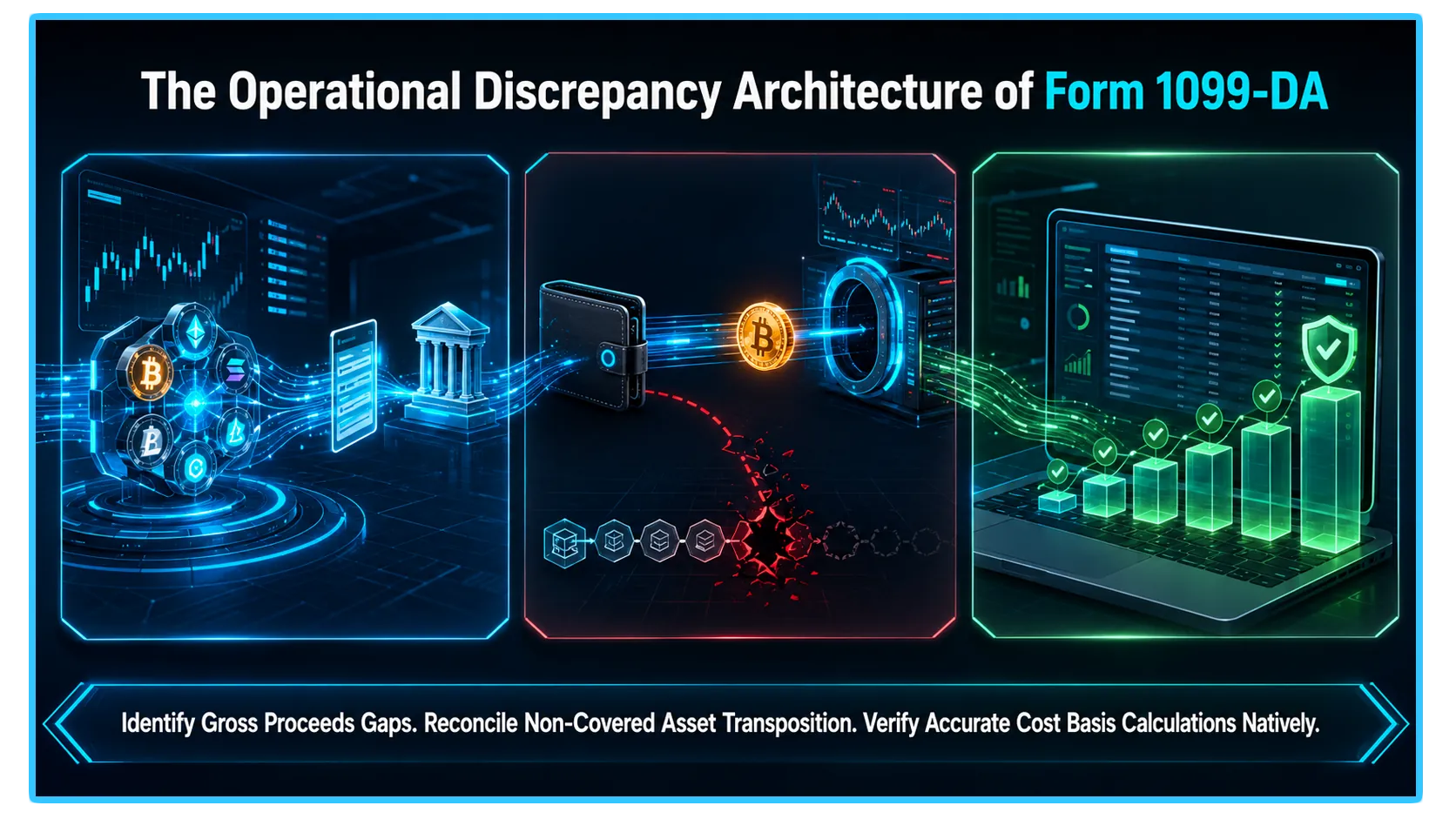
- The primary structural trap for cryptocurrency investors occurs when a non-covered asset is transferred across platforms before liquidation. Because blockchains are designed as open, non-custodial environments, centralized exchanges operate as closed data siloes with zero look-through visibility into external ledger histories.
- Consider this common multi-wallet scenario: an investor purchases 1 Bitcoin for $40,000 on Exchange A. They transfer that Bitcoin to a self-custodial hardware wallet for long-term safekeeping, and later transfer it to Exchange B to liquidate it for $100,000.
- Because Exchange B has absolutely no record of the original purchase history or the transaction fees paid on Exchange A, the platform's automated compliance system will print your cost basis as exactly zero or unknown on Form 1099-DA.
- If you file your taxes by blindly copying the numbers straight from that form, the IRS matching algorithms will view your entire $100,000 gross proceeds as pure, taxable capital gain. You could end up paying capital gains taxes on the full $100,000 liquidation amount, completely overstating your actual tax liability on a trade that should only carry a $60,000 net taxable gain.
4. The Enforcement of Per-Wallet Cost Basis Tracking
- Compounding the cost basis crisis is a monumental structural shift in how the IRS mandates digital asset inventory tracking. Historically, crypto investors frequently utilized the "universal pooling method", an accounting assumption where all identical tokens across a trader's entire global matrix of wallets and exchanges were treated as a single, combined liquidity pool for calculating average cost bases.
- The IRS has officially eliminated this approach. Under current digital asset basis rules, taxpayers are required to maintain and execute cost basis accounting exclusively on a per-wallet or per-account basis.
- If you buy an asset on Exchange A and sell a separate block of that same token on Exchange B, you cannot use the purchase price from Exchange A to offset the sale on Exchange B unless a physical, documented asset migration occurred between the platforms. This localized segregation significantly increases the accounting burden, requiring absolute tracking precision across every independent wallet signature in your portfolio.
5. Reconciling the Gaps: How to Fix a Broken 1099-DA
A blank or incorrect cost basis on an official tax statement is not an unfixable penalty; it is a call to action. The IRS does not require you to accept a broker's incorrect data. You possess the legal right to report your true, verified cost basis on your federal tax return, provided you maintain the necessary sub-accounting records to back up your claims.
To correct a missing or inaccurate basis without triggering an automated red flag, follow this exact operational layout:Step 1: Aggregate Your Entire Global History: Deploy comprehensive crypto tax calculation software (such as Koinly, CoinLedger, or TokenTax) to ingest the API streams and transaction CSVs from every exchange, DeFi protocol, and self-custodial wallet you utilized. This unifies your historical cost paths.
Step 2: Cross-Reference Your Gross Proceeds: Ensure that the total gross proceeds calculated by your personal tax software match the exact gross proceeds printed in Box 1d of your exchange-issued Form 1099-DA. If the proceeds match, your underlying transaction volume is aligned.
Step 3: Manually Supply Your Cost Basis on Form 8949: When filling out Form 8949, map the transaction to the corresponding reporting section. Enter the exchange's reported proceeds in Column (d). In Column (e), do not copy the exchange's blank or zero figure; enter your true, historically reconstructed cost basis including all original acquisition fees.
Step 4: Implement Proper Disclosure Codes: If the exchange reported a specific cost basis number that you know is incorrect, enter the correct cost in Column (e), enter Code B in Column (f) to signal a broker basis mismatch, and enter the adjustment amount in Column (g) to align the final net capital gain. If the basis was simply left blank, supply your original cost in Column (e) and leave the adjustment columns blank.
Conclusion: Preparing for the Automated Audit Wave
- The deployment of Form 1099-DA marks the beginning of an unprecedented wave of automated crypto tax enforcement. Because the IRS data matching systems are programmed to automatically flags accounts where a taxpayer's reported proceeds fall below the totals reported by exchanges, ignoring these forms or filing conflicting data without proper tracking codes will instantly trigger automated CP2000 warning notices or full formal audits.
- The responsibility to prove your original purchase price rests entirely on your shoulders. By taking control of your cross-platform transaction histories, employing disciplined per-wallet accounting methods, and proactively correcting cost basis gaps on Form 8949, you can navigate this heightened regulatory regime safely, ensuring you pay exactly what you owe while protecting your digital wealth from the penalties of overtaxation.
6. On-Chain Diagnostics via DEXTools Telemetry
- Successfully navigating a highly scrutinized tax environment requires absolute, undeniable visibility into your raw ledger activity. While a centralized exchange's Form 1099-DA tracks data points restricted to their internal database loops, verifying the real-world execution pricing and on-chain routing maps of your historic assets is the only method to defend your reconstructed cost basis values during an audit.
- DEXTools provides the critical analytical data infrastructure needed to verify these historical movements. By utilizing real-time pair explorers, multi-chain historical order book data tracking, and comprehensive wallet telemetry, market participants can independently audit their exact entry and exit price ticks across decentralized applications.
- Cross-referencing your personal transaction records with live on-chain market data ensures your cost basis calculations are backed by authentic blockchain telemetry, giving you the documentation required to defeat automated IRS matching letters and preserve your capital efficiency.
You can access DEXTools here and start trading today!
Disclaimer: This article is for informational purposes only and does not constitute investment advice, financial advice, trading advice, or any other kind of advice. DEXTools does not recommend buying, selling, or holding any cryptocurrency or token. Users should conduct their own research and consult with a qualified financial advisor before making any investment decisions. Cryptocurrency investments are volatile and high-risk. DEXTools is not responsible for any losses incurred.