How to Buy Avalanche (AVAX): Beginner Guide 2026
— By Tony Rabbit in Tutorials
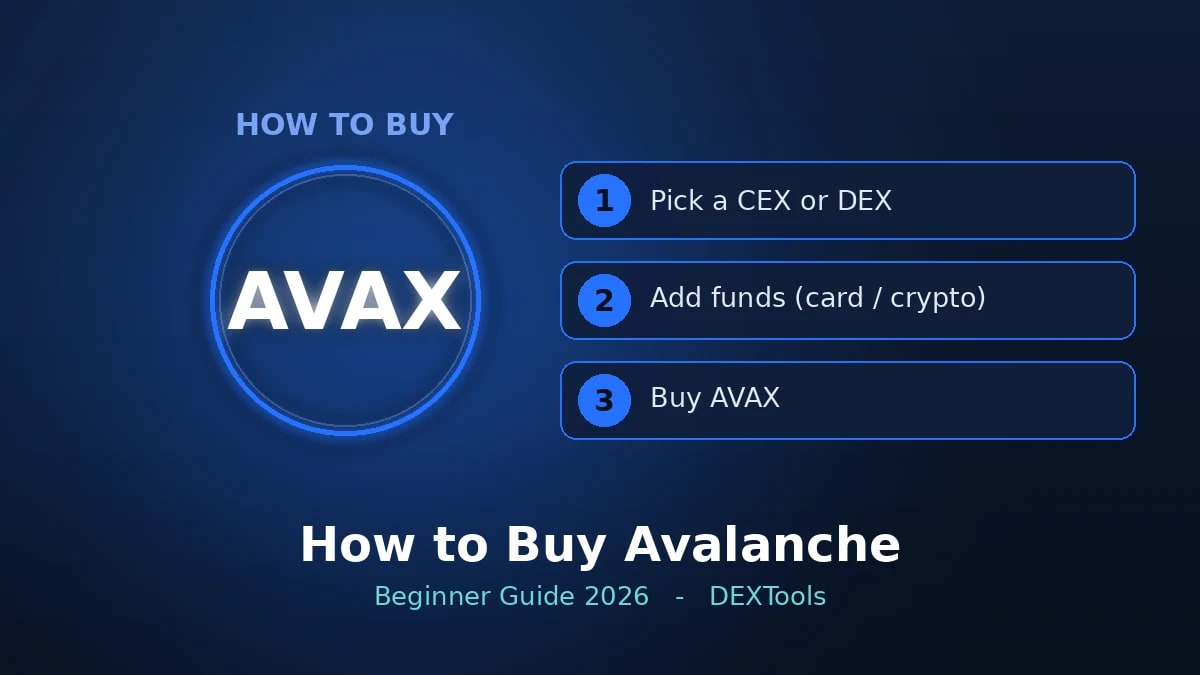
Learn how to buy Avalanche (AVAX) with this beginner's guide. Discover exchanges, storage options, and essential safety tips.
If you're wondering how to buy Avalanche (AVAX), you've come to the right place. Avalanche is a popular blockchain platform, and acquiring its native token, AVAX, is straightforward whether you prefer centralized exchanges (CEXs) or decentralized exchanges (DEXs). Before you begin, keep an eye on the live AVAX price above to inform your decision.
What Is Avalanche (AVAX)?
Avalanche is a high-performance, open-source platform for launching decentralized applications (dApps) and enterprise blockchain deployments. Developed by Ava Labs, it aims to solve the blockchain trilemma of scalability, security, and decentralization. Unlike many other blockchains, Avalanche utilizes a unique architecture with three interoperable blockchains:
- P-Chain (Platform Chain): Coordinates validators, tracks active subnets, and enables the creation of new subnets.
- X-Chain (Exchange Chain): Facilitates the creation and exchange of AVAX and other digital assets.
- C-Chain (Contract Chain): An instance of the Ethereum Virtual Machine (EVM), allowing for the deployment of Solidity-compatible smart contracts and dApps.
AVAX is the native utility token of the Avalanche network. It serves several key functions, including:
- Staking: Users can stake AVAX to secure the network and earn rewards.
- Transaction Fees: All transactions on the Avalanche network require AVAX for gas fees.
- Governance: AVAX holders can participate in the network's governance, voting on important proposals.
- Subnet Creation: Creating custom subnets on Avalanche requires staking AVAX.
Avalanche is known for its fast transaction finality, high throughput, and low transaction costs, making it an attractive platform for developers and users alike.
How to Buy Avalanche: Step by Step
Learning how to buy Avalanche involves a few key steps, regardless of whether you choose a CEX or a DEX. Here's a general guide:
- Step. Pick a Reputable Exchange or Wallet. Your first decision is where you want to buy AVAX. Centralized exchanges like Binance, Coinbase, or Kraken are popular choices for beginners due to their user-friendly interfaces and fiat on-ramps. Alternatively, you can use a self-custody wallet like MetaMask (connected to the Avalanche C-Chain) to interact with decentralized exchanges.
- Step. Create an Account or Connect a Self-Custody Wallet. If using a CEX, you'll need to create an account, which typically involves email verification, setting a strong password, and completing Know Your Customer (KYC) verification by providing identification documents. If using a DEX, you'll simply connect your existing self-custody wallet.
- Step. Deposit Funds. For CEXs, you can usually deposit fiat currency (USD, EUR, etc.) via bank transfer, credit/debit card, or other payment methods. You can also deposit other cryptocurrencies if you already own some. For DEXs, you'll need to have an existing cryptocurrency (like ETH or USDT) in your connected wallet on the Avalanche network to swap for AVAX.
- Step. Buy AVAX. Once your funds are deposited, navigate to the trading section of your chosen CEX. Search for AVAX and select the trading pair (e.g., AVAX/USD, AVAX/USDT). Enter the amount of AVAX you wish to buy or the amount of fiat/crypto you want to spend, and execute the trade. On a DEX, you'll use the swap function to exchange your existing crypto for AVAX.
- Step. Withdraw to Your Own Wallet (Recommended). While CEXs are convenient for buying, it's generally recommended to withdraw your AVAX to a self-custody wallet that you control. This gives you full ownership of your assets and protects them from potential exchange hacks or failures.
Where to Buy Avalanche
There are two primary avenues for how to buy Avalanche:
Centralized Exchanges (CEXs)
CEXs are the most common entry point for newcomers. They act as intermediaries, holding your funds and facilitating trades. They often offer fiat on-ramps, allowing you to convert traditional currency directly into AVAX. Popular CEXs where you can buy AVAX include:
- Binance: One of the largest exchanges globally, offering a wide range of trading pairs and features.
- Coinbase: Known for its user-friendly interface, often favored by beginners.
- Kraken: A reputable exchange with a strong focus on security and a good selection of cryptocurrencies.
- KuCoin: Offers a broad selection of altcoins and advanced trading options.
- Gate.io: Another exchange with a vast array of cryptocurrencies.
Decentralized Exchanges (DEXs)
DEXs allow you to trade cryptocurrencies directly from your self-custody wallet without an intermediary. This offers greater privacy and control over your assets. To buy AVAX on a DEX, you'll need a compatible wallet (like MetaMask) configured for the Avalanche C-Chain and some existing crypto (e.g., Wrapped AVAX, USDT.e) to swap. Popular DEXs on Avalanche include:
- Trader Joe: A leading DEX and DeFi platform on Avalanche.
- Pangolin: One of the earliest and most established DEXs on Avalanche.
- Platypus Finance: A stablecoin-focused DEX on Avalanche.
How to Buy Avalanche on a DEX
Buying AVAX on a decentralized exchange offers a more direct way to interact with the Avalanche ecosystem. Here's a simplified process:
- Step. Connect Your Wallet. Ensure your self-custody wallet (e.g., MetaMask) is set to the Avalanche C-Chain network. Navigate to your chosen DEX (e.g., Trader Joe) and click the 'Connect Wallet' button.
- Step. Select Tokens for Swap. In the swap interface, select the token you wish to trade from (e.g., USDT.e, WETH.e) and select AVAX as the token you want to receive.
- Step. Enter Amount and Confirm. Enter the amount of the token you want to swap. The DEX will show you the estimated amount of AVAX you will receive. Review the transaction details, including any fees, and confirm the swap in your wallet.
- Step. Verify the Token on DEXTools. Before confirming any swap, especially for lesser-known tokens, it's a good practice to verify the token's contract address on DEXTools. This helps ensure you are interacting with the legitimate AVAX token and not a fake.
How Much AVAX Should You Buy?
The decision of how much AVAX to buy depends entirely on your personal financial situation, investment goals, and risk tolerance. It's crucial to only invest what you can afford to lose. Cryptocurrency markets are volatile, and prices can fluctuate significantly, as you can observe with the live AVAX price above.
A common strategy for beginners is dollar-cost averaging (DCA). This involves investing a fixed amount of money at regular intervals (e.g., weekly or monthly), regardless of the current price. DCA helps to mitigate the risk associated with market volatility by averaging out your purchase price over time.
How to Store Avalanche Safely
Once you know how to buy Avalanche, securing your assets is paramount. While leaving AVAX on an exchange might seem convenient, it exposes you to counterparty risk. The safest way to store your AVAX is in a self-custody wallet.
Hardware Wallets (Cold Storage)
Hardware wallets are physical devices that store your private keys offline, making them highly resistant to online hacks. They are considered the gold standard for cryptocurrency security, especially for larger amounts. Popular options include Ledger and Trezor.
Software Wallets (Hot Storage)
Software wallets are applications that run on your computer or smartphone. While less secure than hardware wallets because they are connected to the internet, they offer a good balance of security and convenience for smaller amounts of AVAX and frequent transactions. Examples include MetaMask (configured for Avalanche C-Chain), Core Wallet, and Trust Wallet.
Crucial Security Advice: Regardless of the wallet type, always back up your seed phrase (a series of 12 or 24 words). This phrase is the master key to your funds. Store it in a secure, offline location, and never share it with anyone. If you lose your seed phrase, you lose access to your funds.
Fees and Things to Watch
When you buy AVAX, be aware of various fees and potential pitfalls:
- Exchange Fees: CEXs charge trading fees (taker/maker fees) for buying and selling, as well as withdrawal fees if you move your AVAX off the exchange.
- Network Fees (Gas Fees): All transactions on the Avalanche network (like sending AVAX or interacting with dApps) incur a small gas fee, paid in AVAX.
- Slippage: On DEXs, especially for large trades or illiquid pairs, you might experience slippage, where the executed price differs from the expected price.
By understanding how to buy Avalanche, choosing reputable platforms, and prioritizing security, you can confidently enter the Avalanche ecosystem.
Frequently Asked Questions
How do I buy Avalanche (AVAX)?
You can buy Avalanche (AVAX) on centralized exchanges (CEXs) like Binance, Coinbase, or Kraken, or on decentralized exchanges (DEXs) like Trader Joe or Pangolin. The process typically involves creating an account, depositing funds, and then executing a trade or swap for AVAX.
Where can I buy AVAX?
AVAX is available on major centralized exchanges such as Binance, Coinbase, Kraken, KuCoin, and Gate.io. You can also purchase it on decentralized exchanges on the Avalanche network, including Trader Joe and Pangolin, by connecting a compatible self-custody wallet like MetaMask.
What is the cheapest way to buy Avalanche?
The cheapest way to buy Avalanche often involves using centralized exchanges with lower trading fees or utilizing bank transfers for fiat deposits, which usually have lower fees than credit card purchases. On DEXs, consider gas fees and slippage, especially during high network congestion. Always compare fees across different platforms.
Is Avalanche a good investment?
DEXTools does not provide financial advice. Whether Avalanche (AVAX) is a good investment depends on your individual financial goals, risk tolerance, and market analysis. It is crucial to conduct your own research, understand the project's fundamentals, and consider the inherent volatility of cryptocurrency markets before making any investment decisions.
What is AVAX used for?
AVAX is the native utility token of the Avalanche network. It is used for paying transaction fees (gas), staking to secure the network and earn rewards, participating in network governance, and creating custom subnets on the Avalanche platform.
How do I store AVAX safely?
To store AVAX safely, it is highly recommended to use a self-custody wallet. Hardware wallets (e.g., Ledger, Trezor) offer the highest security by storing private keys offline. Software wallets (e.g., MetaMask, Core Wallet) are also an option for convenience. Always back up your seed phrase and keep it secure offline.
Can I buy Avalanche with USD?
Yes, you can typically buy Avalanche (AVAX) directly with USD on most major centralized cryptocurrency exchanges. These exchanges usually offer various fiat deposit methods, including bank transfers, credit/debit card purchases, or other payment services, allowing you to convert USD into AVAX.
What are the fees for buying AVAX?
Fees for buying AVAX include trading fees charged by centralized exchanges (taker/maker fees), network transaction fees (gas fees) paid in AVAX for on-chain transfers, and potentially withdrawal fees if you move your AVAX to a personal wallet. DEXs also have gas fees and can incur slippage.