How to Buy Dogecoin (DOGE): Beginner Guide 2026
— By Tony Rabbit in Tutorials
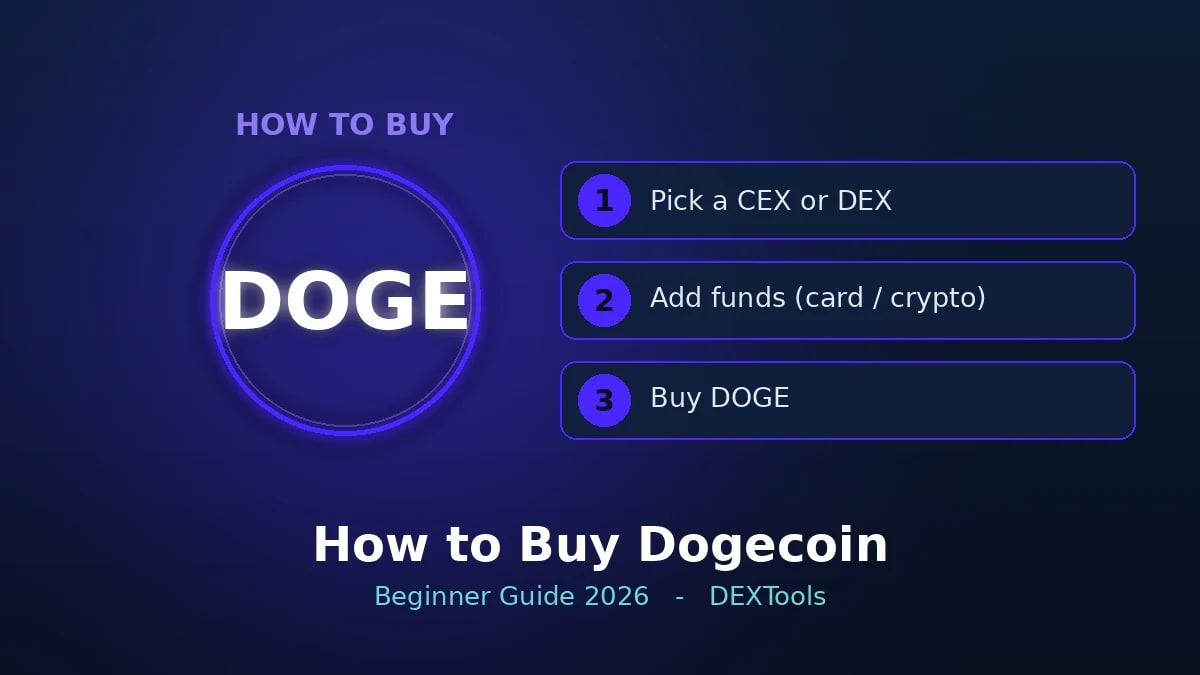
Learn how to buy Dogecoin with our beginner's guide. Discover exchanges, wallets, and safety tips for acquiring DOGE.
Are you wondering how to buy Dogecoin? You've come to the right place. Dogecoin (DOGE) can be purchased on both centralized cryptocurrency exchanges (CEXs) and decentralized exchanges (DEXs). Before you dive in, remember to keep an eye on the live DOGE price above to inform your decisions.
What Is Dogecoin (DOGE)?
Dogecoin (DOGE) is a peer-to-peer, open-source cryptocurrency that was created in 2013 by software engineers Billy Markus and Jackson Palmer. Initially conceived as a lighthearted joke, Dogecoin quickly gained a dedicated following and became one of the most recognizable cryptocurrencies.
It was designed to be more approachable than Bitcoin, featuring the popular Shiba Inu dog from the 'Doge' internet meme as its mascot. Despite its humorous origins, Dogecoin has evolved into a significant player in the crypto space, known for its vibrant community and use in tipping and charitable initiatives.
Dogecoin operates on a proof-of-work consensus mechanism, similar to Bitcoin, but with a faster block time and a higher circulating supply. Its inflationary supply schedule means that new DOGE are continuously minted, which contributes to its accessibility and lower transaction fees compared to some other cryptocurrencies.
How to Buy Dogecoin: Step by Step
Buying Dogecoin is a straightforward process, whether you choose a centralized or decentralized platform. Here's a general step-by-step guide:
- Step. Pick a reputable exchange or wallet. Your first step is to choose where you want to buy DOGE. Centralized exchanges like Binance, Coinbase, or Kraken are popular choices for beginners due to their user-friendly interfaces. Alternatively, you might opt for a decentralized exchange (DEX) or a wallet with integrated swap functionality.
- Step. Create an account or connect a self-custody wallet. If you choose a CEX, you'll need to create an account, which typically involves providing an email address, setting a password, and completing a Know Your Customer (KYC) verification process. This usually requires submitting identification documents. If you're using a DEX, you'll simply connect your existing self-custody wallet (e.g., MetaMask, Trust Wallet).
- Step. Deposit funds. Once your account is set up (or wallet connected), you'll need to deposit funds. CEXs usually support various deposit methods, including bank transfers, debit/credit card payments, or deposits of other cryptocurrencies. For DEXs, you'll need to have an existing cryptocurrency (like ETH or BNB) in your connected wallet to swap for DOGE.
- Step. Buy DOGE. Navigate to the trading section of your chosen platform. Search for DOGE and select the trading pair you wish to use (e.g., DOGE/USD, DOGE/USDT). Enter the amount of Dogecoin you want to buy or the amount of fiat/crypto you wish to spend, and confirm your purchase.
- Step. Withdraw to your own wallet (optional but recommended). While you can leave your DOGE on a centralized exchange, it's generally safer to withdraw your assets to a self-custody wallet that you control. This provides greater security and ownership over your Dogecoin.
Where to Buy Dogecoin
Dogecoin is widely available across various platforms. Your choice will depend on your preference for ease of use, security, and control.
Centralized Exchanges (CEXs): These are often the easiest entry point for beginners. They act as intermediaries, holding your funds and facilitating trades. Popular CEXs where you can buy Dogecoin include:
- Binance
- Coinbase
- Kraken
- KuCoin
- Gemini
CEXs offer features like fiat-to-crypto on-ramps, customer support, and sometimes advanced trading tools. However, you don't hold the private keys to your crypto when it's on a CEX, meaning you don't have full control.
Decentralized Exchanges (DEXs): DEXs allow you to trade cryptocurrencies directly from your self-custody wallet, without an intermediary. This gives you full control over your assets. While Dogecoin itself is not an ERC-20 token, Wrapped Dogecoin (wDOGE) or other bridged versions are available on various DEXs, particularly those on EVM-compatible chains. Popular DEXs include:
- Uniswap (for wDOGE on Ethereum)
- PancakeSwap (for bridged DOGE on BNB Smart Chain)
When using a DEX, you'll need a compatible self-custody wallet and some native tokens of the blockchain you're using to cover transaction fees.
How to Buy Dogecoin on a DEX
Buying Dogecoin on a decentralized exchange involves a slightly different process:
- Step. Connect your wallet. Open your preferred DEX (e.g., Uniswap, PancakeSwap) and connect your self-custody wallet (e.g., MetaMask, Trust Wallet). Ensure your wallet is on the correct network (e.g., Ethereum for Uniswap, BNB Smart Chain for PancakeSwap).
- Step. Swap for DOGE. You'll typically need to swap an existing cryptocurrency (like ETH, BNB, or a stablecoin) for Dogecoin. Search for the DOGE token. Be extremely cautious here, as fake tokens are prevalent.
- Step. Verify the token on DEXTools. Before executing any swap, always verify the token's contract address. You can paste the contract address into DEXTools to check its legitimacy, liquidity, trading volume, and other important metrics. This helps protect you from scams and fake tokens.
- Step. Confirm the transaction. Enter the amount you wish to swap, review the transaction details (including gas fees), and confirm the swap in your wallet.
How Much DOGE Should You Buy?
The decision of how much Dogecoin to buy is entirely personal and depends on your financial situation and risk tolerance. There's no one-size-fits-all answer. It's crucial to only invest what you can afford to lose, as cryptocurrency markets can be highly volatile.
You can use the live DOGE price above to calculate how much fiat currency you'd need for a certain amount of DOGE, or vice versa. Many investors utilize a strategy called dollar-cost averaging (DCA). This involves investing a fixed amount of money at regular intervals (e.g., weekly or monthly), regardless of the asset's price. DCA can help mitigate the impact of market volatility and reduce the risk of buying at a single price peak.
How to Store Dogecoin Safely
Once you've acquired Dogecoin, securing it is paramount. While leaving DOGE on a centralized exchange might seem convenient, it carries risks as you don't control the private keys. For maximum security, consider storing your Dogecoin in a self-custody wallet.
Popular hardware wallets include Ledger and Trezor. These devices require physical confirmation for transactions, adding an extra layer of security.
Software wallets (like Exodus, Atomic Wallet, or Trust Wallet) are another option. They are applications that run on your computer or smartphone. While more convenient than hardware wallets, they are still connected to the internet and thus carry a higher risk of being compromised.
Regardless of the wallet type, always back up your seed phrase (a series of 12 or 24 words). This phrase is the master key to your funds. Store it in a secure, offline location, away from prying eyes and potential damage. Never share your seed phrase with anyone.
Fees and Things to Watch
When you buy Dogecoin, be aware of various fees and potential pitfalls:
- Trading Fees: Centralized exchanges charge fees for buying and selling, which can vary based on your trading volume and the exchange's fee structure.
- Deposit/Withdrawal Fees: Some exchanges charge fees for depositing fiat currency or withdrawing crypto.
- Network Fees (Gas Fees): When transacting on a blockchain (especially on DEXs), you'll pay network fees to validators. These fees can fluctuate based on network congestion.
- Spread: The difference between the buy and sell price can sometimes be considered an implicit fee.
By understanding these aspects, you can navigate the process of how to buy Dogecoin more confidently and securely.
Frequently Asked Questions
How do I buy Dogecoin?
You can buy Dogecoin (DOGE) on centralized cryptocurrency exchanges like Binance, Coinbase, or Kraken, or on decentralized exchanges (DEXs) by swapping other cryptocurrencies for DOGE.
Where can I buy DOGE?
DOGE is available on major centralized exchanges such as Binance, Coinbase, Kraken, and KuCoin. You can also find wrapped versions of DOGE on decentralized exchanges like Uniswap or PancakeSwap.
What is the cheapest way to buy Dogecoin?
The cheapest way to buy Dogecoin often involves using bank transfers for deposits on centralized exchanges, as these typically have lower fees than debit/credit card purchases. Always compare exchange fees and network costs.
Is Dogecoin a good investment?
DEXTools does not provide financial advice. Dogecoin, like all cryptocurrencies, is a volatile asset. Any investment decision should be based on your own research, risk tolerance, and financial situation. Consider consulting a financial advisor.
Can I buy Dogecoin with a credit card?
Yes, most centralized cryptocurrency exchanges allow you to buy Dogecoin using a credit or debit card, although these methods often incur higher fees compared to bank transfers.
How do I store Dogecoin safely?
The safest way to store Dogecoin is in a self-custody wallet, such as a hardware wallet (e.g., Ledger, Trezor) or a reputable software wallet. Always secure your seed phrase offline and never share it.
What should I watch out for when buying DOGE?
Be aware of trading fees, network fees, and potential scams. Always verify the contract address of tokens on DEXs using tools like DEXTools to avoid fake tokens. Never share your private keys or seed phrase.
Can I buy Dogecoin without KYC?
Buying Dogecoin without KYC (Know Your Customer) is generally only possible on decentralized exchanges (DEXs) where you swap existing crypto from your self-custody wallet. Centralized exchanges almost always require KYC.