Como comprar e usar dominios ENS (.eth) (2026)
— By Whatsertrade in Tutorials

Guia ENS 2026. Compre nomes .eth, identidade web3.
Table of Contents
- What Are ENS Domains?
- Why Own a .eth Name?
- ENS Domain Pricing (2026)
- How to Buy an ENS Domain Step by Step
- Connecting ENS to MetaMask
- Setting Your Primary ENS Name
- ENS Subdomains
- ENS Domains as NFTs
- ENS vs Unstoppable Domains
- Advanced Features
- Renewal and Expiry
- Investing in ENS Names
- Pros and Cons of ENS Domains
- Frequently Asked Questions
- Related Tutorials
If you have ever tried to send Ethereum (ETH) to a friend, you know the pain: copying a 42-character hexadecimal address, triple-checking every digit, and hoping nothing goes wrong. ENS domains solve that problem by letting you replace those ugly strings with human-readable names like yourname.eth. Think of it as a decentralized version of the DNS system that powers every website you visit - but built on the blockchain and entirely owned by you.
In this complete 2026 guide, we will walk through everything you need to know: what ENS domains are, why they matter for your Web3 identity, how to register one step by step, pricing breakdowns, advanced configuration, and whether they are a smart investment. Whether you are brand new to crypto or a seasoned DeFi user, this tutorial has you covered.
1. What Are ENS Domains?
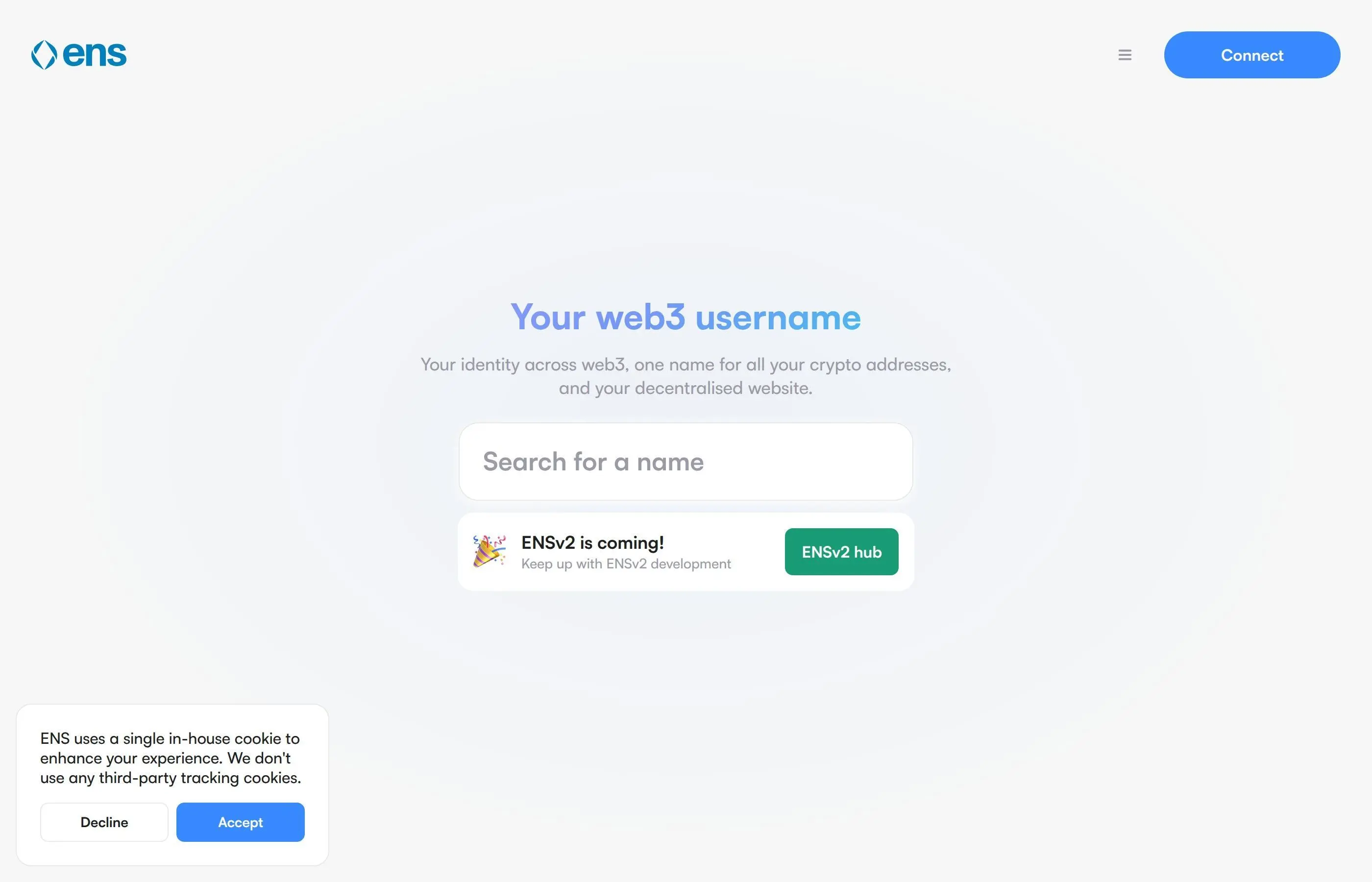
ENS stands for Ethereum Name Service. It is an open, decentralized naming protocol built on the Ethereum blockchain that maps human-readable names (like alice.eth) to machine-readable identifiers such as Ethereum addresses, other cryptocurrency addresses, content hashes, and metadata.
The protocol launched in May 2017 and has since grown into one of the most widely adopted pieces of blockchain infrastructure. As of early 2026, over 2.8 million .eth names have been registered, and ENS resolves names for dozens of wallets, dApps, and browsers.
At its core, ENS works similarly to how the traditional Domain Name System (DNS) converts domain names into IP addresses. Instead of memorizing 0x1234...abcd, someone can simply send ETH to yourname.eth. The key difference is that ENS runs on smart contracts, so no single company controls it - and your name is truly yours as long as you keep the registration active.
2. Why Own a .eth Name?
Human-Readable Addresses
The most immediate benefit is usability. Instead of sharing a long hex address when receiving crypto, you can simply say "send it to myname.eth." This dramatically reduces the risk of sending funds to the wrong address - a mistake that is irreversible on the blockchain. Any wallet that supports ENS (including MetaMask, Rainbow, Coinbase Wallet, and many others) can resolve .eth names automatically.
Web3 Identity
Your .eth name is becoming the username of Web3. Platforms like Twitter (X), OpenSea, Uniswap, and many DeFi protocols display your ENS name instead of a truncated wallet address. It is a portable, censorship-resistant identity that follows you across the decentralized web. Think of it as your on-chain reputation.
Decentralized Websites
ENS supports linking your name to IPFS content hashes, meaning you can host a fully decentralized website at yourname.eth. Browsers like Brave and Opera resolve these natively, and anyone can access them through eth.limo gateways. Because the content lives on IPFS and the pointer lives on Ethereum, no government or hosting company can take your site down.
💡 Golden Rule
Never invest more than you can afford to lose. Start with small amounts ($50-100) and use Dollar Cost Averaging to reduce risk.
Multi-Chain Support
ENS is not limited to Ethereum addresses. You can attach Bitcoin, Litecoin, Dogecoin, and dozens of other cryptocurrency addresses to a single .eth name. This turns your ENS name into a universal payment handle across multiple blockchains.
3. ENS Domain Pricing (2026)
ENS domain pricing is based on character length. Shorter names cost more because they are rarer and more desirable. Here is the current pricing structure:
Important: These prices are the base registration fee paid to the ENS protocol. You also need to pay gas fees for the Ethereum transactions involved in registration. Gas costs vary depending on network congestion, but typically range from $2 to $20 for a registration. You can register for multiple years at once to save on gas - since you only pay the transaction fee once instead of annually.
The total cost to register a 5+ character name for one year is roughly $5 (registration) plus gas. Registering the same name for five years would be $25 plus gas - a much better deal per year since you only pay gas once.
4. How to Buy an ENS Domain Step by Step
Here is a complete walkthrough for registering your first .eth name on the official ENS Manager App.
Step 1: Set Up a Wallet
You need an Ethereum wallet to interact with ENS. We recommend MetaMask for beginners - it is the most widely used browser wallet and works seamlessly with the ENS app. Install the MetaMask extension, create a new wallet, and securely back up your seed phrase. For maximum security, consider pairing it with a Ledger hardware wallet or another cold wallet.
Step 2: Get Some ETH
You will need Ethereum (ETH) to pay for both the registration fee and the gas costs. For a 5+ character name registered for one year, $15 to $30 worth of ETH should be more than enough to cover everything. Buy ETH on an exchange like Coinbase or Binance, then transfer it to your MetaMask wallet.
Step 3: Visit the ENS Manager App
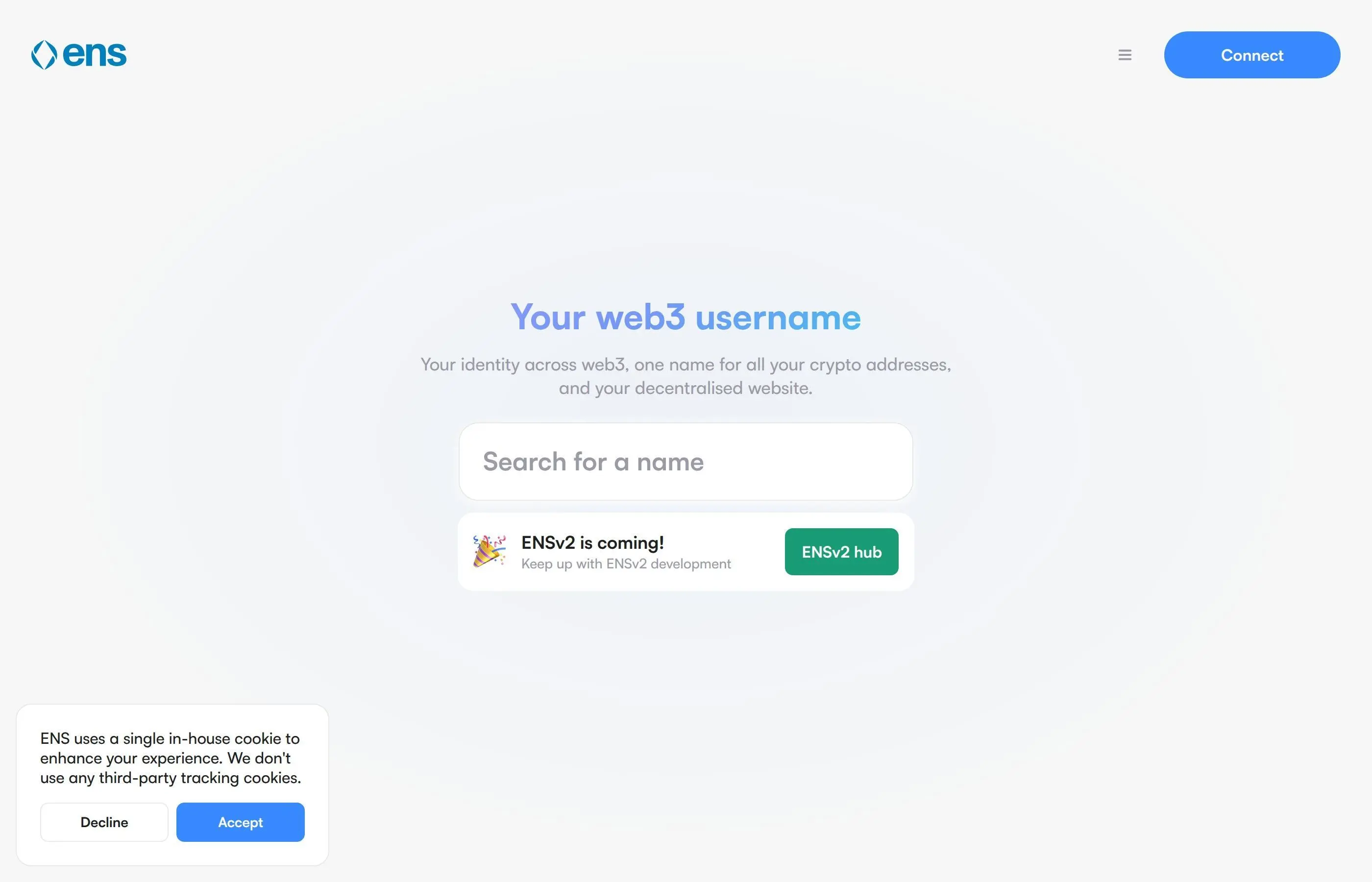
Go to app.ens.domains in your browser. This is the official ENS registration interface. Click "Connect" in the top-right corner and select MetaMask (or whichever wallet you are using). Approve the connection request in your wallet popup.
Step 4: Search for Your Desired Name
Type the name you want into the search bar. The app will instantly tell you whether the name is available. If it is taken, you will see the current owner's address and the expiration date. If it is available, you will see a green "Available" badge and the annual price.
Tips for choosing a name:
- Keep it short, memorable, and easy to spell
- Avoid special characters and confusing letter combinations
- Consider your brand, online alias, or real name
- Check that no one is squatting a similar variation
Step 5: Choose Registration Duration
Select how many years you want to register the name. The minimum is one year. As mentioned above, registering for multiple years saves on gas fees since you only need one transaction. Many users register for 3 to 5 years to lock in their name and avoid the hassle of yearly renewals.
Step 6: Begin the Registration Process
ENS uses a two-step registration process to prevent front-running (someone seeing your transaction and registering the name before you):
- Request to Register: Click "Request to Register" and confirm the first transaction in MetaMask. This commits your intent to register the name without revealing which name you want. You will pay a small gas fee.
- Wait one minute: The app will display a countdown timer. This waiting period ensures no one can front-run your registration.
- Complete Registration: After the timer expires, click "Register" and confirm the second transaction in MetaMask. This finalizes the registration and you will pay the registration fee plus gas.
Step 7: Confirm Ownership
Once both transactions confirm on the blockchain, the name is yours. You can verify by searching for your name on the ENS app - it should show your wallet address as the owner and registrant. Congratulations, you now own a .eth domain.
5. Connecting ENS to MetaMask
After registering your ENS name, you need to configure it so that it actually resolves to your wallet address. Here is how to set it up in MetaMask:
🔑 Key Point
This is where most people stop reading. If you made it this far, you understand more than 90% of crypto users. The next step is to actually try it with a small amount.
- Go to app.ens.domains and connect your wallet
- Click on "My Names" in the sidebar to see your registered names
- Click on the name you want to configure
- Under the "Records" tab, find the "Addresses" section
- Add your ETH address (it may already be pre-filled with the registrant address)
- You can also add addresses for other chains like Bitcoin, Solana, or Polygon
- Click "Save" and confirm the transaction in MetaMask
Once confirmed, anyone can send ETH (or other supported tokens) to your .eth name. MetaMask and most major wallets will automatically resolve the name to your address. You can test it by opening MetaMask, clicking "Send," and typing your .eth name in the recipient field - it should resolve to your full address.
6. Setting Your Primary ENS Name
Your Primary ENS Name (formerly called "reverse record") is the name that dApps display when they detect your wallet address. Without a primary name set, apps will just show your truncated hex address (0x1234...abcd). With it set, they will show your .eth name instead.
To set your primary name:
- Go to app.ens.domains and connect your wallet
- Click on your connected address in the top-right corner
- Select "Settings" or navigate to the Primary Name section
- Choose from the dropdown which .eth name you want as your primary name
- Click "Save" and confirm the on-chain transaction
After this transaction confirms, your .eth name will appear across the decentralized web. Uniswap, OpenSea, Aave, and hundreds of other DeFi protocols will display your ENS name as your identity. This is one of the most important steps - do not skip it.
7. ENS Subdomains
If you own a .eth name, you can create unlimited subdomains under it at no additional registration cost (you only pay gas). For example, if you own yourname.eth, you can create:
wallet.yourname.eth- for your main walletvault.yourname.eth- for your cold storagedao.yourname.eth- for a DAO treasuryblog.yourname.eth- for a decentralized website
To create a subdomain, go to your name's management page on the ENS app, navigate to the "Subnames" tab, and click "Create Subname." Enter the label (the part before the dot), confirm the transaction, and you are done. Each subdomain can resolve to a different address, making this feature powerful for organizations, DAOs, and anyone managing multiple wallets.
Some projects use subdomains to give their community members free ENS names. For instance, a project called "coolclub.eth" could issue member.coolclub.eth names to its holders - a growing trend in the Web3 space.
8. ENS Domains as NFTs
Every ENS .eth name is an NFT (specifically, an ERC-721 token on Ethereum). This means your domain lives in your wallet just like any other NFT, and you can:

- Transfer it: Send your .eth name to another wallet by transferring the NFT. This is as simple as sending any other token using MetaMask or your preferred wallet.
- Sell it on marketplaces: List your ENS name for sale on OpenSea, LooksRare, or other NFT marketplaces. Some names have sold for significant amounts - three-letter .eth names and dictionary words regularly trade for thousands of dollars.
- Use it as collateral: Some DeFi protocols allow you to use valuable ENS names as collateral for loans, though this is still an emerging use case.
- Display it: Many people showcase their ENS names in their NFT collections as a badge of their Web3 identity.
To sell an ENS name on OpenSea, simply navigate to your profile, find the ENS NFT in your collection, click "Sell," set your price (fixed or auction), and confirm the listing. Buyers can purchase it instantly and the name transfers to their wallet automatically.
Warning: When you transfer or sell an ENS name, you lose all control over it. The new owner can change all records, including which addresses it resolves to. Make sure you no longer need the name before transferring it. Also keep your ENS NFTs in a secure wallet - ideally a cold wallet - to prevent theft.
9. ENS vs Unstoppable Domains
ENS and Unstoppable Domains are the two biggest players in blockchain naming. Here is how they compare:
Verdict: ENS is the gold standard for Ethereum users due to its deep integration across the ecosystem, decentralized governance, and broad wallet support. Unstoppable Domains appeals to users who prefer a one-time payment with no renewals and want non-.eth extensions. If you primarily use Ethereum and DeFi, ENS is the better choice. If you want a "buy it and forget it" domain with no annual fees, Unstoppable Domains has merit.
10. Advanced Features
Text Records
ENS allows you to store arbitrary text records on your name. Common uses include your email address, Twitter/X handle, GitHub username, a bio/description, and custom key-value pairs. These records are publicly readable and can be used by dApps to display rich profile information. To set text records, go to your name's management page, click the "Records" tab, and add entries under "Text Records."
Avatar
You can set an avatar for your ENS name that dApps will display alongside your .eth name. The avatar can be an NFT you own (referenced by its contract address and token ID), an IPFS image, or a regular URL. Many users set their favorite NFT - such as a CryptoPunk, BAYC, or other PFP - as their ENS avatar. This creates a cohesive on-chain identity: your .eth name plus your avatar displayed across the decentralized web.
IPFS Websites
One of ENS's most powerful features is the ability to host fully decentralized websites. Here is how it works:
- Build your website as static HTML/CSS/JS files
- Upload the files to IPFS using a pinning service like Pinata or Fleek
- Copy the resulting IPFS content hash (CID)
- Go to your ENS name's management page
- Under "Records," find "Content Hash" and paste your IPFS CID
- Save and confirm the transaction
Your website is now live at yourname.eth (accessible via Brave browser, Opera, or any eth.limo gateway). Because the content is on IPFS and the name is on Ethereum, this website is censorship-resistant. No one can take it down, alter it, or block access to it without controlling the private key to your wallet.
DNS Integration (DNSSEC)
ENS now supports importing traditional DNS names. If you own a .com, .org, or other traditional domain with DNSSEC enabled, you can claim it on ENS and use it just like a .eth name. This bridges the gap between Web2 and Web3, letting you use your existing domain for crypto payments and decentralized applications.
11. Renewal and Expiry
Unlike Unstoppable Domains, ENS names require annual renewal. Here is what you need to know:
- Renewal cost: The same annual fee based on character length ($5/year for 5+ characters), plus gas
- Grace period: After expiration, there is a 90-day grace period during which only the original owner can renew. During this time, the name still resolves but cannot be transferred
- Premium auction: After the grace period, the name enters a 21-day Dutch auction starting at a premium of $100 million that decays to $0. This gives the original owner priority while eventually making expired names available at fair market prices
- Bulk renewal: You can renew multiple names at once through the ENS app to save on gas
Critical tip: Set a calendar reminder to renew your ENS names before they expire. Losing a valuable .eth name because you forgot to renew is a painful and avoidable mistake. You can also register for many years upfront (up to the maximum allowed) to reduce the frequency of renewals. Some third-party tools also offer auto-renewal services, though these require granting smart contract approvals, so use them carefully.
12. Investing in ENS Names
ENS name trading has become a legitimate niche within the broader NFT market. Some strategies include:
Categories That Hold Value
- Three-letter names (999 club): Only 46,656 possible combinations. These are the most premium and trade for thousands of dollars
- Four-letter names (10k club): Limited supply, strong demand, typically $100 to $1,000+
- Dictionary words: Common English words like money.eth, trade.eth, and market.eth command premiums
- Brand-adjacent names: Names associated with companies, products, or cultural references
- Number names: Pure numeric names (especially 3-4 digits) are popular, particularly in Asian markets
Risks to Consider
- Annual renewal costs add up, especially if you hold many names
- The market is illiquid - finding a buyer can take months or years
- ENS governance could change pricing in the future
- Brand-related names may face trademark disputes
- Competing protocols could erode ENS dominance over time
If you are interested in ENS name investing, start small with 5+ character names that have low renewal costs. Focus on names that real people or businesses might actually want, rather than speculative combinations. And always factor in the ongoing renewal costs when calculating potential returns.
13. Pros and Cons of ENS Domains
Pros
- Human-readable crypto addresses eliminate costly mistakes
- Decentralized - no company can revoke your name
- Broad wallet and dApp support across the ecosystem
- Doubles as a portable Web3 identity
- NFT-based ownership means full transferability
- Host censorship-resistant websites via IPFS
- Multi-chain address support
- Governed by a DAO, not a corporation
- 5+ character names are extremely affordable ($5/year)
Cons
- Requires annual renewal (risk of losing name if forgotten)
- Gas fees for registration and record updates
- Only natively supports .eth (DNS import available but complex)
- Short/premium names are expensive
- Relies on Ethereum - inherits its scalability limitations
- Not all wallets and platforms support ENS yet
- On-chain records are publicly visible (privacy concern)
- Name squatting is prevalent for desirable names
14. Frequently Asked Questions
After your name expires, you have a 90-day grace period where only you can renew it. After that, the name enters a 21-day premium Dutch auction where anyone can register it. If no one claims it during the auction, it becomes available at the standard registration price. Set calendar reminders to avoid losing your name.
Can I use an ENS domain as a regular website?Yes. You can link your ENS name to an IPFS content hash, effectively hosting a decentralized website. Browsers like Brave and Opera can resolve .eth domains natively. For other browsers, users can access your site via the eth.limo gateway (e.g., yourname.eth.limo). The site must be static HTML/CSS/JS hosted on IPFS.
How much does it cost to register a 5-letter ENS name?A name with 5 or more characters costs approximately $5 per year in registration fees. On top of that, you will pay Ethereum gas fees for the two registration transactions, which typically range from $2 to $20 depending on network congestion. Total first-year cost is usually between $7 and $25.
Can I register an ENS name without MetaMask?Yes. While MetaMask is the most common wallet used, the ENS app supports any WalletConnect-compatible wallet including Rainbow, Coinbase Wallet, Trust Wallet, and hardware wallets like Ledger. Any Ethereum wallet that can interact with dApps will work.
Is an ENS domain the same as an NFT?Yes. Every .eth name is an ERC-721 NFT on the Ethereum blockchain. You can view it in your wallet, transfer it, list it on NFT marketplaces like OpenSea, or even use it as collateral in some DeFi protocols. It functions both as a naming record and a tradeable digital asset.
Can someone steal my ENS domain?Your ENS name is as secure as your Ethereum wallet. If someone gains access to your private key or seed phrase, they can transfer your ENS name (and everything else in your wallet). Use strong security practices: never share your seed phrase, enable all available security features, and store valuable names on a cold wallet like a Ledger for maximum protection.
What is the ENS DAO and the $ENS token?The ENS DAO is the decentralized autonomous organization that governs the ENS protocol. In November 2021, ENS airdropped governance tokens ($ENS) to early adopters and domain holders. Token holders can vote on proposals that affect the protocol's treasury, pricing, technical upgrades, and overall direction. This makes ENS one of the most genuinely decentralized naming systems in Web3.
Can I point my ENS name to multiple wallet addresses?Yes. A single ENS name can store addresses for multiple blockchains simultaneously. You can set an Ethereum address, a Bitcoin address, a Solana address, and more. When someone sends to your .eth name, their wallet will automatically use the correct address for the chain they are sending on.
Do I need ETH to buy an ENS domain?Yes. ENS registration happens on the Ethereum mainnet, so you need ETH to pay both the registration fee and the gas fees. Even if the domain itself costs only $5/year, you still need ETH in your wallet to execute the blockchain transactions.
How do ENS names work with Layer 2 networks?ENS has been expanding Layer 2 support through its ENSv2 initiative. While the canonical registry remains on Ethereum mainnet, ENS is building infrastructure to allow name resolution and cheaper record updates on L2 networks like Optimism and Arbitrum. This means lower gas costs for updating records while maintaining the security of Ethereum for ownership. Check the official ENS documentation for the latest L2 developments.
15. Related Tutorials
How to Use MetaMask Wallet
Complete tutorial for setting up and using the most popular Ethereum wallet.
How to Buy Ethereum (ETH)
Step-by-step guide to purchasing ETH on exchanges and transferring to your wallet.
What Are Gas Fees?
Understand how Ethereum gas works and how to minimize transaction costs.
What Is an NFT?
Complete beginner guide to non-fungible tokens and how they work.
What Is DeFi?
Explore decentralized finance and how it is reshaping the financial world.
What Is a Blockchain?
Beginner-friendly explanation of blockchain technology and why it matters.
How to Use a Ledger Hardware Wallet
Security tutorial for setting up and using Ledger devices to protect your crypto.
Best Cold Wallets (2026)
Hardware wallet comparison guide to find the best option for your needs.