How to Rebalance an Out-of-Range Liquidity Position on a DEX

Passive yield generation is dead in concentrated liquidity pools. When the spot price breaches your ticks, your fees hit zero. Here is how to rebalance.
How to Do an On-Chain Contract Interactivity Execution Framework
- The evolution of automated market makers (AMMs) from uniform constant-product curves to concentrated liquidity architectures (pioneered by Uniswap V3 and Aerodrome Slipstream) completely altered the risk-return profile of decentralized asset provisioning. In legacy pools, liquidity providers (LPs) were entirely passive entities, spreading their capital across an infinite price range. Today, provisioning liquidity is an active quantitative discipline. You are no longer just a depositor; you are an on-chain market maker managing localized order book depth.
- When the spot market price of an asset moves completely outside your pre-defined tick boundaries, your position stops functioning. Your capital is left entirely stranded, fee generation hits absolute zero, and your portfolio asset allocation shifts completely into the underperforming or depreciating asset of the pair. This technical manual provides the structural mechanics and exact operational playbook required to rebalance an out-of-range position safely.
- Below the Established Floor: Your position transforms entirely into the volatile asset of the pool. This occurs because the spot market price dropped below your lower boundary, forcing the automated protocol to absorb the token that is moving downward.
- Within the Target Range: Your position remains active and maintains a blended composition. This is the optimal performance zone where you continuously capture trading fees as market participants execute swaps within your custom price window.
- Above the Established Ceiling: Your position converts one hundred percent into the stable or opposing counter-asset. This happens because the spot market price broke out past your upper boundary, automatically selling off all your volatile assets along the upward rally.
- The exact millisecond the market price crosses past either of your two designated extremes, your position hits a completely static state. If the price spikes cleanly above your ceiling, the automated market maker's routing engine liquidates every fractional unit of your volatile tokens.
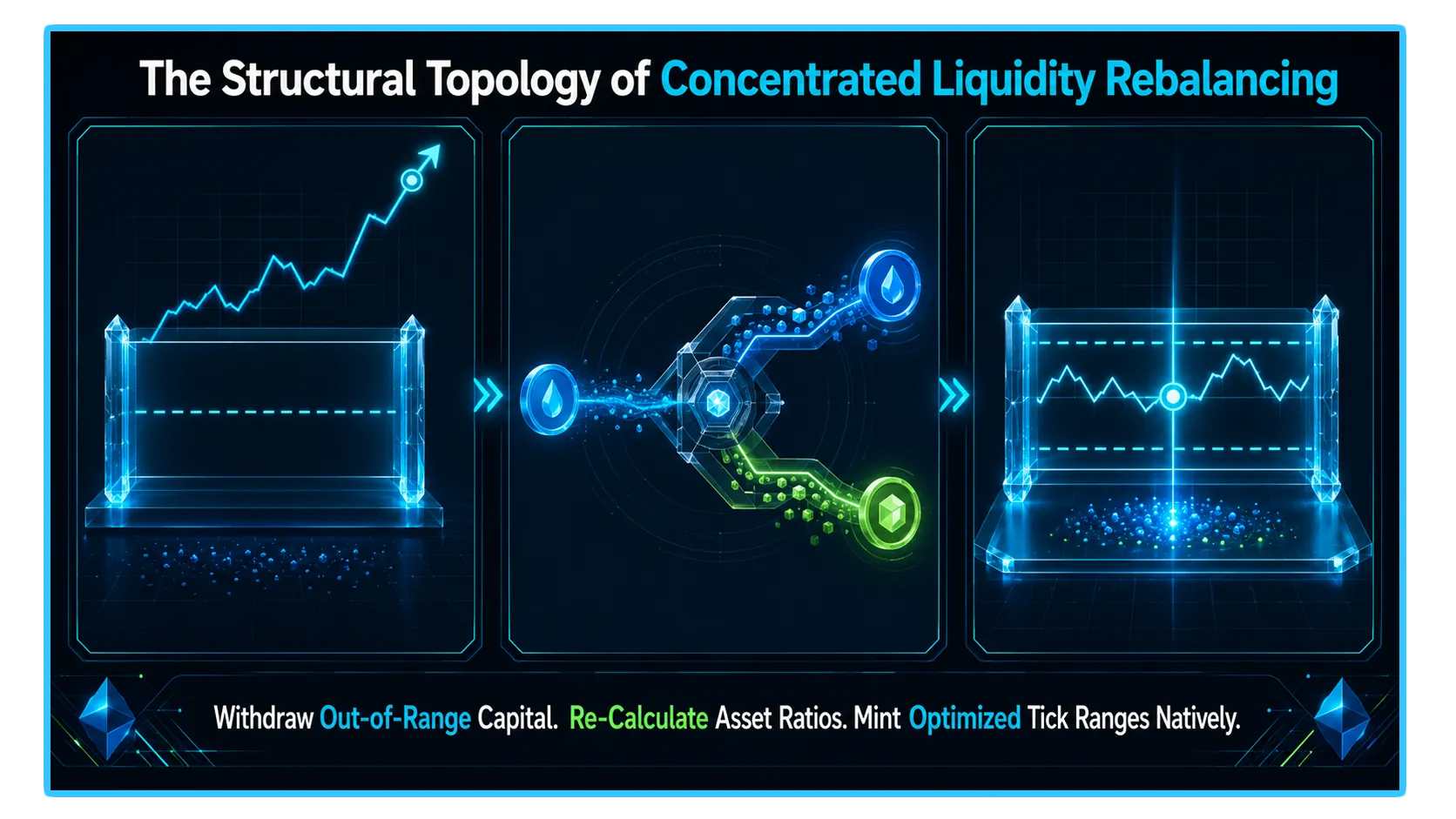
2. The Step-by-Step Rebalancing Playbook
Step 1: Complete Liquidity Removal and Fee Collection
Navigate to the liquidity manager dashboard of the host decentralized exchange (DEX) and isolate your out-of-range non-fungible token (NFT) position receipt.
Activate the Remove Liquidity module. Set the removal parameter allocation to 100%.
Directing this command prompts the smart contract core to execute two concurrent actions: it burns your liquidity position share tokens, withdrawing your full single-sided asset balance back to your private wallet address, and programmatically harvests all uncollected trading fees accumulated before the range breach.
Step 2: Mathematical Re-allocation (The Swap Split)
Because you are holding a 100% single-sided allocation of a single token type, attempting to re-enter a standard symmetric range around the current spot price requires a dual-asset pairing. You must execute a precise rebalancing trade to re-establish the necessary capitalization ratio.
The Single-Sided Pivot Option: If you maintain a high-conviction directional bias and believe the market will soon reverse and trade back into your original territory, you can skip the swap step entirely. You can deploy your tokens as a single-sided, out-of-range position just ahead of the active spot price, functioning essentially as an institutional on-chain limit order that earns fees the moment the market hits your zone.
If you choose to re-center symmetrically instead, navigate to the swap interface and swap an allocated portion of your holdings for the opposing pair token. To achieve a clean balance, calculate your target tick ranges first; asymmetric or narrow ranges will require an alternative asset ratio than a standard 50/50 split.
Step 3: Initializing and Deploying the Optimized Range Ticks
Return to the liquidity provisioning module and select the target token pair.
Select your designated Fee Tier (e.g., 0.05% for highly correlated stable pairings, or 0.30% / 1.00% for highly volatile long-tail primitives).
Set your new price boundary ticks:
Narrow Ranges: Maximizes your immediate fee-generation multiplier per dollar spent, but dramatically increases your sensitivity to impermanent loss and heightens the probability of going out-of-range again quickly.
Wide Ranges: Lowers your immediate fee velocity, but establishes a highly resilient safety net that keeps your capital active across prolonged market expansions.
Input your re-balanced token assets, authorize the standard protocol allowance approvals, and click Mint to initialize a new active liquidity position NFT.
- While rebalancing is a mandatory requirement to revive an idle position, executing this maneuver too frequently can lead to severe capital erosion known as churning risk. Every single time you manually rebalance an out-of-range position, you are executing a non-reversible action: you are crystallizing your impermanent loss.
- If an asset’s market price violently chops back and forth across your tick boundaries, manually removing your liquidity, swapping assets into a loss, and resetting wide ranges repeatedly will cause you to buy high and sell low at the contract level.
- Furthermore, you must cross-reference your structural repositioning overhead against network gas fees and swap slippage expenses. If the total organic trading fees you expect to collect within your new range parameters do not confidently outweigh the friction costs of the rebalancing swap, your net portfolio value will steadily degrade.
- Formulating an unassailable concentrated liquidity rebalancing strategy requires continuous access to look-through, live data analytics. While a DEX's native analytics page presents optimized historical APR figures, tracking the actual underlying real-time order book depth, rolling volume velocity, and net holder concentration changes on an independent data grid is the only method to confirm if a pool's trading activity justifies the cost of a manual rebalancing reposition.
- DEXTools provides the critical analytical data infrastructure needed to perform these diagnostic verifications in real-time. By utilizing advanced pair explorers, live pool tracking metrics, and comprehensive wallet flow diagnostics, market participants can independently verify the structural health of any trading pair.
- Before committing capital to a new tick range, you can use the DEXTools dashboard to analyze active volume concentration bands across alternative block intervals. Cross-referencing your automated range boundaries with authentic blockchain metrics ensures your portfolio safety metrics remain completely optimized, keeping your digital wealth securely protected from sudden pool de-pegs or liquidity contractions.
3. The Structural Matrix: Rebalancing Profiles
To maintain absolute scannability when calculating your portfolio realignment parameters, evaluate the operational profiles organized inside this structured data grid:
4. The Hidden Costs: The Churning Risk and Fee Dilution
5. Real-Time Telemetry and Pool Diagnostics via DEXTools
You can access DEXTools here and start trading today!
Concentrated Liquidity Fee Tiers and Tick Ranges Explained Impermanent Loss Explained: Examples and How to Reduce It Impermanent Loss in DeFi Liquidity Pools: Worked LP Math, Break-Even and Trade-Offs What Is Aerodrome Slipstream: Concentrated Liquidity on Base
Disclaimer: This article is for informational purposes only and does not constitute investment advice, financial advice, trading advice, or any other kind of advice. DEXTools does not recommend buying, selling, or holding any cryptocurrency or token. Users should conduct their own research and consult with a qualified financial advisor before making any investment decisions. Cryptocurrency investments are volatile and high-risk. DEXTools is not responsible for any losses incurred.