What Is Aerodrome Slipstream: Concentrated Liquidity on Base

Passive, wide-range automated market makers struggle to sustain competitive fee models. We deconstruct how Aerodrome Slipstream dominates Base order flow.
Aerodrome Slipstream: Precision Liquidity on Base
- The scaling architecture of Layer-2 networks has successfully minimized raw transaction fees, but it introduces a secondary challenge for decentralized asset deployment: liquidity fragmentation. In traditional automated market maker (AMM) configurations, capital is distributed uniformly across an infinite price curve. While this passive approach guarantees that a pool can handle trades at any price extreme, it means the vast majority of deposited capital sits idle, completely decoupled from active market demand.
- On Coinbase's native Layer-2 network, Base, this capital drag is answered by Aerodrome Slipstream. Evolving from legacy constant-product pooling models, Slipstream acts as the core execution engine dominating the network's decentralized trade volume.
- By seamlessly embedding Concentrated Liquidity primitives straight into a modified ve(3,3) governance flywheel, Aerodrome enables liquidity providers to deploy capital with surgical precision. This integration delivers ultra-low execution slippage for traders while maximizing yield generation for asset allocators.
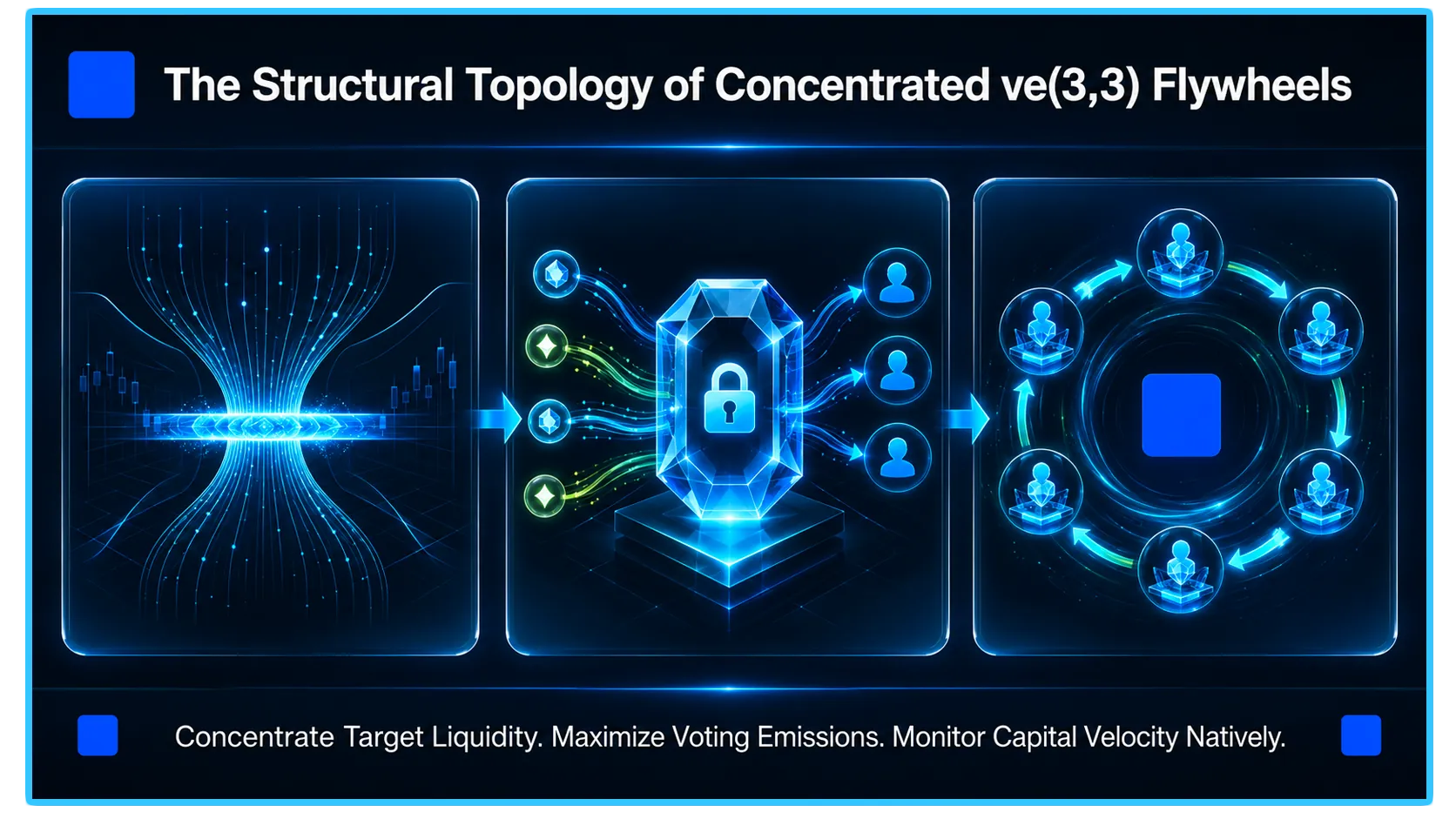
1. The Evolutionary Bridge: Concentrated ve(3,3) Mechanics
- To evaluate Aerodrome Slipstream with professional precision, you must examine how it alters the relationship between capital density and token incentives. In first-generation concentrated liquidity pools, users collected trading fees but operated entirely isolated from broader protocol governance rewards, forcing continuous manual fee-harvesting strategies.
- Slipstream re-engineers this dynamic by connecting concentrated liquidity straight to the ve(3,3) economic engine. Liquidity providers do not just rely on organic trading fees; they receive programmatic token emissions based on how governance voters route protocol incentives.
- Because voters are incentivized by the volume of bribes and trading fees a pool generates, capital concentrated exactly at the active spot price captures the highest velocity of votes. This creates a self-reinforcing loop where capital efficiency directly drives governance rewards.
2. Managing Price Bands: Ticks and Spacing Parameters
The operational optimization of a Slipstream pool relies on assigning capital to discrete price intervals known as Ticks. Instead of underwriting the entire price continuum, a depositor specifies a narrow boundary range where they believe the asset will actively trade.
To support alternative asset volatility profiles, Slipstream deploys customized Tick Spacing and fee tiers:
Stablecoin Configurations: For correlated assets requiring minimal price deviation, tight tick spacings enable extreme capital concentration, allowing millions in volume to clear with virtually zero price impact.
Volatile Market Parameters: For standard crypto pairings and long-tail primitives, wider tick intervals account for rapid price discovery, ensuring the pool remains continuously active without constant rebalancing.
3. The Component Grid: Mapping Slipstream Infrastructure
To maintain a clean structural mapping of how this modernized engine organizes its multi-layered liquidity framework, analyze the core architecture organized inside this standardized layout:
| Slipstream Core Feature | Operational Utility |
| Concentrated Liquidity | Binds capital to targeted tick ranges to maximize efficiency. |
| ve(3,3) Integration | Routes token emissions dynamically via voting incentives. |
| Dynamic Ticks | Optimizes fee tiers for stable and volatile token pairs. |
4. Maximizing Returns and Eliminating Capital Inefficiency
- For sophisticated asset managers on Aerodrome Slipstream, transitioning to Slipstream's concentrated model unlocks unparalleled capital efficiency, but it demands active position underwriting. When an asset's market value fluctuates entirely outside of a depositor's specified tick range, their position transitions to a passive state.
While out of range, the capital stops generating trading fees and ceases to accumulate active protocol rewards.
- To mitigate this exposure, professional market participants utilize automated liquidity managers or deploy automated rebalancing triggers. By dynamically shifting their active bands alongside shifting market demand, allocators ensure their treasury deployment continuously captures the highest yield-per-dollar ratio available on the ledger, safely outperforming legacy passive pools.
5. Real-Time Telemetry and Market Diagnostics via DEXTools
- Executing high-performance concentrated liquidity strategies within the fast-moving Base ecosystem requires access to look-through, live data analytics. While internal exchange interfaces present optimized historical APR figures and aggregate total value locked metrics, tracking the actual underlying order book depth, real-time transaction velocity, and live token pool distributions on an independent data grid is the only method to confirm genuine pool health before locking up capital blocks.
- DEXTools provides the critical analytical data infrastructure needed to perform these multi-chain verifications in real-time. By utilizing advanced pair explorers, live pool trackers, and comprehensive wallet telemetry across alternative layer ecosystems, market participants can independently verify if a token's open-market activity matches its internal protocol parameters.
- Cross-referencing your automated hook and tick setups with authentic blockchain telemetry ensures your portfolio parameters remain completely optimized, keeping your digital wealth securely insulated from sudden market anomalies.
Disclaimer: This article is for informational purposes only and does not constitute investment advice, financial advice, trading advice, or any other kind of advice. DEXTools does not recommend buying, selling, or holding any cryptocurrency or token. Users should conduct their own research and consult with a qualified financial advisor before making any investment decisions. Cryptocurrency investments are volatile and high-risk. DEXTools is not responsible for any losses incurred.