How to Review a Token Without Looking at Price First
— By Whatsertrade in Tutorials
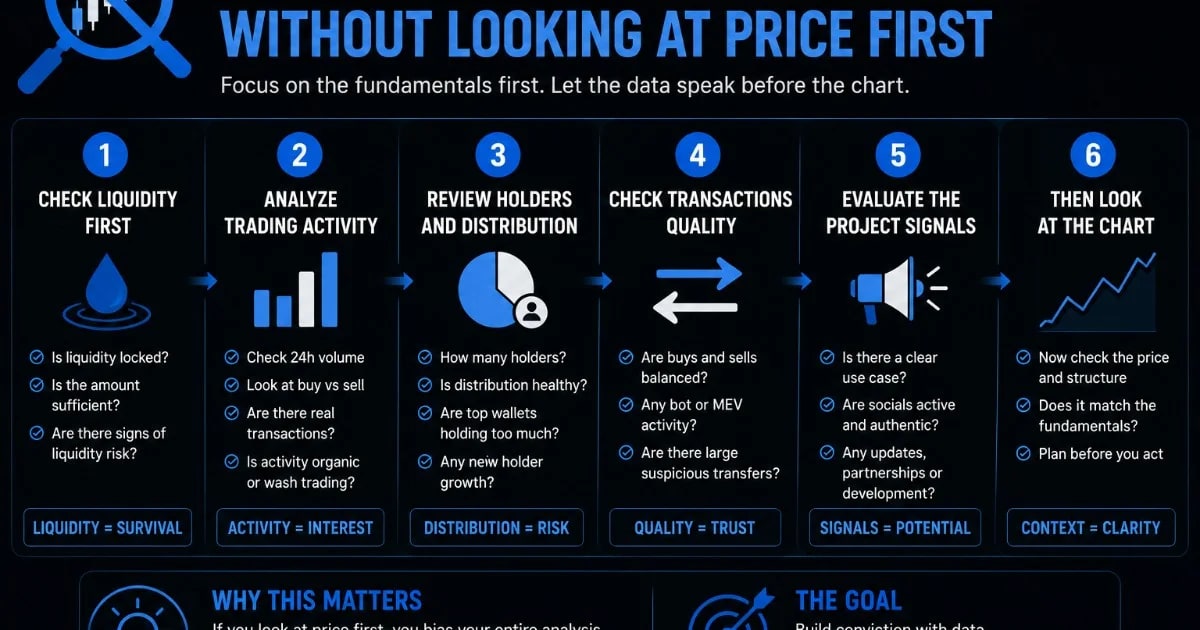
Learn how to analyze a crypto token using DEXTools without looking at price first, so you can reduce bias and make better trading decisions.
Most traders look at price first. If the chart is green, they become interested. If the chart is red, they lose interest. This creates bias before the research even begins.
Key Takeaways
- Why Price Creates Bias
- Step 1: Start With Liquidity
- Step 2: Review Volume Quality
- Step 3: Study Transactions
- Step 4: Review Holders and Wallets
- Step 5: Check Risk Signals
Price is important, but it should not always be the first thing you review.
Analyzing a token without looking at price first can help you make more objective decisions. It forces you to understand liquidity, activity, holders, risk, and market context before the chart influences your emotions.
DEXTools gives traders the data needed to do this.
Why Price Creates Bias
Price is powerful because it creates emotion.
A rising chart can create FOMO. A falling chart can create fear. A flat chart can create boredom. Once emotion enters the process, traders may ignore important data.
If you see a token up 300 percent, you may search for reasons to buy. If you see it down 30 percent, you may ignore a setup that is quietly improving.
Reviewing other data first helps reduce this bias.
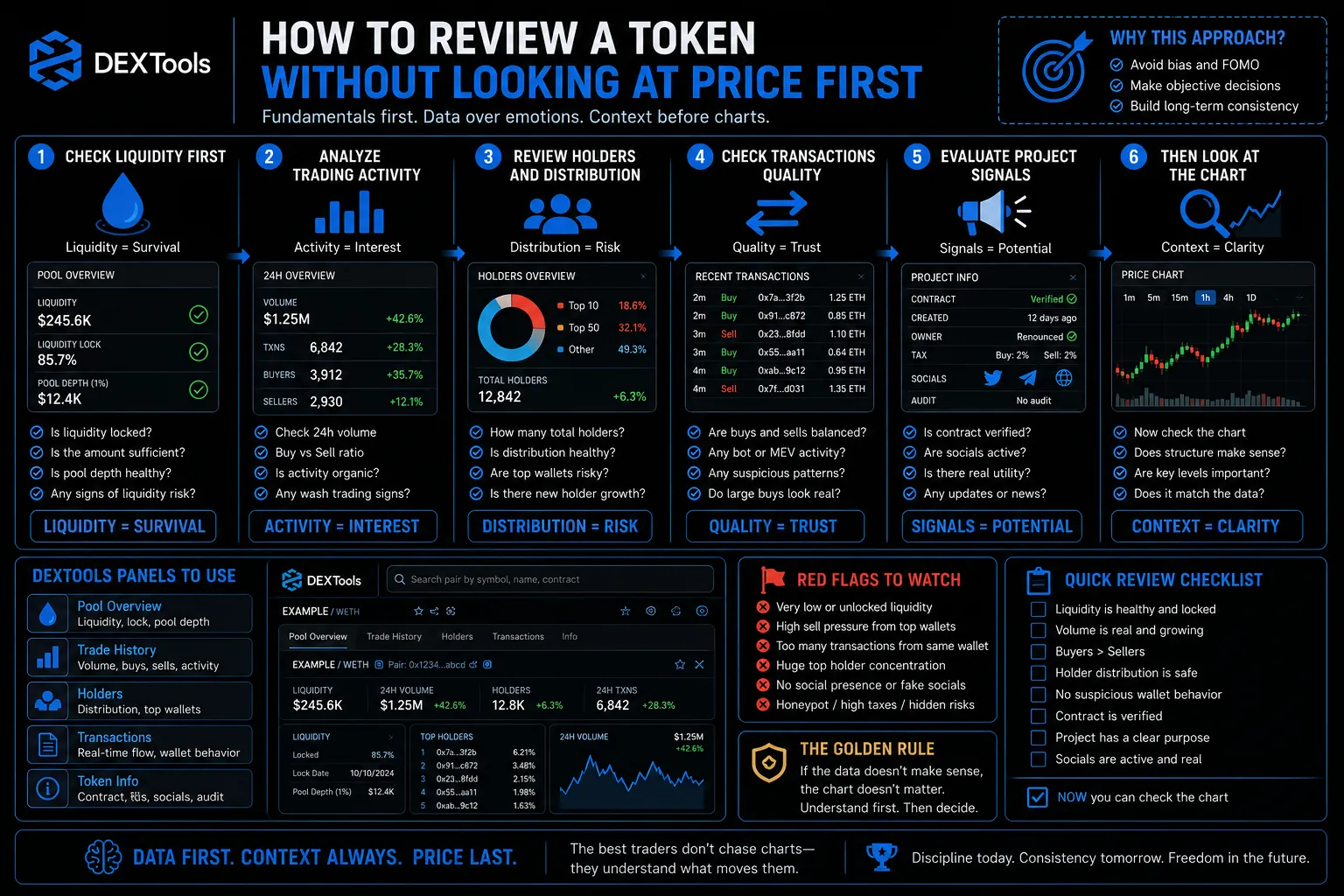
Step 1: Start With Liquidity
Before checking price, review liquidity.
Ask:
Is liquidity deep enough?
Is it stable?
Has it increased or decreased?
Does it support the current trading environment?
Liquidity tells you whether the token can support real market activity. This is more important than the last candle.
Step 2: Review Volume Quality
Next, check volume.
Do not ask only whether volume is high. Ask whether it is useful.
Is volume consistent?
Is it increasing gradually?
Is it supported by transactions?
Does it look like real participation?
Volume gives you a sense of interest before price affects your opinion.
Step 3: Study Transactions
Transactions reveal behavior.
Look for:
Buyer diversity.
Sell pressure.
Large wallet activity.
Repeated patterns.
Trade size quality.
If transactions look weak, a green chart may not matter. If transactions look healthy, a quiet chart may deserve attention.
Step 4: Review Holders and Wallets
Holder data can help you understand participation and distribution.
Ask:
Are holders growing?
Are top holders too concentrated?
Are large wallets accumulating or selling?
Is holder growth meaningful?
This helps you see whether the token has a healthy ownership profile before looking at price.
Step 5: Check Risk Signals
Review contract and risk related information before price.
A strong chart does not remove structural risk. If risk signals are concerning, price excitement should not override caution.
Risk review should always happen before emotional commitment.
Step 6: Now Look at Price
After reviewing the data, open the chart with a clearer mind.
Now ask:
Does the chart confirm what the data suggested?
Is price early, extended, or weakening?
Is the market structure healthy?
Is there a reasonable entry, or has the move already happened?
Because you reviewed other data first, the chart becomes one part of the decision instead of the emotional center.
The No-Price-First Rule
Try this rule:
“Before looking at price, I must understand liquidity, volume, transactions, holders, and risk.”
This simple habit can improve research discipline.
Final Thoughts
Price is important, but it can distort judgment when viewed first. By reviewing a token without looking at price first, traders can reduce bias and make more objective decisions.
DEXTools makes this possible by giving access to liquidity, volume, transactions, holders, and risk data.
The chart should confirm your research. It should not control it.
DEXTools Red Team Method: Try to Disprove a Token Before You Buy It Post-Trade Review Using DEXTools: How to Learn From Failed Crypto Trades Median Trade Size vs Trade Count: Why Small Swaps Can Inflate DEX Activity Fake Holders vs Real Buyers: How Wallet Count Can Mislead Traders