The DEXTools Red Team Method: Try to Disprove a Token Before You Buy It
— By Whatsertrade in Tutorials
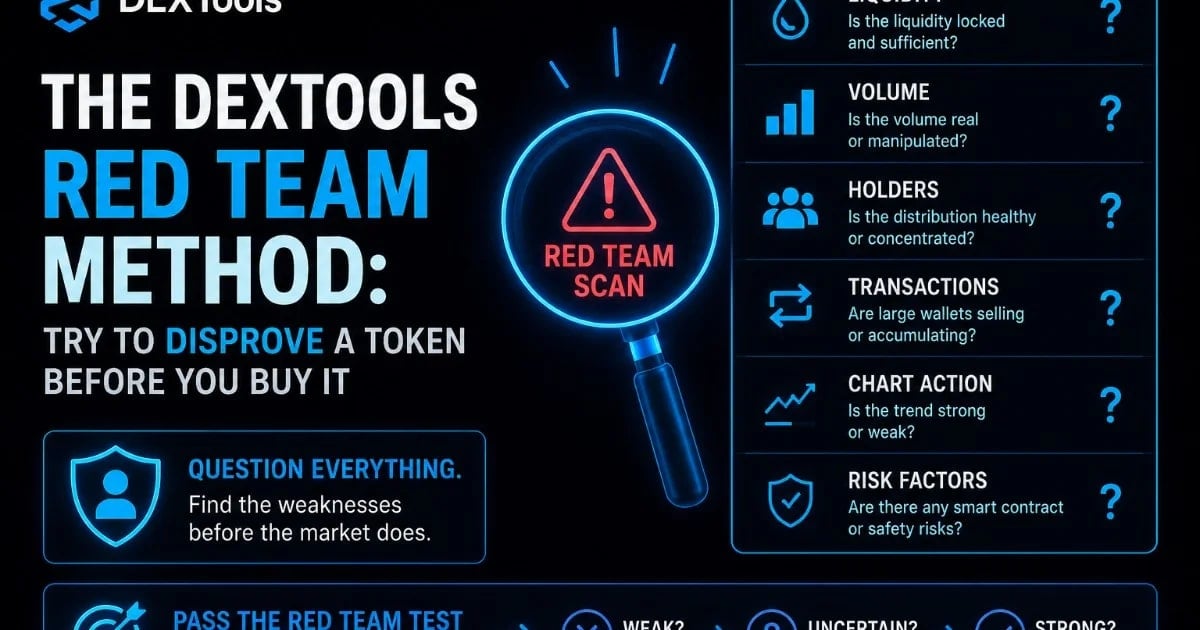
Use the DEXTools Red Team Method to challenge your crypto trade idea before entering. Learn how to test liquidity, volume, holders, and risk signals.
Most traders search for reasons to buy. They look for green candles, rising volume, growing holders, strong community posts, and exciting narratives. This can create confirmation bias. Once a trader wants a token to be good, every metric starts to look positive.
The DEXTools Red Team Method flips the process.
Key Takeaways
- What Is the Red Team Method?
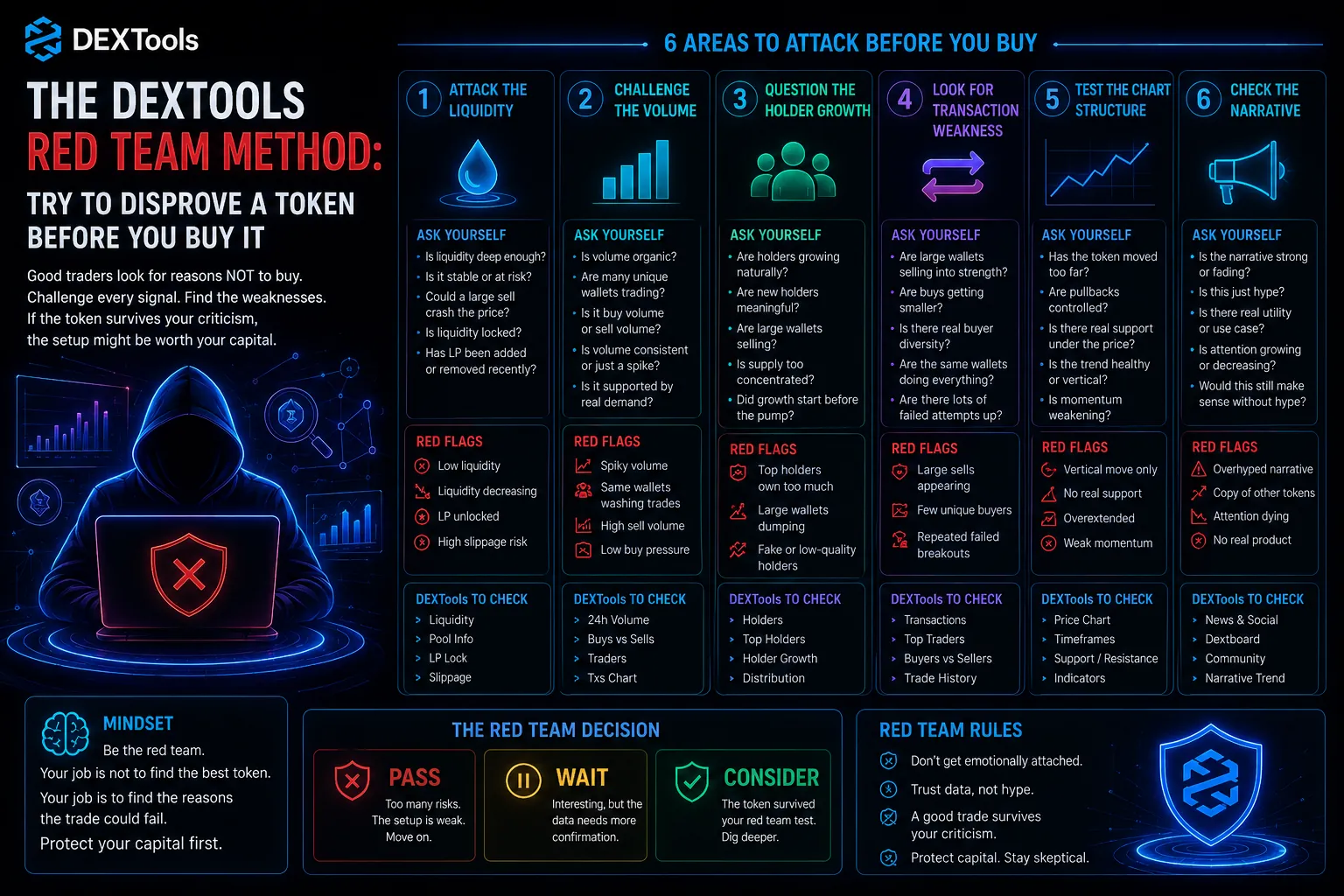
- Step 1: Attack the Liquidity
- Step 2: Challenge the Volume
- Step 3: Question the Holder Growth
- Step 4: Look for Transaction Weakness
- Step 5: Test the Chart Structure
Instead of trying to prove that a token is a good trade, you try to disprove it first. Your goal is to find what could be wrong before you risk capital. If the token survives your own criticism, the setup may be stronger.
This method helps traders become more disciplined, less emotional, and more data-driven.
What Is the Red Team Method?
In security, a red team tries to find weaknesses before attackers do. In trading, a red team mindset means testing your own idea before the market tests it for you.
You are not looking for perfection. No token is perfect. You are looking for hidden weaknesses that could damage the trade.
Before buying, ask:
What would make this setup fail?
What am I ignoring because I want the trade to work?
What does the data say against my idea?
What would a cautious trader notice here?
DEXTools gives you the data to perform this test.
Step 1: Attack the Liquidity
Start with liquidity because liquidity controls entry and exit quality.
Ask yourself:
Is liquidity deep enough for this market cap?
Is liquidity stable?
Is liquidity too small compared to volume?
Could one large sell move the price heavily?
Is liquidity locked or at risk of being removed?
If the liquidity is weak, the trade may depend on perfect timing. That is not a strong foundation.
A good red team question is: “Would I still like this trade if I had to exit quickly?”
Step 2: Challenge the Volume
High volume can attract traders, but the red team method asks whether the volume is meaningful.
Look for quality, not only quantity.
Ask:
Is volume consistent or only spiking?
Are many wallets trading, or only a few?
Is volume supported by holder growth?
Is buying pressure stronger than selling pressure?
Does the chart hold gains after volume spikes?
If the token needs constant volume to avoid falling, it may be more fragile than it looks.
Step 3: Question the Holder Growth
Rising holders can be bullish, but it can also be misleading.
Ask:
Are holders growing naturally?
Are new holders buying meaningful amounts?
Are large wallets selling while smaller wallets enter?
Is supply concentrated in a few wallets?
Did holder growth begin before public attention, or only after the pump?
Healthy holder growth should support the market structure. Weak holder growth may only reflect late retail attention.
Step 4: Look for Transaction Weakness
The transaction feed can reveal what the chart hides.
Ask:
Are large wallets selling into strength?
Are buys becoming smaller over time?
Are sells becoming more frequent?
Are the same wallets creating most of the activity?
Is there real buyer diversity?
A token can look strong on the chart while weakening in the transaction data. The red team method helps you catch that early.
Step 5: Test the Chart Structure
A strong chart should not only go up. It should show structure.
Ask:
Has the token already moved too far?
Are pullbacks controlled?
Are buyers defending support areas?
Is the move vertical and emotional?
Is the chart forming higher lows, or is it losing momentum?
If the chart only looks attractive because of one large candle, be careful. One candle is not a strategy.
Step 6: Check the Narrative
Narratives can create powerful moves, but they can also hide weak data.
Ask:
Is this token truly part of a strong narrative?
Is the market already crowded with similar tokens?
Is attention growing or fading?
Is social hype stronger than on-chain behavior?
Would the trade still make sense without the narrative?
A narrative can support a trade, but it should not be the only reason to enter.
The Red Team Decision
After reviewing the token, give it one of three labels:
Pass: The risks are too strong.
Wait: The idea is interesting, but the data needs confirmation.
Consider: The token survived the red team test and deserves further research.
This creates discipline. You do not need to buy every interesting token. You need to identify the few that still look strong after serious criticism.
Final Thoughts
The DEXTools Red Team Method helps traders avoid emotional entries. By trying to disprove a token before buying, you protect yourself from confirmation bias and weak setups.
A token that only looks good when you ignore the risks is not strong. A token that still looks good after you challenge liquidity, volume, holders, transactions, chart structure, and narrative may be worth deeper analysis.
In crypto trading, the best question is not always “Why should I buy?”
Sometimes the better question is “Why should I not buy?”
Locked Liquidity Is Not Enough: What Traders Still Need to Check Fake Market Cap vs Real Exit Liquidity: Why the Number Can Mislead Traders The Market Cap Mirage: Why Token Valuation Means Little Without Depth Exit Liquidity Signals: Spot Late Entry Risks Fake Market Cap vs Real Exit Liquidity: Why the Number Can Mislead Traders Exit Liquidity Signals: Spot Late Entry Risks Locked Liquidity Is Not Enough: What Traders Still Need to Check Buyers vs Sellers Ratio: Why More Buyers Does Not Always Mean Strength