Krypto-Optionen handeln: Einsteiger-Guide (2026)
— By Whatsertrade in Tutorials

Krypto-Optionen fur Anfanger 2026. Calls, Puts, Strategien.
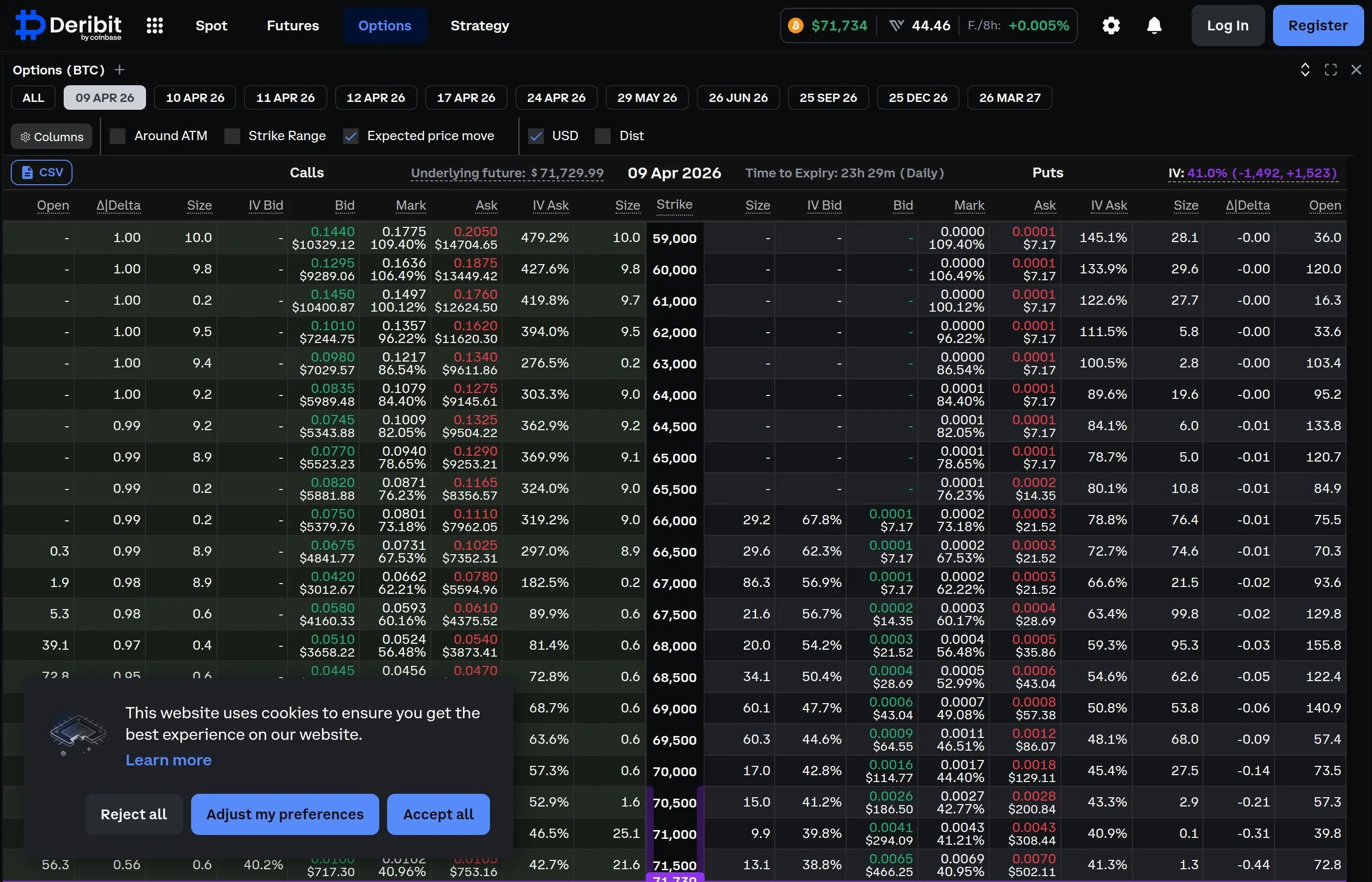
Crypto options are one of the most powerful yet misunderstood tools available to traders in 2026. Unlike buying spot crypto or trading perpetual futures on Hyperliquid, options give you the ability to control risk, define your maximum loss, and profit from volatility in any market direction. Whether you want to hedge an existing portfolio, generate income, or speculate with limited downside, options can do what no other instrument can.
This guide breaks down everything you need to know as a beginner - from what a call and put actually are, to placing your first trade on Deribit, to building multi-leg strategies. No fluff, no jargon soup. Just practical knowledge you can use today.
Table of Contents
- What Are Crypto Options?
- Calls and Puts Explained Simply
- How Options Differ from Futures and Perpetuals
- Key Terms Every Options Trader Must Know
- The Greeks - Basics for Beginners
- Where to Trade Crypto Options
- Buying Calls - Step by Step
- Buying Puts - Step by Step
- Basic Options Strategies
- Options Pricing Factors
- Risk Management for Options
- When to Use Options vs Spot or Futures
- Options Platform Comparison Table
- Common Mistakes Beginners Make
- Pros and Cons of Crypto Options
- Frequently Asked Questions
- Related Tutorials
1. What Are Crypto Options?
A crypto option is a financial contract that gives the buyer the right, but not the obligation, to buy or sell a cryptocurrency at a specific price (called the strike price) before or on a specific date (the expiry). The buyer pays a fee called the premium for this right.
Think of it like paying for insurance on your house. You pay a small premium every year for the right to claim a large payout if something goes wrong. If nothing happens, you just lose the premium you paid. Options work the same way - you pay a small amount upfront, and your maximum loss is capped at that amount. But your potential upside can be enormous.
There are two basic types of options:
- Call Option - Gives the buyer the right to BUY the asset at the strike price. You buy calls when you think the price will go up.
- Put Option - Gives the buyer the right to SELL the asset at the strike price. You buy puts when you think the price will go down.
Crypto options are available on assets like Bitcoin (BTC) and Ethereum (ETH), with Deribit being the dominant exchange handling over 85% of all crypto options volume in 2026. Other platforms like Bybit and OKX also offer options alongside their spot and futures markets.
Unlike trading spot crypto, where you need the full capital to buy a coin, or day trading futures where you face liquidation risk, options let you define your risk upfront. When you buy an option, the maximum you can lose is the premium you paid. Period. No liquidations, no margin calls, no surprise losses at 3 AM.
2. Calls and Puts Explained Simply
Call Options - Betting on Upside
Imagine Bitcoin is trading at $95,000. You believe it will reach $110,000 within the next month, but you do not want to risk $95,000 buying a full Bitcoin. Instead, you buy a BTC call option with a strike price of $100,000 that expires in 30 days. The premium costs you $2,500.
Here is what happens in different scenarios:
Scenario A: BTC rises to $115,000
Your call gives you the right to buy at $100,000. The option is worth at least $15,000 in intrinsic value. You paid $2,500, so your profit is $12,500. That is a 500% return on your premium.
Scenario B: BTC stays at $95,000
Your call to buy at $100,000 is worthless because the market price is below your strike. You lose the $2,500 premium. Nothing more.
Scenario C: BTC drops to $70,000
Same outcome as Scenario B - you lose the $2,500 premium. Even though BTC crashed 26%, your loss is still only $2,500, not $25,000 like it would be if you held spot.
Put Options - Profiting from Downside
Now imagine you hold 1 ETH worth $3,800 and you are worried about a crash. You buy an ETH put option with a strike price of $3,600, expiring in 14 days. The premium costs you $150.
If ETH drops to $3,000: Your put gives you the right to sell at $3,600. The option is worth at least $600 in intrinsic value. Minus the $150 premium, you net $450. This offsets most of the $800 loss on your spot ETH position.
If ETH stays at $3,800 or rises: Your put expires worthless. You lose the $150 premium. Think of it as the cost of insurance you did not end up needing.
The key insight is that buying options gives you asymmetric risk - small fixed downside with large potential upside. This is why professional traders and institutions use options as a core part of their portfolio risk management strategy.
3. How Options Differ from Futures and Perpetuals
Many beginners confuse options with futures and perpetual swaps. While all three are derivatives (their value derives from an underlying asset), they work very differently. If you have traded perpetuals on platforms like dYdX or Hyperliquid, understanding the differences is critical before you start trading options.
The biggest advantage of options over perpetuals is the no-liquidation guarantee for buyers. When you buy a call or put, you cannot be liquidated. Your maximum loss is the premium you paid upfront. Compare that with leveraged perpetual positions on Bybit where a sudden price spike can wipe out your entire margin in seconds.
The tradeoff is that options have a time limit. They expire, and if the market has not moved in your favor by then, your option loses value every day through a process called time decay (theta). Perpetual futures have no expiry, which is why many day traders still prefer them for short-term directional bets.
4. Key Terms Every Options Trader Must Know
Before you place a single trade, you need to understand the following terms. These are the building blocks of every options conversation, order ticket, and strategy.
Strike Price
The price at which the option buyer can buy (call) or sell (put) the underlying asset. For example, a BTC $100,000 call means you have the right to buy BTC at $100,000, regardless of the current market price. Strike prices are set by the exchange and typically come in fixed increments ($1,000 for BTC, $50 or $100 for ETH).

Expiry (Expiration Date)
The date and time when the option contract ends. After this point, the option ceases to exist. Crypto options on Deribit typically expire at 08:00 UTC. Common expiry cycles include daily, weekly, monthly, and quarterly options. Shorter expiries are cheaper but give you less time for your trade to work.
Premium
The price you pay to buy an option. This is your total cost and maximum risk as a buyer. Premiums are usually quoted in the underlying asset (e.g., 0.03 BTC for a Bitcoin option) or in USD equivalent. The premium is determined by the market through supply and demand, influenced by the factors we discuss in the pricing section below.
Intrinsic Value
The real, tangible value of an option based on the current price vs the strike price. A BTC $90,000 call when BTC is at $95,000 has $5,000 of intrinsic value. An option with intrinsic value is said to be "in the money."
Extrinsic Value (Time Value)
The portion of the premium that exceeds the intrinsic value. It represents the possibility that the option could become more valuable before expiry. An option with 30 days until expiry will have more extrinsic value than the same option with 2 days left, because there is more time for a favorable price move.
ITM, ATM, and OTM
In the Money (ITM): The option has intrinsic value. For calls, this means the current price is above the strike. For puts, the current price is below the strike. ITM options are more expensive but have a higher probability of profit.
At the Money (ATM): The strike price is equal to (or very close to) the current market price. ATM options have the most time value and are the most sensitive to price changes.
Out of the Money (OTM): The option has no intrinsic value. For calls, the current price is below the strike. For puts, the current price is above the strike. OTM options are cheap but have a lower probability of profit - most expire worthless.
European vs American Style
European-style options (used by Deribit and most crypto exchanges) can only be exercised at expiry. American-style options can be exercised at any time before expiry. In practice, this distinction matters less than you might think because you can always sell your option before expiry on the open market to capture its current value.
Settlement
Crypto options are almost always cash-settled, meaning no actual Bitcoin changes hands at exercise. Instead, the difference between the strike price and the settlement price is paid out in cash (usually USDC or the underlying crypto). Deribit settles in BTC/ETH, while some platforms settle in stablecoins.
5. The Greeks - Basics for Beginners
The "Greeks" are mathematical measures that describe how an option's price changes in response to different factors. As a beginner, you do not need to master the math behind them, but you do need to understand what each one tells you. Use TradingView and Deribit's built-in analytics to monitor these in real time.
Delta
Measures how much the option price changes for every $1 move in the underlying asset. A call with a delta of 0.50 will gain approximately $0.50 in value for every $1 increase in the underlying. Delta ranges from 0 to 1 for calls and 0 to -1 for puts. ATM options have a delta near 0.50 (calls) or -0.50 (puts). Delta also roughly approximates the probability that the option will expire in the money.
Theta (Time Decay)
Measures how much value the option loses each day due to time passing. If an option has a theta of -$50, it loses $50 in value every day, all else being equal. Theta accelerates as expiry approaches - an option loses value much faster in its final week than in its first week. This is the enemy of option buyers and the friend of option sellers.
Vega
Measures how much the option price changes when implied volatility changes by 1%. High vega means the option is very sensitive to changes in market volatility. When big events are coming (ETF decisions, protocol upgrades, elections), implied volatility rises and options become more expensive. After the event passes, volatility often drops sharply ("vol crush"), and option prices fall even if the underlying price does not change much.
Gamma
Measures how fast delta changes. High gamma means delta shifts quickly with small price moves. ATM options near expiry have the highest gamma, which is why their prices can swing wildly in the final hours before settlement. As a beginner, just know that gamma risk increases as expiry approaches.
Beginner Tip: Focus on delta and theta first. Delta tells you your directional exposure, and theta tells you how much you are paying in time decay each day. Once you are comfortable with these two, add vega to your analysis, especially around major market events.
6. Where to Trade Crypto Options
The crypto options landscape in 2026 includes both centralized exchanges (CEXs) and decentralized protocols (DEXs). Each has different strengths, and the right choice depends on your experience level, location, and preferences. Store any profits you are not actively trading in a cold wallet for security.
Deribit (CEX) - The Industry Standard
Deribit dominates crypto options with over 85% market share. It offers the deepest liquidity, tightest spreads, and widest range of strike prices and expiries for BTC and ETH options. The interface is professional-grade with a full options chain, portfolio margin, and advanced order types. Deribit is the go-to platform for serious options traders, market makers, and institutions. Settlement is in BTC or ETH. Not available to US residents.
Bybit Options (CEX)
Bybit has expanded aggressively into options trading and now offers USDC-settled BTC and ETH options with competitive liquidity. If you already use Bybit for perpetual trading, adding options to your strategy is seamless since you can use the same account and margin. The interface is more beginner-friendly than Deribit, with a simplified options chain and built-in strategy builder.
OKX Options (CEX)
OKX offers BTC and ETH options with USDC settlement and a clean trading interface. Liquidity is decent but generally lower than Deribit. OKX stands out for its portfolio margin system, which lets you offset options positions against futures and spot for better capital efficiency. Good for traders who want everything on one platform.
Hegic (DEX - On-Chain)
Hegic is a decentralized options protocol on Arbitrum that lets you buy calls and puts directly from a liquidity pool. No order book, no counterparty risk from a centralized exchange. The tradeoff is higher premiums (due to less efficient pricing) and limited strike/expiry combinations. Good for DeFi-native users who want to trade options without trusting a CEX.
Lyra (DEX - On-Chain)
Lyra (now part of the Derive ecosystem) is a decentralized options AMM running on Optimism and Arbitrum. It uses a sophisticated pricing model based on real-time implied volatility and offers a more traditional options experience than most DeFi protocols. Lyra is a solid choice for traders who want decentralized options with relatively tight spreads.
Other Notable Platforms
Binance offers basic options (simplified calls/puts with set expiries), but they function more like structured products than true options. Aevo is a decentralized options exchange with an order book model. Opyn uses a permissionless options protocol, and Dopex focuses on options vaults for passive yield strategies.
7. Buying Calls - Step by Step
This walkthrough uses Deribit, but the process is similar on Bybit and OKX. Before you start, make sure you have funded your account and understand the terms from Section 4.
Step 1: Choose Your Underlying Asset
Navigate to the options section and select BTC or ETH. Most beginners start with BTC options because liquidity is deepest.
Step 2: Select an Expiry Date
Choose how long you want your trade to last. As a beginner, stick to 14-30 day expiries. This gives you enough time for the trade to work without paying excessive time decay. Avoid very short expiries (1-3 days) until you are more experienced, as theta eats through those premiums fast.
Step 3: Choose Your Strike Price
For a bullish call, consider these approaches:
- ATM Strike: Strike near the current price. Higher premium but higher probability of profit. Good for moderate bullish views.
- Slightly OTM Strike: Strike 5-10% above current price. Lower premium, lower probability, but better risk-reward if you expect a strong move.
- Deep OTM Strike: Strike 20%+ above current price. Very cheap premium but very unlikely to profit. Avoid as a beginner - these are essentially lottery tickets.
Step 4: Review the Option Details
Before placing your order, check: the premium (your maximum loss), the delta (your directional exposure), the implied volatility (is it high or low compared to recent history?), and the break-even price (strike + premium for calls). Use TradingView charts to confirm your technical analysis supports the trade.
Step 5: Place Your Order
Select "Buy" and "Call." Enter the quantity (number of contracts - on Deribit, 1 BTC option = 1 BTC notional). You can use a limit order at your desired premium or a market order for instant execution. Limit orders are recommended to avoid slippage, especially on less liquid strikes.
Step 6: Manage the Trade
After entry, set mental or actual exit targets. A common approach: close the trade if you reach 50-100% profit on the premium, or if the trade goes against you and the option loses 50% of its value. Do not hold losing options to expiry out of hope - time decay will grind the remaining value to zero.
8. Buying Puts - Step by Step
Buying puts is the mirror image of buying calls. You profit when the underlying asset falls in price. Puts are used for two main purposes: speculation (betting on a price drop) and hedging (protecting an existing long position).
Step 1: Identify Your Reason
Are you buying puts to profit from an expected decline, or to hedge a spot/futures position? This determines your strike selection and sizing. For hedging, you want the put strike near your entry price on the long position. For speculation, you can choose based on your price target.
Step 2: Select Expiry and Strike
For bearish puts:
- ATM Put: Strike near current price. Highest premium but highest delta exposure to downside moves. Best for short-term bearish trades.
- Slightly OTM Put: Strike 5-10% below current price. Acts like crash insurance. Cheaper premium, profits only if there is a significant drop.
- Deep OTM Put: Strike 20-30% below current price. Very cheap "black swan" protection. Low probability of payout but can return 10x-50x in a major crash.
Step 3: Calculate Your Break-Even
For puts, the break-even at expiry = Strike Price - Premium Paid. If you buy a $90,000 BTC put for $1,500, your break-even is $88,500. BTC needs to drop below $88,500 for you to profit at expiry. However, you can still profit before expiry if implied volatility rises or the price moves toward your strike, even if it does not reach the break-even price.
Step 4: Place and Manage
Select "Buy" and "Put." Same order process as calls. For hedging puts, the general rule is to allocate 2-5% of your portfolio value to protective puts. Treat it as an insurance cost. For speculative puts, apply the same management rules as calls - take profits at your target and cut losses early rather than watching theta destroy your position.
Combining put protection with a solid DCA strategy is one of the most effective ways to build long-term crypto wealth while protecting against catastrophic drawdowns. Buy your spot positions over time with DCA, and protect them with periodic put purchases during periods of elevated risk.
9. Basic Options Strategies
Once you understand buying calls and puts, you can combine them into strategies that give you more precise control over your risk and reward profile. Here are the four most important beginner strategies.
Covered Call
Setup: Own the underlying asset (e.g., 1 BTC) + sell a call option against it.
When to use: You hold crypto long-term and want to generate extra income. You are willing to sell at a higher price if the market rallies.
Example: You hold 1 BTC at $95,000. You sell a $105,000 call expiring in 30 days and collect $1,200 in premium. If BTC stays below $105,000 at expiry, you keep the premium as income. If BTC rises above $105,000, your BTC gets "called away" at $105,000, but you keep the premium too - so your effective sell price is $106,200. The risk is that BTC rockets to $130,000 and you miss the upside above $106,200.
Max profit: Premium + (Strike - Current Price). Max loss: Same as holding the underlying (the premium provides a small buffer).
Protective Put (Married Put)
Setup: Own the underlying asset + buy a put option as insurance.
When to use: You want to hold your crypto position but protect against a major crash. This is pure portfolio insurance.
Example: You hold 1 ETH at $3,800 and buy a $3,500 put for $120. If ETH crashes to $2,500, your put is worth at least $1,000. Your total loss on the combined position is capped at $420 ($300 from spot down to strike + $120 premium), versus a $1,300 loss without the put. If ETH rises, you lose only the $120 premium cost.
Max profit: Unlimited (you still hold the asset). Max loss: (Current Price - Strike) + Premium.
Long Straddle
Setup: Buy a call AND a put at the same strike price and expiry.
When to use: You expect a big price move but do not know the direction. Perfect before major events like ETF decisions, protocol upgrades, Fed meetings, or earnings reports from crypto-adjacent companies.
Example: BTC is at $95,000. You buy a $95,000 call for $3,000 and a $95,000 put for $2,800. Total cost: $5,800. You profit if BTC moves more than $5,800 in either direction before expiry - above $100,800 or below $89,200. If BTC barely moves, both options lose value due to theta and vol crush, and you lose part or all of the $5,800.
Max profit: Unlimited in either direction. Max loss: Total premium paid (both options).
Long Strangle
Setup: Buy an OTM call AND an OTM put (different strike prices, same expiry).
When to use: Same logic as a straddle (betting on a big move in either direction), but cheaper because both options are out of the money. The tradeoff is that the market needs to move further before you profit.
Example: BTC at $95,000. You buy a $100,000 call for $1,500 and a $90,000 put for $1,200. Total cost: $2,700. You need BTC above $102,700 or below $87,300 to profit at expiry. Cheaper entry than a straddle, but wider break-even range.
Max profit: Unlimited. Max loss: Total premium paid.
Strategy Selection Tip: If you are bullish, buy calls. If bearish, buy puts. If you expect a big move but are unsure of direction, use a straddle or strangle. If you want income from existing holdings, sell covered calls. If you want crash protection, buy protective puts. Start with single-leg strategies (just buying calls or puts) before moving to multi-leg strategies.
10. Options Pricing Factors
Understanding what drives option prices helps you avoid overpaying and identify good opportunities. Six factors determine the premium of any option:
1. Underlying Price vs Strike Price (Intrinsic Value)
The most straightforward factor. The further an option is in the money, the more expensive it is. A BTC $80,000 call when BTC is at $95,000 has $15,000 of intrinsic value built into its price.
2. Time to Expiry
More time = higher premium. A 60-day option costs more than a 7-day option at the same strike because there is more time for the market to move in your favor. Time value decays non-linearly - it accelerates as expiry approaches, with the steepest decay in the final 7 days.
3. Implied Volatility (IV)
The most important factor for options traders to understand. IV reflects the market's expectation of future price swings. High IV means the market expects big moves, which makes all options more expensive. Low IV means calm markets, making options cheaper. Crypto IV tends to spike before major events and collapse afterward ("vol crush"). Checking IV levels on TradingView or Deribit before entering a trade is essential.
4. Interest Rates
In traditional markets, interest rates have a meaningful effect on option pricing. In crypto, the impact is minimal because there are no standardized risk-free rates. Some models use DeFi lending rates as a proxy, but the effect on your trades is negligible compared to the other factors.
5. Supply and Demand
Like any market, option prices are ultimately determined by buyers and sellers. Large institutional hedging flows can push premiums higher even when the theoretical model price is lower. Pay attention to open interest (the number of outstanding contracts) at different strikes - high open interest often means those strikes will act as magnets or barriers for the underlying price.
6. Dividends / Protocol Events
While crypto does not pay dividends, protocol events like hard forks, airdrops, or token burns can affect option pricing similar to how dividends affect stock options. Staking yield on ETH can also influence put-call parity and affect ETH option pricing.
Practical Takeaway: Before buying any option, always check: (1) Is implied volatility high or low compared to the last 30 days? If IV is elevated, options are expensive and you are paying a "fear premium." (2) How many days until expiry, and how much theta will you lose per day? (3) Does the premium feel reasonable relative to your profit target? If you need a 30% move to break even on a 7-day option, the odds are probably against you.
11. Risk Management for Options
One of the best features of buying options is that your maximum loss is always the premium you paid. There is no liquidation, no margin call, and no scenario where you owe more than your initial investment. This built-in risk cap makes options inherently safer than leveraged futures for directional bets. That said, you still need proper risk management to avoid bleeding your account dry through repeated losing trades.
Position Sizing Rules
- Never risk more than 1-3% of your total portfolio on a single option trade. If your portfolio is $50,000, that means $500-$1,500 maximum per trade.
- Allocate 5-15% of your total portfolio to options trading. Keep the rest in spot holdings, stablecoins, and other investments. Options should be a tool within your broader strategy, not your entire strategy.
- Account for total open risk. If you have 5 open option positions at $1,000 each, your total risk is $5,000. Make sure this total stays within your risk tolerance.
Exit Rules
- Take profits at 50-100% gain on premium. If you paid $1,000 for an option and it is now worth $2,000, seriously consider closing. Options can give back profits quickly due to time decay and vol crush.
- Cut losses at 50% of premium. If your $1,000 option drops to $500 and the trade thesis is broken, close it and preserve the remaining capital.
- Never hold a losing option to expiry. Even a dying option usually has some residual time value. Sell it and recover what you can rather than watching it expire at zero.
- Close before expiry if possible. Options in the final 1-2 days before expiry experience extreme theta decay and gamma risk. Unless you have a strong reason to hold through settlement, close the position 2-3 days before expiry.
Seller Risk Warning
Everything above applies to option buyers. If you sell (write) options, your risk profile is very different. Selling naked calls has unlimited loss potential - if you sell a BTC call and Bitcoin doubles, your losses are catastrophic. Selling naked puts has risk equal to the full strike price. Only sell options if you fully understand the risks and have sufficient collateral. Beginners should stick to buying options only.
12. When to Use Options vs Spot or Futures
Each instrument has its ideal use case. Here is when options are the best tool for the job and when you should use something else instead.
Use Options When:
- You want defined risk. Your max loss is the premium. No liquidation. Period.
- You expect a big move but want limited downside. Buying calls before an expected rally or puts before an expected crash gives you asymmetric payoff.
- You want to hedge an existing position. Protective puts are the best hedging tool in crypto. Better than stop-losses, which can be triggered by wicks.
- You want to profit from volatility, not direction. Straddles and strangles let you bet on a big move without picking a direction.
- You want to generate income from holdings. Covered calls let you earn premium on assets you already hold.
- A major catalyst is approaching. Events like ETF decisions, protocol upgrades, or macro announcements create ideal conditions for options trades.
Use Spot When:
- You want simple, long-term exposure with no expiry pressure.
- You are dollar-cost averaging into a position over time.
- You want to stake, lend, or use the asset in DeFi.
Use Futures/Perpetuals When:
- You want leveraged directional exposure with no time decay.
- You are day trading short-term moves and need instant execution.
- You want to short an asset without expiry constraints. Platforms like dYdX and Hyperliquid are excellent for this.
- You are comfortable managing liquidation risk with stop-losses.
Many experienced traders use all three instruments together. For example, holding spot BTC as a core position, selling covered calls for income, buying protective puts during uncertain periods, and using perpetuals on Bybit for short-term scalps. This multi-instrument approach maximizes flexibility and returns.
13. Options Platform Comparison Table
For most beginners, we recommend starting on Bybit if you want a beginner-friendly interface with USDC settlement, or Deribit if you want the deepest liquidity and most professional tooling. Once you are comfortable, explore decentralized options on Hegic or Lyra for non-custodial trading.
14. Common Mistakes Beginners Make
These are the errors that drain beginner accounts. Learn from them so you do not have to pay for the lessons yourself.
Mistake 1: Buying Deep OTM Options ("Lottery Tickets")
They are cheap for a reason. A $120,000 BTC call when BTC is at $95,000 costs very little, but it also has a very low probability of paying out. Most deep OTM options expire worthless. Stick to ATM or slightly OTM options until you are experienced.
Mistake 2: Ignoring Time Decay
Every day you hold an option, theta chips away at its value. A 7-day option loses roughly 14% of its time value per day in the final week. If the market does not move quickly in your favor, time decay will eat your position alive. Always check your daily theta before entering a trade.
Mistake 3: Buying Options Before a Vol Crush
IV spikes before big events (FOMC meetings, ETF decisions, protocol upgrades). Premiums balloon. After the event, IV collapses ("vol crush"), and option prices drop even if the underlying moves in your direction. If you buy expensive options right before the event, you might be right on direction and still lose money because of the vol crush.
Mistake 4: Holding Losing Options to Expiry
Hope is not a strategy. If your option has lost 50%+ of its value and the trade thesis is broken, sell it and recover whatever time value remains. A common pattern is buying a call for $1,000, watching it drop to $400, and holding to expiry where it goes to $0. Selling at $400 saves you $400 for your next trade.
Mistake 5: Oversizing Positions
Because options are "cheap" compared to the underlying, beginners often buy too many contracts. Risking $10,000 on options because "the max loss is only the premium" is still risking $10,000. Size your positions based on total dollar risk, not the number of contracts.
Mistake 6: Selling Naked Options Without Understanding the Risk
Selling options generates income, which looks attractive. But selling naked calls has unlimited loss potential. A single bad trade can wipe out months of premium income. Never sell naked options as a beginner. If you want to sell options, use covered calls (own the underlying) or cash-secured puts (have the cash to buy the underlying).
Mistake 7: Not Checking Liquidity
Illiquid options have wide bid-ask spreads, meaning you overpay to buy and get underpaid to sell. Always check the spread before entering. If the bid is $800 and the ask is $1,200, you are paying a 50% spread - that is a massive headwind. Stick to liquid strikes and expiries.
Mistake 8: Ignoring the Greeks
Not knowing your delta, theta, and vega is like driving without a speedometer. You might arrive at your destination, but you have no idea how fast you are going or how much fuel you are burning. Spend time learning the Greeks - it is the single biggest edge you can develop as an options trader.
15. Pros and Cons of Crypto Options
Pros
- Defined maximum loss (premium only) for buyers
- No liquidation risk when buying options
- Built-in leverage without margin requirements
- Can profit in any market direction
- Can profit from volatility itself (straddles, strangles)
- Excellent hedging tool for existing positions
- Income generation through covered calls
- Asymmetric risk-reward profile
- No funding fees (unlike perpetuals)
- Can express complex market views precisely
Cons
- Time decay works against option buyers
- Options expire - no ability to hold indefinitely
- Steeper learning curve than spot or futures
- Premiums can be expensive during high volatility
- Limited liquidity on some strikes and expiries
- Fewer asset pairs than spot or futures markets
- Bid-ask spreads can be wide on illiquid options
- Complex pricing mechanics (Greeks, IV, skew)
- Most retail options buyers lose money over time
- Selling options carries substantial risk (unlimited for naked calls)
16. Frequently Asked Questions
Q: Can I lose more than the premium I paid when buying an option?
No. When you buy a call or put, your maximum loss is 100% of the premium paid. There is no liquidation, no margin call, and no scenario where you owe additional money. This is the fundamental advantage of buying options. However, if you sell (write) options, your losses can exceed the premium received - potentially by a large amount.
Q: How much money do I need to start trading crypto options?
You can start with as little as $100-$500 for cheap OTM options, but realistically you want at least $1,000-$5,000 to trade effectively. This allows you to buy ATM or slightly OTM options on BTC and ETH with meaningful notional exposure. Remember to never risk more than 1-3% of your account on a single trade.
Q: What is the difference between European and American options in crypto?
European options (used by Deribit and most crypto exchanges) can only be exercised at expiry. American options can be exercised at any time. In practice, this rarely matters because you can always sell your option on the open market before expiry to capture its current value. You do not need to hold until expiry to realize a profit.
Q: What is implied volatility and why does it matter?
Implied volatility (IV) is the market's forecast of how much the underlying asset's price will move. High IV makes options expensive because the market expects big price swings. Low IV makes options cheap. IV is the single most important factor in determining whether an option is "expensive" or "cheap." Always compare current IV to historical IV before buying. If IV is at the top of its range, consider selling strategies instead of buying.
Q: What happens if I do not sell my option before expiry?
If your option is in the money at expiry, it is automatically exercised and you receive the cash settlement (difference between the settlement price and the strike price). If it is out of the money, it expires worthless and you lose the premium. On Deribit, settlement happens automatically at 08:00 UTC on the expiry date using the 30-minute TWAP of the underlying price.
Q: Should I trade weekly or monthly options?
As a beginner, monthly options (or at least 14-30 days to expiry) are recommended. They give your trade more time to work and experience slower time decay than weeklies. Weekly options are better for experienced traders who want precise, short-term exposure around specific events. Daily options are extremely speculative and best avoided unless you are a skilled scalper.
Q: Can I trade crypto options in the US?
Deribit does not accept US residents. However, US traders can access crypto options through regulated platforms like CME Group (Bitcoin and Ether options), LedgerX (now owned by FTX successor), or decentralized protocols like Hegic, Lyra, and Opyn, which do not require KYC. Always consult a tax professional about your obligations when trading options.
Q: What is a "vol crush" and how do I avoid it?
Vol crush happens when implied volatility drops sharply after a major event (FOMC decision, ETF ruling, protocol upgrade). If you buy options when IV is elevated (before the event), the post-event IV drop can destroy your option's value even if the underlying moves in your direction. To avoid it: (1) Check if IV is historically elevated before buying, (2) Consider selling premium instead of buying before events, (3) Use spreads to reduce vega exposure.
Q: What are options spreads and should beginners use them?
An options spread involves buying and selling options simultaneously to create a position with defined risk and reduced cost. For example, a bull call spread involves buying a call and selling a higher-strike call. Spreads reduce both your cost and your maximum profit. Beginners should master single-leg strategies (buying calls and puts) before attempting spreads. Once you are comfortable with the basics, vertical spreads are the natural next step.
Q: How are crypto options taxed?
Tax treatment varies by country and jurisdiction. In most countries, options profits are treated as capital gains (short-term or long-term depending on holding period). Premiums paid for options that expire worthless are typically deductible as capital losses. The exact rules are complex and evolving, especially for crypto derivatives. Consult a qualified tax professional familiar with crypto derivatives in your jurisdiction.
Q: Is it better to buy options or sell them?
Neither is inherently "better" - they serve different purposes. Buying options gives you asymmetric upside with limited risk, making it ideal for directional bets and hedging. Selling options generates consistent income but exposes you to potentially large losses. Statistically, most options expire worthless, which favors sellers. However, the occasional large loss can erase months of selling income. Beginners should start as buyers to learn the mechanics risk-free (relative to selling), then explore selling strategies like covered calls once experienced.
Q: Can I use options to earn yield on my crypto holdings?
Yes, covered call selling is the most common way to generate yield using options. If you hold BTC or ETH, you can sell OTM call options against your position and collect the premium. This works well in sideways or slightly bullish markets. Many DeFi protocols (like Dopex and Ribbon Finance vaults) automate this strategy, making it accessible even to non-traders. Just understand that you are giving up potential upside above the strike price in exchange for the premium income.
17. Related Tutorials
How to Use Bybit Exchange
Complete trading tutorial covering spot, futures, and options on Bybit.
How to Use dYdX
Perpetual trading tutorial for the leading decentralized derivatives exchange.
How to Use Hyperliquid
Complete guide to perpetual trading on Hyperliquid with advanced features.
How to Day Trade Crypto
Complete day trading guide with strategies, setups, and risk management.
How to Use TradingView
Crypto charting tutorial with indicators, alerts, and technical analysis tools.
How to Dollar Cost Average Crypto
DCA strategy guide for building long-term positions with reduced timing risk.
How to Build a Crypto Portfolio
Risk management and portfolio construction guide for crypto investors.
Best Cold Wallets 2026
Hardware wallet comparison guide to keep your crypto safe off-exchange.