How to Use Drift Protocol: Solana Perps Guide 2026
— By Tony Rabbit in Tutorials

Drift Protocol explained step by step: learn how to trade Solana perps, use Drift Vaults, and understand the DLOB and JIT auction in this 2026 guide.
Drift Protocol is a comprehensive on-chain trading platform on Solana offering perpetual futures, spot markets, lending, prediction markets, and structured vaults. It utilizes a v2 hybrid orderbook, JIT auction, and AMM architecture, designed for traders prioritizing execution quality and risk management. The platform facilitates leveraged trading and is compared to other perpetuals platforms like Hyperliquid, dYdX v4, and Jupiter Perps.
Drift Protocol has become one of the most complete on-chain trading environments on Solana, packaging perpetual futures, spot markets, lending, prediction markets, and structured vaults into a single capital-efficient venue. This guide covers the v2 hybrid orderbook, the JIT auction, leverage sizing, and how Drift compares against Hyperliquid, dYdX v4, and Jupiter Perps.
This tutorial is written for traders who care about execution quality and risk management. We walk through the architecture (DLOB plus JIT plus AMM), step through how to fund and trade your first perp, break down the DRIFT token and Drift Vaults, and look at the honest tradeoffs that come with Solana-based perpetuals in 2026.
Drift is mature now, but maturity does not mean idiot-proof. The interface is powerful, fees are tight, and leverage goes up to 20x. That combination rewards prepared users and punishes the rest. Treat every section on liquidations and oracle risk as mandatory reading rather than optional context.
- Drift Protocol is a Solana-based decentralized exchange offering perpetual futures, spot trading, lending, and prediction markets through a hybrid
DLOB + JIT + AMMarchitecture. - To use Drift, fund a Solana wallet with USDC, connect at app.drift.trade, deposit collateral, pick a market, choose order type, set leverage, and monitor your liquidation price.
- Drift supports 50+ perpetual markets including BTC, ETH, SOL, JUP, BONK, WIF, plus pre-launch markets and prediction markets, with up to 20x leverage.
What Is Drift Protocol?
Drift Protocol is a Solana-native decentralized exchange that combines perpetual futures, spot trading, borrow-lend money markets, and prediction markets into one capital-efficient venue. Trades execute against a hybrid system that blends a Decentralized Limit Orderbook, a Just-In-Time auction, and an automated market maker backstop, all settled directly on Solana with sub-second confirmation and fees that typically sit under a fraction of a cent.
The protocol launched in late 2021 and pivoted to its v2 hybrid architecture after the original vAMM design ran into well-documented liquidity and risk issues. Today, Drift sits among the top three on-chain perp venues by daily volume, alongside Hyperliquid and Jupiter Perps, and routinely processes more than two billion dollars of trading volume per week with hundreds of millions in total value locked across its trading collateral and lending pools.
A Short History of Drift Protocol
Drift was founded in 2021 by Cindy Leow and David Lu, two engineers from a quant trading background who wanted to build a high-performance derivatives venue on Solana. Drift v1 launched in November 2021 with a virtual AMM design and grew quickly during the Solana boom before running into liquidity stress in mid-2022.
The team paused operations, made affected users whole from the insurance fund, and rebuilt from scratch. Drift v2 launched in November 2022 with a hybrid liquidity model where most flow routes to a decentralized orderbook and a JIT auction, with an AMM serving only as a backstop. That redesign turned Drift into a serious institutional-grade venue. The DRIFT governance token launched via airdrop in May 2024, and since then Drift has shipped spot lending (Drift Earn), prediction markets (BET), Drift Vaults, and the Drift Swift MPC smart wallet.
How Drift v2 Works Under the Hood
The Drift v2 architecture is the single most important thing to understand if you want to trade on the platform with confidence. It is also the differentiator that explains why Drift can offer tight spreads on long-tail markets that pure orderbook DEXs like dYdX struggle with. The system has three liquidity sources stacked in order of preference: the Decentralized Limit Orderbook, the Just-In-Time auction, and the AMM backstop.
The DLOB is a fully decentralized orderbook where users can post resting limit orders. Orders are stored on a network of keeper bots that crank them onto Solana when conditions are met. This is different from a centralized matching engine because no single entity controls order placement, yet it still gives you orderbook-style price discovery rather than the slippage curve of a pure AMM.
The JIT auction sits between order entry and execution. When a taker submits a market order, Drift opens a brief auction window (roughly 5 to 30 slots, which translates to a couple of seconds) during which professional market makers can fill the order at any price between the auction start and end. Makers compete to provide the best price, the taker gets price improvement compared to hitting the resting book, and the AMM only catches the trade if no maker steps in.
This three-tier structure delivers two big benefits. First, takers consistently get prices at or inside the visible spread because makers are incentivized to outbid each other inside the JIT window. Second, the system is MEV-resistant by design: because the auction price is bounded and bots cannot front-run by reordering the same block, sandwich attacks that plague pure AMM trades become economically unattractive. Drift documents claim the JIT system saves takers an average of several basis points per trade compared to hitting raw orderbook liquidity.
Behind the trading layer, Drift runs a cross-margined account system where your collateral (USDC, SOL, mSOL, jitoSOL, BTC, ETH, and other supported assets) can simultaneously back multiple positions and earn lending yield. The protocol uses Pyth Network as its primary oracle, with switchboard fallback, and applies confidence-interval logic to reject suspicious price prints before they trigger liquidations.
Drift Markets and Product Suite
Drift hosts more than 50 perpetual markets, the largest spot market lineup on Solana DEXs, lending and borrow pools, prediction markets under the BET brand, and structured Drift Vaults. The depth of this product stack is what makes the protocol genuinely capital efficient: collateral deposited for one purpose can simultaneously secure positions or earn yield in another.
On the perpetual futures side, you can trade majors like BTC, ETH, and SOL alongside Solana ecosystem tokens (JUP, JTO, PYTH, RNDR), top memecoins (BONK, WIF, POPCAT, MEW), and a rotating roster of pre-launch markets that let you take a position on tokens that have been announced but have not yet listed on spot. Pre-launch markets cash-settle in USDC at token generation event, with adjustable position caps to manage manipulation risk.
50+ markets including BTC, ETH, SOL, plus Solana ecosystem tokens, memecoins, and pre-launch markets with up to 20x leverage.
Direct spot swaps against the DLOB with the same JIT execution benefits, ideal for ecosystem token entries.
Borrow-lend pools for USDC, SOL, BTC, ETH, and major assets with variable rates and cross-margin integration.
On-chain markets on sports, politics, crypto events, and macro outcomes, settled against verifiable resolution sources.
Curated strategies for delta-neutral yield, market making, and basis trading run by professional managers.
MPC smart wallet for account abstraction, session keys, and fewer transaction approvals during active trading.
Drift Earn integrates directly with the trading account. When you deposit USDC as collateral for a perp position, that USDC simultaneously earns lending yield from borrowers in the Drift Earn pool. The effective rate floats based on utilization but typically sits in the mid-single-digit APR for stables and lower for volatile collateral. This is the meaning of capital efficiency: your collateral does two jobs at once rather than sitting idle.
The insurance fund underpins the entire system. A portion of protocol fees is permanently allocated to the fund, which absorbs losses from underwater liquidations that the keeper network cannot close in time. As of 2026, the insurance fund sits in the tens of millions of dollars, with stakers earning a share of fees in exchange for accepting the slashing risk. If you want yield with real tail risk attached, staking into the insurance fund is the most aggressive Drift option available.
How to Use Drift Protocol Step by Step
The workflow below assumes you are starting from zero on Solana and walking through your first perp trade on app.drift.trade. The steps are linear, but every step has a decision attached that matters more than the click itself. Take your time on the funding and collateral choices, because those decisions shape how everything downstream behaves.
Two practical notes on order types. First, the Oracle order type is underrated: it lets you specify your price as an offset to the Pyth oracle (for example, oracle minus 0.05 percent), which gives you maker-style limit pricing without manually chasing the chart. Second, Post-only orders will be cancelled rather than filled as taker if the market moves through your price, which protects you from accidentally crossing the spread.
JIT Auction and MEV Protection Explained
The Just-In-Time auction system is the most distinctive piece of Drift's design and worth a dedicated section because it directly affects your execution quality. Most decentralized perp venues either run pure orderbooks (dYdX v4, Hyperliquid) or pure AMMs (Jupiter Perps), and each model has a known weakness. Pure orderbooks struggle with long-tail markets where market makers are not consistently present. Pure AMMs charge predictable slippage that grows with size and creates exploitable MEV opportunities.
Drift's JIT auction sidesteps both problems. When you submit a market order, the system does not immediately fill against the resting book or the AMM. Instead, it opens a short auction window where any qualified market maker can compete to fill your order at a price between an auction start (typically aggressive for the maker) and an auction end (typically aggressive for the taker). The first maker to commit a fill at an acceptable price wins.
From a market maker perspective this is efficient because they can react to the actual flow and price it competitively. From a taker perspective, the result is consistent price improvement: takers regularly fill inside the visible spread and sometimes at oracle price. From an MEV perspective, sandwich attacks become unprofitable because the auction price is bounded and the maker network is competing on price rather than transaction ordering.
On many DEXs, sandwich bots see your transaction in the mempool, front-run with a buy, let you fill at a worse price, then sell into your trade. This extracts value from every uninformed taker. Drift's JIT auction structure and Solana's local fee market design make this attack uneconomic, so the price you see is closer to the price you actually get.
The flip side: JIT auctions add a short delay before fills, typically a couple of seconds. If you are placing aggressive market orders during fast-moving conditions, your fill is not instantaneous. For most retail traders this is invisible. For ultra-low-latency arbitrageurs it can matter, which is why those participants tend to interact with Drift through direct DLOB orders rather than market orders.
Drift vs Hyperliquid vs dYdX v4 vs Jupiter Perps
If you are choosing where to trade on-chain perps in 2026, these are the four venues that account for the vast majority of decentralized derivatives volume. Each has a distinct architecture and tradeoff profile, and your choice should be driven by what you actually trade and how you trade it.
Hyperliquid wins on raw market count and currently leads on aggregate volume thanks to its purpose-built L1. dYdX v4 wins on institutional trust and clean orderbook execution but lags on long-tail markets. Jupiter Perps is the simplest interface and integrates with the broader Jupiter routing ecosystem, but its LP-backed model means the protocol takes the other side of your trade, which creates inherent conflict during one-sided flow.
Drift wins on capital efficiency (cross-margin with lending yield), MEV protection (JIT auction), product breadth (perps plus spot plus prediction plus vaults), and execution quality on long-tail Solana markets where the JIT auction beats pure orderbook depth. If you trade Solana ecosystem tokens or want one venue for derivatives plus lending plus prediction markets, Drift is hard to beat.
DRIFT Token and Tokenomics
The DRIFT governance token has a one billion total supply with a 100 million genesis circulating supply distributed via the May 2024 airdrop. Token allocations broke down roughly as 24 percent to the community, 30 percent to investors, 24 percent to the team, and 22 percent to the foundation, with multi-year vesting schedules on team and investor allocations. The community share funds the ongoing market participant rewards program and DAO treasury operations.
DRIFT is primarily a governance asset: holders can vote on protocol parameter changes including listing decisions, fee structures, insurance fund allocations, and risk parameters. The token does not have a direct fee-share mechanism in the way some DEX tokens do, but staked DRIFT can be deposited into the insurance fund where stakers earn a share of trading fees and pre-launch market fees, with the tradeoff of accepting slashing risk during liquidation cascades.
A meaningful share of every fee collected on Drift routes to the insurance fund and to the DAO treasury, which gives the token an indirect link to protocol economics. Token holders should pay attention to insurance fund health, treasury runway, and proposed parameter changes that affect fee distribution. DRIFT is listed on most major centralized exchanges and trades against USDC and SOL on Drift itself.
Drift Vaults Deep Dive
Drift Vaults are managed strategies that deposit user capital into curated positions on Drift itself. Vaults are non-custodial in the sense that the smart contract holds funds, but a designated manager makes the trading decisions. They are the closest thing on Solana to a regulated managed account, minus the regulation, and they let you access strategies that would be impractical for a retail trader to run manually.
Vault strategies fall into a few categories. Delta-neutral vaults run basis trades between perp funding and spot positions, harvesting funding rate differentials without taking directional exposure. Market-making vaults provide liquidity on the DLOB or via the JIT system, earning maker rebates plus a share of bid-ask capture. Yield vaults compose Drift Earn lending with leveraged borrow strategies for stablecoin yield amplification. Directional vaults take expressed views on macro setups or specific tokens, run by managers with disclosed track records.
- Manager track record (live results, not backtests) and total AUM
- Profit share, management fee, and lockup or withdrawal notice period
- Strategy description and the realistic worst-case drawdown
- Whether the vault uses leverage and how much
- Recent on-chain performance versus the stated benchmark
- Whether the manager has skin in the game (their own capital in the vault)
Vault fees typically follow a two-and-twenty style structure (2 percent management, 20 percent performance) or simpler high-water-mark-only models. Read the specific terms before you deposit. Some vaults have one-day or one-week withdrawal notice periods that matter if the strategy goes off the rails and you want out. Just like with traditional hedge funds, the headline returns hide a lot of structure that affects your actual experience as a depositor.
Drift Swift Smart Wallet
Drift Swift is an MPC-based smart wallet purpose-built for active trading on Drift. It uses session keys and account abstraction to dramatically reduce the number of wallet signature prompts during a trading session, which is genuinely the largest UX improvement Drift has shipped in 2025-2026. With Swift enabled, you can submit dozens of orders in a row without re-approving each one.
Under the hood, Swift uses multi-party computation to split your signing key across multiple parties, so no single party (including Drift itself) can move funds unilaterally. This is structurally safer than a standard hot wallet for a trading account because compromise of any single piece does not compromise the account. Recovery flows include social recovery, email or passkey options, and emergency on-chain timelocks.
The tradeoff is that Swift introduces additional infrastructure dependencies (the MPC signer network) compared to using a vanilla Phantom wallet. For high-frequency active trading the UX gain is worth it. For long-term cold storage or rare-touch positions, a hardware wallet remains the better choice. You can use both: hold the bulk of your capital on a hardware wallet and use Swift for an active trading sub-account.
Common Drift Trading Mistakes to Avoid
Most losses on Drift do not come from market direction. They come from process. Below are the patterns that consume retail accounts most often, ordered by how frequently they show up in liquidation post-mortems.
Risks of Trading on Drift
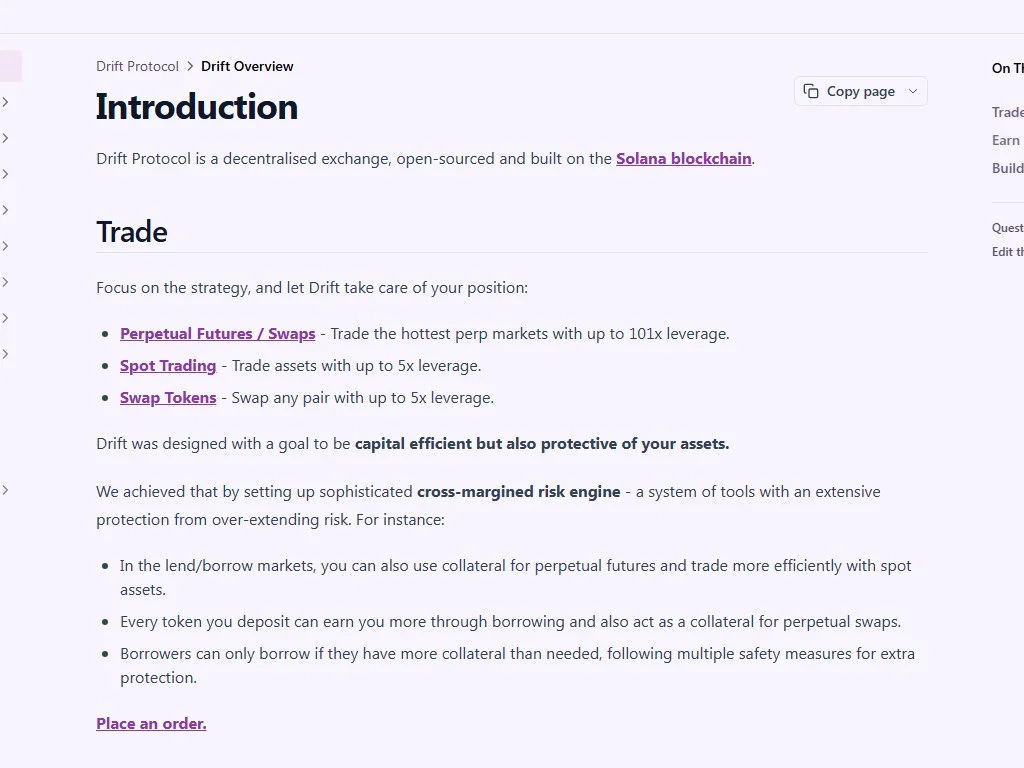
Drift is one of the better-engineered DEXs in crypto, but it is still crypto. Three categories of risk deserve explicit discussion before you size a serious position.
Solana network risk. Solana has historically experienced congestion incidents and at least one extended outage. During heavy congestion, transactions can fail or be delayed, which affects your ability to enter, close, or modify positions in real time. Drift has implemented retry logic and the keeper network helps, but if Solana itself halts, you are stuck with whatever exposure you had at the moment. As of 2026 the network has been substantially more stable than in prior years, but it is not zero risk.
Oracle risk. Liquidations rely on accurate prices from Pyth and Switchboard. If an oracle prints a bad value (whether through a feed glitch, a manipulation attempt, or an upstream exchange anomaly), liquidations can fire incorrectly. Drift's confidence-interval logic mitigates this for major markets but is less robust for thinly traded long-tail markets. For more on how oracle pull pricing works, see our guide to the Pyth Network oracle system.
Liquidation spiral risk. In extreme conditions, cascading liquidations on Solana can overwhelm the keeper network's ability to close positions at fair prices. The insurance fund absorbs residual losses, but if the spiral is large enough to exhaust the fund, socialized losses can apply to profitable traders via auto-deleveraging. This has not happened at scale on Drift v2, but the mechanism exists. Understanding liquidation zones in crypto helps you size positions to stay outside the most dangerous areas.
Smart contract risk is also non-zero despite multiple audits. Drift has been audited by Trail of Bits, OtterSec, and other firms, and has a public bug bounty program through Immunefi, but no audit eliminates risk entirely. Treat Drift the same way you would treat any DeFi protocol: do not deposit more than you are prepared to lose to a low-probability tail event.
Best Practices for Trading Drift Safely
If you only take five things away from this guide, take these. They are the rules that separate users who compound on Drift from users who churn through accounts every few months.
- Start with USDC collateral and 2x to 5x leverage. Add volatile collateral and higher leverage only after you understand the math.
- Set a stop before you set a target. Use Trigger orders for both, but the stop matters more.
- Trade one market at a time until you have a process. Cross-margin makes multiple positions interactive in non-obvious ways.
- Verify the URL is app.drift.trade. Phishing clones with paid search ads are a recurring problem in DeFi.
- Treat Drift Vaults like hedge fund investments, not yield products. Read the manager bio, the fee structure, and the live track record before depositing.
Two additional practical tips. First, use Drift's mobile-friendly interface or Swift session keys to monitor positions away from your desk, but never open a leveraged position you cannot exit within a few minutes if Solana congests. Second, keep a separate trading wallet from your long-term holdings wallet. If your trading wallet gets compromised, your savings are still safe.
Volume, TVL, and Drift in Context (2026)
By mid-2026, Drift consistently posts daily perpetual volume in the high hundreds of millions to multi-billion dollar range during active sessions, with cumulative protocol volume past 200 billion dollars. TVL across trading collateral, lending pools, and vaults sits in the high nine-figure range, placing Drift firmly in the top tier of decentralized derivatives venues globally.
On Solana specifically, Drift competes with Jupiter Perps for derivatives flow and with Kamino, MarginFi, and Solend for lending. Its strongest position is in long-tail perp markets where the JIT auction gives it a real execution advantage over pure orderbook venues that struggle with continuous market making in less liquid pairs. Compared to HYPE and DYDX, the DRIFT token trades at a lower revenue multiple, which bulls call undervaluation and bears call lack of direct fee accrual.
Drift Compared to Centralized Perp Exchanges
Drift will not replace Binance Futures or Bybit for traders who prioritize raw market count and the highest absolute leverage. CEXs offer faster execution under normal conditions, deeper liquidity on niche pairs, fiat on-ramps, sub-accounts, and customer support if something goes wrong.
What Drift offers that CEXs cannot: full self-custody, no KYC for basic usage, transparent on-chain settlement, no counterparty risk in the sense that a CEX can freeze withdrawals, and composability with Solana DeFi. If you care about crypto wallet security and self-custody as a first principle, Drift is the more aligned choice. Many serious traders use both venues for different purposes.
Drift Pros and Cons
- Hybrid DLOB plus JIT plus AMM architecture delivers tight execution
- 50+ perpetual markets including pre-launch and prediction markets
- Cross-margin with simultaneous lending yield on collateral
- Strong MEV protection via JIT auction
- Solana fees keep round-trip cost negligible compared to L1 venues
- Drift Vaults give access to professional strategies
- Swift smart wallet improves UX dramatically for active traders
- Active development, multiple audits, mature insurance fund
- Solana network congestion can degrade execution under extreme load
- 20x maximum leverage lower than Jupiter Perps (100x) or Hyperliquid (50x)
- Oracle risk on thinly traded long-tail markets
- DRIFT token lacks direct fee-share mechanism
- Smaller market count than Hyperliquid
- UX still has learning curve compared to CEXs
- JIT auction adds small fill delay versus pure orderbook execution
- Insurance fund socialization risk in extreme liquidation cascades
Frequently Asked Questions
Q Q Q What is Drift Protocol used for?
Drift Protocol is a Solana-based decentralized exchange used for perpetual futures trading, spot trading, lending and borrowing, prediction markets, and managed vault strategies. Traders use it for capital-efficient leverage on crypto majors, Solana ecosystem tokens, and memecoins, plus access to pre-launch markets and on-chain yield strategies.
Q Q Q How does Drift v2 differ from Drift v1?
Drift v1 used a virtual AMM design that struggled with extreme volatility. Drift v2 replaced it with a hybrid architecture combining a Decentralized Limit Orderbook, a Just-In-Time auction for market orders, and an AMM only as a backstop. This delivers tighter spreads, better MEV protection, and more robust performance during fast markets.
Q Q Q What is the JIT auction on Drift?
The Just-In-Time auction is a short bidding window (a few seconds) opened when a taker submits a market order. Market makers compete to fill the order at the best price within a defined range. This delivers consistent price improvement for takers and structurally prevents sandwich attacks because the auction price is bounded.
Q Q Q What is the maximum leverage on Drift?
Drift offers up to 20x leverage on major perpetual markets like BTC, ETH, and SOL. Long-tail markets typically have lower maximum leverage to account for liquidity and oracle risk. Most new traders should start at 2x to 5x regardless of what the interface allows.
Q Q Q What collateral does Drift accept?
Drift accepts USDC, USDT, SOL, mSOL, jitoSOL, bSOL, BTC, ETH, and several other supported assets as collateral. Each asset has a weight that affects how much margin power it provides. Stable collateral (USDC, USDT) carries the highest weight and is the safest choice for first-time users.
Q Q Q How much does it cost to trade on Drift?
Standard taker fees are 0.05 percent of notional and maker rebates can be negative 0.01 percent for high-volume tiers. Solana transaction fees add a tiny additional cost (typically a fraction of a cent per transaction). There are no withdrawal fees beyond the standard Solana network fee.
Q Q Q Is Drift Protocol safe?
Drift v2 has been audited by Trail of Bits, OtterSec, and other firms, runs an active Immunefi bug bounty, and has an insurance fund in the tens of millions of dollars to backstop liquidation losses. That said, all DeFi protocols carry smart contract, oracle, and network-level risks. Do not deposit more than you are prepared to lose to a low-probability tail event.
Q Q Q What is the DRIFT token used for?
DRIFT is the governance token of Drift Protocol. Holders vote on protocol parameters, market listings, fee structures, and treasury allocations. Staked DRIFT can be deposited into the insurance fund to earn a share of trading fees, with the tradeoff of accepting slashing risk during liquidation cascades.
Q Q Q How is Drift different from Hyperliquid and Jupiter Perps?
Hyperliquid runs a purpose-built L1 with a pure onchain orderbook and the largest market count. Jupiter Perps uses an LP-backed pool model on Solana with simpler UX but only three markets and no orderbook. Drift uses a hybrid orderbook plus JIT auction plus AMM model on Solana, with 50+ markets including pre-launch and prediction markets, and integrates lending plus vaults for capital efficiency.
Q Q Q What are Drift Vaults?
Drift Vaults are managed strategy vaults where designated managers trade user-deposited capital on Drift itself. Strategies include delta-neutral basis trades, market making, leveraged stablecoin yield, and discretionary directional trading. Vaults are non-custodial (smart contracts hold funds) but trust the manager to execute well. Always check track record, fees, lockups, and AUM before depositing.
Q Q Q Do I need to complete KYC to use Drift?
No, Drift is a permissionless on-chain protocol. You connect a Solana wallet and trade. There is no signup, no KYC, and no account creation in the traditional sense. Geographic restrictions may apply at the frontend level for certain jurisdictions, but the underlying contracts are accessible to anyone with a Solana wallet.
Q Q Q What happens if Solana goes down while I have a position open?
If Solana halts, you cannot enter, close, or modify positions until the network resumes. Your existing position remains on-chain at whatever state it was in. If the network resumes with prices significantly different from where it halted, liquidations can trigger immediately when block production restarts. This is why position sizing matters: never carry exposure that you cannot survive through a multi-hour network event.
Conclusion
Drift Protocol is the most complete on-chain trading stack available on Solana in 2026. The v2 hybrid architecture, the JIT auction system, the breadth of perps and prediction markets, the cross-margin with lending yield, the Vault product, and the Swift smart wallet together make a platform that genuinely competes with both centralized exchanges and other top decentralized venues on the criteria that matter most to active traders.
If you are coming from a CEX background, the biggest mental shift is treating self-custody and on-chain transparency as features rather than friction. If you are coming from passive DeFi, the biggest shift is treating leverage and liquidation distance as your primary decisions rather than afterthoughts. Either way, the workflow is the same: small size first, USDC collateral, one market at a time, verified URLs, stops before targets, and a clear exit plan written down before you open the position.
Ready to trade? Connect a Solana wallet to app.drift.trade, deposit a small amount of USDC, pick SOL-PERP, and walk through the full step-by-step section above with size you genuinely do not mind losing. After three or four practice sessions you will have a feel for the interface, the JIT fill behavior, and your own risk tolerance, all of which are worth far more than any tutorial.
- What is DeFi: a complete guide to decentralized finance
- What is Pyth Network: pull oracle pricing explained
- What are liquidation zones in crypto
- Long vs short in crypto: complete guide
- What is a market maker in crypto
- What is VWAP in crypto trading
- Crypto wallet security tips
- What is backtesting in crypto strategy
- How to use a burner wallet for airdrops and memecoins
- How to detect fake volume on crypto charts
Disclaimer: This article is for educational purposes only and is not financial advice. Trading leveraged derivatives carries substantial risk of loss. Always verify current interface details at the official source before placing real trades.
Related Guides
- What Is Jupiter Perps? Solana Perpetuals Guide 2026
- What Is Crypto Bridge Slippage? Why Cross-Chain Transfers Drift (2026)
- Main Pool Drift: How to Know When a Token’s Real Market Has Moved
- What Is Synthetix V3? Perps Multi Collateral Derivatives Guide 2026
- What Is Hyperliquid: Complete Onchain Perps Guide (2026)