How to Use Parcl in 2026: Real Estate Perps Guide
— By Whatsertrade in Tutorials

How to use Parcl in 2026: trade Solana real-estate perpetuals on Miami, NYC, LA and more with USDC, leverage, the PRCL token, and hedging examples.
Parcl is a Solana-based decentralized exchange enabling users to trade perpetual contracts on city-level real estate prices without owning physical property. It allows traders to go long or short on housing markets like Miami or New York, transforming them into liquid, on-chain instruments with leverage and 24/7 accessibility, powered by proprietary real-estate data.
If you have ever wanted to bet on the direction of housing prices in Miami, New York, or Los Angeles without buying a single brick, Parcl is the protocol built exactly for that purpose. Parcl is a Solana-based decentralized exchange that lets traders go long or short on city-level real-estate prices through perpetual contracts. It transforms an entire housing market into a tradable on-chain instrument with leverage, funding rates, and 24/7 liquidity.
For most of modern finance, gaining exposure to a specific city's housing market required either buying a physical property (illiquid, slow, expensive) or trading CME Case-Shiller futures (institutional, low volume). Parcl flips that on its head. With proprietary real-estate data from Parcl Labs and the speed of Solana, any user with a wallet and some USDC can express a directional view on housing within a few clicks.
This 2026 tutorial covers what Parcl is, how the synthetic perpetual model works, how to fund your wallet and trade, the role of the PRCL token, hedging use cases for homeowners, the risks, and how Parcl compares to REITs and CME Case-Shiller futures.
What Is Parcl?
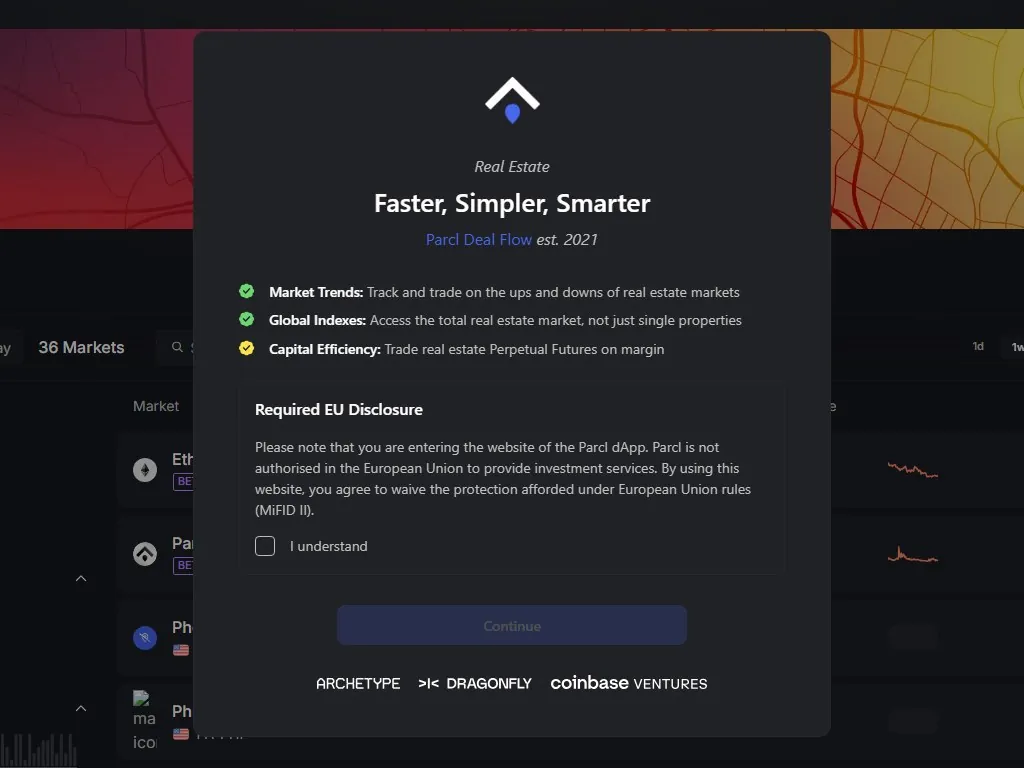
Parcl is a decentralized perpetual futures exchange built on Solana that allows users to long or short the price of residential real estate in major metropolitan areas. Instead of buying a property, you take a leveraged synthetic position on a price index such as Miami Beach or Manhattan, settled in USDC. Positions are continuous (no expiry), use up to 10x leverage, and rely on Parcl Labs as the underlying oracle data source.
That is the featured-snippet answer. The longer story is that Parcl is the first protocol to treat individual real-estate markets the way Binance treats Bitcoin or long versus short exposure on any asset: as a tradable perp with a mark price, funding rate, and order book of LP-backed liquidity. The result is a venue where a retail trader in Madrid can short Phoenix housing in two minutes, something simply impossible in any traditional market structure.
A Short History of Parcl: Trevor Bacon, Miami, and the Bet on Real-Estate Liquidity
Parcl was founded in 2021 in Miami by Trevor Bacon and Kellan Grenier with the thesis that real estate, despite being the largest asset class in the world, remains one of the least liquid markets a person can touch. Parcl raised over 11 million dollars from Coinbase Ventures, Dragonfly, and Solana Ventures.
V1 launched on Solana in 2022 with a handful of cities. Parcl V3 arrived in late 2023 with cross-margined accounts, LP-backed liquidity pools, and a more mature oracle structure. The PRCL governance token launched in early 2024 via airdrop to early traders.
By 2026, Parcl is the reference venue for on-chain real-estate trading, with dozens of city markets and a pipeline of new metros added through community votes. It is one of the more distinctive examples of real-world asset tokenization in DeFi, even though it tokenizes a price feed rather than a physical deed.
How the Parcl Synthetic Perpetual Actually Works
Understanding Parcl requires breaking the product into three moving parts: the oracle price, the funding rate, and the leverage mechanism. Each part contributes to how your position behaves once it is open, and missing any one of them is how new users get unpleasant surprises.
The oracle price comes from Parcl Labs, the company's proprietary real-estate data engine that aggregates millions of property records, MLS listings, and sale transactions to compute a price-per-square-foot index for each supported metropolitan statistical area (MSA). This index is pushed on-chain at a regular cadence and is the reference value the perp tracks. Unlike crypto, where spot prices update every second, real-estate prices change slowly, so the oracle update cadence is measured in hours not milliseconds.
The funding rate is the mechanism that keeps the perp price tethered to the oracle. Because there is no underlying spot market to arbitrage directly (you cannot instantly buy and sell a house), the funding rate does the alignment work. If aggregate trader sentiment is heavily long, longs pay shorts a periodic funding payment, incentivizing shorts to enter and balance the book. If the book is heavily short, the opposite occurs. Funding accrues continuously and is settled into your margin balance.
The leverage and margin mechanism works as cross-margined exposure backed by your USDC collateral. You can take positions up to 10x notional, but at higher leverage the price move required to liquidate you shrinks dramatically. Parcl uses a maintenance margin model similar to other perp DEXs: as long as your account equity stays above the maintenance threshold, your position stays open. Cross unwinds the position when equity falls below threshold, similar to how liquidation zones work on other perp venues.
One important nuance: because real-estate prices move slowly, Parcl perps tend to exhibit lower realized volatility than crypto perps. That sounds like a feature for risk control, and on calm days it is. But it also means that funding rates can dominate the PnL of a position over weeks. If you are long Miami at 5x and pay 0.03% funding every eight hours while the oracle barely moves, the funding bill is what determines whether you profit or lose, not the housing market itself.
The Markets Available on Parcl in 2026
As of mid-2026, Parcl supports perpetual markets on dozens of cities and metropolitan statistical areas, with the most liquid markets being the Sunbelt and major coastal hubs that retail traders care about. The list keeps expanding as Parcl Labs adds coverage and the community votes to whitelist new metros.
Beyond these flagship markets, Parcl also lists secondary metros like Charlotte, Dallas, Houston, Denver, Nashville, Atlanta, Brooklyn, and Boston. Some long-tail markets carry thinner liquidity, which means wider spreads and more aggressive funding spikes. As with any thinly traded perp, position sizing matters more than headline leverage in those venues.
Step by Step: How to Use Parcl from Zero
The full Parcl workflow from a cold start (no wallet, no USDC, no account) to an open position takes roughly fifteen minutes if you already know your way around Solana. Below is the complete sequence with the practical details that the official docs sometimes assume you already know.
Step 1: Install a Solana Wallet (Phantom or Solflare)
Parcl runs on Solana, so you need a Solana wallet. The two most widely supported options are Phantom and Solflare. Both are non-custodial browser extensions with mobile apps. Install the extension from the official site (always verify the URL, address-poisoning and lookalike-domain scams are very common; see our guide on avoiding address-poisoning scams), generate a new wallet, and write down your seed phrase on paper. Store it offline. If anyone asks for it, including someone claiming to be from Parcl, it is a scam.
If you are new to wallet hygiene, consider using a dedicated trading wallet rather than your main vault. Some users even spin up a burner wallet for new dApps to keep their main holdings isolated. Hardware wallets like Ledger work with Phantom and Solflare and are the recommended setup once your position size justifies the friction.
Step 2: Fund the Wallet with USDC on Solana
Parcl collateral is denominated in USDC on Solana (not Ethereum, not Polygon, not USDC.e or any bridged variant, but native USDC on the Solana mainnet). The simplest way to get there is to buy USDC on a centralized exchange that supports Solana withdrawals (Coinbase, Kraken, Binance, OKX, Bybit) and withdraw to your Phantom or Solflare address. Always send a small test transaction first, especially if you copy-pasted the address.
You also need a small amount of SOL (around 0.05 SOL is plenty) to pay for transaction fees. Solana fees are tiny (fractions of a cent per transaction), but you cannot transact without some SOL in the wallet. If you forget this step you will hit confusing errors when trying to open positions. Stablecoin mechanics differ across chains, and if you are unsure which version of USDC you are sending, our overview of stablecoin standards covers the basics that apply equally to USDC.
Step 3: Connect to app.parcl.co
Open a browser and navigate to app.parcl.co. Click Connect Wallet and select Phantom or Solflare. Approve the connection request. Parcl will display your account dashboard, which starts empty. You may also be asked to sign a one-time message proving wallet ownership, this does not authorize any transactions or spend any funds.
Step 4: Deposit Collateral into Your Margin Account
Click Deposit and choose how much USDC to move from your wallet into your Parcl margin account. The deposit is a Solana transaction that you sign in your wallet. Once confirmed (usually under two seconds), the USDC appears in your Parcl account and becomes available as collateral across all markets (cross-margined). Start with a modest amount, even 50 to 100 USDC is enough to test the flow without risking real money on the learning curve.
Step 5: Pick a City Market
The Parcl interface lists every available market with its current oracle price, 24-hour change, funding rate, and open interest. Click on the market you want to trade. The chart loads, showing the price history alongside funding history. Pay attention to the funding column before opening anything: a market with persistent positive funding (longs paying shorts) implies long-heavy positioning, which can be a contrarian signal or simply an expensive long.
Step 6: Decide Long or Short and Choose Leverage
Long means you profit if the city's price index rises. Short means you profit if it falls. Choose your direction based on a thesis, not a hunch. Then set your leverage slider anywhere from 1x to 10x. A 1x position is essentially synthetic spot exposure: you have minimal liquidation risk and your PnL tracks the index directly. A 10x position amplifies everything, including the funding bill and liquidation risk. For a first trade, 2x to 3x is a reasonable comfort range while you learn how the product behaves.
Step 7: Set Take-Profit and Stop-Loss (Optional but Recommended)
Parcl supports conditional orders for TP and SL. Setting these at order entry is a small habit that pays off when you cannot watch the position. Because real-estate prices move slowly, you do not need extremely tight stops, but defining the invalidation level for your thesis is good discipline. If your thesis is "Phoenix corrects 5%", set your stop above the recent swing high so you exit if that thesis is invalidated instead of hoping.
Step 8: Confirm and Sign the Transaction
Review the order preview: market, side, size, leverage, entry price estimate, liquidation price, and fees. Click confirm and sign in Phantom or Solflare. The position is live within a second. From here it is on the dashboard, accruing or paying funding, and updating PnL as the Parcl Labs oracle ticks.
Step 9: Monitor Funding and Margin Health
The single most important habit on Parcl is watching funding. Unlike crypto perps where price moves dominate PnL, on Parcl funding can quietly eat a position over time, especially in low-volatility markets. Check your account daily, particularly the funding paid column and your margin ratio. If funding turns aggressively against you, consider reducing size or closing rather than bleeding it out.
PRCL Tokenomics: Governance, Fee Discounts, and Staking
The PRCL token is Parcl's native governance token, launched in early 2024 with a maximum supply of one billion tokens. Distribution was split across community airdrops to early traders, ecosystem incentives, team and investor allocations (with vesting schedules), and a treasury reserved for ongoing protocol development and liquidity programs. The airdrop component was one of the more equitable distributions in DeFi that year, weighted by actual trading activity rather than wallet count.
PRCL has three principal utilities. First, governance: holders can vote on protocol parameters such as which new city markets to whitelist, funding-rate formula adjustments, fee changes, and treasury allocations. Voting is snapshot-based, so flash-loan governance attacks (a known risk on many DAO tokens, see our writeup on DeFi governance fundamentals) are not viable on Parcl.
Second, fee discounts: traders who stake PRCL receive tiered reductions on trading fees, similar to how exchanges reward BNB or HYPE holders. The discount tiers scale with staked amount and lockup duration, making PRCL an effective working asset for active traders who want to compress costs.
Third, staking and liquidity participation: PRCL stakers earn a share of protocol revenue, denominated in USDC, derived from trading fees. This is a real cash-flow yield rather than emissions, although the realized yield obviously depends on Parcl's trading volume. Some PRCL is also bonded into LP pools that backstop liquidity on individual city markets, earning additional rewards in exchange for taking on inventory risk against traders.
- Governance: snapshot voting on new markets, fees, and treasury
- Fee discounts: tiered trading-fee reductions for stakers
- Revenue share: staked PRCL earns USDC from protocol fees
- LP participation: bond PRCL into market-specific pools for additional yield
One nuance worth flagging: PRCL is a governance token, not a claim on Parcl Labs' equity or its institutional data business. The same team operates both Parcl (protocol) and Parcl Labs (data company), but the token's value capture is tied to protocol activity, not to data-licensing revenue. Treat it accordingly when sizing exposure.
Parcl Labs: The Data Engine Behind the Perp
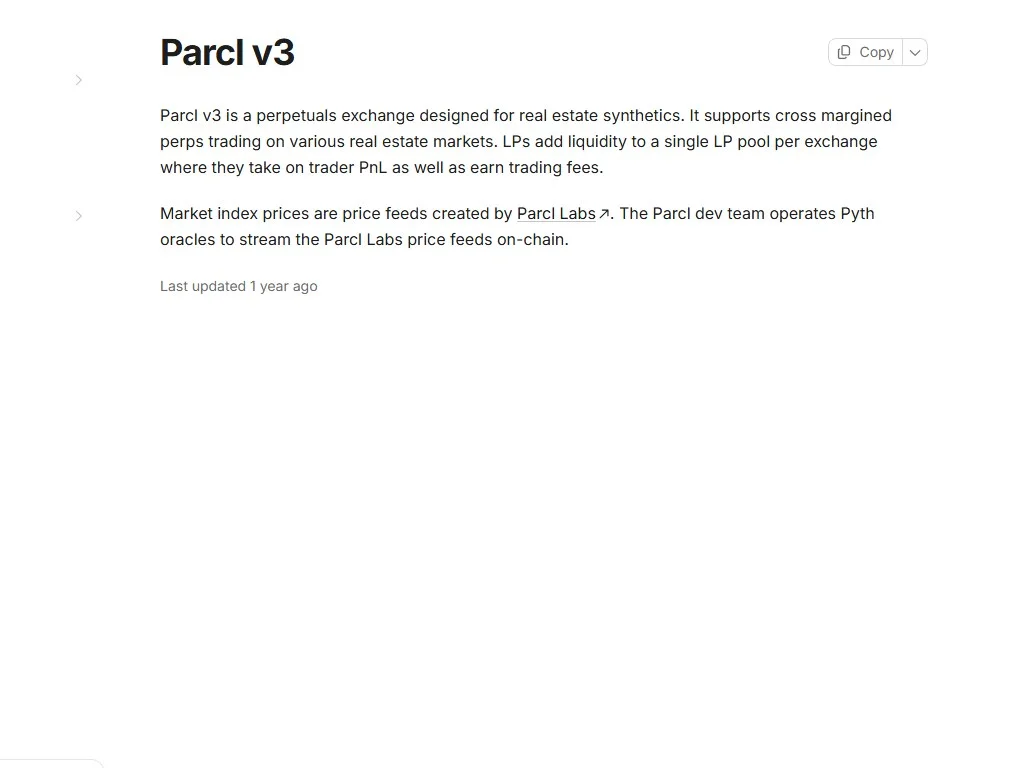
The single biggest differentiator of Parcl versus any naive on-chain real-estate experiment is the depth of Parcl Labs' data. Parcl Labs aggregates millions of property records, MLS feeds, deed transfers, and rental listings to produce proprietary metro-level price indices. These indices are the oracle that the Parcl protocol consumes, giving the on-chain perp the same data quality that institutions pay for. From an oracle architecture perspective, a primary data source that is also a sustainable business is structurally healthier than relying on free public feeds.
Real Use Cases: Hedging, Speculation, and Cyclical Exposure
Parcl's most interesting users are not always the leveraged degens. The protocol enables a handful of use cases that simply did not exist before, and three stand out.
Use Case 1: Homeowner Hedging
The classic example: a Phoenix homeowner with $500,000 of equity in their primary residence is worried about a regional housing correction but does not want to sell, move, or trigger capital-gains complications. Before Parcl, the only hedge available was buying Case-Shiller put options (institutional only) or shorting REITs (poor correlation). With Parcl, that homeowner can open a short Phoenix position with, say, $25,000 of USDC at 2x leverage, creating $50,000 of synthetic short exposure that partially offsets a decline in their home's value. It is not a perfect hedge (basis risk between the index and their specific property exists), but it is the first reasonable approximation that ordinary owners can access.
Use Case 2: Liquid Real-Estate Exposure for Investors
The flip side: an investor who wants exposure to Miami's housing market without the friction of buying property (down payment, mortgage, closing costs, property management, illiquidity) can simply go long Miami on Parcl. The exposure can be sized to taste, leveraged or not, and closed in seconds. For investors who actively allocate capital and value liquidity, this is a fundamentally different proposition than tying up six figures in a single property for years.
Use Case 3: Cyclical and Relative-Value Trades
Sophisticated traders use Parcl for pair trades and macro housing cycle positioning. Long Tampa, short Austin, betting that the Sunbelt outperforms the tech-driven metros. Long the equal-weight basket of cities while short rate-sensitive metros, betting on a soft landing. Short Las Vegas during late-cycle euphoria. These trades are pure relative-value bets that did not have any clean expression vehicle before Parcl existed. They also tend to be lower-volatility than directional bets because metro-to-metro correlation softens single-name risk.
Parcl vs Traditional Real-Estate Vehicles
The clearest way to grasp Parcl's positioning is to compare it directly against the three other ways someone could express a view on housing: buying a property outright, buying a REIT, or trading CME Case-Shiller futures.
The comparison surfaces the obvious tradeoff: Parcl wins decisively on accessibility, speed, leverage flexibility, and city specificity. Traditional vehicles win on regulatory clarity, depth of liquidity in dollar terms, and (in the case of physical property) the actual ownership of an asset that can generate rental income. Parcl is not a replacement for owning a home or building a long-term rental portfolio. It is a complement that fills the gap nothing else has filled: rapid, liquid, leverageable exposure to specific metros.
Why Solana Matters for Parcl
Parcl chose Solana early, and the architecture decision has aged well. Solana's roughly 400 millisecond block time and sub-penny transaction fees mean that the perpetual matching, position updates, and funding settlements happen at speeds compatible with a real exchange. On Ethereum mainnet, the gas cost of opening a single perp position with stop orders could exceed the position's daily expected PnL on smaller trades. On Solana, fees are negligible.
Solana's high throughput also matters for the data oracle. Pushing metro-level price updates frequently is cheap, and the network can absorb the load without congesting. The flip side, of course, is Solana's history of occasional network outages and the fact that the chain has a smaller security budget than Ethereum. Those are real risks (see Risks below), but the speed and cost benefits are also real and material for a trading product. If you want a deeper understanding of how transaction fees affect trading economics, our explainer on gas pricing on Ethereum makes the contrast vivid.
Risks You Must Understand Before Trading on Parcl
Parcl is not a savings account, a yield product, or a passive investment. It is a leveraged synthetic perpetual on slow-moving real-estate price indices. The risks are different from generic perp exchanges, and they deserve to be named explicitly.
Best Practices for Trading on Parcl
Most of the mistakes traders make on Parcl come from importing the wrong mental model. Crypto perp traders use too much leverage because they are used to fast-moving markets. Real-estate investors underestimate funding because they have never paid carrying costs on a leveraged synthetic. A few habits help.
First, start small and learn the funding dynamics. Open a 1x position with a tiny amount of capital and watch how funding accrues over a few days before scaling. The funding rate is the dominant cost variable in this market, not entry price.
Second, diversify across metros if you have a directional macro view. Single-metro positions concentrate basis risk; a basket of long-Sunbelt or short-rate-sensitive metros expresses the thesis with less single-name volatility. Pair trades (long one metro versus short another) reduce overall directional risk further.
Third, respect the slow-moving nature of housing. Real-estate indices do not gap. They drift. A 10x position implies a 10% move triggers liquidation, which sounds safe in a slow market, but a single oracle update that jumps the index can be a 1-2% intraday move in itself. Combined with funding drag, leverage above 5x is hard to justify for most theses.
Fourth, treat Parcl exposure as part of a broader risk framework. If you already own a home, you may already be implicitly long your local metro. Adding more long exposure on Parcl concentrates that risk; adding short exposure partially offsets it. Think about your total real-estate beta before sizing.
Finally, use proper wallet hygiene. Hardware wallet for the main vault, hot wallet with limited funds for trading, and clean separation from any wallets you use for new dApps or airdrops. Parcl's contracts are audited, but the broader security stack (browser extensions, RPC providers, phishing sites) is where most users actually lose money.
Pros and Cons of Parcl in 2026
- First-ever liquid, leveraged exposure to specific metros
- Long or short with one click, 24/7, no KYC
- Backed by serious institutional-grade data via Parcl Labs
- Solana speed and cost make small position sizes viable
- PRCL token offers genuine fee discounts and revenue share
- Enables real hedging use cases for actual homeowners
- Funding rates can dominate PnL on medium-term holds
- Long-tail metro markets have thin liquidity
- Smart-contract and oracle risk are real
- Solana outages can leave you unable to manage positions
- Basis risk for homeowners hedging their specific property
- Regulatory uncertainty in some jurisdictions
How to Troubleshoot Common Parcl Issues
A handful of issues come up repeatedly for new users. None of them are deal-breakers, but knowing the fix in advance saves frustration.
Transaction fails with insufficient SOL. You forgot to fund your wallet with SOL for gas. Send 0.05 SOL from any source and retry. Solana fees are tiny but mandatory.
USDC deposit not appearing. You probably sent USDC on the wrong chain or sent a bridged variant (USDC.e, axlUSDC) instead of native Solana USDC. Check the mint address in the transaction and compare to the official Solana USDC mint. If you sent the wrong asset, you may need to swap on a Solana DEX before depositing.
Position liquidated unexpectedly. Almost always a combination of leverage too high and the oracle ticking against you between checks. The fix going forward is lower leverage and conditional orders set at entry. Use historical backtesting mentally on the metro you trade to develop intuition for how far it moves in a single update.
Funding bill looks huge. Check whether the funding rate flipped against your direction. On heavily one-sided books, funding can be 0.05% per 8h or more, which is 50%+ annualized. Closing the position or reducing leverage is usually the right move rather than waiting it out.
Cannot connect wallet. Usually a browser extension cache issue. Disconnect from app.parcl.co in Phantom's settings, refresh, and reconnect. If that fails, try an incognito window.
Parcl vs Other Solana Perp DEXs
Solana hosts several perpetual exchanges, but Parcl occupies a category of one: it is the only perp DEX trading real estate as the underlying. Other Solana venues like Drift, Jupiter Perps, and Mango focus on crypto pairs. Parcl has no direct on-chain competitor in its niche, which is both a moat and a constraint.
Who Should Actually Use Parcl?
Parcl is well suited for a few specific user profiles. Active traders who already understand perps and want a non-correlated underlying to add to their book. Homeowners with sufficient equity and risk tolerance to hedge a portion of their housing exposure. Macro investors who want clean expressions of city-specific housing theses. Crypto-native users who want to express real-estate views without leaving the on-chain ecosystem. And institutions or family offices that want intraday housing exposure without the operational overhead of buying property or trading CME futures.
Parcl is not well suited for true beginners who have never used a wallet, for users who confuse market exposure with property ownership, for anyone seeking passive yield or stable returns, or for users who are uncomfortable monitoring funding rates and margin health. If you fall in those latter categories, start by learning fundamentals through resources like our introduction to how cryptocurrencies work before opening leveraged real-estate positions.
The Parcl Labs API for Institutions
Beyond the consumer app, Parcl Labs offers a commercial real-estate data API used by hedge funds, single-family-rental operators, and proptech companies. The API provides intraday metro-level price indices, inventory metrics, and rental yield estimates. The same data that powers the on-chain oracle is available as a standalone product, often replacing slower alternatives like Case-Shiller or Zillow Research.
This dual structure (data company plus on-chain protocol) is one of the more interesting business models in crypto. The data business generates real revenue that funds ongoing development of both the API and the protocol, which is structurally healthier than emissions-driven DeFi protocols.
Frequently Asked Questions
Q Q Q What is Parcl in simple terms?
Parcl is a Solana-based decentralized exchange where you can bet on whether the price of housing in a specific city goes up or down. You do not buy any real property. You trade a synthetic perpetual contract that tracks an index of metro-level real-estate prices, with leverage and USDC collateral.
Q Q Q Do I own any real estate when I trade on Parcl?
No. You hold a leveraged synthetic position settled in USDC. There is no deed, no title, no rental income, and no physical asset associated with your position. Parcl is purely a price-exposure instrument, similar to how a Bitcoin perpetual is not the same as holding spot BTC.
Q Q Q What wallet do I need to use Parcl?
Any Solana-compatible wallet works. Phantom and Solflare are the two most widely used. Both are non-custodial browser extensions with mobile apps, and both support hardware wallets like Ledger for added security on larger accounts.
Q Q Q What collateral does Parcl accept?
Native USDC on Solana. Not bridged USDC variants, not USDT, not SOL. Make sure you are sending native Solana USDC when you fund the wallet, otherwise the deposit will not register and you may need to swap on a Solana DEX first.
Q Q Q What is the maximum leverage on Parcl?
Up to 10x on supported markets, though the maximum can vary by market and protocol parameters. Lower leverage is strongly recommended for new users because funding-rate drag on leveraged positions can be significant over time, even when the underlying index barely moves.
Q Q Q How are prices on Parcl determined?
Parcl Labs, the data company that operates alongside the protocol, computes metro-level real-estate price indices from millions of property records, MLS listings, deed transfers, and sale transactions. These indices are pushed on-chain at a regular cadence and serve as the oracle for each city perpetual market.
Q Q Q Can I really hedge my home with Parcl?
Partially. You can short your local metro to offset a decline in your home's value, but there will be basis risk between the broad index and your specific property. The hedge will not be perfect, but for many owners a 50-70% offset is significantly better than the zero hedge available before Parcl existed.
Q Q Q What is PRCL and what does it do?
PRCL is Parcl's governance token. Holders can vote on protocol parameters such as which city markets to whitelist and what fee structures to apply. Staking PRCL also unlocks trading-fee discounts and a share of protocol revenue paid in USDC. The token is not equity in Parcl Labs, the data business.
Q Q Q How is Parcl different from a REIT?
REITs are equity in companies that own pools of properties, typically diversified across sectors and regions. Parcl positions are pure synthetic exposure to a specific city's housing price index, settled in stablecoin. Parcl offers far more city specificity, easy shorting, higher leverage, and 24/7 trading, but no underlying asset ownership or rental income.
Q Q Q How does Parcl compare to CME Case-Shiller futures?
CME Case-Shiller futures are quarterly-expiring contracts on 10 cities and a national index, traded during market hours, requiring a futures account and meaningful minimum size. Parcl offers continuous (no-expiry) perpetuals on dozens of metros, 24/7, with $10-level minimum sizes and just a wallet plus USDC. The tradeoff is that CME has regulatory clarity and Parcl has structural flexibility.
Q Q Q What are the main risks of using Parcl?
Smart-contract risk, oracle deviation between the index and your specific exposure, thin liquidity in long-tail metros, persistent funding rates that can dominate PnL, Solana network outages that may freeze your ability to manage positions, and regulatory uncertainty in some jurisdictions. Never deposit more than you can afford to lose.
Q Q Q Why does Solana matter for Parcl specifically?
Solana's sub-second blocks and near-zero fees make perpetual trading viable at small sizes that would be uneconomical on Ethereum mainnet. The chain can absorb frequent oracle updates and high-volume order flow without congesting, which is essential for a 24/7 trading product targeting both retail and institutional users.
Conclusion: When Parcl Is Worth Your Time
Parcl in 2026 is the most credible attempt to bring real-estate price discovery onto a 24/7 leveraged trading rail. It is not a substitute for owning a home, and it is not a passive yield product. It is a specialized perpetual exchange built around a genuinely novel underlying asset, with proprietary data, real institutional adoption through Parcl Labs, and a token that captures fee revenue rather than relying on emissions.
If you are an active trader looking for non-correlated underlyings, a homeowner exploring partial hedging, a macro investor with views on specific city housing cycles, or a crypto-native user curious about RWA exposure, Parcl deserves a slot in your toolkit. Start small, learn how funding behaves in your chosen metro, scale only when the dynamics feel familiar, and respect the fact that leveraged synthetic exposure to slow-moving indices is its own discipline. The traders who treat Parcl as a thoughtful instrument tend to do well. The traders who treat it as a real-estate themed casino tend not to.
If you want to deepen the broader context around DeFi infrastructure, oracles, and tokenized real-world assets, our guides on Ondo Finance and tokenized treasuries, Pyth Network oracle architecture, and crypto wallet security are useful companions. Open your first Parcl trade only after you can describe the funding rate, the maintenance margin, and your exit condition in one sentence each. If you cannot, keep reading.
Disclaimer: This article is for educational purposes only and is not financial, legal, or tax advice. Synthetic and leveraged products carry significant risk including the total loss of deposited collateral. Real-estate perpetuals are a novel instrument with regulatory uncertainty in some jurisdictions. Always verify live market parameters, oracle behavior, and protocol status before trading.
Related Guides
- What Is Propy (PRO)? The Blockchain Real Estate Transaction Platform Explained in 2026
- What Is Lofty AI? Fractional Real Estate Tokenization on Algorand Explained in 2026
- What Is Synthetix V3? Perps Multi Collateral Derivatives Guide 2026
- What Is Jupiter Perps? Solana Perpetuals Guide 2026
- What Is Hyperliquid: Complete Onchain Perps Guide (2026)