How to Verify an Official Token Contract Address

Copycat tokens look completely identical to the real asset on surface-level interfaces. We deconstruct the precise verification frameworks to validate genuine smart contracts.
How to Verify a Token Contract Address Is Official and Not a Fake
- In the open-source architecture of decentralized finance, anyone can deploy a smart contract in seconds. While this permissionless environment drives continuous web3 innovation, it introduces a severe systemic vulnerability: the ERC-20 token standard does not protect token names or tickers. A malicious actor can launch a token named "USD Coin" with the ticker "USDC," assign it the standard 6 decimals, and match the official logo perfectly.
On surface-level wallet interfaces and decentralized trading desks, a fake clone looks indistinguishable from the authentic multi-billion-dollar asset.
- Relying on social media chatrooms or a simple name search on a block explorer to copy an address is an incredibly high-risk execution error. To insulate your portfolio from malicious honeypots, phishing traps, and artificial liquidity pools, you must treat all unverified data as hostile. This technical playbook delivers the exact on-chain verification steps required to validate if a token contract address is official before interacting with the order book.
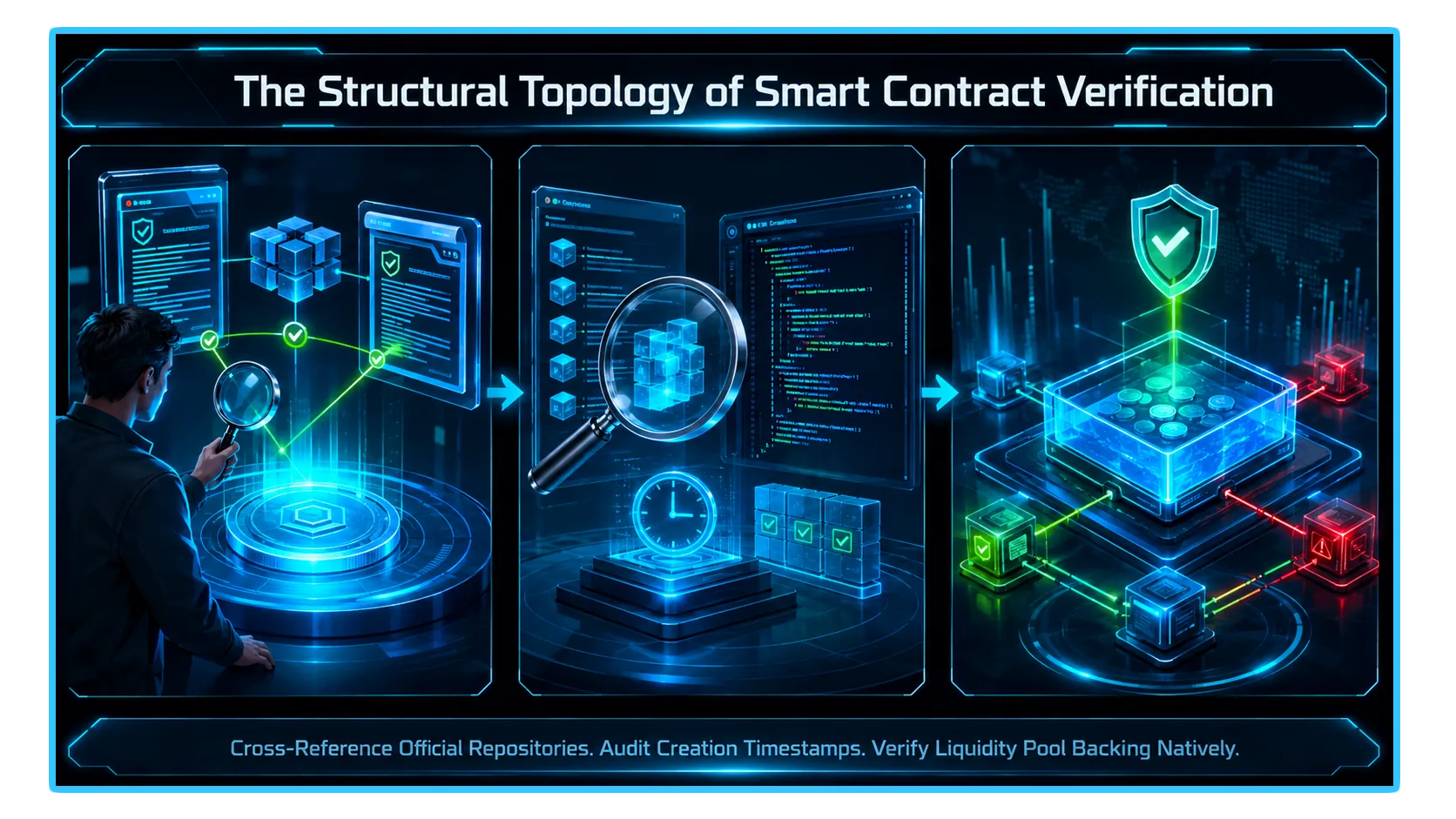
1. The Anatomy of a Token Clone
- To verify a token contract address with professional precision, you must first understand how malicious entities deploy fraudulent pairs. Because block explorers function as search engines for a public database, they parse metadata text fields programmatically.
- When an explosive new asset begins gathering market momentum, bad actors use specialized scripts to capture the exact name and ticker. They then seed a thin liquidity pool on a decentralized exchange (DEX).
- When an unsuspecting retail trader enters the ticker symbol into an open search field, the interface populates multiple identical listings. Without look-through contract analysis, selecting the wrong row results in an immediate capital loss.
2. The Core Verification Framework
Step 1: Primary Source Cross-Referencing
Never harvest a contract address from casual social media discussion feeds, forum comments, or unverified chat alerts. Always extract the core contract hash directly from the project's official, authenticated infrastructure directories:
The Official Documentation Hub: Navigate to the project's official website and locate their formal gitbook, technical documentation, or developer whitepaper.
Verified Token Registries: Cross-reference the address with reputable aggregator tracking repositories (such as the official CoinMarketCap or CoinGecko API data folders).
GitHub Repository Inspection: For open-source protocols, audit the deployment files inside the team's verified public GitHub repository logs.
Step 2: Deep Block Explorer Diagnostics
Once you have an address string, paste it directly into the search bar of a premier block explorer (such as Etherscan, Solscan, or Basescan) to audit its structural history.
The Code Compilation Myth: A green checkmark under the "Contract" tab on Etherscan simply means the deployed machine code matches the human-readable Solidity file submitted by the creator. It does not mean the contract is safe or official.
To confirm authenticity on the explorer, check these key indicators:
The Creation Timestamp: Check the age of the contract. If a token claims to be a blue-chip asset launched years ago, but the block explorer reveals the contract was initialized three hours ago, you are looking at an immediate scam clone.
The Deployer Wallet Profile: Inspect the address that initialized the contract. Official project tokens are deployed by verified protocol deployer vaults or multi-sig developer frameworks, not clean, unlinked wallets funded stealthily via privacy mixers.
Token Holder Distribution: Real tokens exhibit a widely decentralized holder map or route their supply through massive, verified exchange and staking escrow contracts. Fake clones show highly consolidated allocations held inside a tight cluster of insider wallets.
3. The Security Matrix: Authentic vs. Fake Profiles
To maintain clean scannability when filtering real-time token deployments, use this standardized data grid to evaluate asset integrity:
| Security Vector | Official Authentic Token | Malicious Fake Clone |
| Creation Date | Tracks perfectly with historical project launch milestones | Deployed recently, often matching sudden social media hype cycles |
| Liquidity Pool Depth | Deep, institutional liquidity backed by verified lockup contracts | Thin, shallow pools designed to trigger massive execution slippage |
| Holder Decentralization | Supply is broadly distributed across thousands of public nodes | Highly concentrated within a small, programmatically linked wallet cluster |
| Transaction Velocity | Continuous, diverse organic transaction paths from unique entities | Heavy wash-trading patterns driven by automated developer bots |
4. Advanced Exploits: Proxies and Honeypot Pitfalls
As security tools become more sophisticated, malicious actors have evolved past basic static clones to deploy complex smart contract traps.
The Unverified Proxy Trap
Advanced scams utilize a Proxy Contract architecture. The initial token address looks entirely benign and clean under automated scanners. However, the contract contains an underlying routing function that points to an unverified secondary implementation contract. The developer can modify this logic down the road, suddenly flipping a standard utility token into a freeze contract that blocks user withdrawals.
The Algorithmic Honeypot
- A honeypot is a contract engineered with a highly deceptive permission structure. The code is written to allow open purchasing, causing the token's chart to print a beautiful, vertical green line.
- However, the creator embeds a malicious piece of code inside the
transferor_updatefunction that systematically blocks anyone except the deployer's address from selling. If you buy into this structure, your capital is permanently locked inside the pool core.
5. Real-Time Telemetry and Verification via DEXTools
- Formulating a resilient portfolio strategy while navigating emergent multi-chain ecosystems requires access to look-through, live data analytics. While a project's documentation provides a static contract hash, verifying the actual underlying order book depth, real-time transaction velocity, and live trust metrics on decentralized venues is the only method to confirm genuine asset health before executing major capital swaps.
- DEXTools provides the critical analytical data infrastructure needed to perform these diagnostic verifications in real-time. By utilizing advanced pair explorers, live transaction logs, and look-through wallet telemetry, market participants can instantly inspect any token contract address.
- When you load a token pair on the DEXTools dashboard, the system exposes vital security parameters: it displays the verified contract creation log, runs automated honeypot detection tests, audits whether the metadata matches official listings, and assigns a localized DEXTScore based on algorithmic pool health metrics.
- Cross-referencing your contract verification steps with live market telemetry ensures your risk parameters remain fully effective, protecting your digital wealth from unexpected copycats.
You can access DEXTools here and start trading today!
Fake Tokens With the Same Name: How to Verify You're Buying the Real Contract How to Verify Token Safety Before Buying: A Pre-Buy Crypto Checklist Top Token Security Tools in 2026: Scam Checks, Audits and Risk Reviews How to Verify a Token Contract Before Trading
Disclaimer: This article is for informational purposes only and does not constitute investment advice, financial advice, trading advice, or any other kind of advice. DEXTools does not recommend buying, selling, or holding any cryptocurrency or token. Users should conduct their own research and consult with a qualified financial advisor before making any investment decisions. Cryptocurrency investments are volatile and high-risk. DEXTools is not responsible for any losses incurred.