Liquid Restaking Explained: The Shared Security Strategy
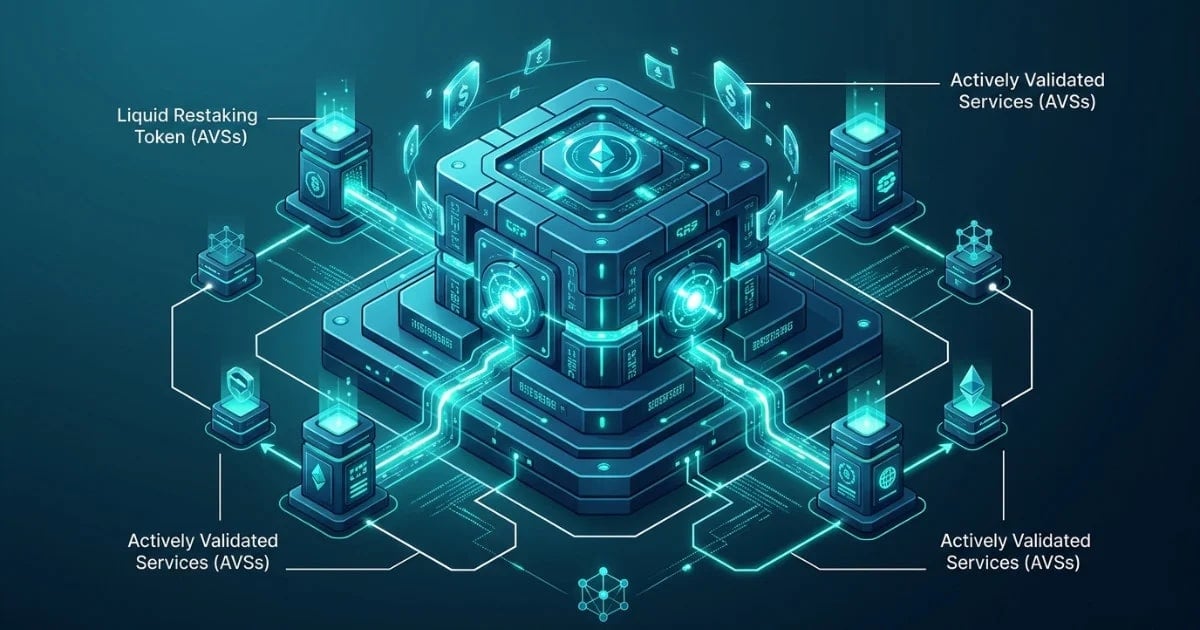
Leveraging staked assets to underwrite multiple infrastructure layers simultaneously maximizes yield but pools severe systemic vulnerabilities. We break down the technical realities of LRTs, AVS exposure, and protocol security profiles.
The Capital Efficiency Escalation: Moving Beyond Single-Chain Yields
- The maturation of decentralized proof-of-stake networks established a robust baseline for securing digital assets. Liquid Staking Tokens (LSTs) successfully unlocked billions of dollars in dormant capital by granting liquidity to locked validator balances. However, as independent decentralized infrastructure networks (such as data availability layers, oracles, and cross-chain bridges) proliferated, they faced a steep economic hurdle. Each new service was forced to build its own independent cryptographic trust pool from scratch, a process requiring massive capital outlays and complex token incentive designs.
- Liquid Restaking fundamentally reshapes this security paradigm. Pioneered by infrastructure engines like EigenLayer, restaking allows market participants to leverage their existing staked Ethereum validation weight to underwrite secondary decentralized applications simultaneously. By wrapping this multi-layered staking arrangement inside tradable Liquid Restaking Tokens (LRTs), protocols eliminate the lockup constraints of shared security. This comprehensive guide details the structural differences between LSTs and LRTs, the mechanics of Actively Validated Services, the operational profiles of dominant market providers, and the unique risk profiles defining contemporary restaking markets.
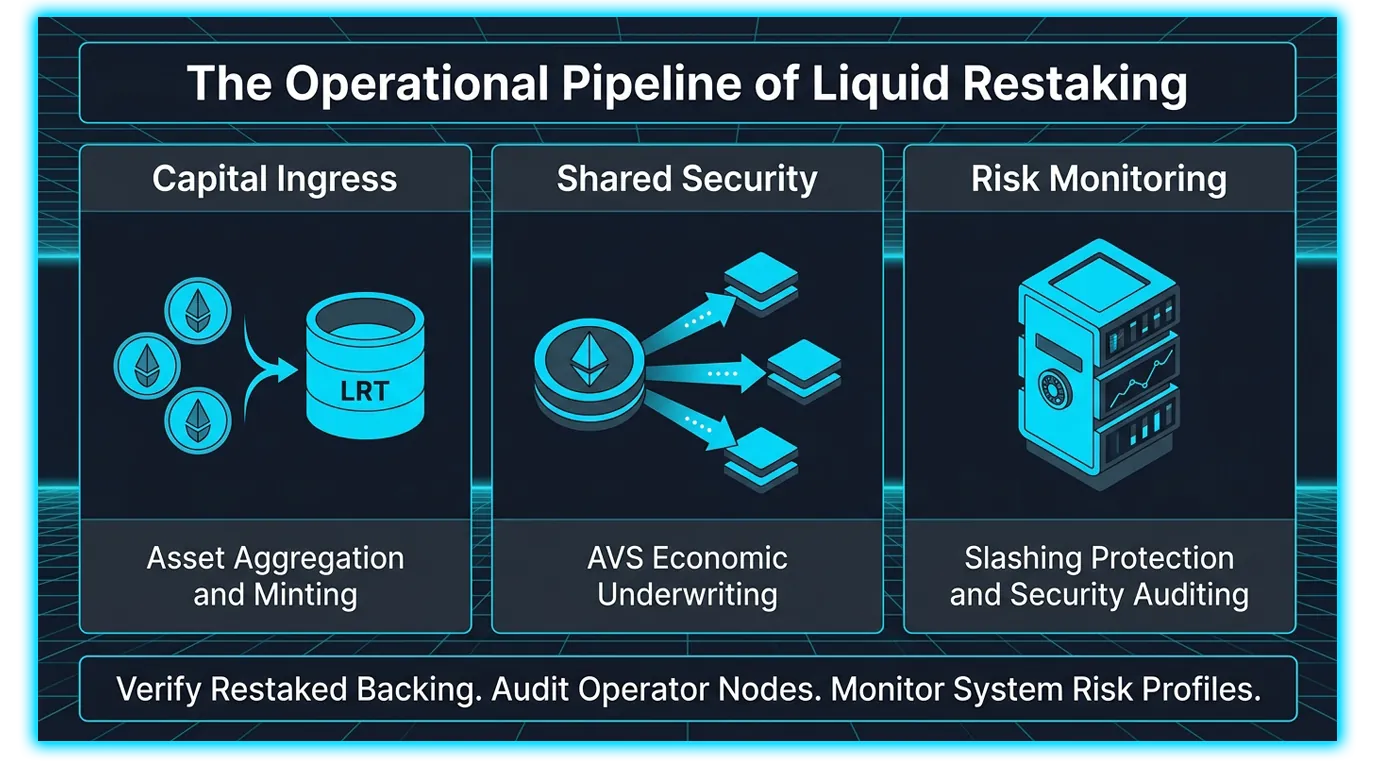
1. The Shared Security Model: LRT vs. LST
To navigate the restaking landscape, you must first understand how the underlying financial derivatives differ from standard liquid staking assets.
Liquid Staking Tokens (LSTs): Represent a direct, one-to-one claim on native assets locked inside a single blockchain's validation layer. Your capital is dedicated exclusively to securing consensus on that primary chain (e.g., Ethereum), and your yield is generated solely from native block emissions and local transaction tips.
Liquid Restaking Tokens (LRTs): Function as a high-performance aggregator wrapper built on top of the staking architecture. When you deposit assets into an LRT protocol, your capital is restaked to secure multiple secondary networks simultaneously. The LRT protocol issues a liquid voucher token that represents your principal stake plus a compounded stream of validation rewards pulled from diverse infrastructure layers.
Essentially, while an LST gives you exposure to a single layer of sovereign network security, an LRT transforms your assets into a programmable economic shield capable of backing dozens of external systems at the same time.
2. Actively Validated Services (AVS) Exposure and Yield Compounding
- The mechanics of restaking center on a specialized class of decentralized networks known as Actively Validated Services (AVSs).
- An AVS is any decentralized platform or middleware service that requires its own distributed verification environment to function. Examples include specialized rollup sequencing networks, sidechains, decentralized oracle networks, and data availability layers (such as EigenDA).
- Instead of forcing these startup networks to launch a native utility token and convince validators to buy it, they tap into the shared security pool. The LRT protocol assigns your assets to specialized Node Operators who register to validate for these specific AVSs. In exchange for extending this economic protection, the AVSs distribute transaction fees and operational rewards back to the pool. This arrangement compounds your overall return profile, stacking diverse, independent streams of infrastructure yield directly on top of your baseline staking rewards.
3. Market Leaders Profiling: Ether.fi, Renzo, and the Realities of Risk
The liquid restaking arena features distinct protocols that approach node orchestration, multi-chain availability, and risk automation with unique design trade-offs.
Ether.fi (weETH)
Ether.fi stands as the dominant leader by Total Value Locked (TVL) and market integration. The protocol distinguishes itself by utilizing a permissionless node operator network, allowing any independent validator to support the restaking pool. Its native derivative token, weETH, enjoys the deepest composability across the wider ecosystem, serving as a primary collateral asset across major decentralized lending markets and automated trading hubs.
Renzo (ezETH)
Renzo operates as an algorithmic, hands-off strategy manager for the restaking ecosystem. Instead of requiring users to manually evaluate the security profiles and slashing risks of dozens of independent AVS platforms, Renzo’s smart contracts automate selection. The protocol programmatically allocates pooled assets to specific operators and services based on real-time yield optimization algorithms, making it an ideal entry point for hands-off participants.
Kelp DAO (rsETH)
- Kelp DAO focuses heavily on accessibility and multi-chain availability, allowing users to mint and interact with its native token, rsETH, directly on cost-effective Layer 2 networks like Arbitrum and Optimism. However, the protocol's reliance on cross-chain infrastructure highlights real security trade-offs.
- A stark reminder of these dependencies arrived in April 2026, when a major vulnerability inside an external LayerZero cross-chain bridge adapter allowed an attacker to execute an exploit that drained a substantial portion of rsETH liquidity across multiple networks. While the core Kelp smart contracts remained uncompromised, the incident significantly altered the protocol's market trust profile, highlighting that cross-chain multi-network deployment introduces serious third-party bridge vulnerabilities.
4. Systemic Risk Aggregation and Layered Slashing
While liquid restaking delivers unparalleled capital efficiency, it concentrates significant systemic risk at the base layers of decentralized networks.
The Complexities of Layered Slashing
- The primary technical threat to a restaking portfolio is the reality of Layered Slashing. In a standard staking setup, your capital only faces penalties if your validator node misbehaves on the primary blockchain. Under a restaking model, your assets are tied to the compliance parameters of multiple completely independent networks simultaneously.
- If a node operator handling your assets suffers an enterprise hardware failure, hits an edge-case software bug, or experiences an internal exploit on any single AVS they are underwriting, your principal capital can be programmatically slashed across all linked platforms, triggering severe losses from a single localized infrastructure failure.
The Liquidity Leverage Loop
- Because LRTs are liquid tokens, they are routinely recycled as collateral across secondary money markets to borrow assets, which are then used to purchase more LRTs. This recursive leverage loop creates high systemic vulnerability. If an AVS suffers a major hacking event or an unexpected slashing penalty, the sudden drop in the underlying value of the LRT can trigger a cascading wave of automated margin liquidations across multiple lending applications, putting severe pressure on open-market token pegs.
Core Architectural Matrix: Restaking Protocols
| Technical Parameter | Ether.fi (weETH) Framework | Renzo (ezETH) Framework | Kelp DAO (rsETH) Framework |
| Node Operator Design | Highly distributed, permissionless nodes | Curated, professional operators | Curated, enterprise-grade operators |
| AVS Allocation Selection | Driven by user choice and governance | Algorithmic, fully automated selection | Curated via protocol management strategies |
| Primary Structural Focus | Maximum DeFi liquidity integration | Hands-off risk-spread automation | High cross-chain Layer 2 deployment |
| Historical Trust Marker | Smooth operational continuity | Smooth operational scaling | Recovering from April 2026 bridge exploit |
Universal On-Chain Forensics via DEXTools
- Utilizing advanced decentralized charting architectures like DEXTools provides market participants with an essential, universal platform to monitor live token behaviors, evaluate pool depths, and inspect contract parameters across all public execution networks.
- By leveraging core features such as the Pair Explorer, the Live New Pairs dashboard, and Trade Story, among other options, technical traders can audit localized volume trends and verify automated contract safety scores before initiating any on-chain interactions. This ensures that your secure hardware setup only engages with verified market venues.
You can access DEXTools here and start trading today!
Disclaimer: This article is for informational purposes only and does not constitute investment advice, financial advice, trading advice, or any other kind of advice. DEXTools does not recommend buying, selling, or holding any cryptocurrency or token. Users should conduct their own research and consult with a qualified financial advisor before making any investment decisions. Cryptocurrency investments are volatile and high-risk. DEXTools is not responsible for any losses incurred.
Related Guides
- What Is YieldNest (YND)? The MAX LRT Liquid Restaking Protocol Explained in 2026
- What Is Renzo (REZ)? ezETH Liquid Restaking on EigenLayer Guide 2026
- What Is Puffer Finance Pufeth Liquid Restaking Guide 2026
- What Is KelpDAO (rsETH)? Liquid Restaking on EigenLayer Guide 2026
- What Is a Liquid Restaking Token (LRT): Complete DeFi Guide (2026)
Frequently Asked Questions
What is liquid restaking?
Liquid restaking lets users restake already-staked assets to help secure additional services while receiving a liquid token in return. That liquid token represents the restaked position and can be used elsewhere in DeFi.
What is a liquid restaking token (LRT)?
A liquid restaking token is a tradable token that represents a restaked position and any rewards it earns. It allows holders to keep liquidity while their underlying assets remain committed to securing networks.
What are the risks of liquid restaking?
Restaking can pool risks because the same collateral helps secure multiple services, so a failure in one can have wider effects. Additional risks include smart contract bugs and slashing penalties for misbehavior.
What is shared security in restaking?
Shared security means restaked assets are used to back multiple networks or services at once instead of just one. This improves capital efficiency but concentrates exposure across the systems being secured.